BC Forest Service Road Requirements
Forest Service roads can look like ordinary gravel roads, but they are working roads first. If you plan to ride an ATV or UTV on one in British Columbia, you need to know what registration, insurance and safety rules apply—and how to share the road with logging trucks and other industrial traffic. This guide covers the basics and the checks to make before you head out.
What counts as a Forest Service road
A Forest Service road, often shortened to FSR, is a road on Crown land that the provincial government manages under its forestry authority. Some are smooth and regularly used; others are rough, narrow or maintained only for industrial access. They are not automatically recreational trails just because they appear on a map or are open to the public.
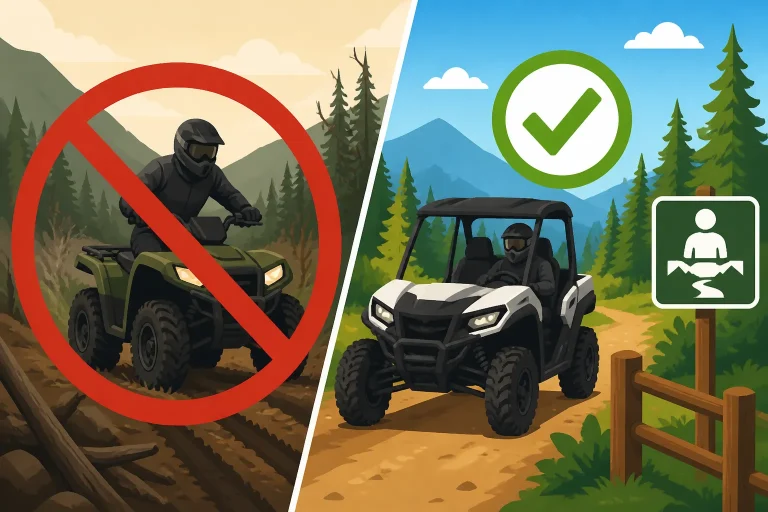
The road’s status matters because the rules for an ATV or UTV on an FSR differ from the rules for riding on private land, a managed recreation trail or a public highway. In particular, an FSR is treated as a resource road for certain off-road vehicle requirements. It is not a blanket invitation to ride any road with “Forest Service” in its name.
For a wider explanation of how Crown land and FSRs fit into the rules, see BC Forest Service Road Rules for ORVs and BC Crown Land Riding Explained. The key practical point is to confirm both that the road is open to your type of vehicle and that you have the required documents and coverage.
Not every road in the forest is an FSR
A road may be on Crown land without being a Forest Service road. It could be a privately controlled industrial road, an access road on leased land, a municipal road or a route subject to a separate closure. Conversely, a road may be an FSR even if it is rough, unsigned at a particular entrance or used mainly by logging and forestry crews.
Do not rely on a map label alone to decide that riding is allowed. Check the road’s current status, signs, gates and restrictions before travelling. A road can be closed to public use, restricted to industrial traffic, or temporarily unsafe because of active work, a washout or a fire-related order. A gate being open does not necessarily mean the road is open to recreational ORVs.
If you are unsure whether a route is actually a resource road or whether an FSR-specific rule applies, ask the road manager or the relevant authority before riding. The distinction matters for insurance and safety obligations, so treating every gravel road the same is a poor shortcut.
An FSR is a shared work route
The biggest difference many recreational riders notice is traffic. Logging trucks, pickups, low-beds, graders and other work vehicles may use an FSR at any time. They may be travelling faster than you expect, carrying a heavy load, or unable to stop quickly on a steep grade. Dust, corners and hills can also limit how far either driver can see.
Ride as though a work vehicle could be around the next bend. Keep right, travel at a speed that lets you stop within the distance you can see, and avoid stopping in a narrow section or just beyond a blind corner. Do not assume that a truck driver can see an ATV or UTV in dust, glare or brush.
On some roads, posted signs or local practices direct drivers to use a radio. Where radio use is required or recommended, follow the road’s posted instructions and use the channel and call procedure specified for that route. A radio can improve awareness, but it does not give you the right of way or replace slowing down and looking carefully. For more detail, see BC Resource Road Radio Practice and BC Riders Meeting a Logging Truck.
Registration, plate and documents
Before riding an ATV or UTV on an FSR, make sure the machine is properly registered for off-road use in British Columbia, unless it falls under a specific exemption or is already registered under a different applicable system. The basic registration question is explained in Do You Need to Register an ATV in BC?. FSRs are one reason riders who only use a machine recreationally may still need to register it.
For most privately owned ORVs, registration is handled through an Autoplan broker. Registration is not the same as a vehicle title, and it does not make the machine street legal. Once registered, the machine must display its plate as required and the operator must carry the registration certificate when riding. The plate should be mounted where it can be seen and kept readable; a load, mud or a rack-mounted accessory should not hide it.
The broad registration process is covered in How to Register an ATV in BC, while BC ATV Registration Requirements and Documents to Bring to a Broker can help you prepare. If you bought a used machine with incomplete papers, resolve the ownership-document problem before planning a ride. A registration application can be delayed if the chain of ownership is not established.
What to carry on the ride
Have the required documents with you, not just stored at home or in a truck parked at the staging area. In general, an ORV rider should be ready to show the machine’s registration certificate and personal photo identification. The relevant details are in BC Riders Must Carry the Certificate and BC Riders Must Carry Photo ID.
Keep papers protected from rain, mud and damage. A sealed pouch in a pocket or secure compartment can help. If you use a phone to store copies, treat that as a backup rather than assuming an electronic image will replace every document you are required to carry. Cell service may be absent, and a dead or damaged phone is not useful proof.
A small document pouch, protective sleeve or waterproof storage case is easy to find through retailers such as Amazon, but choose one that stays secure while riding and does not interfere with safe control of the machine. Keep the original documents in the format required, and do not let a digital copy create false confidence about what you must produce during a roadside check.
Plate display and machine condition
Registration does not make an unreadable plate acceptable. Mount the plate in the location and orientation required for the vehicle, secure it so it does not swing loose, and check that mud, cargo or a winch accessory does not block it. Plate location can depend on the machine’s design; see BC Plate Placement on Front, Back or Left and Keeping Your ORV Plate Clean Enough to Read.
Before leaving the staging area, check that the plate is attached firmly and that the machine’s identifying number is legible. If the VIN is missing, damaged or difficult to find, deal with that before you need to prove the machine’s identity. A broker may need to inspect or verify identifying details during registration.
Insurance on a Forest Service road
The insurance requirement is one of the most important differences between riding on an FSR and riding on other Crown land. An ORV operated on a Forest Service road must have third-party liability coverage of at least $200,000. That is the required minimum for this setting, not a recommendation that the amount will necessarily be enough to cover every serious loss.
Do not assume your home, truck or automobile policy automatically provides the required ORV coverage. Confirm that the policy applies to the specific machine and that it covers operation on Forest Service roads. If you have a side-by-side, make sure the policy identifies or otherwise covers the UTV rather than only another vehicle in your household.
For background on what liability coverage does, read What Liability Coverage Pays for on a Resource Road and BC Resource Road Insurance of $200,000. If you ride on both FSRs and other Crown land, remember that the insurance rules can differ by location. Coverage that satisfies one setting may not be required in another, but it is still worth considering the risks of riding there.
Check the policy, not just the insurance card
Before you ride, verify these points with your insurer or broker:
- The correct ATV or UTV is covered.
- The policy includes third-party liability protection.
- The coverage applies to operation on a Forest Service road.
- The coverage meets the required minimum for that road.
- Any exclusions, restrictions or rider conditions are understood.
- You know what proof of coverage to carry and how to access it without cell service.
A card or policy summary may not explain every limitation. If the paperwork is unclear, ask the insurer a direct question: “Does this policy provide the required third-party liability coverage while this machine is being operated on a Forest Service road in BC?” Keep the answer and policy documents available with your ride papers.
If you plan to buy or change coverage, do not select a policy based only on a general description such as “off-road use.” Ask specifically about FSR operation. A policy may distinguish between riding on a managed trail, private land, Crown land and a resource road.
Do not confuse road access with street legality
An ATV or UTV being permitted on an FSR does not mean it can be driven on an ordinary public highway. FSR requirements do not create a general street-legal path for an off-road machine. Rules for a short highway crossing or a police-issued operation permit are separate matters. See BC Has No Street-Legal Path for an ATV and BC Police Operation Permits for Highway Travel before assuming that an FSR trip permits road travel between trail systems.
If your route includes a highway, determine exactly where and how you are legally allowed to cross it. Do not ride along a highway shoulder or use a highway to connect two FSR segments unless you have confirmed that the law and any required permit allow that specific movement.
Helmets, belts, lights and passengers
Safety equipment requirements depend in part on the type of machine. A quad is a ride-astride vehicle; a UTV or side-by-side has seats and a protective structure. Do not assume that a rule written for one kind of ORV applies in exactly the same way to the other.
For an ATV, the rider should wear a compliant helmet. A helmet should fit securely, be in good condition and be appropriate for riding, not simply be a hard hat or casual bicycle helmet. Helmet standards and practical buying guidance are covered in BC ATV Helmet Law Explained and Buying a Helmet That Passes in BC.
A UTV’s seat belts and rollover protection are central to occupant safety. Use the belt in every seat, keep arms and legs inside the vehicle, and follow the manufacturer’s instructions for the machine’s doors, nets and restraints. Do not treat the cage as a substitute for a seat belt. Where a helmet rule applies to the vehicle or circumstances, comply with it; if you are uncertain whether a particular UTV configuration qualifies for an exception, verify the rule rather than guessing. The details are addressed in BC Seat Belt Rules on a Side-by-Side.
Lights and visibility
A Forest Service road can be dusty, shaded, foggy or dark even when the ride began in daylight. Make sure the machine’s lighting equipment works and use lights when visibility calls for them. A light that is coated in mud or blocked by a front rack may be nearly useless to another road user.
Do not count on being visible just because you can see the road. Work vehicles may be coming through dust, around a bend or over a crest. Wear visible clothing where practical, keep a safe following distance, and avoid riding in a tight dust cloud behind another vehicle. See What Lights BC Requires Front and Rear for more on lighting requirements.
Children and passengers
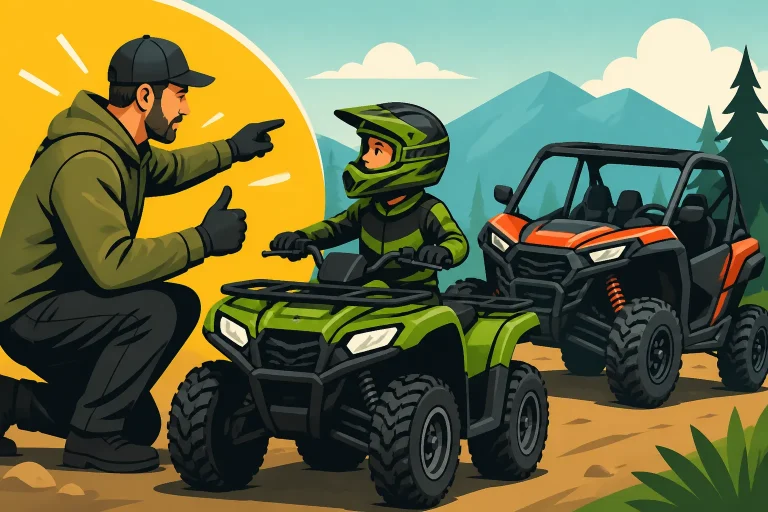
An FSR ride is not automatically suitable for every child or passenger. British Columbia has rules for young ORV operators, including supervision requirements for riders under 16. The details depend on the child’s age and circumstances; review BC Youth Riding Rules Explained, BC Rules for a Supervising Adult and BC Rules for a 14-Year-Old Rider before taking a young rider.
Also check the machine manufacturer’s guidance. A child may be too small to reach controls, maintain a safe riding position or fit the machine’s restraint system, even if an adult believes the child is capable. For passengers, follow the manufacturer’s seating capacity and age or size guidance. Do not carry someone on a seat or cargo area that was not designed for a passenger.
On a UTV, every passenger needs an actual designated seat and a working belt. On an ATV, do not add a passenger unless the machine is designed for one and the passenger can sit and hold on as intended. A long, bumpy road can be harder on a passenger than a short ride around a field.
Before you go: road status and trip planning
Registration and insurance do not guarantee access. FSRs can have closures, restrictions and changing conditions. Before you leave, check the road’s status with the appropriate official source or road manager, look for recent notices, and read signs at the entrance. A road that was open last weekend may be restricted today because of logging, maintenance, a fire hazard or damage.
Start with a route that matches your experience, vehicle and fuel range. Check whether the road is steep, narrow, exposed or prone to washouts. A route suitable for a truck may still be an unpleasant or unsafe ride for a small ATV, especially if it involves long stretches of active industrial traffic.
A practical pre-ride checklist
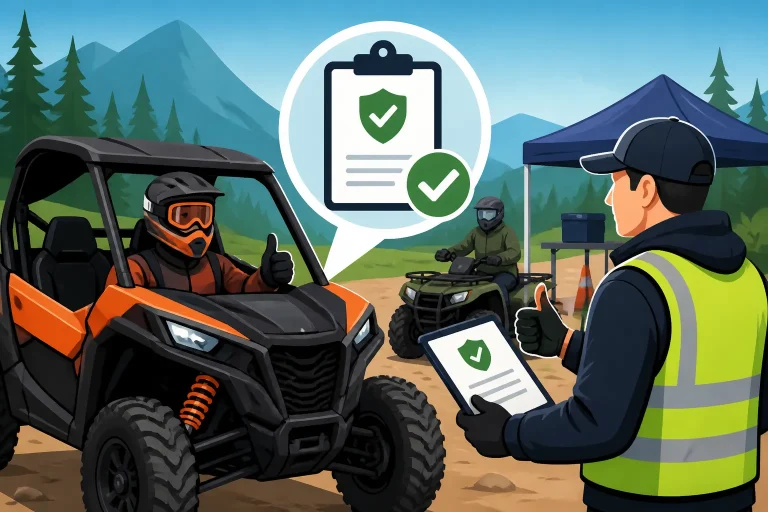
Use this checklist before setting out:
- Confirm the route is open. Check for closures, posted restrictions, fire-related orders, road work and active hauling.
- Confirm your machine is eligible and registered. Check that the plate is attached and the certificate is with you.
- Verify insurance. Make sure the ATV or UTV has the required liability coverage for FSR operation and carry proof.
- Pack identification. Carry personal photo ID along with the required machine documents.
- Inspect the machine. Check tires, brakes, throttle, steering, fuel, lights, belt or chain, and any required safety equipment.
- Plan communication. Find out whether the road has a radio protocol, what channel or call procedure is posted, and whether you need an alternative communication plan.
- Tell someone your route. Share where you are going, who is with you and when you expect to return.
- Pack for a delay. Bring water, warm or rain layers, basic first aid and enough fuel for the route and a reasonable contingency.
- Review your turnaround plan. Decide what conditions will make you turn back rather than press on.
Some riders buy a handheld radio or accessories through Amazon. Check first that the device can use the frequencies and features permitted for your situation, and learn how it works before you reach a remote road. A radio bought online does not automatically match local resource-road procedures, and it is not a substitute for checking signs or yielding to industrial traffic.
Fire, weather and seasonal conditions
Fire conditions can affect whether ORVs may operate in a particular area. Restrictions can vary by location and change as conditions develop. Check for current fire-related prohibitions before riding, and do not assume that a road remaining physically open means recreational ORV use is permitted. The same care applies after a storm, when a road may be washed out or a bridge or slope may be unsafe.
Mud and water deserve judgment, not just mechanical confidence. Deep puddles can hide rocks, ruts, culverts or damaged road edges. Avoid damaging shoulders and drainage features, and do not create new tracks around a blockage or gate. If a road is too damaged or unsafe for your vehicle, turn around instead of widening the problem.
For broad recreation-area closures and access issues, BC Motor Vehicle Closures and How to Find Them is a useful companion. For fire-specific checks, see Checking a Fire Ban Before You Ride in BC.
Driving safely around industrial traffic
A Forest Service road is not a recreational trail with occasional trucks. On an active road, the truck may be the largest and least maneuverable vehicle, and the consequences of a close encounter can be severe. Give work traffic room, follow posted speed limits and instructions, and never assume that recreational vehicles have priority.
Reduce speed before blind corners, crests, bridges and narrow sections. Keep far enough to the right to leave room for an oncoming vehicle, but do not ride so close to a soft shoulder that you risk dropping a wheel off the road. If visibility is poor, slow down more than feels necessary. Dust can hide a stopped truck, a grader or another rider.
Radio use and passing
Where a road has a posted radio procedure, follow it. The procedure may specify a channel, call points or how to announce your direction of travel. Listen for traffic before entering a narrow segment, and make clear calls at the points the road instructions specify. If you cannot tell whether a call has been heard, do not treat silence as proof that the road is clear.
A radio is useful, but it has limitations. You may be on the wrong channel, out of range, or unable to understand a call. A worker may not be monitoring the channel continuously. Continue to watch the road, use mirrors where fitted and make conservative decisions.
When a large vehicle approaches, move to a safe place where there is room, stop if needed, and let it pass. Avoid stopping on a blind corner or directly beyond a hill. Never race a truck to a pullout or try to squeeze past a loaded vehicle in a narrow spot. On a road with a posted passing procedure, use it as directed.
Riding in a group
Groups should travel at a pace that suits the slowest rider and leaves enough space for everyone to react. Do not bunch up so tightly that a sudden stop turns into a collision. Keep track of the rider behind you, but do not make unsafe turns or sudden stops just to keep the group together.
Before leaving, agree on meeting points and what to do if someone becomes separated. On a long FSR, riders can lose sight of each other in dust or around bends. A lead rider should not assume that the rest of the group has cleared a junction or hazard; a sweep rider can help confirm that everyone is accounted for.
Carry communication that works for your group, but do not confuse group radios with a resource-road radio protocol. If a road requires a particular channel or calling practice, follow that separately. The group should know where to pull over without blocking work traffic and should avoid stopping across bridges, narrow road sections or active work areas.
Signs, gates and closures
Obey signs even if the road looks passable. A closure can be there for safety, road maintenance, industrial work, environmental protection or another legal restriction. Do not move a barrier, go around a gate or assume a closure is only for full-size trucks. If you encounter a restriction you do not understand, stop and clarify it before proceeding.
Some signs may be temporary or installed beyond the main entrance. Watch for notices as you travel, and turn back when a closure applies to your route or vehicle. If a work crew is present, follow their direction and do not enter an active work zone unless authorized.
Common mistakes and how to avoid them
Most problems come from treating an FSR like an ordinary trail or assuming that one form of permission covers every requirement. A little checking before the ride can prevent a ticket, a denied claim or a dangerous meeting with industrial traffic.
| Common assumption | Better approach |
|---|---|
| “It’s a gravel road, so I can ride it.” | Confirm it is open to recreational ORVs and check for current closures and restrictions. |
| “My ATV registration means I’m insured.” | Registration and insurance are separate. Verify the required liability coverage for FSR use. |
| “A photo of my papers is enough.” | Carry the required registration certificate and personal ID in the required form. |
| “A UTV cage means I don’t need to buckle up.” | Use the seat belt in every seat and follow the machine’s safety instructions. |
| “If I can hear no trucks, the road is clear.” | Use posted radio procedures where required, but still drive cautiously and assume traffic may be nearby. |
| “An open gate means public riding is allowed.” | Check the road’s status and obey signs; an open gate is not permission by itself. |
| “If my machine can make it through, the route is safe.” | Consider traffic, road width, visibility, weather, fuel range and your group’s experience. |
| “An FSR lets me connect by highway.” | FSR access does not make an ATV or UTV street legal. Check highway rules separately. |
Another common mistake is planning around the road as it looked on an older map or video. Conditions change. Road maintenance, logging activity, washouts and closures can make a familiar route different from one visit to the next. Check current information and be ready to change plans.
Also avoid relying solely on advice from a friend who rode the route months ago. Their machine, insurance, route and timing may not match yours. If the rule turns on whether a road is an FSR, whether it is open, or what insurance applies, get confirmation from a relevant official or insurance source.
A simple way to prepare for an FSR ride
Think of FSR preparation in three parts: legal readiness, road readiness and personal readiness.
Legal readiness means your machine is registered as required, its plate is displayed, you have the registration certificate and photo ID, and you have verified the required liability coverage. It also means understanding that an FSR is not the same as a highway and that a permit for a highway crossing, if relevant, is a separate matter.
Road readiness means knowing that the route is open, checking signs and restrictions, understanding local radio instructions, and accounting for industrial traffic. It means choosing a route your machine and group can handle and being willing to turn around.
Personal readiness means wearing appropriate safety equipment, carrying water and weather-appropriate clothing, bringing basic supplies, and telling someone your plan. It also means knowing when not to ride: if the road is closed, the weather is poor, the machine is not in safe condition or the group lacks the required documents or coverage, postpone the trip.
If you are unsure about a requirement, ask a broker or the appropriate road authority before you go. An Autoplan broker can help with registration and insurance questions, while road status and access questions belong with the authority or manager responsible for that road. For a broader document checklist, see BC Registration Paperwork Checklist.
A Forest Service road can be a useful way to reach riding areas, but it is still a working route with specific obligations. Prepare as though you are sharing it with heavy industrial traffic, confirm the rules for the road you intend to use, and carry what you need to prove that your machine and coverage are in order.
Disclaimer
This article is for general informational purposes only and does not constitute professional advice. Laws, prices and regulations vary by location and change over time. Consult a qualified professional for guidance on your specific situation.