What the Provincial Federation of ATV Clubs Does
What the Provincial Federation of ATV Clubs Does
It can be hard to tell what a provincial ATV federation actually provides: a riding permit, a trail pass, a club membership, or something else? In British Columbia, a federation’s central role is to connect and support local clubs, not replace government rules or site-specific requirements. Knowing the difference helps you find the right organization before you ride.
A provincial federation is an umbrella for local clubs
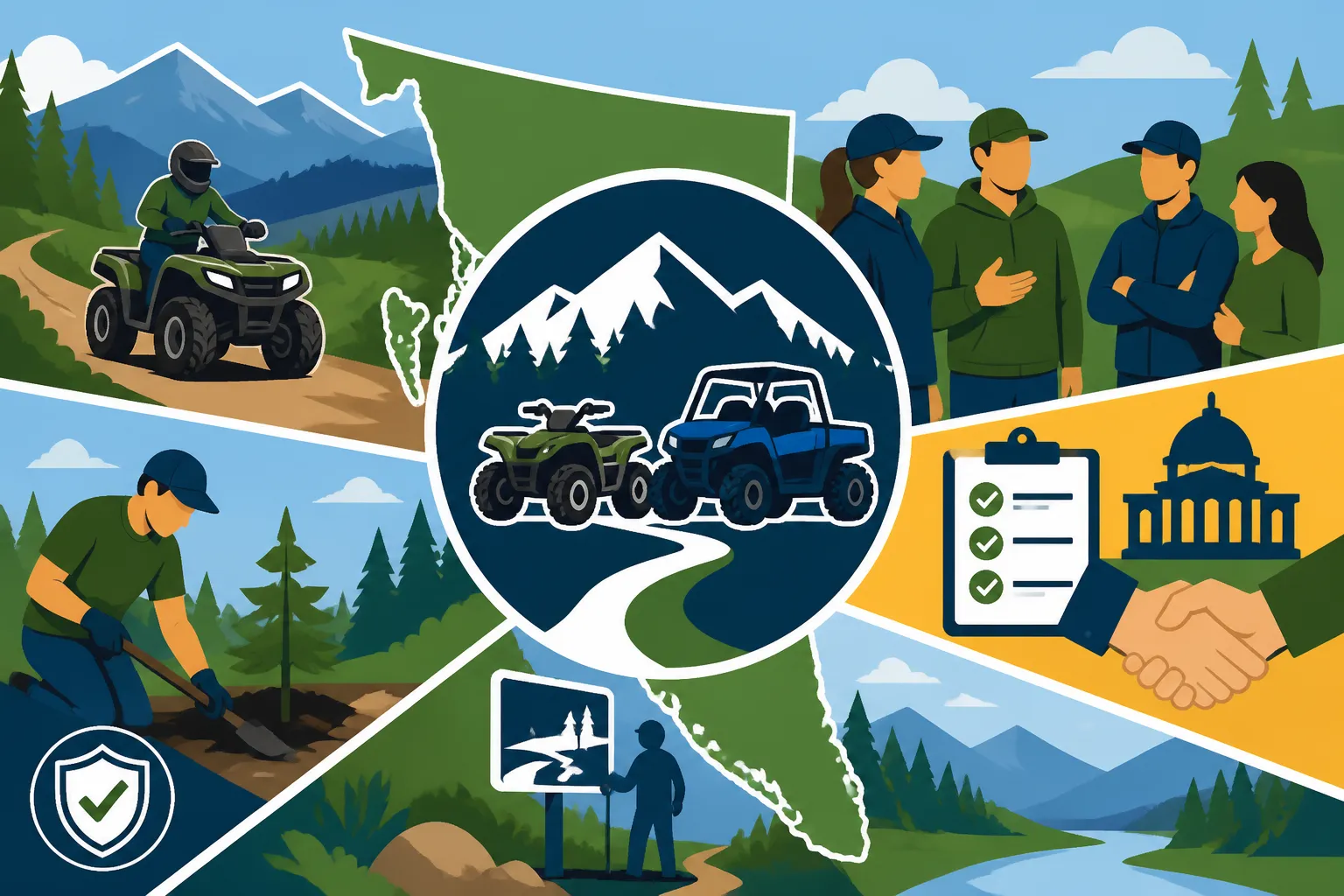
A provincial federation of ATV clubs brings local riding organizations together around shared interests. A local club is usually the group closest to a particular trail network, staging area, or riding community. The federation works at a broader level, helping clubs coordinate, share information, and speak collectively about off-road riding.
That distinction matters because riders often expect one organization to handle everything. A federation may help organize the wider ATV community, but that does not automatically make it the authority responsible for every trail, pass, permit, or legal requirement in BC.
A useful way to think about the different roles is:
| Organization or requirement | Typical role | What a rider should confirm |
|---|---|---|
| Provincial federation | Connects clubs, supports shared interests, and represents a province-wide perspective | Current programs, membership structure, and which clubs are affiliated |
| Local ATV club | Supports local riding, trail work, events, or community activities | Whether it maintains or manages a particular area |
| Trail or recreation-site operator | Sets access conditions for a site it manages | Pass requirements, closures, rules, and current access |
| Government authority | Sets or administers laws, permits, land-use rules, and enforcement | Legal requirements for the route or land |
| Rider | Follows applicable rules and checks conditions before setting out | Registration, insurance, equipment, permissions, and access restrictions |
A federation can help riders understand how these pieces fit together. It may share information about clubs, riding opportunities, safety, trail stewardship, or issues affecting off-road users. But its advice and services are not a substitute for checking the rules that apply to your machine and the land you plan to use.
In particular, do not assume that federation membership authorizes you to ride wherever you like. Membership is different from registration, insurance, landowner permission, a police-issued operation permit, or a trail pass. BC Club Memberships and What They Buy explains why those benefits need to be considered separately.
Nor should a provincial organization be confused with a government department. A federation is an association representing or supporting the ATV community. It does not become a lawmaking body because it speaks on behalf of clubs, and it cannot waive a legal requirement that applies to riders.
That boundary is especially useful when you are planning a trip. A club might know the local trails well, while a land manager or public authority controls access. A federation may help you locate the club or understand broader issues, but the actual access decision can depend on the site, current closures, and the rules for the land.
What the federation can help with
An umbrella organization may be useful in several ways:
- Connecting riders with local clubs. If you are new to an area, the federation can be a starting point for finding an organization with local knowledge.
- Sharing information across clubs. A provincial network gives clubs a way to discuss common concerns rather than each group working in isolation.
- Representing shared interests. Clubs may have similar concerns about responsible access, land-use decisions, trail sustainability, or the public’s understanding of ATV recreation.
- Supporting participation. A federation can help make club events, volunteer opportunities, or educational resources easier to find.
- Encouraging responsible riding. Information about safety and trail care can be shared across a wider community.
The exact services, programs, and affiliated clubs can change. If you need a specific service, confirm directly with the federation or the local club rather than relying on a general description.
What it cannot automatically do
A federation’s role does not, by itself, give it authority to:
- register your ATV or side-by-side for you;
- make an unregistered machine legal to ride;
- issue a police operation permit;
- grant access to private land or leased Crown land;
- open a closed road or trail;
- provide a province-wide pass that covers every managed recreation site; or
- guarantee that membership includes insurance, training, or access benefits.
If a club or federation advertises a particular service, read the current terms and ask who delivers it. For example, a local club may manage a site pass, while another organization administers a separate membership. Similar names or shared events do not necessarily mean the same fee buys the same benefit.
Clubs do much of the local work
Local clubs are often where the practical, on-the-ground work happens. Depending on the club and the area, members may help maintain trails, organize rides, communicate local conditions, or support a staging area. Some clubs may work with land managers or other organizations on access and stewardship. The details vary, so do not assume that every club maintains every trail it promotes.
A provincial federation can support this local work by helping clubs communicate and by raising shared issues at a broader level. It may also give smaller clubs a way to learn from other groups, coordinate efforts, or draw attention to challenges that are not limited to one riding area.
That does not mean the federation personally builds or maintains every trail. Trail responsibility can rest with different organizations, land managers, clubs, or site operators. A club may volunteer in an area without being the authority that decides whether the route remains open. If you are unsure who manages a location, ask the club or relevant site operator.
Trail stewardship is more than clearing brush
Trail work can involve a range of practical tasks. Depending on the place and the group’s role, volunteers may help with maintenance, signage, cleanup, route information, or other stewardship activities. Responsible trail use also depends on riders: staying on permitted routes, respecting closures, avoiding damage, and following posted directions.
Clubs may share local knowledge about conditions that affect a ride, but those updates are not a guarantee that a route is open or suitable. Weather, fire activity, active work, seasonal restrictions, or land-use decisions may change access. Check current information before driving to a trailhead, and be prepared to turn around if conditions or signage indicate that riding is not allowed.
You can support trail stewardship without assuming that your membership buys access. Volunteering, following club guidance, respecting land restrictions, and reporting damage through the appropriate channel can all help. For opportunities to contribute, start with a club connected to the area you ride. BC Trail Volunteer Days gives more context on how riders can find and take part in trail work.
Local knowledge has limits
A local club can be a helpful source for route descriptions, riding etiquette, and where to ask about access. But local knowledge should be treated as a starting point, not a replacement for official notices. A route that was open on one visit may later be restricted, and a familiar road may pass through land with different access conditions.
Before relying on a club’s map or post, check:
- Whether the information applies to the exact route you plan to ride.
- Whether it has a date or a recent update.
- Whether the map shows a managed recreation site, a resource road, or another type of land.
- Whether a separate pass, permission, or permit is required.
- Whether closures or posted restrictions have changed.
A map is useful for planning, but it does not grant permission. BC ATV Trail Map Downloads can help with finding mapping resources, while current access conditions still need to be checked for the particular area.
Membership, passes, permits, and registration are different things
One of the most common sources of confusion is assuming that an ATV-related payment covers every other requirement. It usually does not. A provincial federation or local club may offer a membership, while a managed riding area may charge or require a separate pass. Government requirements, such as registration or an operation permit, are separate again.
Use this comparison as a starting point:
| Item | What it is for | Does federation membership replace it? |
|---|---|---|
| Federation or club membership | Supports participation in an association or club and may provide member benefits | No |
| Managed-site trail pass | Fulfills an access requirement set for a particular site | Only if the site’s current rules explicitly say so |
| Government registration | Registers an eligible off-road vehicle under BC’s requirements | No |
| Operation permit | Allows a specified kind of operation where a permit is required | No |
| Insurance | Provides coverage under the applicable policy | No |
| Landowner or land manager permission | Authorizes access where permission is needed | No |
There is no general rule that a membership card is a riding pass. BC also does not have one province-wide trail pass that automatically provides access to all riding areas. A managed site can set its own access conditions, so check the site’s current requirements before you go. BC Has No Province-Wide Trail Pass and BC Passes Exist Only at Managed Sites explain why a local pass should not be confused with a province-wide permit.
A local club may sell or administer a pass for a site it manages, or it may direct riders to the organization that does. The pass may apply only to that location and may have particular rules about who needs one, where it is valid, or how proof must be carried. Confirm those details with the site operator or club.
Membership can still be worthwhile even when it does not provide a pass. It may give you a way to participate in a riding community, learn about local events, support trail work, or access specific member benefits. Benefits differ among organizations, and they can change. Check what is included rather than assuming that all clubs offer the same package. BC’s Federation Sells Membership, Not Passes and What a Local Club Trail Pass Gets You are useful distinctions to keep in mind.
Registration is a separate legal question
The federation does not determine whether your machine needs BC registration. That depends on the rules that apply to the machine and how or where you intend to operate it. Do not treat club membership, a trail pass, or a day-use receipt as proof that registration requirements have been met.
If you are unsure about registration, check the rules before riding. In BC, land and route type matter; a riding plan that includes Crown land or a resource road can raise requirements that a private-property-only plan may not. Do You Need to Register an ATV in BC? explains the basic question, and BC Registration Before Riding Crown Land focuses on the timing riders should consider.
Likewise, registration is not the same as permission to ride. A registered machine can still be prohibited from a particular road, trail, park, or private property. Check both vehicle requirements and land-access rules.
Ask exactly what a payment covers
Before paying a federation or club, ask what the payment is for and what proof you will receive. Useful questions include:
- Is this an annual membership, a site pass, or both?
- Which organization collects the payment?
- Which trail or recreation site does it cover?
- Does every rider or machine need separate proof?
- How should the proof be carried or shown?
- Does membership include any insurance or other benefit, and what are its limits?
- Are there separate requirements for guests or youth riders?
A clear answer should identify the provider, the benefit, and any limits. If the answer is vague, contact the organization responsible for the site before making the trip.
The federation can represent riders, but reciprocity is limited
A federation can help clubs and riders speak with a broader voice on issues that affect ATV recreation. That may include discussions about access, responsible use, trail sustainability, safety, or how off-road riding is understood by decision-makers and the public. It can also help local clubs share concerns that would be harder to raise individually.
Advocacy is not the same as a legal exemption. A federation may communicate a position or support a discussion, but it cannot guarantee that a road will stay open, reverse a closure on its own, or authorize a rider to ignore a posted restriction. Access decisions rest with the relevant landowner, authority, or manager.
This matters when riders hear that a club or federation has worked with an agency or land manager. That relationship may support communication or stewardship, but it should not be interpreted as an open-ended right to ride. Follow the current rules and signs for the specific location.
Reciprocity does not mean a BC pass works everywhere
The word “reciprocity” can suggest that membership, registration, or a trail pass from one province is automatically accepted in another. Do not assume that. Membership recognition between organizations, vehicle registration, insurance, and trail access are separate questions.
For riders visiting BC, the applicable rules depend on factors such as where the machine is from, where it will be operated, and the land or road involved. A federation membership from another province does not automatically settle those questions. Visitors should carry the ownership or registration proof required for their situation and check BC’s rules before riding. BC Non-Resident Riding Rules provides more detail on the visitor question, and BC Riders From Alberta Use Alberta Plates covers a specific example.
The same caution applies when a BC rider travels elsewhere. A membership card from a BC club may not satisfy another province’s registration, insurance, or site-access requirements. Check the destination’s official requirements and any local club or site rules.
A federation may help with contacts or general information about how clubs work, but it is not a substitute for confirming the laws and access conditions in the place where you will ride. For a cross-border trip, check requirements before loading the machine, not at the trailhead.
Safety and education support
Provincial and local ATV organizations may share safety information or connect riders with training opportunities. Such support can make it easier to find relevant resources, but it does not necessarily mean a course is mandatory, officially recognized for every purpose, or included in a membership.
Check the course provider, who the training is designed for, and whether a particular authority recognizes it if recognition matters to you. The same applies to youth riding: family expectations, manufacturer guidance, and legal supervision requirements are distinct issues. BC ATV Safety Training Options is a starting point for understanding training choices, while riders should still verify the rules that apply to a young operator.
Safety promotion also does not shift responsibility away from the rider. You remain responsible for operating within your ability, using appropriate protective equipment, following road and trail rules, and making sound decisions when conditions change.
How to get useful help from a federation or club
If you want help with a specific riding question, contact the organization that is most likely to control or know the issue. A federation is a good starting point for questions about affiliated clubs or province-wide association work. A local club is often better placed to answer questions about its events, trail work, or local riding community. A site operator or land manager is the right contact for current access rules at a particular place.
Before you contact anyone, write down the details that affect the answer:
- the machine type, such as a quad or side-by-side;
- your home province and where the machine is registered;
- the name or location of the road, trail, or recreation site;
- whether you are asking about membership, a pass, registration, insurance, or permission;
- your planned date of travel, if access may be seasonal; and
- any sign, notice, or map detail that prompted the question.
Then use a direct, specific question. For example: “Does this membership include a pass for this managed site?” is more useful than “Can I ride in BC with a club card?” If the answer concerns legal registration or permission, confirm it with the relevant official source as well.
A practical way to sort out your requirements is:
- Identify the land, road, or managed site you plan to use.
- Check whether access is open and whether the route has posted restrictions.
- Confirm whether the machine needs registration and what proof you must carry.
- Check insurance and any road-specific requirements.
- Ask the site operator whether a separate pass or permission is required.
- Treat club or federation membership as an additional benefit unless the organization clearly confirms otherwise.
This sequence prevents a common mistake: getting a membership or pass first and only later discovering that it does not cover the route you planned. It also helps you ask the right organization rather than expecting one group to answer every legal, land-access, and site-management question.
Joining a club can be a useful way to meet other riders, support local work, and get connected to a riding community. A federation can make that network easier to find and can help clubs coordinate on shared concerns. The practical value depends on the organization’s current activities and the local group you choose, so check the details and join for the benefits it actually provides.
Frequently Asked Questions
Does a provincial ATV federation issue riding permits?
Do not assume that it does. A federation may share information or connect riders with a local organization, but a government permit or site-specific pass must come from the authority or operator responsible for it.
Does club membership let me ride anywhere in BC?
No. Membership does not automatically grant access to every trail, road, or recreation site. Check land access, closures, and any local pass requirements for each riding area.
Is a trail pass the same as ATV registration?
No. A trail pass concerns access to a particular managed site when one is required. Registration is a separate vehicle requirement. One does not replace the other.
Can out-of-province club membership satisfy BC requirements?
Not automatically. Membership, vehicle registration, insurance, and site access are separate. Visitors should check the BC requirements that apply to their machine and planned route.
Who should I contact about a specific trail?
Start with the club or site operator connected to that area, then confirm current restrictions with the relevant land manager or official source. A federation may help you locate the right contact.
Disclaimer
This article is for general informational purposes only and does not constitute professional advice. Laws, prices and regulations vary by location and change over time. Consult a qualified professional for guidance on your specific situation.