BC ATV Safety Training Options
Learning to ride an ATV or UTV safely in British Columbia is more than getting comfortable with the throttle. You need to know which training options suit your experience, what the rules mean for young riders, and whether a course certificate matters for your planned rides. This guide compares practical ways to build skills and explains what training does—and does not—replace.
What ATV and UTV training can do for you
A good course helps turn general advice like “ride within your ability” into decisions you can make on a real trail. You practise managing speed, braking, turns, slopes and obstacles, and learn to recognize when the safest choice is to stop or turn around. Training can also help you spot hazards that are easy to miss when you are focused on keeping the machine moving.
An ATV and a side-by-side are not interchangeable in how they handle. On a quad, the rider shifts body weight and must stay balanced with the machine. A side-by-side has a seat, steering wheel and often a rollover protective structure and seat belts; those features change the protective equipment and operating habits that matter. A course that mainly covers one kind of machine may not prepare you for the other.
Training is especially useful if you are:
- New to off-road riding or returning after a long break.
- Moving from a smaller machine to a larger or more powerful one.
- Switching between a quad and a side-by-side.
- Riding with children, passengers or a group.
- Planning to use resource roads or remote trails.
- Visiting from another province or country and unfamiliar with BC rules.
- Operating a machine for work, a club activity or a guided ride.
An adult recreational rider generally is not required to complete a province-wide ATV safety course before riding in BC. That does not mean training is unnecessary, or that every rider can ignore age-related rules. Young operators have specific supervision and training conditions, and a course may be part of meeting those conditions. The details matter: do not assume that any online certificate, attendance slip or course from another jurisdiction automatically qualifies.
Keep the legal and practical questions separate. A course can teach you how to operate more safely, but it does not by itself register your machine, provide insurance, grant land access or authorize highway travel. For the basics of the provincial riding rules, see What the Off-Road Vehicle Act Covers in BC. If your first question is whether a machine needs registration, Do You Need to Register an ATV in BC? is a useful starting point.
Training is most valuable when it matches the machine and riding you actually plan to do. A short introductory session may be enough to get a new rider started on a familiar trail. Someone preparing to ride a heavy utility quad on steep ground, operate a UTV on a resource road or supervise a young rider needs more specific preparation.
The main training options in BC
There is no single training route that suits every rider. Some people need a structured course with an instructor and supervised practice; others need a refresher, a youth qualification or work-focused instruction. Before paying for or enrolling in anything, check what the provider teaches, which machine classes it covers and whether it is recognized for the particular rule you are trying to satisfy.
| Training option | Best suited to | What to check before enrolling |
|---|---|---|
| Structured safety course | Beginners, returning riders and families | Machine type, hands-on practice, instructor qualifications and course recognition |
| Youth-focused course | Young operators and their supervising adults | Minimum age, class of machine and whether the certificate meets the relevant BC requirement |
| Workplace or industry training | Employees operating machines as part of a job | Employer acceptance, job-specific content and documentation |
| Club or group instruction | Members who want local trail skills and shared practice | Whether it is formal training or informal coaching, and what proof is provided |
| Dealer or rental orientation | New owners and first-time renters | Whether it includes riding practice or only machine familiarization |
| Self-study and supervised practice | Experienced riders refreshing basic knowledge | Whether self-study is enough for your purpose; it may not meet a formal certificate rule |
Structured courses with an instructor
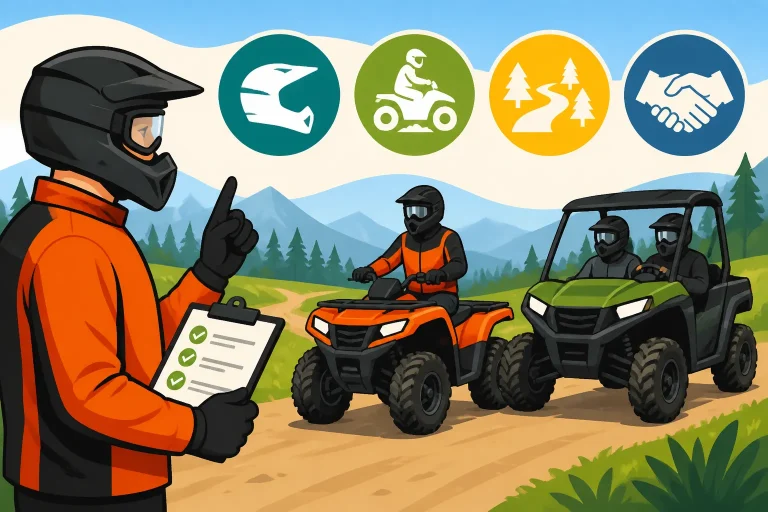
A structured course is often the most dependable option for a novice. Good instruction combines classroom or briefing time with a practical component. The instructor can explain how to use the controls, then observe the rider and correct unsafe habits before they become automatic.
A useful course typically covers:
- Pre-ride checks and basic machine controls.
- Starting, stopping and controlled braking.
- Turning and managing body position or passenger restraint, depending on the vehicle.
- Choosing an appropriate speed and following distance.
- Recognizing changing surfaces, slopes and obstacles.
- Riding in a group and communicating with other riders.
- Trail etiquette, environmental care and basic emergency planning.
The exact curriculum varies. Some courses emphasize general recreational riding; others concentrate on a particular machine class or workplace setting. Ask whether participants ride the same kind of machine they intend to use later. A classroom-only course can be helpful, but it cannot show an instructor how you handle a real turn, slope or stop.
Youth-focused instruction
Youth training should cover more than machine controls. A young rider needs to understand what they can do without an adult, when supervision is required, how to ask for help and why a machine that feels manageable on flat ground can become difficult on a slope or in rough terrain.
Parents and guardians should take part in course selection. Ask about age eligibility, the machine class covered and the meaning of any certificate the student receives. If you are relying on a course to meet a legal requirement, confirm that it is recognized for that requirement before enrolling. The answer to “Is this a safety course?” is not necessarily the answer to “Does this certificate satisfy the BC rule for this rider and machine?”
Workplace and industry training
People who ride for work may need training that goes beyond recreational trail skills. Work can involve hauling, tools, long shifts, unfamiliar terrain and coordination with other vehicles. An employer may also have its own training, competency and record-keeping requirements.
A recreational course might offer a strong foundation, but it may not satisfy an employer’s occupational safety expectations. Conversely, a workplace course may be designed for a particular job and not include the recreational riding skills a person needs for a family trip. Ask the employer or training provider what the course is intended to qualify the rider to do.
Club, dealer and rental instruction
Local clubs sometimes offer orientation, group rides or practical skill-building. These can be excellent ways to learn about local trails, riding etiquette and common hazards. However, a club ride or informal coaching session should not be treated as a formal course certificate unless the organizer clearly says it is one and explains its recognition.
A dealer may show a new owner how to operate a specific model, and a rental operator may explain controls and site rules before a tour. These introductions are useful, but their scope is usually limited. They may not include the repeated practice or individual feedback that a full training course provides. If you are renting for the first time, see BC Tours for First-Time Riders for questions to ask before booking.
Choosing a course that fits your machine and goals
The right course is not necessarily the longest or most advanced one. It is the one that matches your experience, machine and intended use. A beginner on a small quad needs different practice from an experienced rider switching to a side-by-side. A person who will ride on remote trails needs preparation for navigation and emergency planning as well as vehicle control.
Start by writing down what you expect to do. Be specific: “I want to ride a family quad on easy trails,” “I need to operate a UTV at work,” or “My 15-year-old wants to ride a particular machine.” That description helps a provider tell you whether a course is appropriate and whether it meets any certificate requirement.
Check the machine class
Ask the provider which machines the course covers. A certificate or training record may refer to a class of machine rather than every off-road vehicle. That distinction is important if a rider completes instruction on a quad and later plans to operate a side-by-side, dirt bike or snowmobile.
Even when the law does not require a separate certificate for an adult, the skills may not transfer perfectly. A quad rider leans and shifts position; a UTV operator needs to use restraints and understand how a cab-style vehicle behaves. If the course only uses one type, ask what additional instruction is available for the other.
Look for supervised practice
A meaningful practical course gives riders a chance to practise under controlled conditions. Ask how much of the session is hands-on, what each participant will do and whether instruction is adjusted to experience level. If the course is intended for novices, it should not assume that everyone already knows how to brake, turn or control speed.
Find out whether the provider supplies machines or expects participants to bring their own. If you bring your own, ask about size, condition, safety equipment and any machine restrictions. If the provider supplies machines, check whether you will practise on the same general type you intend to ride.
Ask who teaches the course and what proof you receive
Ask about the instructor’s experience and training. A good instructor should be able to explain not only what to do, but why a technique matters and when it might not be appropriate. They should also be comfortable identifying a rider who needs more practice before progressing to harder terrain.
At the end, ask what documentation you will receive. It might be a completion record, a course certificate or proof of attendance. Those terms are not automatically interchangeable. If you need the document for a youth riding condition, an employer or another formal purpose, ask the responsible authority whether that exact provider and certificate are accepted. For more on this distinction, see Which Rider Course Providers Are Actually Recognized.
Match the difficulty to your real riding
A course that promises advanced techniques may sound appealing, but advanced practice is not a substitute for basic control. If you cannot consistently stop smoothly, maintain a safe pace or turn on an easy surface, start with beginner instruction. A course should build confidence without encouraging riders to take risks to prove themselves.
On the other hand, riders with substantial experience can still benefit from a refresher. Familiarity can make people overconfident, particularly after changing machines or riding with a faster group. A focused session on braking, hills, passenger safety or group communication can address gaps without requiring a full beginner program.
Use these questions when comparing providers:
- Does the course cover the kind of machine I will ride?
- Is practical riding included, and how much individual feedback is provided?
- What age and experience level is the course designed for?
- What document will I receive at completion?
- Is that document recognized for the particular BC requirement I need to meet?
- What safety equipment and clothing must I bring?
- What happens if weather or trail conditions make the planned practice unsuitable?
- Is the course recreational, workplace-focused or both?
A direct, specific answer is reassuring. If a provider cannot explain what its certificate qualifies you to do, do not rely on a general claim that the course is “approved” without checking with the authority that administers the rule.
Rules for riders under 16 and their supervisors
Age is one of the main reasons a BC rider may need to look beyond voluntary adult training. The province has special operating conditions for young people. In general, riders under 16 must follow supervision requirements unless they meet the applicable conditions for operating without a supervisor. For riders aged 14 or 15, training and written permission can be relevant to that exception.
The details are not something to guess at. The course must meet the applicable training requirement, the certificate must relate to the correct class of machine, and written permission must come from the appropriate parent or guardian. A course certificate by itself should not be treated as permission to ride unsupervised.
Before a young rider operates a machine, confirm:
- The rider’s age and the rule that applies to that age.
- Whether the rider needs direct supervision or qualifies for an exception.
- Whether the planned training provider and course are accepted for that purpose.
- Whether the training covers the machine class the rider will use.
- Whether written permission is required and what it needs to say.
- Whether the machine is suitable for the rider under its manufacturer’s guidance.
For a fuller overview, see BC Youth Riding Rules Explained. The articles BC Rules for a 14-Year-Old Rider and BC Rules for a 15-Year-Old Rider can help you focus on the age-specific questions. If a younger child is involved, read BC Rules for a Child Under 16 before planning a ride.
Supervision is an active responsibility
A supervising adult is not simply someone who is somewhere nearby. The adult needs to be able to keep the young rider in view and give direction promptly. That can be difficult on a long, winding trail, in heavy dust or when a group splits up. A plan that depends on radio contact alone may not be a substitute for the required kind of supervision.
The adult should also be capable of helping if the rider stalls, becomes stuck or encounters a hazard. Choose a route where the young rider can be monitored, and do not let the group’s pace determine what the child can safely handle. It is sensible to ride with enough separation for everyone to stop safely, but not so much that the supervisor loses sight or control of the situation.
If you are supervising a youth, training is valuable for you too. The adult should understand the machine, the route, the rules and the rider’s current skill level. A certificate does not make a child ready for difficult terrain; it is one part of a wider judgment about age, size, ability and conditions.
Manufacturer guidance still matters
Legal permission to operate does not mean every machine is a suitable fit. Manufacturers provide age, size or weight guidance for particular models. A rider who cannot reach the controls comfortably or manage the machine’s weight may be at risk even if they have completed a course.
Check the owner’s manual and the machine’s labels. A child should be able to reach and use the controls without stretching, understand the instructions and respond quickly when conditions change. Avoid carrying a passenger on a machine that is not designed for one, and do not assume an adult riding behind a young operator is an appropriate way to supervise.
Keep the paperwork available
If a young rider’s permission or course documentation is important to their ability to ride, keep a copy accessible. Make sure the supervisor knows what documents exist and can explain the arrangement if asked. For the photo ID and registration requirements that apply during a ride, read BC Riders Must Carry Photo ID and BC Riders Must Carry the Certificate.
Rules and accepted course documentation can be technical. Before relying on an exception, confirm the current requirement with an official source or a qualified provider familiar with BC’s off-road vehicle rules. That small check is easier than discovering at the trailhead that the course or paperwork does not qualify.
Visiting riders and training reciprocity
A rider visiting BC may arrive with a safety card, operator certificate or course record from another province, territory, state or country. It may be useful evidence of experience, but do not assume it automatically gives the rider a legal exemption or replaces BC requirements. Reciprocity depends on the rule at issue and on whether the certificate is recognized for that purpose.
A training certificate is also different from registration or proof of ownership. BC generally does not register non-resident machines in the same way it registers locally owned ORVs. Visitors should follow the requirements that apply to their home jurisdiction and carry the appropriate ownership documents. For more on that, see BC Non-Resident Riding Rules and BC Proof of Ownership for Visitors.
Ask two separate questions
When checking a certificate from outside BC, ask:
- Does the certificate satisfy a specific BC training or supervision requirement for this rider and machine?
- Does the rider still need to meet any separate rules for registration, ownership documents, insurance, helmets, land access or road use?
A “yes” to one does not answer the other. A certificate can demonstrate that a person completed a course without authorizing them to ride anywhere they choose. Likewise, permission to operate a machine under one jurisdiction’s rules does not necessarily remove obligations in BC.
For a young visitor, be especially careful. If the rider is under 16, check the BC rules that apply to the rider’s age and confirm whether the outside certificate is accepted. Get the answer before the trip, not after reaching the trailhead. Ask the relevant BC authority or a provider familiar with the specific course and machine class. Keep the course record, written permission and any supporting documents together.
For an adult visitor, training remains useful even where no BC course is mandatory. Conditions and trail customs can be unfamiliar: resource roads may have industrial traffic, local routes can be steep or remote, and access rules vary by land and location. An experienced rider can still benefit from a local orientation or club ride.
Also distinguish road access from general off-road riding. A course certificate does not make an ATV or UTV street legal. Separate rules may apply when crossing a highway or using a resource road. Start with Can You Ride an ATV on the Road in BC? and BC Forest Service Road Requirements if those routes are part of your plan.
Getting ready for a course and using what you learn
A course is easier to learn from when you arrive prepared. Confirm the start location, what clothing and protective equipment are expected, whether you need to bring a machine and what happens if the weather changes. If you have a medical, mobility or accessibility concern that could affect riding, talk with the provider before enrolling rather than waiting until the day of the session.
Bring the equipment the provider requires and make sure it fits. For quad riding, helmet fit and the ability to see clearly matter. For a side-by-side, use the required restraint system and wear equipment appropriate to the vehicle and conditions. The rules for protective equipment are not identical for every machine, so check BC ATV Helmet Law Explained and BC Seat Belt Rules on a Side-by-Side.
If you are comparing helmets or protective gear online, treat Amazon listings as a starting point for product research, not proof that an item is legal, suitable or correctly sized. Check certification marks, fit guidance and the course provider’s requirements. A bargain that does not fit properly is not a useful safety purchase.
A second Amazon search can help you compare basic items such as gloves, goggles or rain layers, but read the product details carefully. A listing may be unclear about standards, sizing or compatibility. If the provider specifies equipment, follow that advice; if you are unsure whether a helmet is acceptable, ask before buying.
You may also find manuals and general riding references through Amazon, but the machine’s own owner’s manual should remain your first reference for controls, loading limits, maintenance and manufacturer guidance. A book or video can supplement instruction; it cannot watch you practise or correct a risky habit.
During a course, ask questions and be honest about your experience. If you are uncomfortable with an exercise, say so. A responsible instructor can adapt practice or explain what skills you need to build first. Do not feel pressured to attempt a slope, obstacle or speed that exceeds your ability just because other participants are progressing.
After the course, use the skills gradually:
- Practise in a legal, open area before tackling unfamiliar trails.
- Ride with a group that is willing to match your pace.
- Choose terrain appropriate to your current ability and the machine.
- Revisit the owner’s manual when controls or operating procedures are unfamiliar.
- Check weather, fire restrictions, closures and route conditions before departure.
- Stop when fatigue, poor visibility or changing conditions affect your judgment.
Training is not a one-time guarantee of safe riding. Skills fade if they are not used, and new machines, passengers, cargo and terrain create new demands. A short refresher before a difficult trip can be worthwhile, even if you have years of experience.
What training does not replace
A course certificate is useful evidence of training, but it is not a universal riding permit. Before setting out, make sure the other requirements are handled separately.
- Registration: Check whether the machine must be registered and carry the required certificate. Training does not replace registration. See How to Register an ATV in BC.
- Insurance: Confirm what coverage applies to your machine and where you plan to ride. A course does not buy or extend insurance. See BC ATV Insurance Requirements.
- Land access: A trained rider still needs lawful access. Permission, site rules, seasonal restrictions and closures can affect where riding is allowed.
- Road use: Training does not make a quad or side-by-side street legal. Highway crossings, permits and resource-road requirements are separate issues.
- Protective equipment: A certificate does not replace a helmet, seat belt or other equipment required for the vehicle and conditions.
- Safe judgment: Completing a course does not mean every trail or manoeuvre is within your ability. Terrain, weather, fatigue and machine condition still matter.
- Employer approval: A recreational certificate may not satisfy workplace requirements. Check with the employer or site operator.
- Youth permission and supervision: A certificate does not necessarily remove supervision requirements. Confirm that the rider meets every condition that applies to their age and machine.
If you are registering a machine for a young rider or trying to establish which documents to carry, gather those details before the first ride. A useful course is part of a safe riding plan, alongside legal access, a properly maintained machine, suitable equipment and conservative route choices.
The practical approach is straightforward: identify why you need training, choose a provider that teaches the right machine class, verify whether its certificate is recognized for your purpose, and keep the course separate from the other requirements for riding in BC. For adult beginners, hands-on instruction is a sound investment in skill even when it is not mandatory. For young riders, verify the applicable conditions before treating any course certificate as a substitute for supervision.
Disclaimer
This article is for general informational purposes only and does not constitute professional advice. Laws, prices and regulations vary by location and change over time. Consult a qualified professional for guidance on your specific situation.