Can You Ride an ATV on the Road in BC?
It’s a frustration many of us off-road enthusiasts in British Columbia have felt: you’re heading out for a fantastic day of trail riding, or maybe you just need to pop down the road a short distance to get fuel or hit another trail access point, and you wonder, "Can I just take my ATV or UTV on the pavement for a bit?" The answer, as with many things involving regulations and laws, isn't a simple yes or no. This guide is here to untangle the complexities of riding your off-road vehicle (ORV) on public roads in BC, so you know exactly what’s allowed, what’s definitely not, and what you need to do to stay on the right side of the law.
The Short Answer: Generally, No, But There Are Exceptions
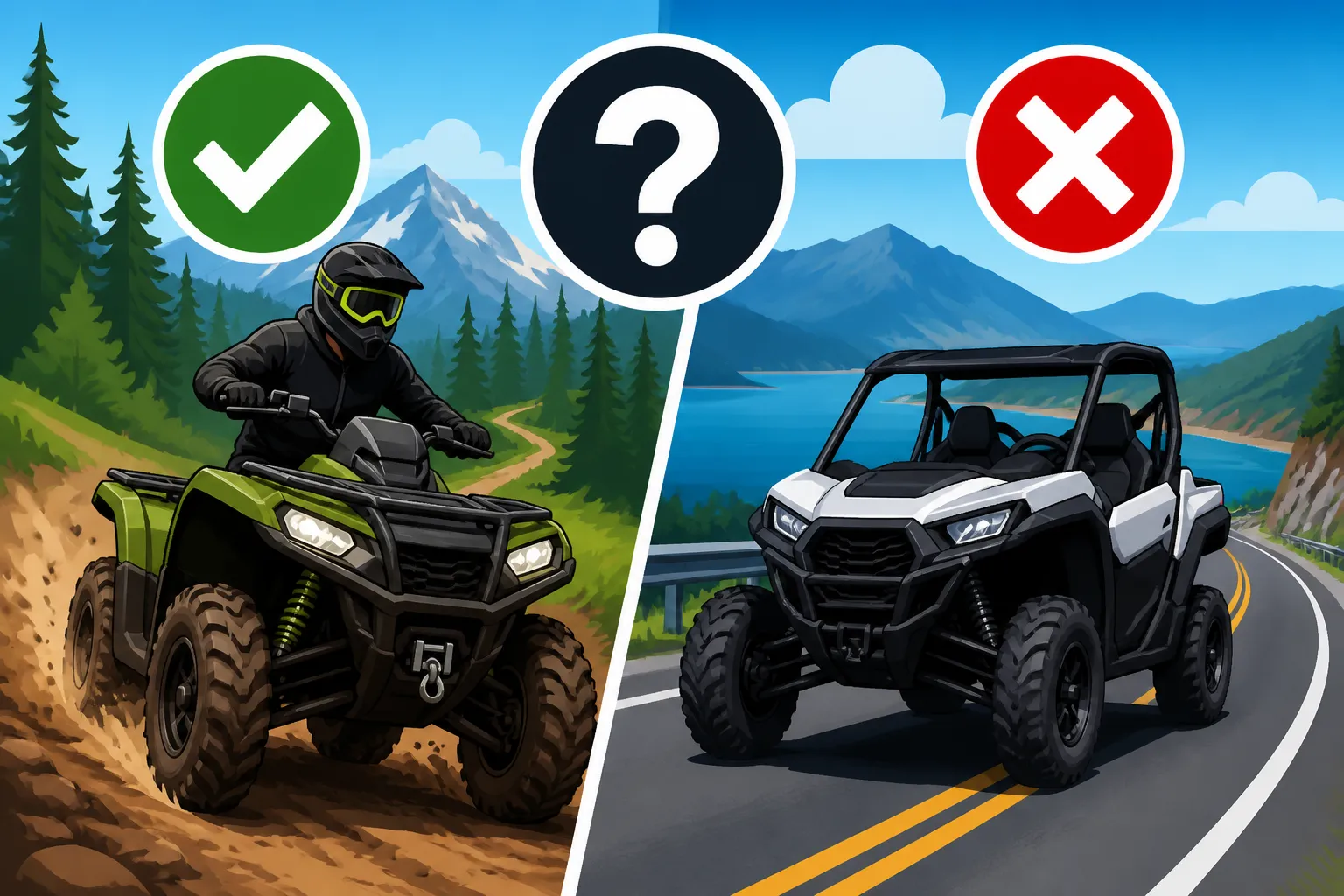
Let's get straight to it: for the most part, you cannot simply ride your ATV or UTV on paved public roads in British Columbia. The province has clear distinctions between off-road vehicles and highway vehicles, and these distinctions come with very different rulebooks. Trying to treat your quad or side-by-side like a car on the highway can lead to some pretty hefty fines, and nobody wants that. It's not about being a spoilsport; it's about safety for everyone on the road and managing how different types of vehicles interact.
Why BC Roads Are Different for ORVs
The core of the issue lies in BC's legislative framework. You have the Off-Road Vehicle Act, which governs where and how ATVs, UTVs, dirt bikes, and snowmobiles operate. Then, you have the Motor Vehicle Act, which dictates the rules for vehicles registered for use on public highways – think cars, trucks, and motorcycles. These two acts are largely separate, and an ORV, by its very definition, is designed and regulated for off-road use, not for sharing lanes with highway traffic.
This legislative split means that your shiny new side-by-side, even if it has headlights, tail lights, and turn signals, isn't automatically street legal just because it looks like it could be. It needs to meet specific federal and provincial standards for highway use, and the vast majority of ATVs and UTVs simply don't. The rules are in place because ORVs often handle differently, have different braking capabilities, and aren't designed with the same crash safety standards as vehicles meant for highway speeds and conditions. It's a fundamental difference in purpose and engineering that the law reflects.
What Counts as a "Road" in BC?
This is where things can get confusing because not all "roads" are created equal in the eyes of BC law.
When we talk about public roads where ORVs are generally banned, we're primarily referring to highways, which include provincial highways, municipal roads, and most paved streets in towns and cities. These are areas covered by the Motor Vehicle Act. If it has double yellow lines or a posted speed limit over, say, 50 km/h, it's almost certainly a highway.
However, there are other types of roads. Forest Service Roads (FSRs) and other resource roads are a prime example. These are often gravel, unpaved roads used primarily for industrial purposes (like logging or mining) or access to recreation sites. While they are public access, they generally fall under the Off-Road Vehicle Act's domain when it comes to ORVs, not the Motor Vehicle Act. This distinction is absolutely critical. You can typically ride your ORV on these resource roads, provided you meet specific requirements, which we’ll dive into shortly. [BC Resource Roads Count as Crown Land] is a good article for understanding these.
Then there’s private land and roads on private property. If you own the land, or have explicit permission from the landowner, you generally have more freedom, though you still need to adhere to local bylaws and basic safety practices. However, this is distinctly different from public roads, where traffic from multiple sources converges. It’s vital to know whose land you're on, as trespassing is a serious matter. [BC Private Land and the Registration Question] goes into more detail about this.
The Specific Exceptions: When an ORV Can Touch Pavement
While riding freely on paved public roads is mostly off-limits, there are a few very specific situations where your ATV or UTV might legally find itself on pavement. These exceptions are narrow and come with strict conditions that you must follow to avoid trouble.
Crossing a Highway
Imagine your favourite trail system is bisected by a provincial highway. It happens all the time. The good news is that BC law does allow ORVs to cross a highway, but only under very specific circumstances. You can't just cruise across anywhere you please. The crossing must occur:
- At a recognized intersection: This means a place where two roads meet, ideally with a stop sign or traffic light.
- Perpendicular to the highway: You must cross directly, not travel along the shoulder or turn onto the highway. The goal is to minimize your time on the pavement.
- After yielding to all highway traffic: Safety is paramount. You must ensure the way is clear before proceeding.
If you're crossing at a stop sign, the procedure is simple: stop, look both ways, and cross when it's safe. [BC Crossings at a Stop Sign] offers more detail. If you're at a traffic light, you must obey the light, just like any other vehicle. [BC Crossings at a Traffic Light] explains the nuances there. This isn't an invitation to ride on the highway, but rather a necessary evil to get from one section of trail to another. You absolutely need to be registered and insured for this, and wearing your helmet is mandatory.
Police Operation Permits
This is perhaps the most intriguing, and often misunderstood, exception. In certain situations, local police detachments (RCMP or municipal police) have the authority to issue an Operation Permit that allows an ORV to travel on a specific section of highway for a specific purpose. These permits are not a blanket "street legal" pass; they are highly restrictive.
Why would you need one? Perhaps your closest staging area requires a short hop on a low-traffic municipal road, or there's an annual community event where ORVs are part of a parade. To get one of these, you'll need to apply directly to your local police detachment. They will assess your request based on public safety concerns, the specific route, and the purpose of your travel. These permits are often free but come with very strict conditions, such as specific times of day you can ride, maximum speeds, and required safety equipment. You’ll definitely need your ORV registration and valid insurance, and you'll need to carry the permit with you at all times. [BC Police Operation Permits for Highway Travel] and [Getting a Free Operation Permit From Your Local Detachment] provide a comprehensive look at this process. For improved visibility when operating under such permits, consider aftermarket lighting solutions like those from SuperATV, which can enhance safety in mixed traffic environments.
Forest Service Roads and Resource Roads
Here’s where a lot of your riding freedom comes into play. Forest Service Roads (FSRs), also known as resource roads, are not considered highways under the Motor Vehicle Act. Instead, they fall under the jurisdiction of the Forest and Range Practices Act and, crucially, the Off-Road Vehicle Act for ORV use. This means that, unlike provincial highways, you generally can ride your ATV or UTV on these unpaved, working roads.
However, "can" does not mean "anything goes." There are still important rules to follow:
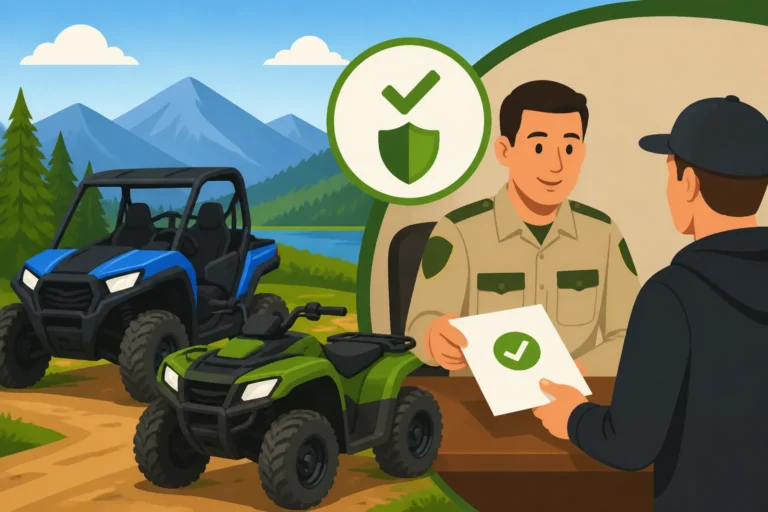
- Registration is mandatory: Your ORV must be registered with ICBC and display a valid BC ORV plate. [Registering an ATV With ICBC in BC] details the steps.
- Insurance is required: You need at least $200,000 in third-party liability insurance for FSRs. This is often purchased through ICBC when you register your machine. [BC Forest Service Road Insurance] covers this in depth.
- Helmets are a must: Both driver and any passengers on ride-astride ATVs must wear an approved helmet. For UTVs with roll cages and seatbelts, seatbelts are mandatory, and helmets are typically not required, though always a good idea. [BC Forest Service Road Helmet Rules]
- Driver's Licence: You generally need a valid driver's licence to operate an ORV on an FSR.
- Industrial Traffic: FSRs are active industrial zones. You will encounter logging trucks and other heavy machinery. Always yield to industrial traffic, drive cautiously, and consider carrying a resource road radio to communicate your position. [BC Forest Service Road Radio Rules]
Riding on FSRs can be an incredible experience, opening up vast areas of BC's backcountry. Just be prepared, informed, and equipped. SuperATV offers a wide range of accessories, from heavy-duty winches for self-recovery to rugged skid plates for protection, which are invaluable for the challenging conditions often found on these resource roads. They also provide excellent windshields and full cab enclosures that can make your FSR journey much more comfortable, protecting you from dust and the elements.
What You Need to Know for Any On-Pavement Riding
Even with the limited exceptions for riding your ORV on paved surfaces in BC, there are fundamental requirements you absolutely must meet. Ignoring these is a surefire way to invite a ticket or, worse, an accident. These aren't suggestions; they are legal necessities.
Registration and Insurance
First and foremost, your ORV must be registered in British Columbia. Since November 2015, all off-road vehicles operated on Crown land (which includes FSRs) must be registered with ICBC. This isn't a "title" like a car gets, but a Certificate of Registration and a physical plate for your machine. [BC ORV Registration You Pay Once] and [BC's Certificate of Registration Explained] are key resources for understanding this.
Even if you're only riding on your own private property, if you ever plan to transport your machine on a public road, it needs to be registered. For any on-pavement travel, even a brief crossing or with a police permit, this registration is non-negotiable.
Alongside registration, you need insurance. For FSRs, a minimum of $200,000 in third-party liability insurance is mandatory. For any travel on a highway (even with an Operation Permit), you'll need basic Autoplan insurance, just like a car. This is often where things get tricky, as many ORVs don't qualify for full Autoplan. This is why police permits are so specific – they’re typically for very short distances on roads with low traffic and speed, where the risk profile might be acceptable for a limited-coverage permit. Always check with your Autoplan broker about the specific insurance requirements for your intended route. [BC ATV Insurance Requirements] is a must-read.
Driver's Licence and Safety Gear
Operating an ORV on any public road, including FSRs or during a permitted highway crossing, generally requires you to hold a valid driver's licence. You can't just be any age; for riding on FSRs, you typically need to be 16 and hold a learner's, novice, or full driver's licence. [Do You Need a Licence for an ATV in BC?] details the specific age and licence rules.
Safety gear is equally critical:
- Helmets: If you're on a ride-astride ATV (a typical quad), both the operator and any passengers must wear an approved helmet when on Crown land, FSRs, or during any permitted highway travel. [BC ATV Helmet Law Explained]
- Seat Belts: If you're in a side-by-side (UTV) equipped with seat belts and a roll cage, you must use those seat belts. Helmets are usually not required in this scenario, but again, safety first!
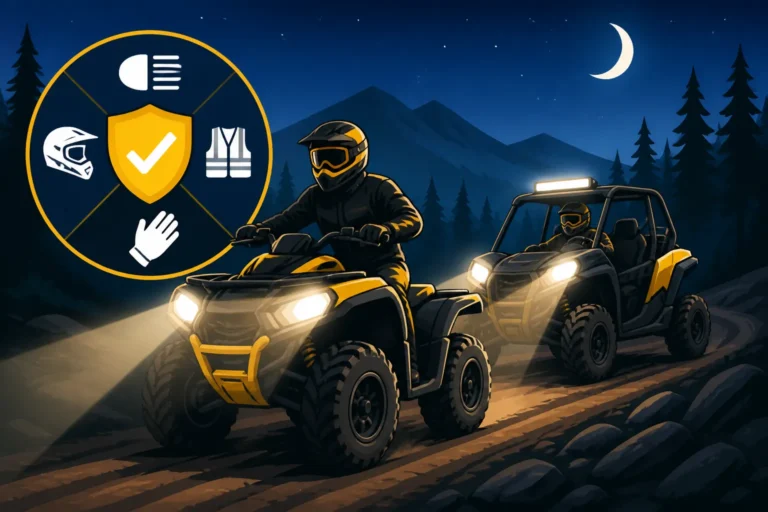
- Lighting: Your ORV must have working headlights and taillights, especially if you're riding in low light conditions, crossing a road, or operating with an Operation Permit. Ensure your lights are bright and fully functional for maximum visibility. Aftermarket lighting kits, such as LED light bars and auxiliary lights from SuperATV, can significantly improve your visibility to other road users, a crucial consideration for any permitted on-pavement travel.
- Mirrors: While not universally mandated for all off-road use, mirrors become vital for safe operation when you are in an area with other traffic, such as when crossing a highway or on a resource road. Having clear rearward visibility is key.
Penalties for Non-Compliance
The penalties for ignoring BC's ORV regulations can be severe. This isn't just a slap on the wrist; it can hit your wallet hard and even result in losing your machine.
- Tickets and Fines: Riding an unregistered ORV on Crown land (including FSRs) or on a highway without a permit can lead to significant fines. [BC Penalties for Riding Unregistered] outlines these costs. Careless operation, excessive speed, or other dangerous behaviours can also result in violation tickets under the Off-Road Vehicle Act or even the Motor Vehicle Act if you're deemed to be operating unsafely on a road. [BC Fines for Careless Operation]
- Machine Seizure: In serious cases, particularly repeat offences or highly reckless behaviour, enforcement officers have the power to seize your off-road vehicle. This means your machine could be impounded, and you'd face additional costs to retrieve it, on top of any fines.
- Insurance Issues: If you're involved in an accident while riding illegally on a highway, your insurance could be invalidated, leaving you personally liable for damages to other vehicles or property, which could amount to hundreds of thousands of dollars.
It's simply not worth the risk. Understand the rules, get the right paperwork, and ride responsibly.
Alternative Riding Opportunities (Where You Can Ride)
Since riding on paved roads is largely restricted, where can you truly enjoy your ATV or UTV in BC? Thankfully, British Columbia is a vast province with incredible backcountry, offering myriad opportunities for responsible off-road adventure. Focusing on these legal and designated areas is the best way to enjoy your machine without the stress of breaking the law.
Crown Land and Designated Trails
This is the bread and butter of ORV riding in BC. The vast majority of British Columbia is Crown land, and much of it is accessible to off-road vehicles. This includes:
- Forest Service Roads (FSRs) and Resource Roads: As discussed, these are your main arteries into the backcountry. Always assume industrial traffic and exercise caution.
- Designated ORV Trails: Many areas have dedicated trail networks maintained by local clubs or Recreation Sites and Trails BC. These trails are specifically designed for off-road vehicles and offer varying levels of difficulty. Riding on these trails is often the most enjoyable experience, as they are managed with riders in mind. You can find comprehensive information on these areas by researching [BC ATV Trails: Where to Ride] and [BC Crown Land Riding Explained]. Many clubs and organizations work tirelessly to maintain these trails, and joining a local club is a great way to support these efforts and discover new riding spots.
Always stay on marked trails and roads. Going off-trail in sensitive areas can cause significant environmental damage, lead to closures, and result in fines. Respect wildlife, stay out of riparian zones (areas near water bodies), and pack out everything you pack in.
Private Property
If you own land, or have express permission from a landowner, you can generally ride your ATV or UTV on that private property. This provides a safe and controlled environment to ride, practice skills, or simply enjoy your machine without needing to worry about public road regulations (though local noise bylaws or other municipal regulations might still apply).
When riding on private land, ensure you have permission in writing if it's not your own property. Respect the landowner's wishes, stick to designated riding areas, and be mindful of noise and dust for neighbours. Even on private land, basic safety practices like wearing a helmet and not riding impaired are crucial. If you're looking to maximize the off-road capability of your machine for private land riding, companies like SuperATV offer lift kits, portal gear lifts, and heavy-duty axles that can transform your ORV into an even more formidable off-road beast, perfect for tackling challenging terrain right on your own property or permitted areas.
Summary of Road Types and ORV Access in BC
Here's a quick overview of where you can and cannot ride your ORV on different types of roads in British Columbia:
| Road Type | ORV Access for Riding | Key Requirements & Considerations
This article is for general informational purposes only and does not constitute professional advice. Laws, prices and regulations vary by location and change over time. Consult a qualified professional for guidance on your specific situation.