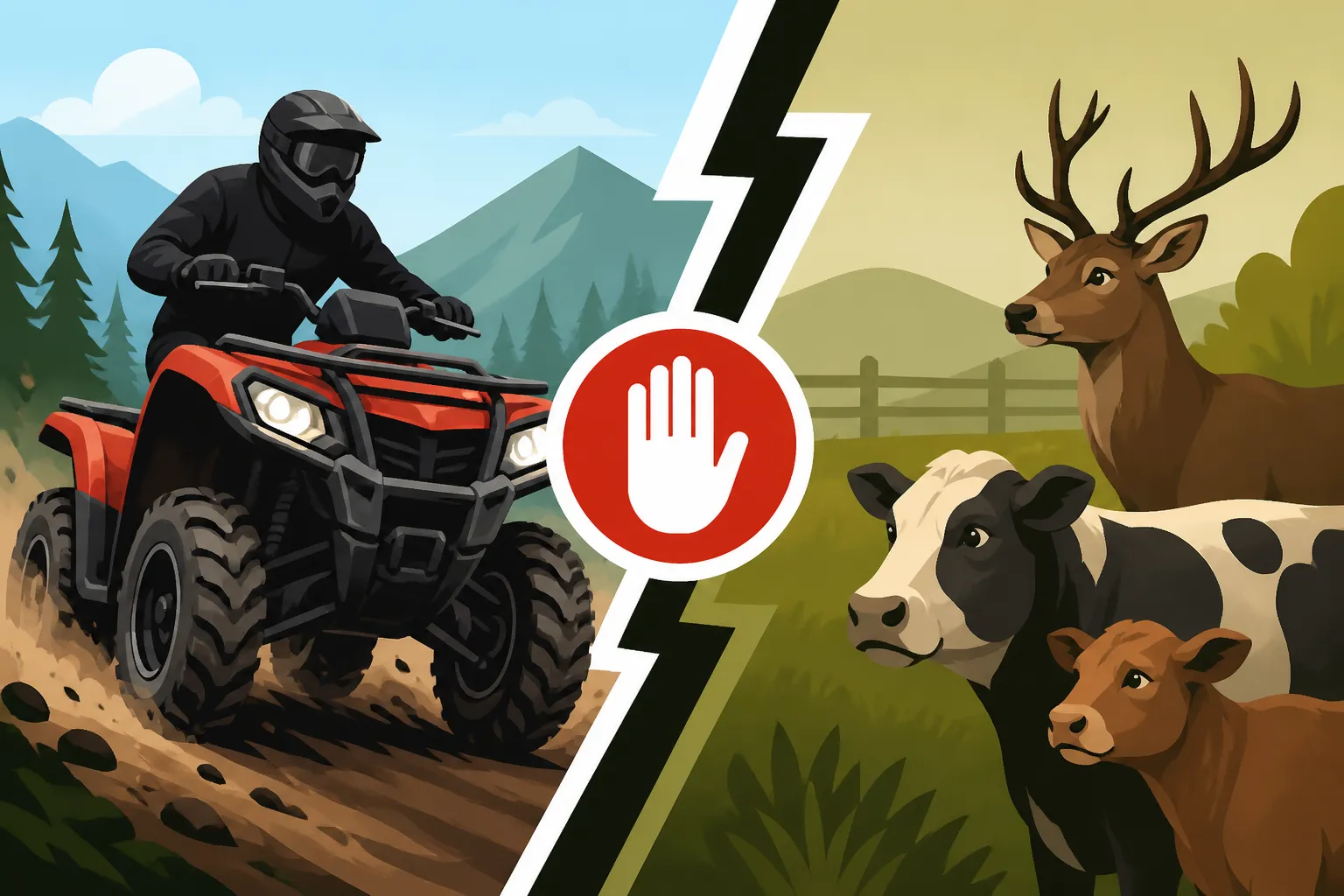
Endangering Wildlife or Livestock
It's an unfortunate truth that when we head out into British Columbia's stunning backcountry on our ATVs and UTVs, the sheer excitement of the ride can sometimes overshadow the critical responsibility we have to the natural world around us. Accidentally disturbing or even harming wildlife and livestock isn't just bad form; it carries serious legal consequences. This guide is here to walk you through exactly what "endangering wildlife or livestock" means in BC, where those rules apply, and how to enjoy our incredible trails without landing yourself in trouble or damaging our precious ecosystems.
The Serious Business of Protecting BC's Wildlife and Livestock
British Columbia is a vast, beautiful province, and much of its allure lies in its wild spaces and the animals that call them home. From the majestic elk herds of the Interior to the delicate bird species nesting in riparian zones, our province boasts incredible biodiversity. On top of that, agriculture, especially ranching, is a fundamental part of BC's heritage and economy. When we take our off-road vehicles into these areas, we become guests in their homes and must act accordingly.
Why These Rules Exist: More Than Just a Fine
These rules aren't just arbitrary lines drawn on a map to make your life harder; they are the bedrock of conservation and responsible land management. Ecologically speaking, every species plays a role in the intricate web of life. Disturbing wildlife, even seemingly minor actions like repeatedly flushing birds from a nesting site or chasing deer, can have significant cumulative impacts. It causes stress, burns vital energy reserves, disrupts feeding patterns, and can even lead to animals abandoning their young or their habitat entirely. The long-term health of our wildlife populations depends on minimizing human disturbance.
Beyond the wild, BC's ranching communities rely on open rangelands, often leased Crown land, for their cattle, sheep, and other livestock. These animals are a rancher's livelihood. When ORV riders fail to close gates, ride through herds, or otherwise harass livestock, it can lead to animals scattering, getting injured, lost, or even mixing with other herds, causing significant financial loss and immense stress for the ranching families. The rules are there to protect these vital parts of our provincial fabric, ensuring both nature and agriculture can thrive alongside recreational use.
What 'Endangering' Really Means in Practice
The term "endangering" might immediately conjure images of deliberately harming an animal, but in the context of ORV use in BC, it's far broader and often unintentional. It means any action that puts an animal at risk of injury, distress, or death, or significantly disrupts its natural behaviour or habitat. This isn't just about direct physical contact; it's about the impact of your presence.
For wildlife, this could include chasing animals, driving too close to make them flee, disrupting a mother with her young, or even just repeated noisy passes through a known breeding or feeding ground. For example, roaring through an area where salmon are spawning can stress the fish and damage their spawning beds. For livestock, leaving a gate open that allows cattle to wander onto a highway, driving aggressively through a pasture where animals are grazing, or spooking a herd into a stampede all fall under the umbrella of endangering. It’s about being aware of your surroundings and recognizing that your machine, no matter how much fun it is, has a significant presence in these sensitive environments.
Where the Rules Apply: Crown Land, Range Land, and Private Property
Understanding where you're riding is just as important as how you're riding. British Columbia's diverse landscapes mean that rules and land designations can change rapidly, often without obvious signage. It's easy to stray from one type of land to another without realizing it, which can inadvertently put you at odds with regulations concerning wildlife and livestock.
Navigating Crown Land and Wildlife Management Areas
A significant portion of British Columbia is Crown land, open for various uses, including ORV recreation. However, even on Crown land, there are crucial distinctions. Many areas are designated as wildlife management areas, critical wildlife habitat, or are subject to [BC Motor Vehicle Closed Areas] specific to certain seasons or species. These closures are implemented to protect vulnerable populations during breeding, nesting, or migration periods, or to safeguard particularly sensitive ecosystems. A common example might be a winter range closure to protect deer and elk from disturbance when they are already stressed by cold and scarce food. You need to be aware that [BC Crown Land Riding Explained] comes with responsibilities.
It's your responsibility as a rider to know if the area you plan to ride in has any restrictions. Ignoring signs, or simply not checking a map before you go, is not a valid excuse if you're found to be disturbing wildlife. Conservation Officers have the authority to enforce these regulations, and they frequently patrol areas known for ORV use. An unannounced check by a Conservation Officer might include questions about your knowledge of local regulations and a check of your machine for things like spark arrestors, which are essential for preventing wildfires that can devastate wildlife habitats. [BC Equipment Checks by Conservation Officers] are a real possibility.
Respecting Private Property and Leased Range Land
While the allure of vast, open spaces is strong, not all land you encounter in the backcountry is public. Many private land holdings, including farms and ranches, are nestled within or adjacent to Crown land. Crossing onto private property without permission is trespassing, regardless of whether there's livestock present. Fences and gates are clear indicators of property boundaries, and they must always be respected and left as you found them. If a gate is closed, close it behind you. If it's open, leave it open. Never assume you have the right to pass through.
Furthermore, a significant amount of Crown land is leased to ranchers for grazing livestock – this is known as range land. While technically Crown land, these areas function very much like private pastures for the duration of the lease. [BC Leased Crown Land and Permission] is a critical concept here. You might see cattle, horses, or sheep grazing freely across vast unfenced areas. Even though you're on Crown land, you must treat these areas with the same respect you'd give to a private farm. Disturbing livestock on range land can lead to direct fines and potentially civil action from the rancher if their animals are harmed or lost due to your negligence. Familiarize yourself with [BC Rules for Riding Private Land] and [BC Rules for Riding Crown Land] to avoid any misunderstandings.
The Off-Road Vehicle Act and Other Relevant Legislation
When you're out riding in BC, you're not just subject to one set of rules; there's a tapestry of legislation designed to ensure safety and responsible use of our natural resources. While the Off-Road Vehicle Act is probably the one you hear about most often, it works in conjunction with other important laws to protect our environment and our agricultural sector.
Understanding the ORV Act's Mandate
The Off-Road Vehicle Act, which became mandatory in 2015 for ORV registration, covers a wide array of responsibilities for riders in British Columbia. While many focus on registration requirements, mandatory helmets, and operating permits, the Act's mandate extends far beyond mere administrative details. It fundamentally shapes how we interact with the land and its inhabitants. [What the Off-Road Vehicle Act Covers in BC] includes sections that speak to operating a machine in a way that is "careless or without reasonable consideration for other persons or property," which absolutely includes wildlife and livestock.
This means that even if you're registered and insured, riding in a manner that unnecessarily frightens a herd of elk or drives cattle away from their grazing area could be considered a violation under the spirit of the Act. The intent is to promote responsible recreational use that minimizes conflict with other land users and protects the natural environment. It's about ensuring your adventure doesn't come at the expense of another's livelihood or the well-being of BC's incredible wildlife.
Other Laws Protecting Animals and Their Habitats
Beyond the ORV Act, several other pieces of legislation fortify the protection of wildlife and livestock in BC. The Wildlife Act is a cornerstone, specifically outlining prohibitions against harassing, molesting, or injuring wildlife. This is where most tickets for direct wildlife disturbance would come from. It's crucial because it focuses explicitly on the animals themselves. For example, if you're caught chasing a deer, you'd likely be facing a charge under the Wildlife Act.
The Trespass Act is another important one, particularly when dealing with private property or leased range land. Unlawfully entering or remaining on someone else's land, even if you don't directly harm an animal, can result in fines and legal action. For extreme cases involving deliberate cruelty or significant damage, elements of the Criminal Code of Canada could even come into play, leading to much more severe penalties than those found in provincial statutes. All these acts together form a robust framework, reminding riders that venturing into the backcountry means accepting a broad range of legal responsibilities.
Real-World Scenarios and How to Avoid Trouble
It's easy to think, "I'd never intentionally endanger an animal!" And most riders wouldn't. However, many violations occur simply due to a lack of awareness, an oversight, or getting caught up in the moment. Understanding these common pitfalls can help you stay out of trouble and ensure your rides are truly responsible.
Common Mistakes Riders Make (Even Accidentally)
One of the most frequent accidental disturbances comes from riders veering off established trails. This can damage sensitive vegetation, disrupt ground-nesting birds, or inadvertently expose wildlife to predators by breaking cover. [BC Trail Etiquette Locals Expect] usually involves staying on marked paths for good reason. Another common error is approaching wildlife too closely for photos or just to get a better look. While a majestic elk or a grizzly bear might seem like an incredible photo opportunity, getting too close stresses the animal, makes them feel threatened, and can lead to dangerous encounters for both you and the animal. Always give wildlife ample space.
Leaving gates open on range land is another big one. A quick pass through a gate, a moment of forgetfulness, and suddenly a rancher's herd could be wandering onto a busy highway or mixing with a neighbour's cattle. The noise and speed of ORVs can also be disturbing. While an ATV is inherently noisy, continuously revving engines or speeding through quiet areas can create chronic stress for wildlife. It might not seem like a big deal to you, but consistent disturbance can make animals abandon prime habitats. Even seemingly minor actions, like riding through a small creek rather than over a bridge, can cause [BC Riparian Areas to Avoid] damage to delicate stream banks and disrupt fish habitats.
Best Practices for Responsible Riding
Being a responsible ORV rider in BC is all about preparedness and mindfulness. Before you even leave your driveway, plan your route and check for any [BC Motor Vehicle Closed Areas] or seasonal restrictions. Websites from BC Parks, Recreation Sites and Trails BC, and local conservation groups often have up-to-date information. If you're heading into a known wildlife corridor or range land, research what animals you might encounter and their typical behaviours. For instance, knowing when deer fawn or when birds are nesting can help you avoid certain areas during sensitive times. Always be aware that [BC Hunting Closed Areas for Vehicles] might exist in some regions.
While riding, keep your speed appropriate for the terrain and conditions, and always be looking ahead for signs of wildlife or livestock. Slow down significantly around blind corners, near water sources, or in dense vegetation. If you encounter wildlife, slow down, give them a wide berth, and if they react negatively, stop and wait for them to move on, or turn around and find an alternate route. Never chase or harass animals. If you encounter a gate, operate under the "leave it as you found it" principle. If it was closed, close it behind you. If it was open, leave it open. Report any illegal or irresponsible ORV activity you witness to the Conservation Officer Service or the local RCMP. Being a good steward of the land benefits everyone and helps preserve our riding opportunities for generations to come.
The Consequences: Fines, Penalties, and Machine Seizure
Riding an ORV in British Columbia is a privilege, not an unfettered right. And with that privilege comes the responsibility to adhere to the province's laws and regulations. Failing to do so, especially when it comes to the serious matter of endangering wildlife or livestock, can lead to significant and costly penalties that can quickly turn your backcountry adventure into a nightmare.
Administrative Penalties and Violation Tickets
The most common form of penalty you're likely to encounter for less severe infractions is a violation ticket, often issued by a Conservation Officer or the RCMP. These are akin to traffic tickets, carrying set fines for specific offences. For instance, operating an ORV in a prohibited area, disturbing wildlife, or failing to follow land-use restrictions can result in substantial [BC Fines for Careless Operation]. These fines are designed to be a deterrent and cover a range of behaviours from minor negligence to more significant disturbances.
What often catches riders off guard is that even if you didn't mean to cause harm, if your actions led to an animal being endangered or distressed, you could still be on the hook. Ignorance of the rules is rarely accepted as a valid defence. These administrative penalties can quickly add up, and if you dispute them, you'll have to appear in court to plead your case. It's a costly and time-consuming process that most riders would much rather avoid by simply knowing and following the rules in the first place.
Serious Repercussions: Court Fines and Machine Seizure
For more egregious or repeated violations, the consequences can escalate dramatically beyond a simple violation ticket. Under various acts, including the Wildlife Act and the Off-Road Vehicle Act, individuals can face much larger court-imposed fines. These aren't fixed amounts but are determined by a judge and can range significantly depending on the severity of the offence, the level of intent, and the impact on the animals or environment. We're talking about fines that can be in the thousands of dollars, far exceeding typical violation ticket amounts.
Perhaps one of the most impactful penalties is the potential for [BC Machine Seizures by Police]. If you're caught operating an ORV in a manner that seriously endangers wildlife or livestock, or if you're a repeat offender, your machine can be impounded. This means your prized ATV or UTV could be taken away from you, and you'd be responsible for towing and storage fees, on top of any fines or court costs, to get it back – if you get it back at all. In very severe cases, particularly those involving intentional harm, long-term operating bans or even jail time are possibilities under the Criminal Code. These are not just idle threats; authorities in BC are serious about protecting our natural resources and holding irresponsible riders accountable.
What to Do if You Witness or Cause an Incident
Even with the best intentions and the most careful riding, sometimes things happen. You might stumble upon an injured animal, witness someone else acting irresponsibly, or inadvertently cause a disturbance yourself. Knowing how to react responsibly in these situations is crucial, not just for the well-being of the animals, but also to protect yourself and the ORV community's reputation.
Reporting Concerns and Incidents
If you witness someone else endangering wildlife or livestock, or observe an injured animal, it's vital to report it. The primary contact for wildlife and environmental violations in BC is the Conservation Officer Service (COS). You can call their RAPP (Report All Poachers and Polluters) line. Be prepared to provide as much detail as possible: the exact location (GPS coordinates are best if you have them), the time of the incident, a description of the ORVs involved (colour, make, model, licence plate numbers if possible), and what you observed. For injured livestock, contacting the local RCMP detachment or, if you can identify the rancher, calling them directly is the best course of action.
Equally important, if you accidentally cause an incident – perhaps you startled a herd of cattle and they scattered, or you accidentally drove too close to a sensitive nesting area – you should report it. While it might feel counterintuitive to admit to a mistake, taking responsibility can often lead to a more favourable outcome than if the incident is discovered later and traced back to you. It also shows a commitment to responsible riding, which is valued by authorities and fellow riders alike.
Taking Proactive Steps to Mitigate Impact
The best way to handle an incident is to prevent it from happening in the first place. Proactive planning is your best friend when hitting the trails. This means always carrying detailed maps of the area, understanding where you are in relation to private land, wildlife management zones, and range tenures. Utilizing GPS apps on your phone or a dedicated GPS unit can prevent accidental trespassing or entering closed areas. Before each ride, check local conditions, including any [BC Fire Centre Riding Bans] which can lead to closures, and any specific alerts from local conservation groups or government websites regarding wildlife activity.
Additionally, consider equipping your machine for minimal impact. Things like well-maintained mufflers to keep noise levels down and appropriate tires to minimize rutting and soil disturbance can make a difference. Always keep your ORV well-maintained and clean, especially when moving between different ecological zones, to prevent the spread of invasive species. Carry binoculars to observe wildlife from a safe distance, and always pack out what you pack in. The collective actions of responsible riders truly make a difference in maintaining access to our beautiful backcountry and ensuring that wildlife and livestock can thrive alongside our recreational pursuits.
| Scenario | Risk to Wildlife/Livestock | Appropriate Action | Potential Consequence |
|---|---|---|---|
| Riding off-trail in a sensitive area | Habitat destruction, disturbing ground-nesting birds, exposing animals | Stay on designated trails, consult maps, avoid closed areas | Fines, potential habitat restoration costs |
| Approaching wildlife too closely for photos | Stress, energy depletion, disruption of natural behaviours | Maintain significant distance, use binoculars, never chase or crowd | Violation tickets, animal distress |
| Leaving a gate open on range land | Livestock escape, injury, mixing with other herds, property damage | Always close gates behind you if found closed, report damaged gates | Fines, civil liability for lost/injured livestock |
| Driving aggressively/noisily near animals | Stress, stampeding, separation of young from mothers | Slow down, reduce noise, give animals wide berth, stop and wait for them to move on | Fines for careless operation, animal injury |
| Entering a signed 'Motor Vehicle Closed Area' | Direct disturbance to critical habitat or species | Always check for and respect closures, plan alternative routes | Substantial fines, machine seizure |
| Riding through a creek instead of using a bridge | Damage to riparian areas, fish spawning beds, water quality | Stick to designated crossings, use bridges or culverts if available | Fines, environmental damage charges |
Disclaimer
This article is for general informational purposes only and does not constitute professional advice. Laws, prices and regulations vary by location and change over time. Consult a qualified professional for guidance on your specific situation.