BC Youth Riding Rules Explained
British Columbia’s youth riding rules are not simply “old enough to reach the controls.” A young rider’s age, written permission, supervision, machine size and riding location can all matter, and rules for passengers and protective equipment still apply. This guide explains how those pieces fit together so families can plan a ride without assuming that one adult nearby makes every setup legal or safe.
How BC’s youth riding rules work
BC’s rules distinguish between riders under 16 and those who have turned 16. For a rider under 16, the starting point is adult supervision. There is a limited route for some 14- and 15-year-olds to ride without that supervision if they have the required written permission from a parent or guardian. Age alone does not establish that a young person can safely operate any machine.
The details matter. A 13-year-old and a 15-year-old may not have the same options, and neither age overrides a machine’s manufacturer guidance, passenger restrictions or the rules for the land being used. For a closer look at one age group, see BC Rules for a Child Under 16 and BC Rules for a 14-Year-Old Rider.
| Rider or situation | What to check before riding |
|---|---|
| Under 14 | Plan for supervision by an adult who meets the legal requirements. Check the machine’s age and size guidance. |
| Age 14 or 15 | Confirm whether the rider will be supervised or is relying on the written-permission option. Keep the permission available and check its conditions. |
| Age 16 or older | The under-16 supervision rule no longer applies, but equipment, passenger, access, insurance and other operating rules still do. |
| Any rider carrying a passenger | Confirm the machine is designed for passengers, the passenger fits the manufacturer’s guidance and the operator is legally permitted to carry one. |
| Any ride on public or managed land | Check registration, access restrictions, local conditions, required equipment and any site-specific rules. |
This table is a planning aid, not a substitute for checking the current regulation or conditions where you intend to ride. Rules may depend on the machine and location, and a trail operator or land manager may impose requirements in addition to provincial law.
The law is only one part of the decision
It helps to separate three questions:
- Can this young person legally operate the machine in this situation? Check age, supervision and any written permission.
- Is this machine appropriate for the young person? Check the manufacturer’s age, height, weight and skill guidance, then make a realistic assessment of the rider’s ability.
- Is riding permitted at this location? Check the land manager’s rules, road restrictions, registration and any permit or insurance requirements.
A “yes” to one question does not answer the others. A young person might have the required permission but be on a machine that is too large to control. A suitable youth quad might be legally operated, but still be barred from a particular trail or park.
Rules can differ by land and road
The youth rule is not a complete guide to where an off-road vehicle may go. Crown land, private property, managed recreation sites, parks, roads and local trails can have different access conditions. Owners and land managers may also set rules that are stricter than the general provincial requirements. See BC Rules for Riding Crown Land when planning a public-land ride.
Highways are a separate issue. An ATV or UTV is not automatically allowed on a public road because a young rider has adult supervision or written permission. A particular crossing or road-use situation may have separate legal requirements, and a young person may not be eligible to meet them. If your route involves pavement, confirm the rules for that exact road before leaving home.
Supervision and written permission
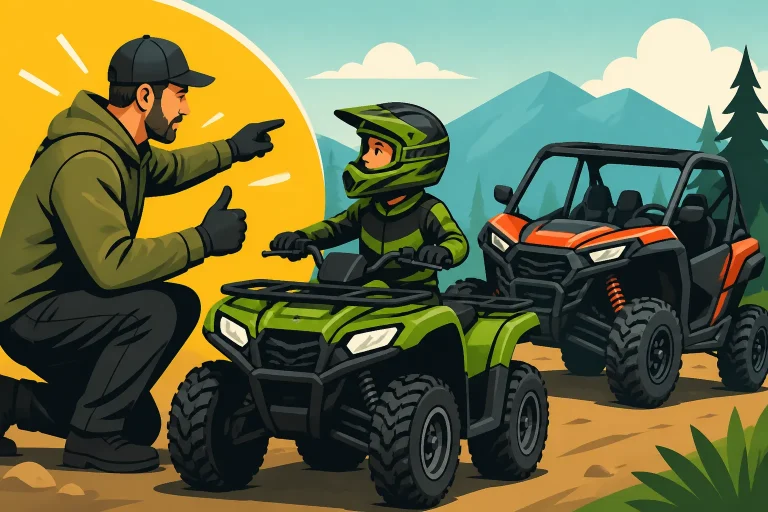
For a rider under 16, supervision is not just an adult being somewhere in the same group. The supervising person must meet the age requirement and be able to keep the young rider within sight and provide immediate direction. In practical terms, a parent who is far ahead, out of view or unable to respond promptly may not be providing the required supervision.
The supervising adult must be at least 19. They need to be present in a position where they can observe what the young person is doing and intervene or give direction when needed. For details about the adult’s role, see BC Rules for a Supervising Adult.
What useful supervision looks like
Legal supervision and good supervision are closely related, but they are not identical. Meeting the legal test does not guarantee that the ride is well managed. A responsible adult should be able to do more than keep the child in sight: they should understand the route, know the machine and be ready to stop the ride if the child is tired, distressed or losing control.
Before the ride, agree on simple instructions:
- Stay within the distance the supervising adult can see and direct.
- Stop when signalled, and do not continue around a blind corner alone.
- Wait at junctions and trail intersections.
- Do not follow another machine into an unfamiliar route.
- Keep a safe gap from other riders and slow down when visibility is poor.
- Stop if the machine behaves unexpectedly or the rider is uncomfortable.
On a narrow trail, “in sight” may mean riding close enough to see the child and communicate clearly, not merely knowing which trail they are on. Dust, trees, bends and changes in elevation can quickly break visual contact. Choose a route and pace that make real supervision possible.
The written-permission option for some 14- and 15-year-olds
BC provides a written-permission option for a rider who is 14 or 15, subject to the applicable requirements. It is not a general permission for every child to ride alone, and it does not turn an underage rider into an adult operator. Before relying on it, confirm the current rule and make sure the permission comes from the appropriate parent or guardian.
A practical permission letter should clearly identify:
- The young rider by name.
- The parent or guardian giving permission.
- The fact that permission is for the young person to operate an off-road vehicle.
- Any limits the parent wants to set, such as approved machines, areas, hours or adult check-ins.
- The date and the parent or guardian’s signature.
- A way to contact the parent or guardian if questions arise.
Those details are sensible record-keeping, not a guarantee that a letter meets every legal requirement. Confirm whether the current rule sets particular conditions for the permission and follow those conditions. Keep a readable copy with the rider or supervising group, and make sure the young person understands what the permission does and does not allow.
Permission does not make an unsuitable machine suitable. It does not authorize riding where vehicles are prohibited, remove passenger restrictions, replace registration or insurance requirements, or allow a machine onto a highway. Parents can also set stricter limits than the law requires. For example, a parent may require an adult to accompany a 14- or 15-year-old even when the legal option for riding without that supervision is available.
Training does not replace every requirement
Training is a valuable way to build safe habits, especially for a new rider, but do not assume that completing a course automatically replaces supervision or written permission. The legal effect of a course depends on whether it is recognized for the relevant rule and machine class. Check that before treating training as an alternative to another requirement.
For families looking at a course, ask the provider what the rider will practise, which machines the instruction covers and whether the training has any formal recognition for the situation you have in mind. A course that is useful for learning control and trail awareness may still be voluntary rather than a legal substitute for supervision. See BC Safety Courses Are Voluntary for Adults for broader context about training requirements.
Even a trained young rider needs routes and machines that match their experience. A short practice session on a familiar, open area is a better place to build confidence than a busy trail with steep grades, deep ruts, traffic or limited sightlines.
Choosing a machine and managing passengers
A child’s age is only one part of the fit. The operator has to be able to reach and use the controls, maintain a stable riding position, steer, brake and respond to uneven ground. A machine that is technically operable by a youth may still be too heavy, powerful or physically demanding for that particular rider.
Read the owner’s manual and manufacturer guidance for the exact model. Pay attention to any stated age, height, weight or passenger limits. Do not rely on engine size alone: two machines with similar engine capacity can differ in weight, throttle response, braking, seat height and handling.
Check fit before a trail ride
Have the young person sit on the machine with it switched off and secured. Check whether they can:
- Reach the controls without stretching or shifting into an unstable position.
- Use the brakes firmly and operate them as intended.
- Keep both hands on the handlebars while steering.
- Maintain balance through the seat or footrests.
- Understand the throttle response and stop the machine reliably.
- Mount and dismount without help that would be unavailable on the trail.
If the rider cannot comfortably reach a control, cannot hold the machine steady or struggles to stop it, the machine is not a good choice. A helmet, close adult supervision or a careful route cannot compensate for poor fit.
Power matters, too. An abrupt throttle response can surprise an inexperienced rider, and a heavy machine can be difficult to recover after a slow-speed tip-over. Start with a machine the young person can control confidently rather than buying ahead for the size they may grow into. A more powerful model is not a shortcut to more capability.
When buying gear or researching a machine, Amazon listings may provide useful photographs and dimensions, but verify specifications against the manufacturer’s manual. Product listings can be incomplete, and a listed youth size or age range does not replace checking actual fit and the model’s instructions.
A child operator should not carry a passenger
A young person’s ability to drive a machine does not mean they can take someone along. BC’s youth rules restrict a child operator from carrying a passenger. Do not treat an adult passenger as an extra supervisor riding behind the child; supervision and passenger carriage are different issues. See BC Rules for Passengers on a Quad for the broader passenger rules.
This restriction also matters when a machine has a second seat. The presence of a passenger seat does not remove the age-related restriction on a child operator carrying someone. A child should not carry a sibling, friend or adult simply because the passenger can hold on.
A passenger changes the machine’s balance, handling and stopping distance. The operator also has to manage another person’s movement. Even apart from the legal restriction, carrying a passenger is not a sensible way to teach a young rider.
A child riding as a passenger is a separate question
A young person may be a passenger in a machine operated by an eligible adult, but that does not mean any child can safely ride in any seat. Confirm that the manufacturer designed the machine for a passenger and check the stated minimums for size, age or weight. The child must be able to sit correctly, hold on or use the available restraints, and keep arms and legs clear of moving parts.
Never add a passenger to a single-rider ATV or improvise a seat. A passenger who cannot maintain a stable position can be injured even at low speed. For more on the passenger-specific considerations, see BC Rules for a Child Passenger.
In a side-by-side, use the seat and restraint system as designed. The operator should confirm that a child fits the seat belt properly and can remain seated for the route. If a belt does not fit securely, do not assume that holding the child or adding a cushion solves the problem. Review BC Rules for Riding a Side-by-Side for the rules and practical considerations specific to that vehicle type.
Helmets, restraints and other equipment
Protective equipment remains important regardless of age, supervision or permission. For ride-astride machines such as quads and dirt bikes, check the helmet requirements and use a properly fitted helmet that meets the applicable standard. A helmet that is loose, too large or poorly fastened can shift or come off in a fall. See BC ATV Helmet Law Explained for a focused explanation.
For a child, fit matters especially. A helmet should sit level, cover the intended area and stay stable when the rider moves their head. The chin strap should be fastened as instructed. If the child has grown, if the helmet has been damaged or if its fit has changed, reassess it before riding. Do not assume a helmet is safe because it looks new or because the product page calls it a youth model.
If you are considering helmets on Amazon, use the listing to identify the model and sizing information, then check the manufacturer’s guidance and the certification information on the helmet itself. A product title is not proof of fit or compliance. When possible, try the helmet on before the ride and make sure the young person can wear it comfortably for the full planned trip.
A side-by-side has different protective equipment considerations. Occupants should use the vehicle’s installed seat belts and remain inside the vehicle’s protective structure. Follow the manufacturer’s instructions for the belt, doors or nets and seating positions. A child who cannot be properly restrained in the designated seat should not ride there.
Other equipment should match the machine and conditions:
- Wear sturdy footwear that protects the feet and ankles and does not interfere with the controls.
- Use gloves that allow the rider to feel and operate the controls.
- Consider eye protection where dust, branches or flying debris are likely.
- Check that the machine’s required lights and safety equipment are present and working.
- Make sure any gear fits securely and cannot snag on the machine.
- Carry water and suitable layers for the route and weather.
The younger the rider, the more useful it is to check equipment before every outing. Children may not notice a loose strap, uncomfortable boot or failing glove until they are already on the trail. A quick pre-ride check by the adult can prevent small problems from becoming reasons to continue unsafely.
Location, access and paperwork still matter
Youth rules do not replace the requirements that apply to the machine or riding area. Before a family ride, confirm whether the machine must be registered, whether the route is open to off-road vehicles, whether the land manager requires a pass and whether insurance or other conditions apply. A young rider’s permission letter is not a substitute for vehicle paperwork.
Public land and managed recreation sites
Crown land and managed recreation sites are not automatically open to every machine on every day. Closures, posted restrictions, fire-related prohibitions, seasonal conditions and site rules may affect access. A trail that was open on a previous visit may have changed. Check current notices before travelling, especially when a route crosses areas with active industrial use or limited access.
A youth rider should not be sent ahead to scout an unfamiliar trail or closure. Keep the group together, agree on turnaround points and make sure the supervising adult knows the planned route. If a trail is rougher than expected, turn back rather than pushing a young rider through terrain that exceeds their skill.
Private land is not a free pass
Permission from a landowner is important, but it does not mean every provincial safety or vehicle rule disappears. Landowners may set their own conditions, including age limits, adult supervision, operating hours and restrictions on where machines may travel. Ask clearly before riding, and do not assume that permission to use one field or track includes neighbouring land, roads or access routes.
A young person riding on family property still needs an appropriate machine, suitable protective equipment and close attention from an adult. Familiarity with the property can make a ride feel low-risk, but it may also lead people to overlook hidden hazards such as ditches, fences, livestock, parked equipment or uneven ground.
Roads and route connections
Do not plan a youth ride on the assumption that an ATV or UTV can use a public road to connect two trails. Road use and highway crossings have their own rules, and an off-road vehicle is not made street-legal by registration or parental consent. If a route includes a forest service road, check the specific road requirements, restrictions and traffic conditions. An industrial road can carry large trucks and other traffic that are difficult for a young rider to anticipate.
For a novice, a route with road crossings, active hauling, blind corners or unfamiliar intersections may be inappropriate even if the young person can legally operate the machine. Choose a lower-risk route and keep the adult close enough to direct the rider before a hazard, not after.
Registration, insurance and proof
Check the machine’s registration and carry any required documents. A family should not assume that a youth’s age changes the paperwork rules for the vehicle. Registration, insurance and proof-of-ownership questions are separate from supervision and permission. If the machine will be used on public land, review the relevant requirements before leaving.
A smartphone can be helpful for keeping a copy of permission or route information, but do not depend on cell service. If a document is required, carry it in a form that can be shown where you are riding. Keep the machine’s plate and any required markings visible, and make sure the adult knows where the documents are.
A practical family ride plan
The best way to apply the rules is to make the key decisions before the engine starts. A simple plan reduces the chance that a family reaches a trailhead and discovers that the young rider, machine or route is not a good fit.
- Confirm the rider’s age and legal route. Decide whether the young person will ride under the required adult supervision or, if eligible, rely on the written-permission option. Check the current conditions rather than relying on a friend’s interpretation.
- Read the machine’s manual. Check the manufacturer’s age, size, weight and passenger guidance for the exact model. Confirm the young person can operate the controls and stop the machine.
- Choose the location. Verify that the route is open to the vehicle and suitable for the rider’s experience. Check for closures, road exposure, active hauling and site-specific requirements.
- Check paperwork and equipment. Confirm registration and any insurance or pass requirements. Inspect the helmet, restraints, footwear, lights and machine condition.
- Set supervision expectations. Agree on hand signals or other communication, stopping points, speed limits, spacing and what the rider should do if they lose sight of the adult.
- Start with a controlled practice. Let the young person practise stopping, turning and responding to instructions in an appropriate area before entering a longer or more difficult trail.
- Reassess during the ride. Fatigue, cold, heat, hunger and anxiety can affect judgment. Take breaks and end the ride when the child is no longer alert or comfortable.
An adult should also set a clear rule for what happens if the ride becomes difficult: stop, regroup and turn around if necessary. A child who is worried about holding up the group may keep going when they should stop. Tell them explicitly that asking to turn back is the right decision, not a failure.
Common mistakes to avoid
A few assumptions cause repeated problems:
- Assuming “my child is mature” is a legal exception. A parent’s judgment matters for safety, but it does not replace a legal age, supervision or permission requirement.
- Assuming an adult in the group counts as a supervisor. The adult must be old enough and able to see and direct the young rider as required.
- Treating written permission as a universal pass. It does not make every rider eligible, remove machine restrictions or authorize access to closed land.
- Putting a child on an adult-sized machine because they are tall. Height alone does not establish that the rider can manage the machine’s weight, braking or power.
- Letting a child carry a passenger because the quad has a second seat. The youth operator restriction still matters.
- Confusing a passenger’s age with the operator’s age. A child riding as a passenger has separate fit and restraint considerations.
- Assuming a trail is open because it was open last season. Closures and access conditions can change.
- Using online product claims as the final word. Whether a helmet or other item is suitable depends on its actual specifications, fit and the applicable requirements.
When to check with an official source
Get clarification before riding if the rider’s age or permission situation is unusual, the machine’s class is unclear, or the route involves a road, managed site or special access condition. Ask the relevant regulator, land manager or local authority about the specific machine and location. When buying equipment, confirm specifications with the manufacturer or seller rather than relying only on a brief marketplace description. Amazon can be one place to compare product information, but the manufacturer’s manual and the physical label are better checks for important safety details.
A short conversation before the ride is much easier than trying to resolve uncertainty at a trailhead or after an officer asks for documents. Keep the plan conservative: a young rider should be on a suitable machine, with the required permission and supervision, wearing the right equipment and travelling somewhere the vehicle is allowed.
Disclaimer
This article is for general informational purposes only and does not constitute professional advice. Laws, prices and regulations vary by location and change over time. Consult a qualified professional for guidance on your specific situation.