BC Does Not Register Non-Resident Machines
A trip into British Columbia does not mean you need to register your ATV or side-by-side in BC. The practical question is whether your machine meets the rules where you normally live, and what proof you should carry when you ride here. This guide explains the visitor rule, the documents and plate to bring, and the separate riding requirements that still apply once you arrive.
The short answer for visitors
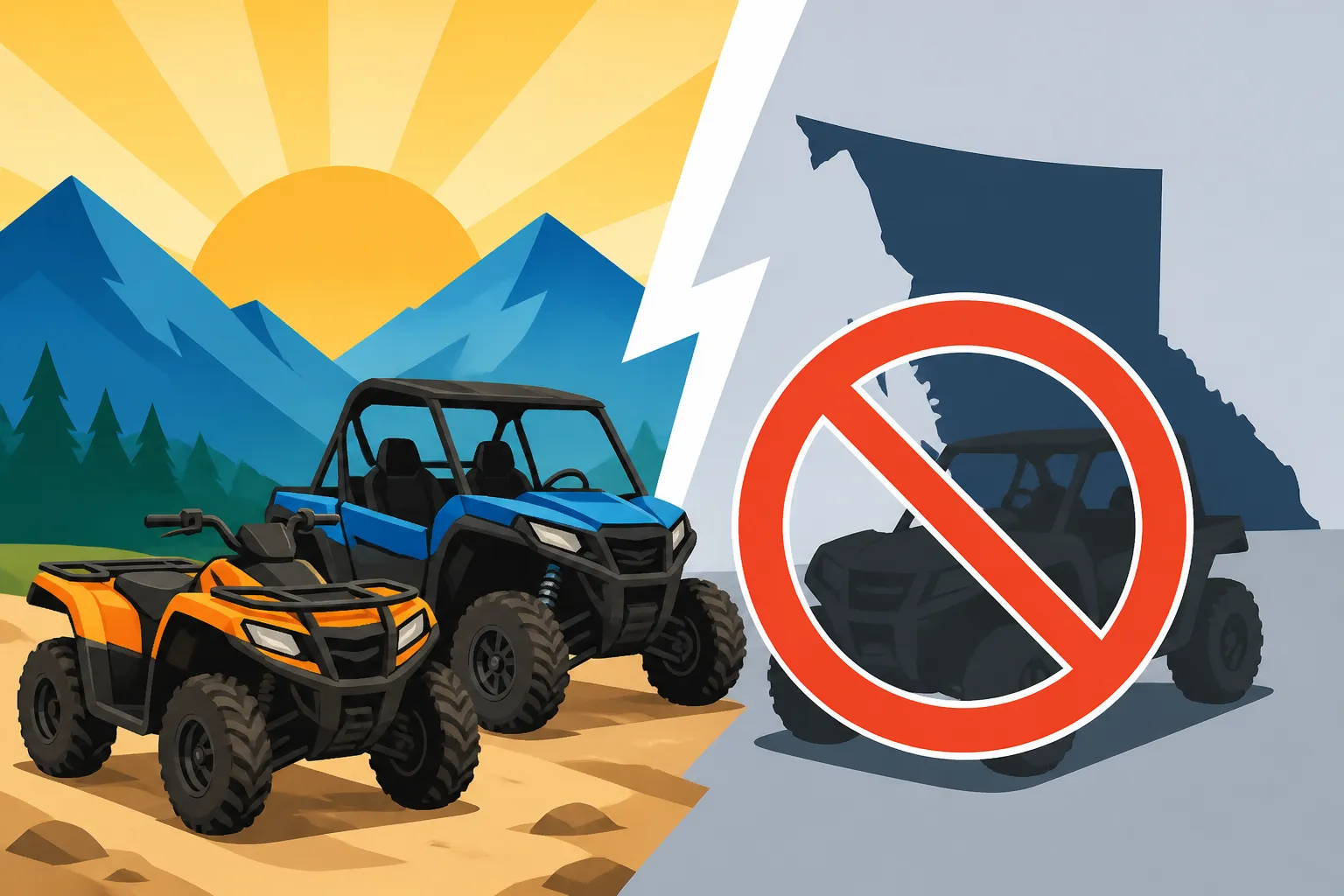
British Columbia does not register a machine simply because a non-resident brings it into the province for a visit. Visitors generally rely on the registration or legal status of the machine in their home jurisdiction, rather than applying for a BC registration.
That is a registration answer, not permission to ride anywhere. A visitor still needs to meet applicable requirements for the machine’s home jurisdiction and follow BC rules about where and how it is operated. Those include rules for helmets, youth riders, insurance in certain places, road access, and local closures.
| Your situation | What to sort out before riding in BC |
|---|---|
| Your home jurisdiction registers ORVs | Keep the registration current, bring the documents, and display the required home-jurisdiction identifier |
| Your home jurisdiction does not register this type of machine | Bring proof that you own or are entitled to use it, and confirm what applies to visitors from your jurisdiction |
| You live in BC or have moved here | Do not assume visitor treatment applies; check whether BC registration is required |
| You are renting or borrowing a machine | Confirm who is responsible for registration, insurance, permission to use it, and any required pass |
| You plan to ride on a Forest Service Road | Check the road’s rules and arrange the required insurance before entering |
| You plan to use a managed recreation site | Check whether that site requires its own pass or has other local conditions |
A visitor from Alberta, for example, may bring a machine with Alberta registration and use the home-jurisdiction documents and identifier rather than obtaining BC registration. A visitor from a place that does not register the machine should not assume that a missing plate automatically makes the trip legal. Carry ownership evidence and check the visitor rule for your circumstances.
The key distinction is between BC registration and the machine’s legal status for a visitor. BC’s non-resident approach does not mean every visiting machine is automatically exempt from every paperwork requirement. The rules can depend on where you normally live, whether that jurisdiction registers that class of machine, and whether the machine is being used temporarily or is now based in BC.
For the wider background on BC’s system, see BC Registration Compared to Alberta and BC’s Rule Keys on Whether Home Has a Registry. If you live in BC, or your stay has turned into a move, start with Do You Need to Register an ATV in BC? instead of relying on the visitor rule.
Work out whether you are a visitor or a BC owner
“Non-resident” is not just a label you choose because the machine still has an out-of-province plate. The useful question is where you normally live and whether the machine is genuinely visiting BC or has become a machine kept and used here.
A person who lives outside BC and brings an ATV or UTV for a holiday, a weekend ride, or a temporary visit is in a different position from someone who has moved to BC and is keeping the machine here. If you have recently relocated, bought property in BC, or are spending extended periods here, do not decide the registration question from the plate alone. Confirm with an Autoplan broker or the appropriate BC authority how your circumstances are treated.
That distinction matters because registration obligations may change when a machine is no longer just visiting. The province where you now live may have requirements for registering an ORV, documenting a transfer, or carrying particular papers. If you have moved, Moving Provinces With a Machine can help you identify the issues to resolve.
Check your home jurisdiction first
Before packing the machine, find out how your home jurisdiction treats that particular vehicle. “ATV” or “UTV” may be used casually to describe several kinds of machines, while laws can distinguish between classes or uses.
Ask yourself:
- Does your home jurisdiction require this type of machine to be registered?
- Is the registration current and attached to this machine?
- Does it require a plate, decal, permit, or other identifier to be displayed?
- Do you need proof of ownership or permission to operate it?
- Does your home coverage apply while riding in BC?
- Are there restrictions on taking the machine out of the jurisdiction?
If registration is required where you live, arrive with it in force and display the correct identifier as required there. If registration is not required, keep enough documentation to explain the machine’s status and show that you own it or have permission to use it. A visitor from a jurisdiction without an ORV registry may find Visiting From a Province That Registers Nothing useful.
Do not assume that a vehicle registration for a road vehicle automatically covers an ATV or UTV, or that an insurance card proves ownership. These are separate questions. Bring the relevant papers for each.
Temporary visit versus moving the machine to BC
A holiday machine usually remains tied to its home jurisdiction: it is owned, stored, and ordinarily used there, then brought to BC temporarily. A machine purchased elsewhere and permanently brought to BC is a different situation. So is a machine that is sold to a BC resident while it is here.
If you are buying a machine outside the province and bringing it home to BC, read BC Registration for a Machine From Alberta, BC Registration for a Machine From Washington, or Importing a Machine Into Canada, as appropriate. Those situations can involve ownership records, border paperwork, and BC registration steps that do not apply to an ordinary visitor.
Bring proof that answers the likely questions
A tidy document set can prevent a small question from turning into a frustrating delay. Officers, site staff, or a land manager may want to establish who owns the machine, where it is registered, or whether you have permission to ride it. Not every rider will be asked for every document, but it is sensible to be prepared.
Carry, as applicable:
- Current home-jurisdiction registration or permit
- Proof of ownership, such as a registration document, bill of sale, or other accepted record
- Insurance documents that show what coverage applies
- Written permission if the machine belongs to someone else
- Rental paperwork if it is a hired machine
- A pass or proof of payment if the managed riding area requires one
- Identification for the operator, where required by the riding situation
If your machine is not registered where you live, do not make your explanation depend on a verbal claim alone. A bill of sale, ownership document, or other reliable record can help show where the machine came from and who is entitled to use it. For a visitor whose jurisdiction has no registration system, it is especially useful to have proof of ownership readily available.
Keep the documents dry and accessible. A sealed pouch in a pack or vehicle is usually more useful than papers tucked under a seat where they can get soaked, covered in mud, or left behind at camp. A waterproof document pouch from a general retailer or Amazon can be a practical option, but use one that closes securely and keep a backup photo of the documents on your phone. A phone image is convenient; it should not be your only plan if the device loses power or reception.
If the machine is borrowed, get permission in writing. A short note from the owner identifying the machine and authorizing you to use it is better than trying to reach the owner from a trailhead with no cell service. If there is a passenger or another operator, make sure the permission covers the actual use you plan.
For a more complete preparation list, see Documents to Bring to a Broker and BC Proof of Ownership for Visitors. Those pages address different paperwork situations, but the same practical principle applies: bring evidence that matches the machine and the person using it.
Make the documents match the machine
Before departure, compare the machine’s identification number with the number on its paperwork. A small mismatch can become a large problem if someone needs to verify the vehicle. Check that the documents refer to the same make, model, and machine identifier, and that the registration has not expired or been transferred away.
If the machine has been modified, do not remove or obscure its identification markings. If you have recently bought it, keep the bill of sale and any prior ownership documents that came with it. If the machine is registered in another person’s name, bring permission from that person rather than assuming a family relationship will explain the situation.
For a borrowed or rented unit, the owner or rental operator should be able to tell you what documents and insurance accompany it. Do not assume that the machine’s plate settles every question about your own permission to operate it or the coverage that applies to you.
Keep the home identifier visible and legible
If your home jurisdiction requires a registration plate, decal, or other identifier, bring it as required and make sure it is visible. Do not remove it because you are entering BC, and do not add a BC plate simply to make the machine look locally registered. BC does not issue its own ORV registration to a non-resident just for a visit.
The identifier must be usable in the real world, not merely attached somewhere on the machine. Mud, cargo, a fuel can, a spare tire, or a passenger’s gear can cover it. Before a long ride, stand behind or beside the machine and check whether the identifier can actually be seen. Clean it when needed, and secure it so it does not flap, crack, or fall off on rough ground.
The correct mounting location can depend on the rules that apply to your home-jurisdiction plate and the machine. Follow those requirements and check BC’s guidance for visitors if you are unsure how the identifier should be displayed here. Do not improvise by placing a plate where it is likely to be hidden or damaged. The related BC guidance is in BC Plate Placement on Front, Back or Left and Keeping Your ORV Plate Clean Enough to Read.
If your home jurisdiction does not issue a plate for the machine, that does not mean you should display a homemade number as though it were official. Carry ownership evidence instead, and confirm whether your jurisdiction has another required identifier or document for out-of-area use.
A second practical issue is that a visitor may be used to riding without carrying paperwork at home. That habit can leave you unprepared in BC. Keep the documents with the machine or operator, not in the truck parked miles away at the staging area. For BC riders, the general requirement to carry registration documents is explained in BC Riders Must Carry the Certificate. Visitors should check what documents apply to them and keep the papers that establish their own machine’s status close at hand.
A simple storage routine helps. Put papers in a sealed pouch, attach the pouch to a secure bag or carry it on your person, and return it there after each stop. If you use a small pouch from Amazon, test the closure before the trip and do not leave it exposed to abrasion or heat near the engine. Take clear photos of the documents as a backup, but keep original documents available when they are required.
Registration is only one part of riding legally in BC
A valid home registration does not authorize an ATV or UTV to travel on every road, trail, beach, or recreation site. Treat the registration question as one item on a larger pre-ride checklist.
Roads and Forest Service Roads
An ATV or UTV is not automatically street-legal in BC because it carries an out-of-province plate. Ordinary highway use and limited road access are separate legal questions. Do not use a public road as a shortcut unless the route and the specific type of travel are allowed.
Some highway crossings or local road access may be possible under specific conditions or permits. The conditions can depend on the road, location, and the authority responsible for it. For the general rule, see Can You Ride an ATV on the Road in BC?. For an allowed crossing or permit situation, see BC Rules for Crossing a Highway and BC Operation Permit Application Steps.
Forest Service Roads need particular attention. They are not automatically recreational ATV trails, and industrial traffic may be present. Applicable insurance requirements can differ from those on other Crown land. Check the road’s current access conditions and carry the coverage required for the kind of operation you intend. BC Forest Service Road Requirements explains the road-specific questions, while BC Resource Road Insurance of $200,000 covers the liability issue described for these roads. Confirm current requirements with your insurer and the relevant authority before leaving home; a home policy is not automatically valid for every BC riding situation.
On an active resource road, follow posted signs and yield to industrial traffic. A logging truck may need the full road and may not be able to stop quickly. Radios can be useful or expected on some roads, but requirements and practices vary. Check local signage and road information rather than assuming every road uses the same channel or procedure.
Helmets, passengers, and young riders
BC rider rules can apply even when the machine is registered elsewhere. A visiting operator should not assume that a home-jurisdiction exemption carries over to BC. Check the rules for helmets, passengers, youth operators, and supervision before you ride.
For example, a machine’s seat count does not automatically mean every passenger is permitted in every situation. Manufacturer guidance about rider age, weight, and passenger capacity matters for safe operation, and BC rules for younger operators may impose additional requirements. Review BC ATV Helmet Law Explained, BC Rules for Passengers on a Quad, and BC Youth Riding Rules Explained if children or youth will be riding.
A helmet is more than a box to tick. It needs to fit properly, be suitable for the type of machine, and be in good condition. If someone in your group is borrowing gear, check the fit before you reach the trailhead. A helmet that is loose, damaged, or not intended for the activity is a poor substitute for suitable equipment.
Insurance and other coverage
Registration and insurance are not interchangeable. A registration document does not prove that your liability or other coverage applies to a BC ride. Contact the insurer before travelling and describe where you expect to ride, including whether your route uses a Forest Service Road or another public road.
Ask directly:
- Does the policy cover the machine while it is operated in British Columbia?
- Does it cover the named operators and passengers?
- Are there exclusions for public roads, resource roads, or particular land types?
- What proof of coverage should you carry?
- What level of liability coverage is required for the specific road or activity?
BC’s insurance requirements vary with where the machine is operated. BC ATV Insurance Requirements and BC’s Three-Tier Insurance Rule are useful starting points, but a visitor should confirm the policy’s territorial coverage and the current requirements for the planned route. If you ride on a Forest Service Road, do not rely on a general statement that the machine is “insured.” Confirm the required liability coverage and whether your policy provides it.
Land access, closures, and site passes
A plate does not grant permission to enter private land, leased Crown land, a closed area, or a park where motorized recreation is prohibited. It also does not replace a pass required by a managed riding site.
Before leaving, check whether the land is open to ORVs, whether the road or trail is subject to seasonal or fire-related restrictions, and whether a site operator requires a pass. BC does not have one province-wide trail pass that grants access to every riding area. Some managed sites have their own fees or conditions, while other areas are governed by different access rules. See BC Passes Exist Only at Managed Sites and BC Motor Vehicle Closures and How to Find Them.
Private land requires permission from the landholder. Crown land can also have restrictions, including leases, closures, or posted limits. Riding on a trail visible on a map does not prove that it is open today. Check current notices and signs at the entrance, and turn around if a road is gated or marked closed.
Special cases that deserve an extra check
Most visiting riders have a straightforward situation: they bring their own registered machine, carry the registration, and ride where access is permitted. Some circumstances call for more care.
Visitors from a jurisdiction without an ORV registry
If your home jurisdiction does not register the type of ATV or UTV you are bringing, do not try to solve the issue by obtaining a BC registration as a non-resident. Instead, establish what proof your home jurisdiction provides, carry proof of ownership, and verify the BC visitor requirements before travelling.
Bring more than a vague explanation. A bill of sale, ownership document, or written confirmation from the relevant home authority can help show why there is no plate. If you use the machine for work or it belongs to a business, carry records that connect the business to the machine and authorize you to operate it.
This situation is different from a machine that should be registered at home but has not been. A missing home registration is not made acceptable merely by crossing the border. If your jurisdiction requires registration, resolve that before the trip.
Visitors from another Canadian province or a US state
Do not assume all provinces and states treat ORVs the same way. One place may register an ATV, another may require a different form of permit, and another may not register that class at all. Check the system where you live, not the rules you remember from a previous trip or a different machine.
Visitors from Alberta can start with BC Riders From Alberta Use Alberta Plates. Visitors from Washington can review BC Riders From Washington Use Home Plates. Other visitors should look for guidance specific to their home jurisdiction, particularly if it has no comparable registry or uses a document rather than a visible plate.
A US visitor should also separate the vehicle’s status from border and customs paperwork. If the machine is only being brought for a temporary trip, the documents needed for entry and return may be different from the documents relevant to BC ORV registration. If you bought the machine outside Canada or intend to leave it in Canada, check import requirements before transporting it.
Borrowed, rented, or business machines
A borrowed machine should come with the owner’s permission and a clear understanding of who is responsible if it is damaged, ticketed, or involved in a collision. Ask the owner whether their insurance covers you, the location, and the type of use planned. A registration in the owner’s name does not by itself confirm permission or insurance.
For a rental, ask the operator what the rental agreement requires and what coverage is included or excluded. Confirm whether a trail pass is included, whether the machine can be taken onto the roads you have planned, and who to call if the vehicle is damaged or becomes disabled. Do not assume the rental company’s paperwork covers every activity you might choose to do.
A business-owned machine may need different records from a privately owned one. The operator should be able to show the machine’s registration or status and their authority to use it. If the machine is part of a fleet, follow the company’s instructions about documents, insurance, and permitted routes.
A sale or ownership change during the visit
If you buy an ATV or UTV while visiting BC, the visitor rule does not remove the need to document the sale. Get a properly completed bill of sale and make sure the machine identifier is recorded accurately. If you sell the machine to a BC resident, the new owner’s obligations are a separate matter; do not assume your out-of-province documents will transfer the machine into the buyer’s name in BC.
For sellers and buyers, BC Transfer of Ownership Explained and Buying From a Private Seller in BC cover the local paperwork questions. If the new owner is registering a machine with incomplete records, the process may be more involved than simply handing over the keys and plate.
A practical pre-trip checklist
Use this list a few days before leaving, not at the trailhead when the group is waiting.
- Confirm your status. Decide whether you are a genuine non-resident visiting temporarily or whether you have moved to BC or are keeping the machine here.
- Check your home-jurisdiction rule. Confirm whether this type of machine must be registered and whether the registration is current.
- Match the papers to the machine. Compare the identifying number on the machine with the number on the registration or ownership documents.
- Bring proof of ownership or permission. Carry a bill of sale, ownership record, written authorization, or rental agreement as appropriate.
- Keep the required identifier visible. Do not cover or remove a home-jurisdiction plate or decal that must be displayed.
- Call your insurer. Ask whether coverage applies in BC and whether it meets the requirements for your planned roads and riding areas.
- Plan the route by access type. Separate trails and Crown land from highways, private land, Forest Service Roads, managed recreation sites, and parks.
- Check restrictions close to departure. Look for closures, posted restrictions, fire-related limits, and local pass requirements.
- Review rider and passenger rules. Check helmet, age, supervision, and passenger requirements for everyone in the group.
- Store papers securely. Keep them dry and available to the operator, with phone photos as backup rather than as your only record.
- Tell the group what is allowed. Make sure every rider knows which routes are approved, what coverage applies, and what to do if the group gets separated.
- Recheck if plans change. A route that starts on a trail may connect to a resource road or a closed area. Confirm the rules before continuing.
Amazon can be one source for basic trip supplies such as a document pouch or a small label holder, but the important part is that the documents remain legible and the required identifier stays attached. Avoid adding accessories that obscure a plate, interfere with lights, or make the machine harder to inspect.
A careful visitor does not need to carry a suitcase of paperwork. The aim is to have enough evidence to explain the machine’s home-jurisdiction status, show ownership or permission, and prove any coverage or site access that is relevant to the ride. Keep the answers simple and consistent: where you live, how the machine is treated there, who owns it, and where you plan to ride.
Common mistakes to avoid
Assuming an out-of-province plate makes every ride legal. A valid plate does not authorize highway use, private-land access, or entry to a closed trail. Check the route separately.
Assuming no BC registration means no paperwork. A visitor may not need BC registration, but proof of home registration, ownership, insurance, or permission can still matter.
Riding with a home registration that has expired. If your home jurisdiction requires registration, keep it current. A trip into BC does not cure an expired or invalid home document.
Treating a visitor rule as a moving rule. If you have relocated to BC or left the machine here, seek advice about BC requirements rather than relying on temporary-visitor treatment.
Believing insurance automatically follows the machine everywhere. Coverage can have geographic, road, operator, or activity exclusions. Ask the insurer about the actual route.
Leaving the paperwork in the truck. If the machine is stopped away from the staging area, the documents in the truck may not help when you need to explain the machine’s status.
Confusing site access with registration. A local pass, where required, is separate from vehicle registration. A registered machine may still need a site pass, and a pass does not replace registration or insurance requirements.
Using an identifier that cannot be read. Mud, cargo, and loose mounting can make a valid plate useless in practice. Check it before the ride and during longer trips.
If your situation does not fit the ordinary visitor pattern, ask before travelling. Contact the relevant authority or an Autoplan broker with the machine’s home jurisdiction, type, registration status, ownership documents, and intended use in BC. That specific information is more useful than asking only whether “out-of-province ATVs are allowed.”
Disclaimer
This article is for general informational purposes only and does not constitute professional advice. Laws, prices and regulations vary by location and change over time. Consult a qualified professional for guidance on your specific situation.