BC Helmets Required on an FSR
A ride on a British Columbia forest service road can put your ATV or side-by-side among industrial traffic, but the helmet rules are easy to misread—especially for UTV occupants. Here’s when head protection is required, what the vehicle-style exception means, and how to check your gear before setting out.
The helmet rule on a BC Forest Service Road
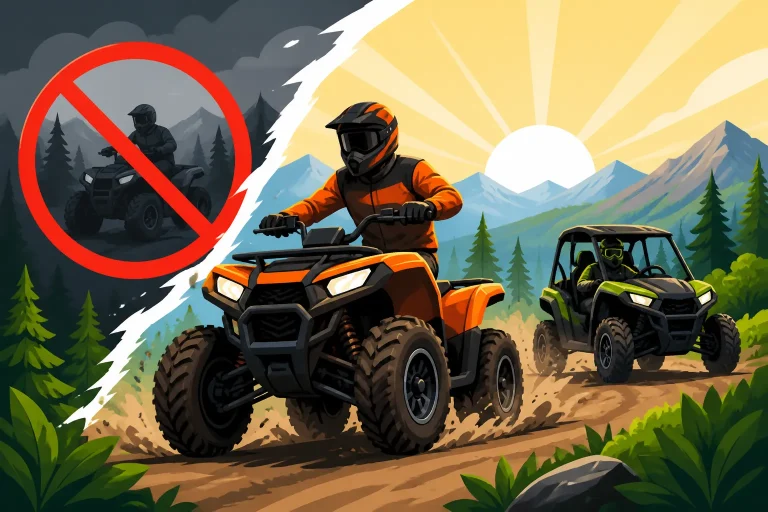
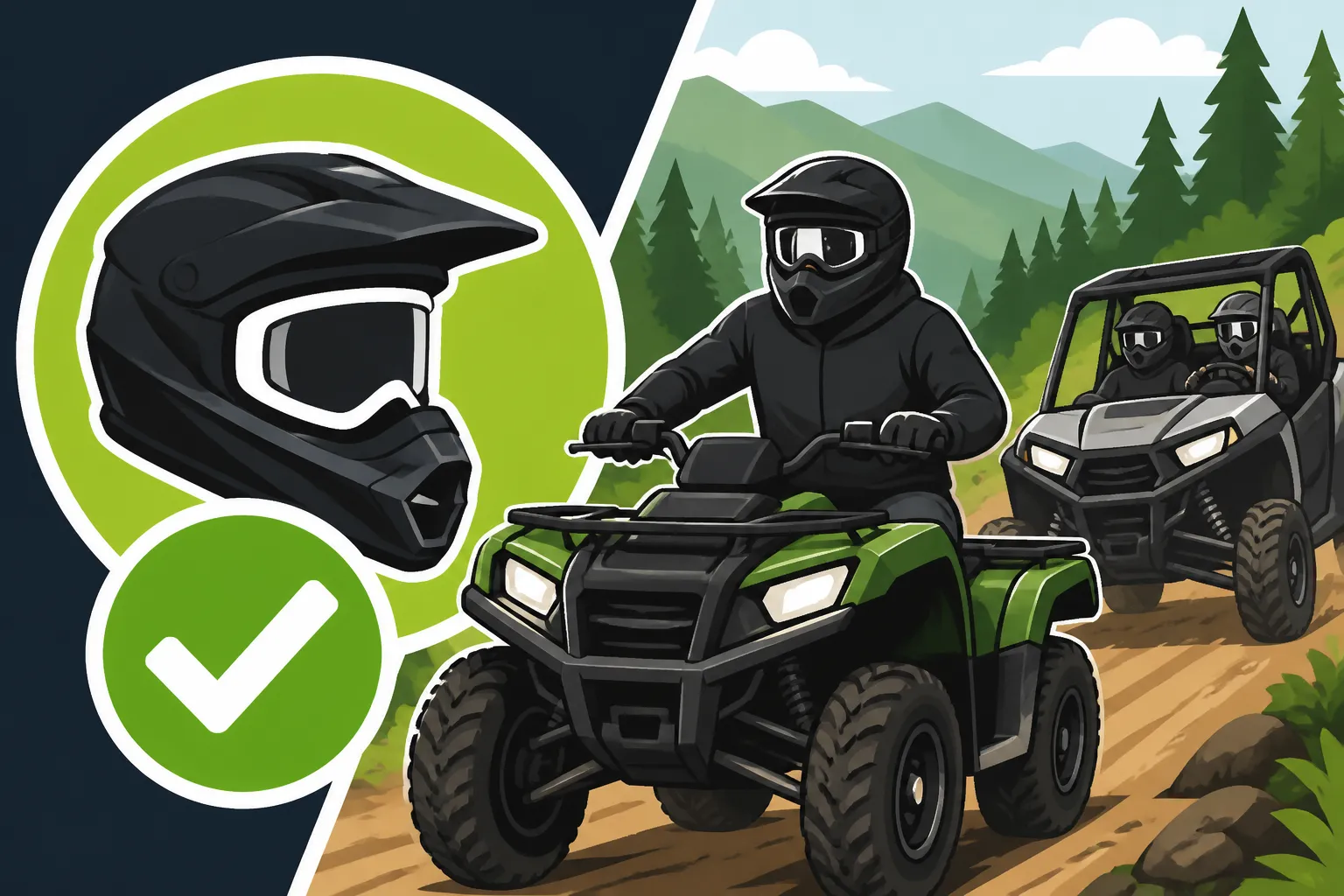
If you’re riding an ATV or another ride-astride off-road vehicle on a British Columbia forest service road, plan to wear a helmet. The rule applies to the operator and any passenger, not just the person steering. A passenger riding on an ATV without a helmet can create the same compliance problem as an unhelmeted operator.
A forest service road is not simply any gravel road through the woods. It is a road designated or managed as a forest service road, and it may carry logging trucks, service vehicles and other traffic. The road’s remote location or rough surface does not make it a helmet-free recreation area. Before riding, check that your route is actually open to ORVs and review the applicable BC Forest Service Road Rules for ORVs.
Helmet use is one part of the rules for riding an ORV on an FSR. It does not replace the other requirements that may apply to your machine, your insurance, or the way you use the road. For example, FSR riding has a separate liability insurance requirement. Review BC Forest Service Road Insurance and BC Rules for Riding a Forest Service Road as well as the helmet rules.
A helmet requirement also does not mean that any helmet, worn in any way, will do. The helmet needs to comply with the standards recognized by the applicable BC regulation, fit securely and stay fastened while the machine is moving. A helmet that is sitting loose on the rider’s head, or that has an open strap, may not provide meaningful protection even if its label looks right.
| Situation | Practical rule of thumb |
|---|---|
| ATV or other ride-astride machine on an FSR | The operator and passenger should wear compliant helmets |
| Passenger on an ATV | The passenger needs a helmet too |
| Side-by-side with a roll-over protective structure and seat belts | Check whether the vehicle and occupants qualify for the helmet exception; occupants must use the seat belts |
| Side-by-side with no seat belts, or occupants not wearing them | Do not assume the helmet exception applies |
| Unclear vehicle, road status or equipment | Confirm the requirement before riding |
The table is a practical summary, not a substitute for checking how the regulation applies to your particular vehicle. The distinction between a ride-astride ATV and a UTV is important, but calling a machine a “side-by-side” does not automatically settle the question. The machine’s safety equipment and how the occupants use it matter.
The helmet requirement is not a reason to assume that all other riding rules are the same everywhere. An FSR, private property, a managed recreation site and a public highway can raise different questions. In particular, a road that looks like a public road may have a different legal status than you expect. Check access and restrictions as well as safety gear before planning your route.
Choose a helmet that complies and fits
A helmet can only meet the legal requirement if it satisfies the standards recognized under the relevant BC rules. It should have a certification label or marking that can be checked, rather than relying on a seller’s broad description such as “off-road helmet” or “ATV helmet.” Read the product information and the helmet itself, and confirm that the named standard is accepted for the kind of riding you plan to do.
This is worth checking carefully if you are buying online or using a helmet that has been stored for years. Product photos may not show the certification label clearly, and listings can combine information for different models. If comparing helmets on Amazon or another retailer’s site, check the exact model and its certification details before ordering. Do not assume that a racing style, a high price, or a claim that a helmet is “DOT-style” means it meets the applicable standard.
The rules can specify accepted standards and may change. For a detailed explanation of the legal requirements, see BC Helmet Standards in the Regulation and BC ATV Helmet Law Explained. When in doubt, check the current official requirements or ask an appropriate local authority before riding. A retailer’s advice may help with fit and product selection, but it is not a substitute for confirming that the helmet is legally compliant.
Fit matters as much as the label
A properly fitting helmet should sit level and feel secure, without sliding around when you move your head. It should not pinch painfully, lift off at the back, or wobble when you gently try to rotate it. Follow the manufacturer’s sizing and fit instructions, and fasten the retention strap snugly each time you ride.
A helmet that fits one person may not fit another person in the same household, even if they wear the same hat size. Children need helmets sized for them, not a loose adult helmet that they can “grow into.” If a helmet cannot be kept in the correct position and fastened properly, it is not a safe choice for that rider.
Also consider the type of riding and conditions. Off-road trails can throw up dust, stones, branches and insects. A full-face helmet or a helmet used with suitable eye protection can help shield the face, but comfort and visibility matter too. Avoid equipment that restricts your vision or hearing in a way that makes it harder to notice traffic, road conditions or other riders.
Inspect it before leaving
Check the helmet before each ride. Look for damage to the shell, cracks, loose or damaged straps, worn fasteners and missing or unreadable certification information. If a helmet has taken a hard impact, follow the manufacturer’s guidance on whether it must be replaced; damage may not always be obvious from the outside.
Store helmets away from conditions that can damage their materials, and follow the maker’s cleaning and care instructions. Do not make modifications that could affect the helmet’s protective structure or certification. If the helmet is old, has unknown history or no longer fits correctly, replace it rather than relying on how it looks.
For more on which riders must wear head protection, see BC Helmets on Ride-Astride Machines. The practical takeaway is simple: wear a compliant, well-fitting helmet and keep it secured for the whole ride.
Side-by-sides and the seat-belt exception
UTVs and side-by-sides are different from ride-astride ATVs. They have seats and a steering wheel, and some are equipped with a roll-over protective structure and seat belts. BC’s rules recognize a helmet exception for certain occupants of vehicles with this protective equipment when they are wearing the seat belt. The exception is conditional: it should not be treated as permission for every UTV occupant to ride without a helmet.
The key questions are whether the vehicle has the required protective structure, whether it has seat belts, and whether each occupant is actually wearing the belt. A roof, windshield, doors or an enclosed-looking cab should not be taken as proof that a machine meets the exception. Nor does the fact that a machine is sold as a UTV automatically establish that its equipment qualifies.
If the vehicle’s configuration has been changed, or you are unsure what its protective structure consists of, verify its specifications and the applicable rules rather than guessing. A belt that is present but not being worn does not provide the protection the exception depends on. Passengers should use the seat belts provided and follow the manufacturer’s instructions for the vehicle.
The safety logic is straightforward: a helmet protects the head, while a roll-over protective structure and properly worn seat belt are intended to help protect occupants in a different way. They are not interchangeable accessories. Do not remove or bypass safety equipment because a passenger finds it uncomfortable, and do not assume that a helmet is unnecessary just because a UTV has a cage.
| UTV setup | Safer approach |
|---|---|
| Protective structure and seat belts are present; all occupants use the belts | Check that the vehicle qualifies for the helmet exception under the current rules |
| Seat belts are fitted but an occupant is not wearing one | Do not rely on the exception for that occupant |
| No seat belts, no qualifying protective structure, or uncertain equipment | Wear a compliant helmet and confirm the rule for the machine |
| Passenger is a child or does not fit the seat and belt properly | Do not carry them unless the vehicle’s manufacturer guidance and applicable rules allow it |
A seat belt must fit the occupant and be used as intended. A child who cannot sit properly or be secured safely should not be carried just because there is an available seat. Follow manufacturer limits and the applicable passenger rules. You can read more about belt use in BC Seat Belt Rules on a Side-by-Side.
Even if a particular UTV setup qualifies for the helmet exception, wearing a helmet may still be a sensible choice depending on the route, terrain and rider. The exception is a legal distinction, not a guarantee that a machine is risk-free without head protection. Make the decision based on the vehicle’s equipment and the conditions, not on assumptions about what other drivers do.
If you ride different machines, check each one separately. A helmet that you use on an ATV remains a sensible choice when switching to a UTV, but the legal analysis may differ with the UTV’s protective structure and belts. Conversely, owning a UTV does not mean your ATV passengers can ride without helmets.
Before you ride: a practical helmet check
Make helmet checks part of the same routine as checking fuel, tires and route access. A few minutes before departure can prevent a preventable problem on the trail or road.
- Identify the road and machine. Confirm that the route is an FSR and that ORV use is permitted. Determine whether you are riding a ride-astride machine or a UTV with protective equipment that may affect the helmet requirement.
- Check each person’s gear. Make sure the operator and every passenger have the appropriate helmet if required. For a UTV relying on the exception, check that the required equipment is present and that every occupant is wearing a correctly fitted seat belt.
- Verify the certification. Look for the helmet’s actual certification information and confirm that the standard is accepted under the current BC requirements. Do not rely only on a product title, a sticker added by a seller, or a verbal assurance.
- Check fit and condition. Make sure the helmet sits correctly, the strap fastens securely and there is no damage or history that makes the helmet unsuitable.
- Pack for the conditions. Dust, rain, cold, glare and low light can affect comfort and visibility. Choose eye protection and clothing that work with the helmet without blocking your view or interfering with the fastening system.
- Review the rest of the FSR requirements. Check access notices and road restrictions, carry the required documents and confirm the insurance that applies to your ride. Helmet compliance does not authorize access to a closed road.
That last point is easy to overlook. A helmet does not give you permission to ride on every forest road. Roads can have closures, active industrial traffic or posted restrictions. Verify conditions close to the time you travel, and be prepared to turn around if access is closed or the road is unsafe. For additional context, see BC Forest Service Road Rules for ORVs.
Common mistakes to avoid
Assuming a gravel road is an FSR. Road appearance is not a reliable way to identify its legal status. Check the route and its posted signs instead of deciding based on the surface.
Treating the operator as the only person who needs a helmet. Passengers are part of the helmet rule too. Check the gear for every rider before leaving the staging area.
Calling every UTV helmet-exempt. The exception depends on protective equipment and seat-belt use. The vehicle’s marketing name or body style does not answer the legal question by itself.
Treating an unfastened helmet as worn. A helmet needs to be secured. If the strap is open or the fit is unstable, stop and correct it before moving.
Assuming a helmet is compliant because it was sold for ATV use. Confirm the certification information for the exact helmet model. Product descriptions can be incomplete or confusing.
Forgetting about the passenger’s fit. A spare helmet is not automatically suitable for another person. Check that it fits the passenger and can be fastened correctly.
Relying on what another rider does. Other people’s equipment choices do not establish what the law requires for your machine, nor do they prove that their setup is compliant.
If a police officer or other authorized official checks your riding, stay calm and provide the documents or information requested. If you are unsure about the rule for your equipment, ask before you ride rather than trying to settle the question at the roadside. For broader context on how helmet obligations apply to different off-road vehicles, see BC ATV Helmet Law Explained.
Frequently Asked Questions
Do ATV passengers need helmets on a BC FSR?
Yes. Riders on ride-astride machines should plan for both the operator and any passenger to wear compliant helmets. Do not assume a passenger is exempt because they are not driving.
Can occupants of a side-by-side ride without helmets?
Some UTV occupants may qualify for an exception when the vehicle has the required roll-over protective structure and seat belts and the occupants are wearing their belts. The exception is not automatic for every side-by-side. Check the vehicle and current rules before relying on it.
Does a roof or windshield make a UTV helmet-exempt?
Not by itself. A roof or windshield is not proof that the machine has the protective equipment required for the exception. Check the vehicle’s specifications and the applicable regulation.
What should I do if I can’t confirm that my helmet is compliant?
Do not guess. Check the helmet’s certification information against current BC requirements, or choose a helmet whose compliance you can verify before riding. A helmet that fits securely and meets an accepted standard is the practical choice.
Disclaimer
This article is for general informational purposes only and does not constitute professional advice. Laws, prices and regulations vary by location and change over time. Consult a qualified professional for guidance on your specific situation.