BC Insurance Proof at a Staging Area
Arriving at a BC ATV staging area can raise a practical question: will anyone ask to see insurance, and what document counts as proof? The answer depends on where you plan to ride, how you get there, and whether the site or event has its own conditions. Knowing the difference between registration and insurance helps you arrive prepared.
When you may need to show insurance
A staging area is a place to park, unload and begin a ride; it does not automatically determine which insurance rules apply. The route you take after unloading matters. A trail may connect to a Forest Service Road, or the staging area may be part of a managed recreation site with its own access or event requirements.
In BC, liability insurance is required when operating an off-road vehicle on a Forest Service Road. The required coverage is commonly stated as at least $200,000 in third-party liability, but requirements can change. Confirm the current rule and the road’s status before your trip. The details are covered in BC Forest Service Road Insurance and BC Resource Road Insurance of $200,000.
Insurance requirements differ elsewhere. For example, basic Autoplan coverage is required for an ATV being operated on a highway under the applicable rules and permits. On other Crown land, liability coverage may be voluntary under the general ORV rules, though a specific site, organizer or activity can set additional conditions. See BC’s Three-Tier Insurance Rule for an overview of how the location affects the requirement.
A staging area itself may be on Crown land, at a managed recreation site, or in another location. Do not assume that the rule for the parking area covers the route beyond it. Ask:
- Is the road I will ride a Forest Service Road or another type of access road?
- Does my planned route cross a highway?
- Is the staging area managed by a club, recreation-site operator or event organizer?
- Does the operator require insurance for access, a pass or participation?
Some organized rides may ask participants to confirm they have liability coverage. A managed site may have conditions that do not apply to every public Crown land staging area. If you are attending an event, check its written instructions rather than relying on what is typical at other sites.
The same caution applies to a truck or trailer. Your towing vehicle’s insurance does not automatically establish that the ATV or UTV has the coverage required for its use. Check the policy and the rules for the machine and route, not just the truck.
What counts as insurance proof
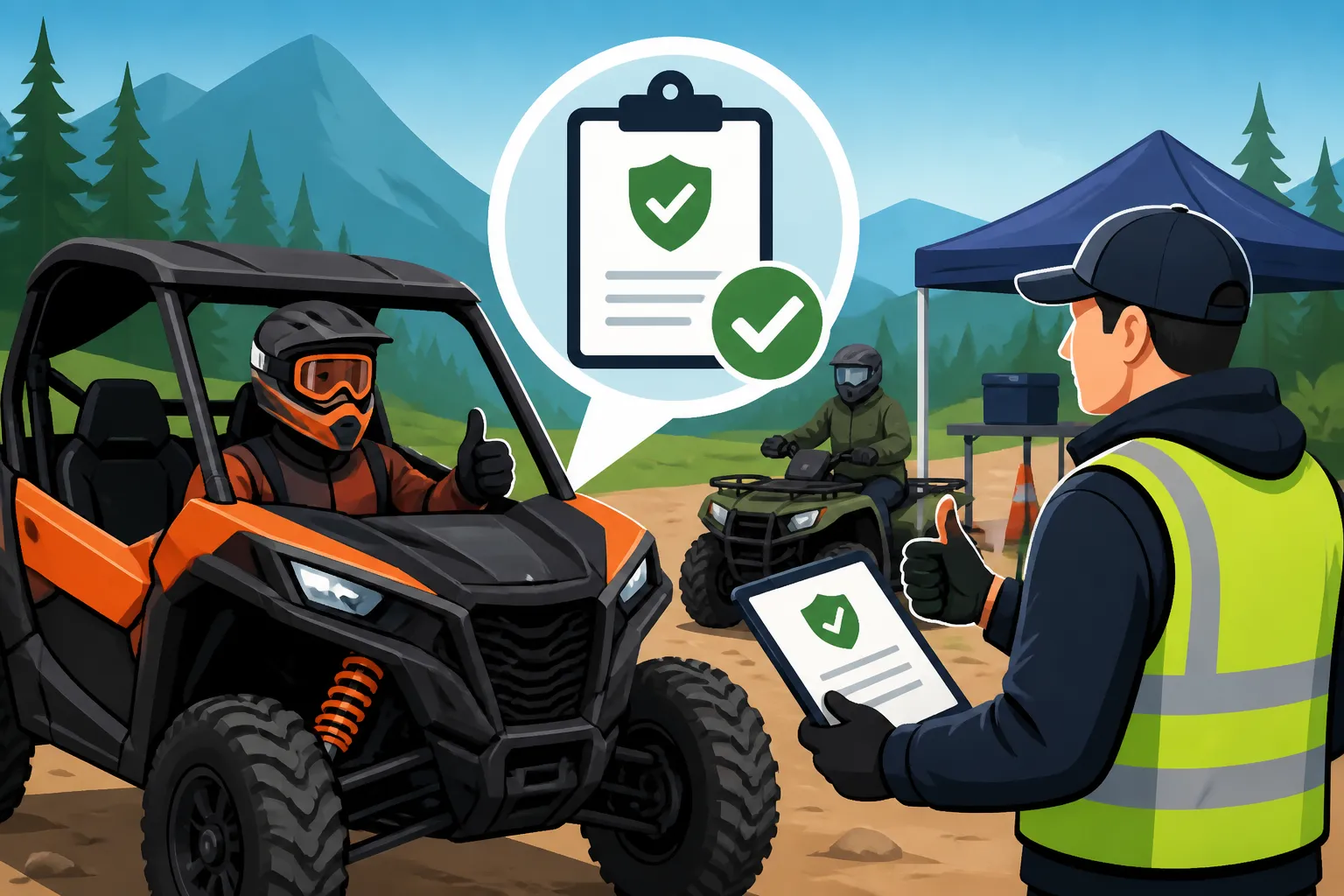
For a ride, carry a current document from your insurer or broker that identifies the insured machine and shows that coverage is in force. Depending on the policy and provider, that may be an insurance certificate, policy document, insurance card or another official proof-of-coverage record.
Before leaving, check that the document is easy to match to the machine. Look for:
- The insured owner or named insured
- The machine’s identifying details, such as its description or vehicle identification number
- The policy’s effective dates
- The type of coverage shown
- Any relevant restrictions or conditions
A document that only shows a payment, quote or application may not prove that coverage has started. If your policy was recently changed, renewed or transferred, ask the insurer which document confirms active coverage and whether the machine is correctly listed.
The insurer’s name appearing on a document is not, by itself, enough to show that the particular machine and use are covered. A policy can have exclusions, limits or conditions. If you are unsure whether it applies to Forest Service Road riding, a side-by-side, a borrowed machine or a specific trip, ask the insurer or broker directly.
Registration paperwork is different. In BC, an ORV registration certificate documents registration; it is not a substitute for proof of insurance. The distinctions are explained in BC’s Certificate of Registration Explained and BC Riders Must Carry the Certificate. Carrying the certificate may be required, but it does not establish that a liability policy is active.
A trail pass or club membership is different again. A pass may provide access to a particular managed site, while membership may support club activities or trail work. Neither should be treated as insurance proof unless the specific terms clearly say otherwise. BC Has No Province-Wide Trail Pass explains why access arrangements can vary from site to site.
How to prepare your documents before unloading
A few checks at home can prevent delays at the staging area or confusion if an officer, site operator or event organizer asks about coverage.
- Confirm the route and land type. Identify whether your ride includes a Forest Service Road, a highway crossing, other Crown land or a managed site. If you are uncertain about the road classification, check with the relevant road manager or a local source familiar with the route.
- Confirm the policy covers the machine and use. Make sure the ATV or UTV is insured for the way you plan to operate it. Do not rely on coverage for a different machine or assume a general vehicle policy applies.
- Ask what the site or event requires. Contact the site operator or organizer if the rules are unclear. Ask whether they require proof of liability insurance, what document they accept and whether the requirement applies to every rider or only certain activities.
- Save a usable copy. Keep the insurer’s current proof in a place you can reach at the staging area. A paper copy is useful where phone service or battery life is unreliable. A saved digital copy can be convenient, but it should be available offline.
- Carry the documents required for the ride. Keep registration and photo ID with you where required, as well as insurance proof. These documents serve different purposes, so one does not replace the others.
- Recheck after a policy change. If you renew, change machines, alter coverage or borrow another vehicle, confirm that the proof still reflects the correct machine and dates.
If you rely on a phone, open the file before driving to the trailhead and make sure it is stored locally rather than only in an email inbox or online account. Remote sites can have limited or no cell service. A printed copy is a simple backup, especially for a group where one person may need to show the document.
For a group ride, each owner or operator should know which machine is insured and where its proof is kept. One person’s policy should not be assumed to cover every ATV or UTV in the group. If a machine is borrowed, the owner and rider should clarify coverage before the trip, including who is permitted to operate it.
Common mistakes at staging areas
Assuming every staging area has the same rule. A public access point, managed recreation site and organized event may have different conditions. Check the specific site or event, and separately confirm the rules for the route.
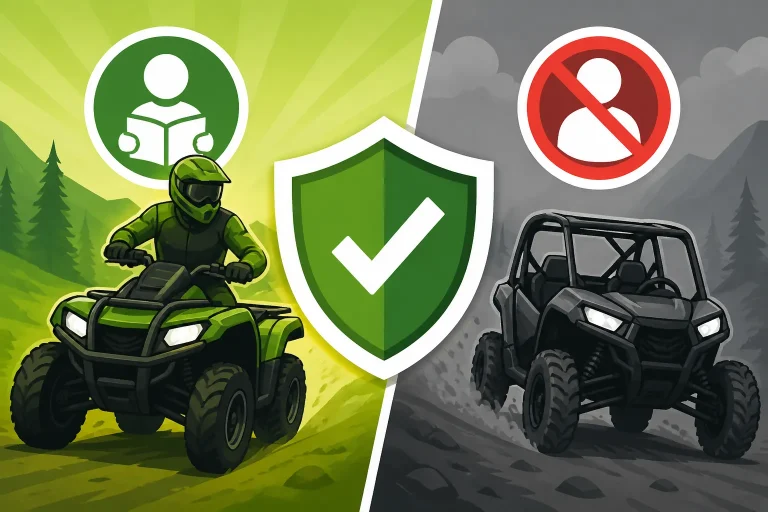
Treating registration as insurance. Registration establishes that the machine is registered; it does not show that liability coverage is active. Keep the registration certificate and insurance proof distinct.
Relying on a pass or membership card. A site pass or club membership may be relevant to access, but it does not automatically prove insurance. Ask what the document actually covers.
Showing a document for the wrong machine. A policy document for another vehicle, an old machine or a previous owner may not establish coverage for the ATV you brought. Match the proof to the machine before departure.
Assuming an area is not a Forest Service Road because it looks like a trail. Roads and routes can be easy to misidentify on the ground. If your route may use a Forest Service Road, check the classification and insurance requirement in advance rather than deciding based on the surface or appearance.
Counting on cell service. A file that cannot be opened offline may be hard to produce in a remote area. Save it to the device or bring a paper copy.
Ignoring site-specific instructions. A club, event organizer or managed site may set conditions for participation or access. Those conditions are separate from general provincial rules. Read them before travelling and ask for clarification if the wording is unclear.
If you are uncertain about a policy’s coverage, the useful question is not simply, “Do I have insurance?” Ask whether the policy covers this machine, this operator and this kind of riding on the route you plan to use. Then ask the site or organizer what proof it accepts. That gives you a clear answer about both coverage and access without confusing registration, insurance and passes.
Disclaimer
This article is for general informational purposes only and does not constitute professional advice. Laws, prices and regulations vary by location and change over time. Consult a qualified professional for guidance on your specific situation.