Certification for a Class of Machine
If a young rider in British Columbia wants to operate an ATV or side-by-side without an adult supervising every move, the training requirement can be confusing. Certification is not a general driver’s licence: it relates to the class of off-road machine covered by the training. Knowing that distinction helps families choose the right course and avoid assuming one certificate covers every vehicle.
What certification for a class of machine means
In this context, certification means documented completion of safety training that applies to a particular class of off-road vehicle. It is not the same as registering the machine, getting insurance, earning a driver’s licence or receiving permission to ride anywhere.
The class matters because vehicles have different controls, handling and safety risks. A course for one type of machine may not qualify a rider to operate another. Before enrolling, identify the specific vehicle the rider will use and ask the course provider whether the training and completion document cover that machine’s class under the rules that apply in BC.
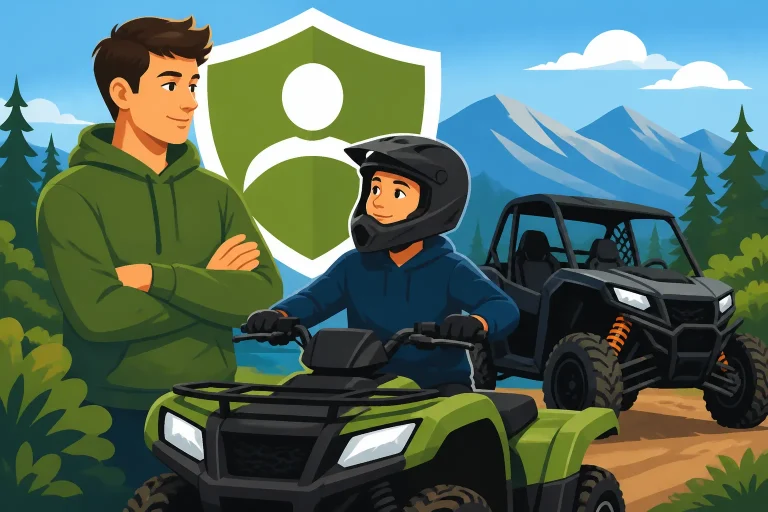
Certification is most likely to matter to a young operator. BC’s youth rules set conditions for people under 16, and training is one possible route for some riders to operate without adult supervision. The exact requirements depend on the rider’s age and circumstances. Start with BC Youth Riding Rules Explained and BC Supervision Required Under 16 rather than assuming that course completion automatically removes every restriction.
A training certificate is also not a blanket authorization. It does not make a machine street-legal, replace required registration, supply insurance, or override trail closures and land-access rules. A certified rider still has to follow the rules for the place they are riding. For example, BC Registration Before Riding Crown Land explains a separate requirement that can apply to the machine itself.
| Question | What certification addresses | What it does not address |
|---|---|---|
| What machine can the rider operate? | Training for a particular vehicle class may satisfy a youth training condition | It does not automatically cover every ATV, side-by-side or other machine |
| Can the rider operate without supervision? | It may be one part of the youth-rule requirements, depending on age | It does not remove all age, permission, passenger or machine-size rules |
| Can the machine be used on a road? | Nothing by itself | Certification does not make an off-road vehicle street-legal |
| Is the machine ready for a legal ride? | Nothing by itself | Registration, insurance, equipment and access rules may still apply |
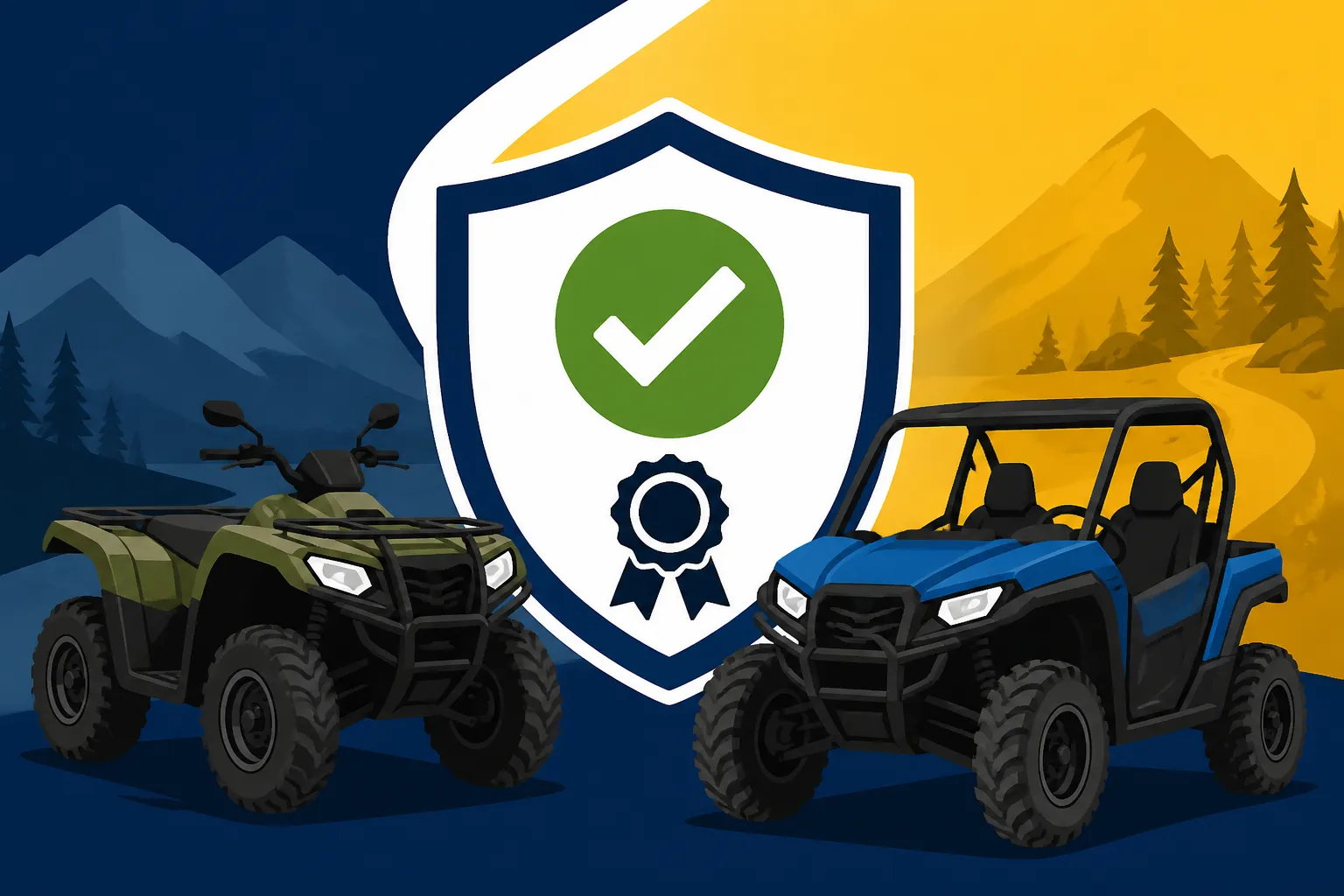
The phrase “class of machine” is important. A rider may have experience on one vehicle but little experience on another. An ATV and a side-by-side can differ in seating, controls, stability, passenger arrangements and protective equipment. A course that is appropriate for one should not be treated as interchangeable with training for another unless the provider confirms that it covers both.
Certification also should not be confused with general riding ability. A course can teach skills and safe practices, but completing it does not prove that a rider is ready for every trail, weather condition or group situation. Parents and guardians still need to make practical decisions about the rider’s maturity, the machine’s size and the terrain.
When a young rider may need training
The training condition is part of BC’s rules for young operators, not a province-wide licensing system for every adult ATV or UTV rider. For adults, safety training is generally a choice rather than a standard operator licence requirement; see BC Safety Courses Are Voluntary for Adults. A youth rider may face different conditions based on age, supervision and whether the required training has been completed.
Do not rely on a simple rule such as “under 16 means a course” or “a course means no supervision.” Age categories and conditions matter. A young rider may need an adult supervisor, written permission, training, or a combination of requirements depending on the situation. Read BC’s Written Permission Rule at 14 and 15 alongside the current youth requirements, and confirm which conditions apply before the ride.
The distinction between supervised and unsupervised operation matters too. Supervision is more than having an adult somewhere in the area. The adult may need to be able to keep the child in view and give immediate direction. The requirement is described further in BC’s Visible and Immediate Direction Test. A parent watching from home or an adult riding far ahead may not meet the practical purpose of supervision.
Certification does not necessarily settle every question about what the young person can operate. Manufacturer age and weight guidance remains important, and restrictions on passengers can apply to a child operator. A course certificate should not be used to justify putting a rider on a machine that is too large or powerful for their ability. See BC Manufacturer Minimums by Model and BC Rules for Passengers on a Quad for related considerations.
Use this table as a starting point, not as a substitute for checking the current rule for the rider’s exact age and situation.
| Rider’s situation | What to check |
|---|---|
| Under 16 and riding with an adult | Whether the supervision conditions are met, including the adult’s age and ability to direct the rider |
| Age 14 or 15 and seeking to ride without supervision | Whether the required written permission and qualifying class-specific training apply |
| Under 14 | The applicable supervision and operating restrictions; do not assume a course alone permits independent riding |
| Any rider on a different machine from the one covered by training | Whether the certificate applies to that machine’s class |
| Any rider carrying a passenger | Whether the rider’s age, vehicle, manufacturer guidance and passenger rules allow it |
The table deliberately avoids treating certification as a shortcut around supervision or permission. A course may satisfy a particular training requirement, but it does not grant a general exemption from the rest of the rules. If the rider’s age or circumstances do not fit the course provider’s explanation, pause and confirm the requirement with an appropriate official source before relying on the certificate.
One common misunderstanding is that a young rider can use an adult’s experience as a substitute for the required training. Another is that completing a course makes supervision unnecessary in every situation. Neither assumption is safe. The rules turn on the rider’s age and the conditions attached to that age group; the training is only one possible part of the answer.
How to choose the right course and document the result
The practical challenge is not just finding a course. It is making sure that the course is appropriate for the machine and that the completion record will meet the requirement being relied on. Course descriptions can use broad terms such as ATV safety or off-road training, while the rule may turn on a specific vehicle class.
Before booking, gather the machine’s basic details: its type, how it is operated, whether it is an ATV or side-by-side, and the manufacturer’s age and weight guidance. Then ask the provider direct questions. A clear answer in writing is useful if the family later needs to explain which training the rider completed.
- Identify the exact machine. Note whether it is an ATV, side-by-side or another type of off-road vehicle. If you are unsure how the vehicle is categorized, ask the seller, manufacturer or course provider rather than guessing from its appearance.
- Explain the rider’s age and intended use. Tell the provider whether the rider is under 16 and whether the plan is supervised or independent operation. A course suitable for a general adult audience may not answer a youth-rule question.
- Ask whether the course covers that class. Do not settle for “we teach ATV safety” if the rider plans to operate a different machine. Ask what vehicle classes the training covers and whether completion documentation identifies the relevant class.
- Confirm that the training meets the applicable requirement. Ask the provider whether the course is recognized for the youth training condition in BC, and verify the answer against the current official rule. A course can be useful and worthwhile without necessarily satisfying a particular legal requirement.
- Check what proof the rider receives. Find out whether the provider issues a certificate or other record, what information it shows, and how to request a replacement. Keep the document where it can be found and carry or store it as the current rules require.
- Review the remaining conditions. Check supervision, written permission, passenger restrictions, machine suitability and riding-location rules. Completion of training is not the last step.
Training providers may include organizations that offer recreational safety courses or training for people who use off-road vehicles at work. Those programs can have different audiences and content. A workplace course may focus on job-related tasks, while a recreational course may emphasize trail riding. The course title alone is not enough to establish that it satisfies a particular youth requirement.
Questions worth asking include:
- Which machine classes does this course cover?
- Does the completion certificate identify the class?
- Is this course intended to meet the BC training condition for a young operator?
- Are there prerequisites or age limits?
- What should the rider bring, and does the course use a machine supplied by the provider?
- What proof of completion is issued, and what happens if it is lost?
- Does the course cover passengers, protective equipment and riding on mixed-use trails?
Families should keep a copy of the certificate and make sure the identifying details are legible. If the certificate does not name a class, keep the course description or written confirmation from the provider with it. That extra record can help clarify what the rider was trained to operate, though it cannot turn an unsuitable course into a qualifying one.
A course is only one part of preparation. Young riders need a machine that matches their size and ability, protective equipment that fits, and a riding area suited to their experience. The adult responsible for the ride should also plan for hazards, communication and changing trail conditions. A certificate is evidence of training, not a substitute for sound supervision and judgment.
What certification does not let a rider do
Certification does not authorize an ATV or UTV to travel on public roads as though it were a car. BC has separate restrictions on highway use, and an off-road machine does not become street-legal because its operator has passed a safety course. For road questions, see Can You Ride an ATV on the Road in BC?.
It also does not replace registration. Registration applies to the machine, while certification applies to the rider’s training. Those are separate issues, with separate documents and rules. A rider can be properly trained while operating a machine that is not properly registered, and a registered machine can still be operated by someone who does not meet the youth requirements.
Nor does certification create permission to use any trail or land. Access can depend on closures, landowner permission, local restrictions, fire-related prohibitions and the type of road or recreation area. Before travelling, check the route and the rules for the specific location. BC Crown Land Access Rules and BC Motor Vehicle Closures and How to Find Them cover two important parts of that check.
Insurance and equipment are separate again. A certificate does not provide liability coverage, and it does not guarantee the vehicle has the required safety equipment for the area where it will be used. Where a ride includes a forest service road, for example, distinct insurance and operating requirements may apply. Review BC Forest Service Road Requirements before planning that kind of route.
| Item | Applies to | Why it is separate from certification |
|---|---|---|
| Training certificate | The rider and the class of machine covered by training | Shows training completion; it is not vehicle registration |
| Registration | The off-road machine | Addresses registration requirements, not the operator’s age or training |
| Insurance | The machine or its use in a particular setting | Provides coverage under the applicable policy; training does not create coverage |
| Permission and supervision | The young operator and the circumstances of the ride | May still be required even when training is complete |
| Land access | The route, trail or property | A certificate does not open a closed area or replace landowner permission |
| Road authorization | The machine and type of roadway | Training does not make an off-road vehicle street-legal |
A sensible pre-ride check is to confirm each item independently: the rider meets the youth requirements, the course covers the machine class if training is required, the machine is registered where required, any necessary insurance is in place, the route is open, and the vehicle is suitable for the rider. If any answer is uncertain, resolve it before travelling rather than relying on the certificate to cover multiple issues.
The bottom line is simple: certification is specific training, not a universal ATV or UTV licence. Match the course to the machine class, confirm that it satisfies the relevant youth requirement, keep proof of completion, and check all the other rules separately.
Disclaimer
This article is for general informational purposes only and does not constitute professional advice. Laws, prices and regulations vary by location and change over time. Consult a qualified professional for guidance on your specific situation.