Staying Within Sight of a Child
A child riding an ATV or side-by-side needs more than an adult somewhere nearby. In British Columbia, supervision involves keeping the young operator in sight and being able to give immediate direction. Here’s what that means in practice, how the age rules affect the requirement, and how to set up a ride so you can respond quickly.
What BC’s supervision rule means
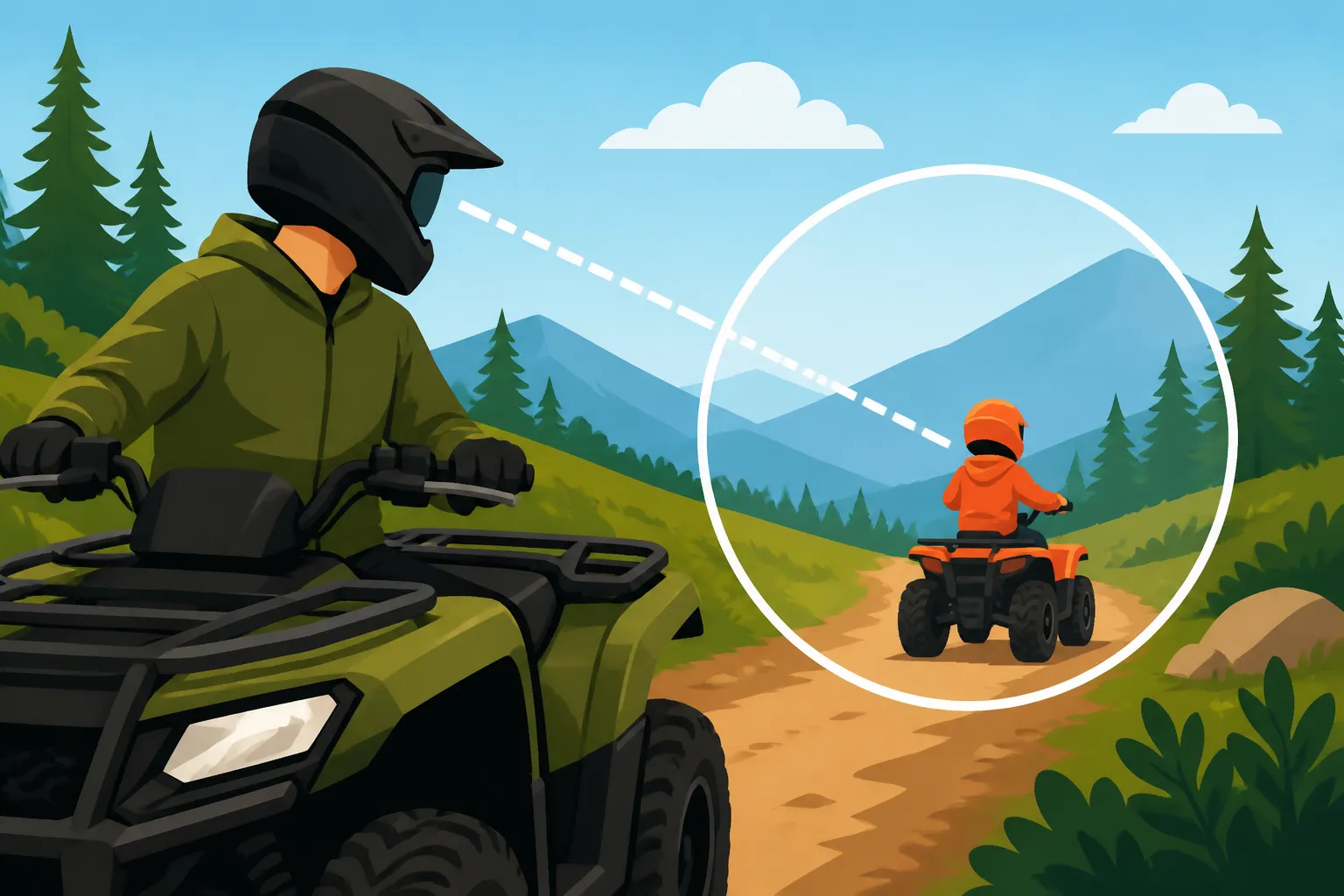
In BC, a person under 16 generally must be supervised while operating an off-road vehicle. The supervising adult must be at least 19. Supervision is not simply being at the same staging area, following somewhere out of view, or checking in by phone. The adult needs to keep the young rider in sight and be close enough to give immediate direction.
That standard is about what the adult can actually see and do—not a fixed distance in metres. A child riding around a bend, through thick trees, or over a ridge may be out of sight even if the adult is not far away. If you cannot see the child and quickly communicate a direction, you should not assume the required supervision is in place.
The rule is separate from the questions of whether a particular trail is open, whether the machine is registered, and what protective equipment it needs. For example, being supervised does not make a closed route legal to ride or replace the requirements discussed in BC ATV Helmet Law Explained and BC ATV Registration Requirements.
The key test is practical, not just physical proximity
Think of supervision as a continuous line of sight and communication. The adult should be able to notice a developing problem—such as a child approaching a steep drop, an oncoming vehicle, or a confusing junction—and tell the child what to do before the situation becomes more dangerous.
Being close by is useful, but it is not enough by itself. An adult standing behind a parked vehicle, riding well ahead, or watching several children spread across a large area may not be able to supervise each child effectively. The question is whether the adult can see the operator and give direction promptly when needed.
There is no benefit in trying to measure the maximum permitted gap. Terrain, vegetation, speed, visibility, noise, and the child’s experience all affect how quickly an adult can intervene. On a winding trail, a short gap can put the rider out of view. In an open practice area, a larger gap may still allow clear sight and communication, though the adult must remain attentive.
Supervision is not the same as riding on the same machine
The rule is about effective oversight, not automatically about sharing a vehicle. An adult may be able to supervise from another suitable machine or from a safe position nearby, provided they maintain sight of the child and can give immediate direction. A parent watching from a distant campsite or a second rider who disappears around every corner cannot rely on being “with the group” as a substitute for supervision.
Whether a child may ride on a particular machine, carry a passenger, or use a specific trail is a separate question. Check the machine’s manufacturer guidance as well as BC’s age and passenger requirements. BC Manufacturer Age and Weight Rules explains why a machine’s size and design matter, while BC Rules for Passengers on a Quad covers a separate set of considerations.
How age changes the requirement
The supervision rule applies generally to operators under 16, but the requirements are not identical for every age. In BC, riders aged 14 and 15 may operate without direct adult supervision if they have written permission from a parent or guardian. That exception is specific: it does not mean every young rider can choose to ride alone, and it does not remove other rules that apply to the machine or riding area.
For children younger than 14, plan on direct supervision by an adult aged 19 or older. For a rider who is 14 or 15, confirm whether the written-permission exception applies before relying on it. If you choose to supervise anyway, the adult should still maintain sight and be able to give immediate direction.
| Rider’s age | General approach in BC | Practical point |
|---|---|---|
| Under 14 | Adult supervision is required | Keep the child in sight and close enough to direct promptly |
| 14 or 15 | Written permission from a parent or guardian may allow riding without direct supervision | Confirm the permission and other requirements before the ride |
| 16 or older | The under-16 supervision rule no longer applies | Other riding, equipment, access, and safety rules still apply |
This table is a planning summary, not a substitute for checking the current rule and the details of a specific situation. If you are unsure whether a young rider’s written permission meets the requirement, ask an appropriate authority or qualified professional before the ride rather than assuming a verbal okay is enough. For more on the age-specific rules, see BC Youth Riding Rules Explained, BC Rules for a 14-Year-Old Rider, and BC Rules for a 15-Year-Old Rider.
Written permission is also not a riding credential. It does not confirm that a child can safely control a particular ATV, nor does it give permission to ride on private land without the landowner’s consent. It does not override manufacturer age or weight guidance, passenger restrictions, or site closures. A parent can authorize a ride only within the limits that still apply.
If you are supervising a young rider, agree on the route and boundaries before starting. Make sure the child understands what to do if they lose sight of you, reach a junction, meet a larger vehicle, or feel unsure. A simple instruction such as “stop in a safe place and wait” is easier to follow than an improvised decision made under pressure.
Setting up a ride so you can keep the child in sight
A supervision plan starts before the engine is running. Choose terrain that gives you a clear view and allows both riders to stop safely. A wide, open practice area is usually easier to supervise than a narrow trail with blind corners. If you are not confident you can maintain sight on a route, pick another route or have the child ride in a supervised setting instead.
Choose the adult’s position carefully
The best position depends on the terrain and the child’s ability. An adult following behind can watch the child’s pace and decisions, but may have trouble stopping the child from entering a hazard ahead. An adult in front can show the route, but may not see what the child is doing behind. Neither arrangement works if the child quickly disappears from view.
Before setting off, decide how you will keep the child visible. On a short, open stretch, riding behind at a controlled distance may work. At junctions or difficult sections, stop and regroup so the child is not left to guess which way to go. Avoid spreading a group across several bends or allowing a faster rider to pull the child away from the supervising adult.
If a trail becomes tight, steep, dusty, or crowded, slow down and reassess. Dust can block sight even on an open road. Trees and terrain can hide a rider much sooner than expected. A route that was easy to supervise on the way out may be harder when traffic, weather, or fatigue changes the conditions.
Agree on clear stop-and-wait instructions
Children should know what to do when they cannot see the adult. Set a simple rule before departure: stop somewhere safe, stay on the machine or move to a safe spot as appropriate, and wait for the supervising adult. Do not encourage a child to continue through an unfamiliar junction or search for the adult on another trail.
Agree on how the group will handle stops, turns, and obstacles. The child should know not to race ahead, attempt a difficult climb to catch up, or follow another rider without checking. The adult should avoid giving directions from a position where the child cannot hear or understand them. If noise, distance, or terrain makes voice communication unreliable, close the gap and stop before giving instructions.
A phone can help with emergencies, but it does not make out-of-sight riding compliant with a supervision requirement. Cell service may be limited, and a call is not the same as being able to give immediate direction. Plan as if the phone will not work.
Match the route and pace to the child
A young rider may not have the judgment or vehicle control to handle the same route as an experienced adult. Choose a manageable machine and a route that fits the child’s skill, not just the group’s ambition. Leave room for frequent breaks. Fatigue, cold, heat, and frustration can make it harder for a child to respond to instructions.
Keep the group small enough that the supervising adult can focus on the child. If one adult is responsible for multiple young riders, consider whether they can keep all of them in sight and respond effectively if two need help at once. A route with several forks or concealed hazards may make that unrealistic. Adding another responsible adult can improve oversight, but only if each adult has a clear understanding of which child they are watching.
For supervised rides on public land or resource roads, remember that supervision is just one part of the plan. Confirm access and closures, and understand road conditions and traffic. BC Rules for Riding Crown Land and BC Forest Service Road Requirements cover important differences between riding areas. Do not assume a trail is appropriate for a child simply because it is open to ORVs.
Common supervision mistakes and what to do instead
The most common mistake is treating “nearby” as equivalent to “supervising.” An adult at the trailhead cannot watch a child several turns away. A rider who is following the group but cannot see the child is not providing continuous oversight. Set the route and pace so the child remains visible, and stop when the terrain makes that impossible.
Another mistake is focusing only on the child’s age. The age exception for 14- and 15-year-olds depends on written permission, but the rider still needs to be capable of operating the machine safely and following restrictions. A child who is legally allowed to ride without direct supervision may still benefit from an adult nearby, especially on unfamiliar terrain. Legal permission is a minimum condition, not proof of readiness.
Do not let a child carry a passenger just because another adult is close. Passenger rules are separate, and an extra rider can affect control and balance. Check the manufacturer’s guidance and the applicable rules before anyone rides as a passenger. BC Children Cannot Carry Passengers explains the child-operator restriction in more detail.
Finally, avoid improvising once the group is moving. If a child falls behind, disappears around a corner, or cannot hear directions, stop the group and regroup rather than asking another rider to keep going while you wait. If the adult cannot maintain sight for a section, choose a different route or make a plan that keeps the child under effective supervision. A ride should be organized around the least experienced rider, not the fastest one.
Disclaimer
This article is for general informational purposes only and does not constitute professional advice. Laws, prices and regulations vary by location and change over time. Consult a qualified professional for guidance on your specific situation.