BC Children Cannot Carry Passengers
BC Children Cannot Carry Passengers
Families planning an ATV or UTV ride often wonder whether a child can take a sibling, friend or parent along. In British Columbia, an operator under 16 cannot carry a passenger on an off-road vehicle. Knowing who the rule applies to—and how it differs from an adult carrying a child—helps families choose a safe setup before riding.
What the passenger rule means
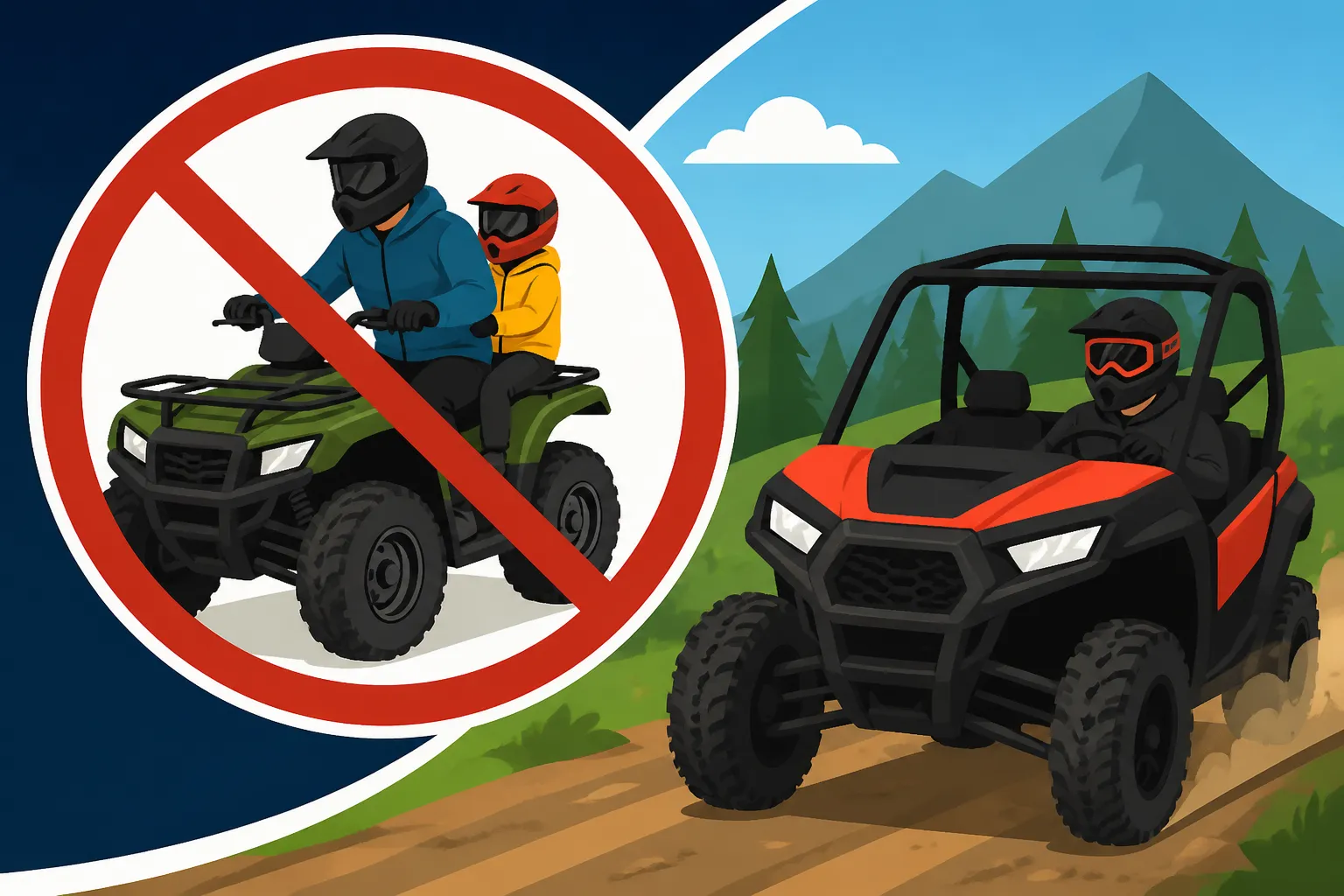
In British Columbia, a person under 16 who operates an off-road vehicle cannot carry a passenger. The rule is about the age of the operator, not the passenger’s age. A child does not get an exception because the passenger is a parent, an adult supervisor, a sibling or someone who weighs very little.
That means a youth operator should ride alone on the machine. Do not put a second person on the seat, behind the operator, on a cargo rack or in another improvised spot. A passenger may change how the vehicle handles, and an adult riding behind a child does not replace any supervision the child is required to have.
The ban applies to ATV and UTV riding. A side-by-side’s extra seat does not create an exception for a young operator. If the person driving is under 16, the safe and compliant plan is a single rider on that machine.
This is separate from the question of whether a child is allowed to operate a particular machine at all. Youth operation can involve age-related supervision and permission requirements, as well as the manufacturer’s minimum age, size and weight guidance for that model. Review BC Youth Riding Rules Explained and BC Rules for a Child Under 16 before deciding whether a child is ready and eligible to ride.
The operator’s age is the key
The restriction applies to an operator under 16. It does not turn on whether the passenger is also a child. For example, an adult cannot make a passenger arrangement acceptable simply by saying they are supervising from the same seat. The youth operator still must not carry anyone.
At the same time, the rule does not mean that no child may ever ride as a passenger. An adult may be able to carry a child on an appropriately designed machine, subject to the machine’s passenger capacity, manufacturer guidance and other applicable requirements. That is a different situation: the adult, rather than the child, is operating the vehicle.
A useful way to keep the two cases straight is:
| Situation | What to keep in mind |
|---|---|
| Operator is under 16 and someone else wants to ride on the machine | The youth operator cannot carry a passenger |
| Adult is operating and a child wants to ride along | Check that the vehicle is designed for a passenger and that the child can ride safely |
| Youth is operating a side-by-side with an empty passenger seat | The empty seat does not change the youth passenger restriction |
| Adult supervises a youth from another machine | The youth still rides alone; supervision requirements remain separate |
If the rider’s age, machine type or circumstances are unusual, check the applicable rule with a qualified source before the ride. Don’t assume that a family agreement or a machine’s extra seat overrides the restriction.
No workaround through an added seat
A second seat, passenger footrests or a grab handle can make a machine more suitable for an adult operator and passenger. Those accessories do not change who is allowed to carry a passenger. Adding a seat or buying an aftermarket passenger kit cannot make it lawful for an operator under 16 to take someone along.
This applies whether the extra equipment came with the vehicle or was added later. Accessories sold through retailers such as Amazon do not change the vehicle’s passenger rating or the age-based restriction. Check the manufacturer’s information for the exact model and keep the youth riding rule separate from equipment choices.
Youth riders may have other requirements
The passenger ban is only one part of the rules for young operators. A youth may have to meet additional conditions to operate an off-road vehicle. Requirements can depend on the rider’s age and the situation, so families should not treat permission to ride as permission to ride alone or on any machine.
In particular, supervision and parental permission are separate questions from passenger capacity. An adult supervisor does not become a permitted passenger simply by accompanying the youth on the same vehicle. Instead, plan for the child to ride alone while the adult meets any applicable supervision requirements.
Supervision is not the same as riding together
A parent might reasonably think that sitting behind a child is the closest possible supervision. But the passenger restriction means that arrangement is not the solution for an operator under 16. Supervision should be arranged in a way that complies with the youth rules without putting another rider on the child-operated machine.
Check BC Rules for a Supervising Adult for the role and expectations of a supervisor. Depending on the circumstances, supervision may involve staying where the child can be seen and being able to give direction promptly. Do not assume that being somewhere on the same trail, or reachable by phone, is enough.
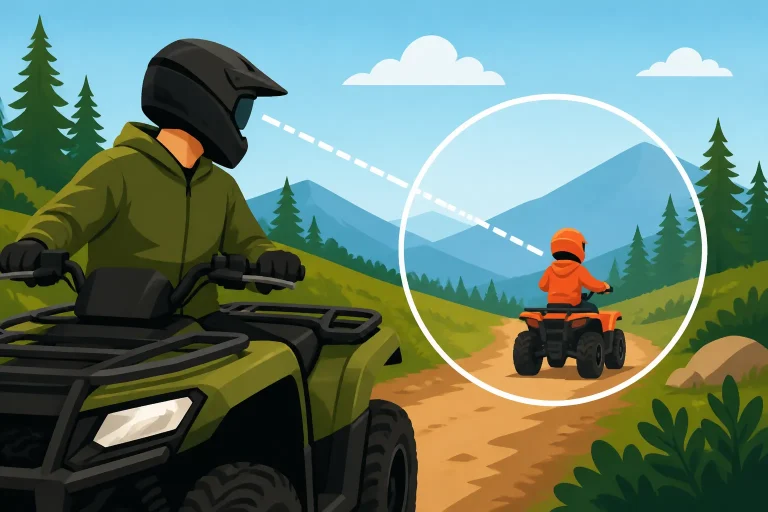
Some families may plan for the supervising adult to operate another vehicle nearby. Others may decide the child should not operate until the required supervision can be provided. Either way, the child’s machine should remain a single-rider setup while the child is driving.
Permission does not create a passenger exception
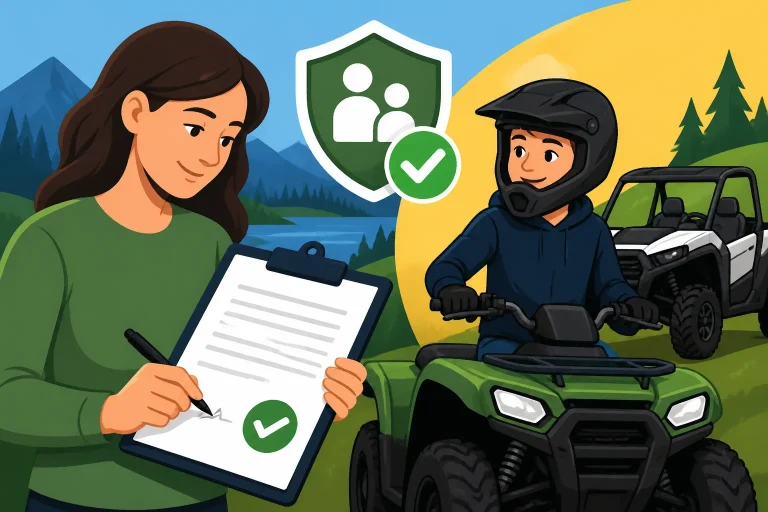
Written permission from a parent or guardian, where relevant to the rider’s age and situation, does not cancel the no-passenger rule. Permission addresses whether a young person may operate under applicable conditions; it does not authorize them to carry another person.
For example, a parent who gives permission cannot also approve a sibling riding behind the youth operator. The same is true if the passenger is an adult, a friend from the riding group or the supervisor. Keep permissions, supervision and passenger capacity as three distinct checks.
Families with a rider who is 14 or 15 can review BC Rules for a 14-Year-Old Rider for age-specific considerations. The general point remains: meeting a youth-operation condition does not change the under-16 passenger restriction.
Machine size and skill still matter
Legal eligibility does not establish that a machine is a good fit. A child may meet an applicable age requirement and still lack the strength, coordination or experience to manage a particular ATV or UTV. A larger machine can be harder to control, especially on uneven ground, in mud or when braking downhill.
Follow the manufacturer’s age, size and weight guidance for the exact model. Consider the rider’s ability to reach and operate the controls, turn the vehicle, stop safely and respond to changing terrain. A youth who can manage a small, familiar machine may not be ready for a more powerful or heavier one.
A passenger can affect balance, braking and steering on machines designed for two people. That is one reason manufacturers specify passenger seating and occupant guidance. But even if a machine is rated to carry a passenger, the youth operator’s age-based restriction still applies.
An adult carrying a child is a different situation
The restriction on a youth operator carrying a passenger should not be confused with an adult carrying a child. If an adult is driving, a child may be able to ride as a passenger when the machine is designed for that arrangement and the child can be seated and restrained appropriately. That does not mean every ATV or UTV can safely carry a child.
Before the ride, check the manufacturer’s instructions for the model and confirm that it has a proper passenger position. A passenger should not sit on a cargo rack, stand on a footrest not intended for passengers, or share a seat that is designed for one person. The ride should be cancelled or the child should travel separately if there is no proper, suitable passenger position.
For more detail on quad passengers and passenger limitations, see BC Rules for Passengers on a Quad. If the adult is driving a side-by-side, review BC Rules for Riding a Side-by-Side as well. The vehicle’s layout matters: an ATV and a UTV do not provide the same seating or restraint system.
Check whether the child fits the passenger position
A child who can physically sit in a passenger seat may still be too small to use it safely. The child needs to sit in the intended position, keep their feet where the manufacturer expects, and use any available restraint properly. If the child cannot reach or fit the footrests, cannot remain seated securely, or cannot use the belt or other restraint as intended, do not take them as a passenger.
Avoid trying to solve a fit problem with cushions, improvised straps or equipment that changes the seating position. Ask the manufacturer or a knowledgeable dealer about the specific vehicle and passenger setup. If the answer is unclear, choose another arrangement rather than guessing.
The phrase “child passenger” can cover a wide range of ages and sizes. The relevant question is not only whether a child is legally permitted to ride along, but whether that child can occupy the particular passenger position safely. BC Rules for a Child Passenger can help families assess the passenger side of the question.
Match the protection to the vehicle
Protective equipment depends in part on the kind of machine. A ride-astride ATV has different occupant protection from a side-by-side with a roll cage and seat belt. Make sure every occupant uses the protection required for that type of vehicle and rides in the intended position. Do not carry a passenger who cannot use the available protective equipment correctly.
For helmets and other ride-astride requirements, see BC ATV Helmet Law Explained. For a side-by-side, follow the manufacturer’s instructions for seat belts and occupant positioning. A belt should not be treated as optional simply because the ride is short or the trail looks easy.
A passenger should understand basic instructions before the vehicle moves: keep hands and feet inside the designated area, stay seated, use the restraint, and tell the operator if something feels wrong. The operator should be able to drive without having to manage a frightened or shifting passenger.
A practical plan for family rides
A little planning prevents the common mistake of reaching the trailhead and trying to fit everyone onto the available machines. Decide who will operate each vehicle, who will ride as a passenger, and how youth supervision will work before loading the trailer.
- Write down each rider’s age and role. Identify the operator of every ATV or UTV and the age of each passenger.
- Apply the under-16 rule first. If an operator is under 16, plan for that machine to carry no passenger.
- Check youth-operation conditions. Confirm whether the child may operate that machine in the planned circumstances and what permission or supervision is required.
- Check the vehicle’s passenger design. For an adult-operated machine, confirm that it is intended to carry a passenger and has a suitable passenger position.
- Check the passenger’s fit. Make sure the child can use the seating, footrests and restraints as intended.
- Review the route and conditions. A setup that may work on a familiar, easy trail may not suit rough terrain, steep slopes, poor visibility or a long ride.
- Make a backup plan. If a passenger does not fit, a supervisor is unavailable or the trail conditions change, be prepared to leave someone behind or end the ride.
A seating plan can help:
| Rider setup | Planning decision |
|---|---|
| Youth under 16 operating an ATV | One rider on that machine; no passenger |
| Youth under 16 operating a UTV | One rider on that machine; do not use the passenger seat |
| Adult operating a two-person ATV | Confirm passenger design, passenger fit and protective equipment |
| Adult operating a side-by-side | Use intended seats and restraints, and follow the vehicle’s occupant guidance |
| Adult supervising a youth rider | Meet supervision requirements without placing the supervisor on the youth-operated machine |
The plan should account for every machine in the group, not just the one carrying a young rider. If a youth is riding alone on their machine, that does not automatically mean they can travel beyond the supervisor’s sight or control. Decide how adults will stay in a position to supervise and how the group will stop if the child needs help.
Keep the ride within the child’s ability
Choose a route and pace appropriate for the least experienced rider. A child should not feel pressured to keep up with adults on larger, faster machines. Allow time for breaks, water and instruction, and stop before fatigue affects control or attention.
Set simple ground rules before starting:
- The child rides alone on their machine.
- Nobody swaps onto the child’s machine while it is moving.
- The child follows the supervisor’s directions and stops when asked.
- The group stays together in a way that supports the required supervision.
- No one rides as a passenger on a cargo rack or other unapproved position.
- The ride ends if the child is tired, upset or struggling to control the machine.
These points are practical safety measures, not substitutes for checking the applicable rules. A route may also have access conditions, closures or other restrictions. If you plan to ride on a forest service road, review BC Forest Service Road Requirements separately; a youth passenger restriction does not answer questions about road access, insurance or other road rules.
Common misunderstandings and what to do
The passenger rule is straightforward, but several situations can lead families to misunderstand it. The safest approach is to apply the rule to the operator’s age and not look for exceptions based on family relationships, seat design or the trip’s length.
“The passenger is an adult, so it should be fine”
The identity of the passenger does not change the restriction. An adult cannot ride behind an operator under 16 on that youth-operated machine, even if the adult is the parent or supervisor.
“There is a spare seat, so the vehicle must allow it”
A vehicle may have a passenger seat while still being unsuitable for a youth operator to carry someone. The manufacturer’s passenger capacity and the legal restriction are separate checks. A spare seat is not permission for a young operator to use it with a passenger.
“It is only a short ride”
A short trip is still a ride with a passenger. Do not treat distance, speed, private land, a quiet trail or a familiar route as an exception. When the rule’s application to a particular location or activity is uncertain, check before riding rather than assuming.
“The supervisor has to be on the same machine”
Do not use a passenger position on the youth’s machine as a substitute for supervision. Check the applicable youth-supervision requirements and arrange for the adult to meet them separately. If the group cannot provide the required supervision, postpone the child’s ride.
“The child can carry a sibling because both are small”
The size or age of the passenger does not change the rule for a youth operator. A small passenger still counts as a passenger. The machine’s ability to carry two people does not make the arrangement permissible for an operator under 16.
“We can add a seat or footrests”
Aftermarket equipment does not create an exception. It may also create fit, balance or control problems if it is not approved for the vehicle. Use only equipment suited to the exact model, follow manufacturer guidance and keep the youth passenger restriction in mind.
If an officer or other official asks about the setup, stay calm and provide accurate information. Do not rely on a family interpretation of the rule as proof that a passenger arrangement is allowed. If you are unsure before a ride, ask an appropriate authority or qualified professional about the specific vehicle, rider and location.
Frequently Asked Questions
Can a child under 16 carry a parent on an ATV?
No. An operator under 16 cannot carry a passenger, even if the passenger is their parent or adult supervisor. The youth should ride alone on that machine.
Can a child under 16 carry a passenger in a side-by-side?
No. The additional seat in a side-by-side does not change the restriction on a youth operator carrying a passenger. Plan for the child-operated machine to have one occupant.
Can an adult carry a child on an ATV?
Possibly, if the ATV is designed for a passenger, the child fits and can use the intended seating and protective equipment, and other applicable requirements are met. Check the exact vehicle’s instructions and passenger rules.
Does parental permission allow a young operator to carry a passenger?
No. Permission relating to youth operation does not create an exception to the passenger restriction. Permission, supervision and passenger capacity are separate matters.
Can a supervisor ride behind a child to keep them safe?
No. A supervisor should not ride as a passenger on a machine operated by someone under 16. Arrange supervision in a way that meets the applicable youth rules while the child rides alone.
Disclaimer
This article is for general informational purposes only and does not constitute professional advice. Laws, prices and regulations vary by location and change over time. Consult a qualified professional for guidance on your specific situation.