BC Closed Areas Under the Wildlife Act
A trail that appears open on a map may still cross a wildlife closure. In British Columbia, some restrictions under the Wildlife Act limit where ATVs and UTVs can travel, sometimes only in particular places, seasons or vehicle classes. The key is to check the actual restriction for your route—not to assume that a hunting closure and a riding closure mean the same thing.
What a Wildlife Act closure can mean for ATV and UTV riders
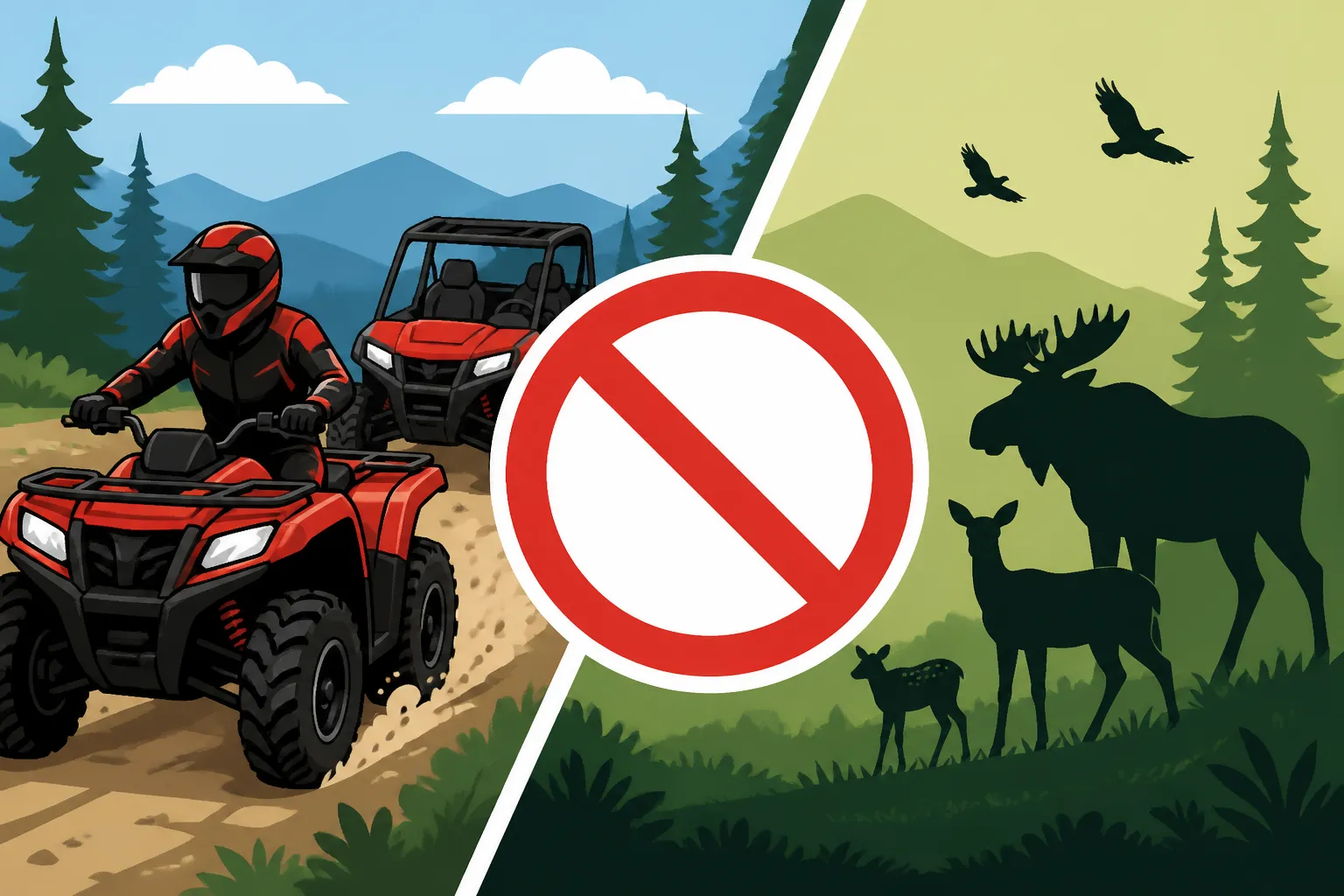
The phrase “closed area” can refer to more than one kind of restriction. Some rules limit hunting in a place; others restrict the use of motor vehicles to protect wildlife or habitat. For riders, the distinction matters: a place closed to hunting is not automatically closed to riding, and an area with a motor-vehicle prohibition may be off-limits even if hunting is allowed.
British Columbia’s motor-vehicle restrictions can apply to designated areas and periods, and their wording determines what vehicles and activities are covered. An ATV or UTV may fall within the restriction, but you should check the applicable definition and conditions rather than relying on the everyday meaning of “off-road vehicle.” A closure might cover motor vehicles generally, name specific vehicle types, or include exceptions. The boundaries and dates are just as important as the title of the restriction.
| What you find | What it may restrict | What a rider should check |
|---|---|---|
| A hunting closed area | Hunting in a specified area, possibly for certain species or dates | Whether a separate motor-vehicle restriction applies |
| A motor-vehicle prohibition | Vehicle travel in a designated place or during stated dates | Which vehicle classes, routes, dates and exceptions are covered |
| A trail or road closure | Access to a particular route, which may be managed under a different authority | The manager’s current notice and any overlapping restrictions |
| A park or protected-area rule | Motorized access under that area’s rules | Whether the route is permitted for motorized use at all |
A hunting closure and a vehicle prohibition can overlap, but they are not interchangeable. A motor-vehicle closure can apply outside hunting season, while a hunting closure may not prohibit riding. For a broader look at the difference, see BC Hunting Closed Areas for Vehicles and BC Trail Closures in the Hunting Synopsis.
A closure also does not always cover every road or every vehicle in the surrounding region. The legal description may name a specific watershed, road, trail, elevation range or mapped boundary. It may apply only during a stated season or only to certain vehicles. Do not assume that a nearby open road makes the adjoining trail open, or that a closure covering one route prohibits all travel in the larger area.
Exceptions require care. A rule may distinguish between public recreational travel and access for particular authorized purposes. Do not treat a possible exception for someone else’s work, land access or permit as permission for your ride. You need to establish that the exception applies to you and to the route you plan to use. If the wording is unclear, confirm it with the responsible authority before setting out.
How to check a closure before you ride
The safest approach is to identify the exact route and date first, then check the restrictions that could apply there. A broad search for an area name can miss a small boundary or a seasonal condition. A planned route may also cross from one management area into another, so checking only the trailhead is not enough.
- Draw or save your planned route. Include the staging area, connecting roads, turnarounds and any side trips. Note where it may cross a named boundary, watercourse, road or management area.
- Check the current official information. Look for the applicable Wildlife Act regulation or official closure notice, including its maps, schedules, dates and definitions. The BC Motor Vehicle Closures and How to Find Them article offers a related starting point.
- Compare the legal boundary with your route. Read the written description as well as the map. A map helps you see the area, but the governing wording and any schedules determine what is restricted.
- Check the vehicle wording. Find out whether the rule covers motor vehicles generally, specifically includes the type of machine you plan to ride, or creates a relevant exception. Do not infer that a machine is allowed just because the notice does not use the word “ATV.”
- Check dates and conditions. A restriction may be seasonal, apply only during certain hours or conditions, or change through an official amendment. Confirm that the information covers the day of your ride.
- Check for overlapping restrictions. A Wildlife Act rule is not the only possible limit. Trail managers, parks, road authorities, landowners and other agencies can impose separate access rules. BC Motor Vehicle Prohibitions Explained covers the broader issue of checking restrictions that may affect a ride.
- Save the information for offline use. Cell service may be unreliable in riding areas. Keep a map or notice available on your phone without a connection, and consider carrying a printed copy or recording the relevant boundary and dates.
Official online maps are useful, but a pin dropped on a route-planning app is not proof that riding is lawful. Layers can be incomplete, difficult to interpret or out of date. Use them to locate the area, then verify the restriction against its official description and current notice. For help with map boundaries, see Reading a Closure Map.
Pay particular attention to the edges of a restricted area. If the boundary follows a road, creek, ridge or other feature, determine which side is included and whether travel on that feature itself is restricted. When the route is close to a boundary and the map does not make the answer clear, choose a route outside the uncertain area or ask the responsible authority for clarification. Guessing is a poor plan when a short detour can avoid a possible violation.
Planning a ride around a closed area
If part of your route is restricted, do not assume you can ride through because you are only passing across it. A prohibition may apply to travel itself, not just stopping or riding recreationally. Likewise, do not assume that a road shown as a through route is exempt. Check whether the restriction contains a specific allowance for that route or type of travel.
Build a practical alternative before leaving. A good backup route should avoid both the restricted area and any access roads that enter it. Check that the alternative is open to your machine, that you have permission where required, and that it does not cross another closure. If the only viable route is uncertain, postpone the ride or get confirmation rather than risking an unauthorized entry.
Wildlife closures can be easy to overlook because they may not look like a physical barrier. A gate, sign or marker is useful information, but the absence of one does not necessarily mean the area is open. Conversely, a sign may describe a local restriction that needs to be considered alongside the formal rule. Check posted notices, but do not use the presence or absence of signage as your only legal test.
Before you ride, make a quick final check:
- Confirm the route, date and boundaries against the current official notice.
- Verify that the restriction’s vehicle definition covers—or excludes—your machine.
- Look for seasonal updates and other closures that overlap the route.
- Keep the relevant map or notice available when cell service is poor.
- Turn around if you encounter a closure you cannot confidently interpret.
Riding on Crown land also involves access rules beyond wildlife restrictions. A route being outside a Wildlife Act closure does not by itself mean it is open for recreational vehicle use. Check BC Rules for Riding Crown Land and BC Rules for Riding in a Provincial Park when your route crosses those areas. If the wording, map or exception is still unclear, contact the authority responsible for the restriction before entering.
Disclaimer
This article is for general informational purposes only and does not constitute professional advice. Laws, prices and regulations vary by location and change over time. Consult a qualified professional for guidance on your specific situation.