Does the Supervising Adult Need a Licence or Training?
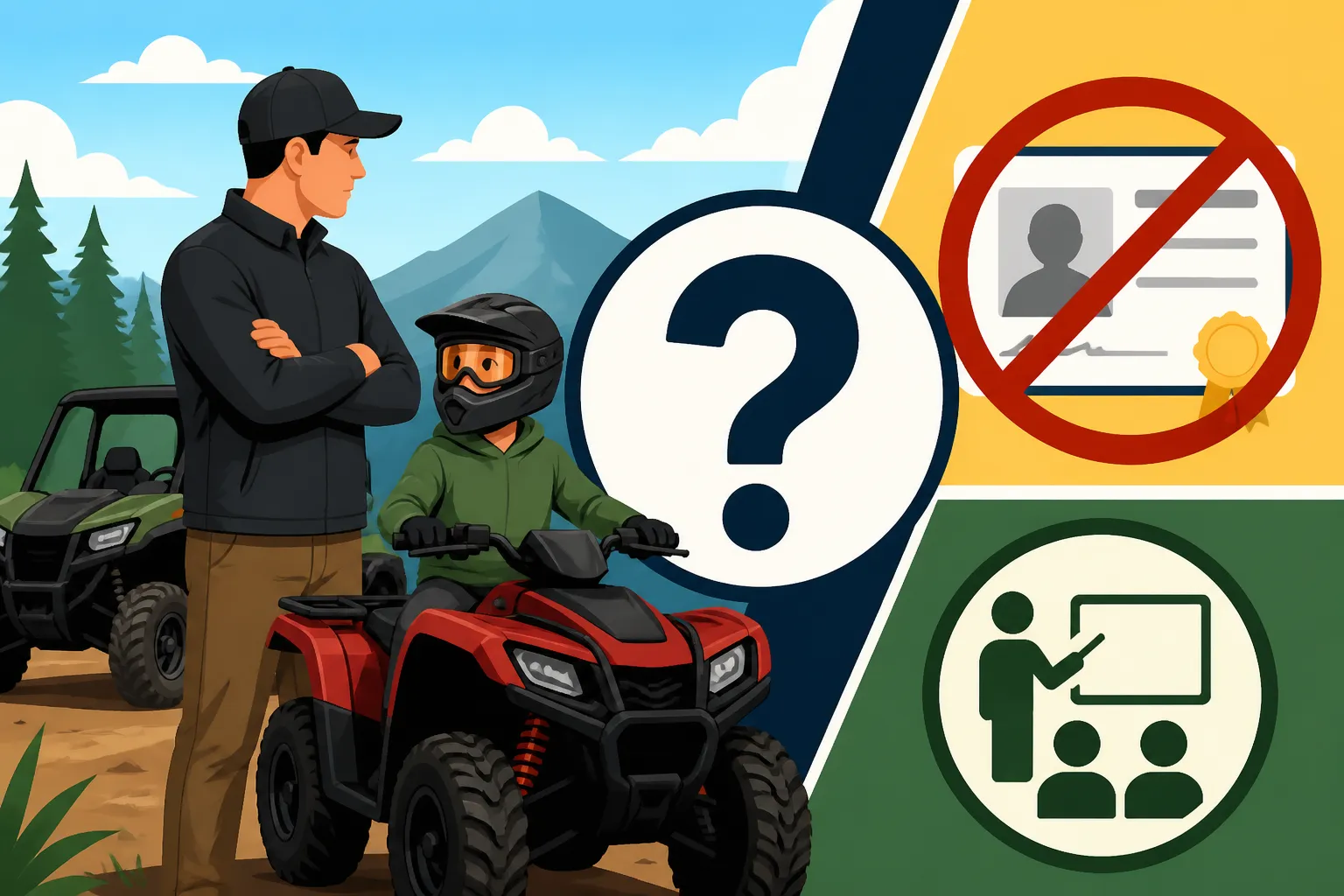
If a child under 16 is riding an ATV or UTV in British Columbia, the adult supervising them may wonder whether they need a driver’s licence or a safety certificate. The short answer is generally no: the supervision rule focuses on the adult’s age and ability to guide the young rider, not a licence or course. The riding location and machine still matter.
What BC Requires of a Supervising Adult
For an off-road vehicle ride where the under-16 supervision rule applies, the supervising adult must be at least 19 years old. The adult also needs to be close enough to supervise in a meaningful way: able to see what the young rider is doing and give direction promptly when needed. An adult who is simply somewhere on the same property, but cannot observe or respond, may not provide effective supervision.
The rule is about supervision, not the adult’s qualifications as a driver. It does not generally require the supervising adult to hold a driver’s licence or complete a formal ATV or UTV safety course just to supervise a young rider off-highway. The distinction is useful: being legally old enough to supervise does not make every riding arrangement safe, and taking a course does not replace the requirement for effective supervision.
| Question | General answer for off-highway supervision |
|---|---|
| How old must the supervising adult be? | At least 19 |
| Must the adult have a driver’s licence? | Not generally just to supervise under the youth rule |
| Must the adult hold a safety-course certificate? | Not generally just to supervise |
| Must the adult be able to observe the young rider? | Yes, supervision needs to be practical |
| Must the adult be able to give direction promptly? | Yes |
| Does the answer cover every road or riding area? | No; location-specific rules can add requirements |
The full youth rule is worth checking before a ride, particularly if the young person is 14 or 15, because written permission may be relevant in those cases. See BC Supervision Required Under 16, BC Supervisors Must Be 19 or Older, and BC’s Written Permission Rule at 14 and 15 for related details.
A licence is a separate question
A driver’s licence is not the same thing as permission to supervise. The youth rule concerns an adult who can oversee a young operator. A separate rule may apply if the machine is being operated on, or is permitted to travel along, a highway. BC does not provide a general street-legal route for an ATV, and highway operation is subject to specific restrictions and requirements.
That means a supervisor should not assume that being an adult—or being licensed to drive a car—makes a particular route lawful. Before using pavement, check whether the route is a highway, whether the specific movement is allowed, and whether any required permit, licence, insurance, or equipment applies. Start with Can You Ride an ATV on the Road in BC? and BC Rules for Crossing a Highway if a ride involves a highway crossing or roadside travel.
A Forest Service road is not automatically the same thing as a highway for these purposes. It has its own riding conditions, and the rules for a road can depend on its status and posted restrictions. If the route uses one, review BC Forest Service Road Requirements rather than relying on the general supervision rule.
Training is useful, but not the supervision test
A course can help an adult recognize hazards, explain safe habits, and make better decisions with a new rider. But the core supervision question is whether the adult is at least 19 and can keep the young rider under effective oversight—not whether the adult can show a training card. Adult training is generally voluntary under the provincial youth framework; see BC Safety Courses Are Voluntary for Adults.
There may be other reasons to take a course. A workplace, organized event, land manager, rental operator, insurer, or club may set its own training conditions. A course might also be a sensible choice when the adult is new to the machine or unfamiliar with the terrain. Those conditions should be checked separately; they do not turn a course certificate into a substitute for supervision.
What “Supervising” Looks Like on a Ride
Supervision is a practical responsibility, not a box to tick before starting the engine. The adult should be able to monitor the young rider’s speed, distance, route choices, and response to hazards. They should also be close enough to communicate and intervene before a small mistake becomes a serious problem.
The suitable setup depends on the rider, the machine, and the terrain. A cautious new rider on a small, open practice area may need a different level of attention from a more experienced teenager riding a larger machine on a trail with blind corners, steep grades, or other traffic. The adult should set the riding plan around the young person’s ability, not assume that the rider’s age alone tells the whole story.
A useful pre-ride check is:
- Choose a suitable area. Confirm that riding is allowed there and that the route matches the young person’s experience. Private land still requires permission, and public land can have closures or restrictions.
- Agree on boundaries. Set a route, stopping points, speed expectations, and a clear signal for stopping or getting help.
- Keep the rider in view when practical. If bends, trees, distance, or terrain block the adult’s view, adjust the pace or position so supervision remains effective.
- Stay close enough to communicate. The adult should be able to give direction promptly, not wait until the group reaches a distant trail junction.
- Stop when conditions change. Weather, fatigue, mechanical trouble, traffic, or a rider who is no longer following instructions can all be reasons to pause or end the ride.
The adult does not necessarily have to ride on the same machine as the child. The key issue is whether they are genuinely supervising and can provide immediate direction. In some situations, riding together may make that easier. In others, a nearby adult on a separate machine may keep a clearer view and leave more room for the young rider to practise. The details are discussed in Does the Supervising Adult Have to Ride Along?.
A group ride can complicate supervision. If the adult is also managing several riders, navigating an unfamiliar trail, or riding far ahead, they may not be able to give one young person the attention the rule expects. It is safer to keep the young rider close to the supervising adult and agree that the group will wait at junctions and other decision points. A young rider should not be left behind with the expectation that they will catch up.
The machine and the child both matter
Supervision does not make an unsuitable machine suitable. Follow the manufacturer’s age, size, and operating guidance for the particular ATV or UTV. A child may be legally supervised and still lack the strength, reach, coordination, or judgment to control a machine safely.
Check that the rider can comfortably reach and operate the controls, understand how to stop, and manage the machine’s weight and power. Have them demonstrate basic control in a low-risk area before heading onto a trail. If they cannot make a controlled stop, turn without panic, or follow a simple instruction, postpone the ride or use a more appropriate machine.
Passengers need separate attention. A young operator should not carry a passenger if the rules or the machine’s design prohibit it. The passenger can change the vehicle’s balance and make control harder, even if the machine has an extra seat. Review BC Rules for Passengers on a Quad and follow the manufacturer’s seating and age guidance.
Where the Licence and Training Question Can Change
The general answer is about supervising an off-road ride. It does not override requirements that apply to a particular route, activity, or operator. Before setting out, identify where the machine will travel and check the rules for that place.
Highways and road crossings
ATVs and UTVs are not generally street-legal vehicles in BC. A limited crossing or permitted highway movement is not the same as permission to ride along a road wherever the rider chooses. The adult’s driver’s licence does not, by itself, make the young rider’s operation lawful.
If the route touches a highway, check the applicable permit and crossing requirements in advance. A young rider may need to stop and dismount or use another lawful way to travel, depending on the location and situation. Do not treat a brief road connection as a harmless gap in an otherwise off-road route.
Forest Service roads and other resource roads
Forest Service roads can carry industrial traffic, including loaded trucks, and may have site-specific restrictions. A supervising adult should understand the route, check posted signs, and make sure the young rider can follow road-safety instructions. Insurance, helmet, lighting, radio, and other requirements may apply depending on the road and the activity. Consult BC Forest Service Road Requirements and the current requirements for the road before riding.
A rider who is old enough to operate a machine under supervision may still be unprepared for a busy resource road. If the adult cannot keep the rider close and respond quickly to traffic or hazards, choose another route. A radio, where appropriate, can support communication on an industrial road, but it does not replace close supervision or safe riding decisions.
Work, events, and managed riding areas
A worksite or organized event may have a stricter policy than the general provincial supervision rule. An employer may require specific training, protective equipment, or a minimum age for a particular machine. A managed riding area may also set conditions for access. Ask the organizer or site manager what applies before arriving, and do not assume that a general legal minimum settles every question.
These extra conditions are different from a province-wide requirement for every supervising adult. If a site asks for proof of training, follow its rules for that activity. If it does not, a course can still be valuable preparation, especially for a family member who has little experience operating or supervising an ATV or UTV.
A Practical Plan for Parents and Supervisors
Before the ride, make sure the young rider and adult agree on who is responsible for what. The adult should be ready to focus on supervision rather than treating the outing as an ordinary group ride. If the adult plans to ride too, they should choose a position and pace that make it possible to watch the young person.
Use this checklist:
- Confirm the adult is at least 19.
- Check whether the young rider’s age means written permission is relevant.
- Confirm riding is allowed on the chosen land and route.
- Match the machine to the rider’s size, ability, and experience.
- Review the machine’s controls, braking, and emergency stop procedure.
- Set a route, regrouping points, and clear stop signals.
- Keep the young rider within sight and close enough for prompt direction.
- Check the requirements for highways, Forest Service roads, or managed sites if the ride involves them.
- Use the protective equipment and safety practices appropriate to the machine and location.
- Stop if the rider is tired, distressed, unable to follow instructions, or riding beyond their ability.
If any part of the plan depends on an exception, a permit, or a site-specific rule, confirm it before the ride. A quick check is easier than discovering at the trailhead that the chosen route or activity has different conditions.
The bottom line is straightforward: the supervising adult generally does not need a driver’s licence or formal training just to meet BC’s under-16 supervision rule for off-highway riding. They do need to be at least 19 and able to supervise effectively. A separate road, worksite, event, or land-manager requirement can change what is needed, so check the rules for the specific ride.
Disclaimer
This article is for general informational purposes only and does not constitute professional advice. Laws, prices and regulations vary by location and change over time. Consult a qualified professional for guidance on your specific situation.