What Exhaust Screen the Wildfire Rules Require
BC ATV and UTV riders can find conflicting advice about the exhaust screen needed for wildfire compliance. The key is not to treat one mesh size as automatic proof that a machine is legal. This article explains what the rule asks for, how to check your arrestor, and why fire restrictions can still prevent a ride.
What BC’s wildfire rule requires
BC’s wildfire rules require a suitable spark arrester to be installed and in good working order when a vehicle or engine is operated in forest or grassland areas covered by the rule. For an ATV or UTV, that means paying attention to the exhaust system, not just carrying a loose screen or tool kit.
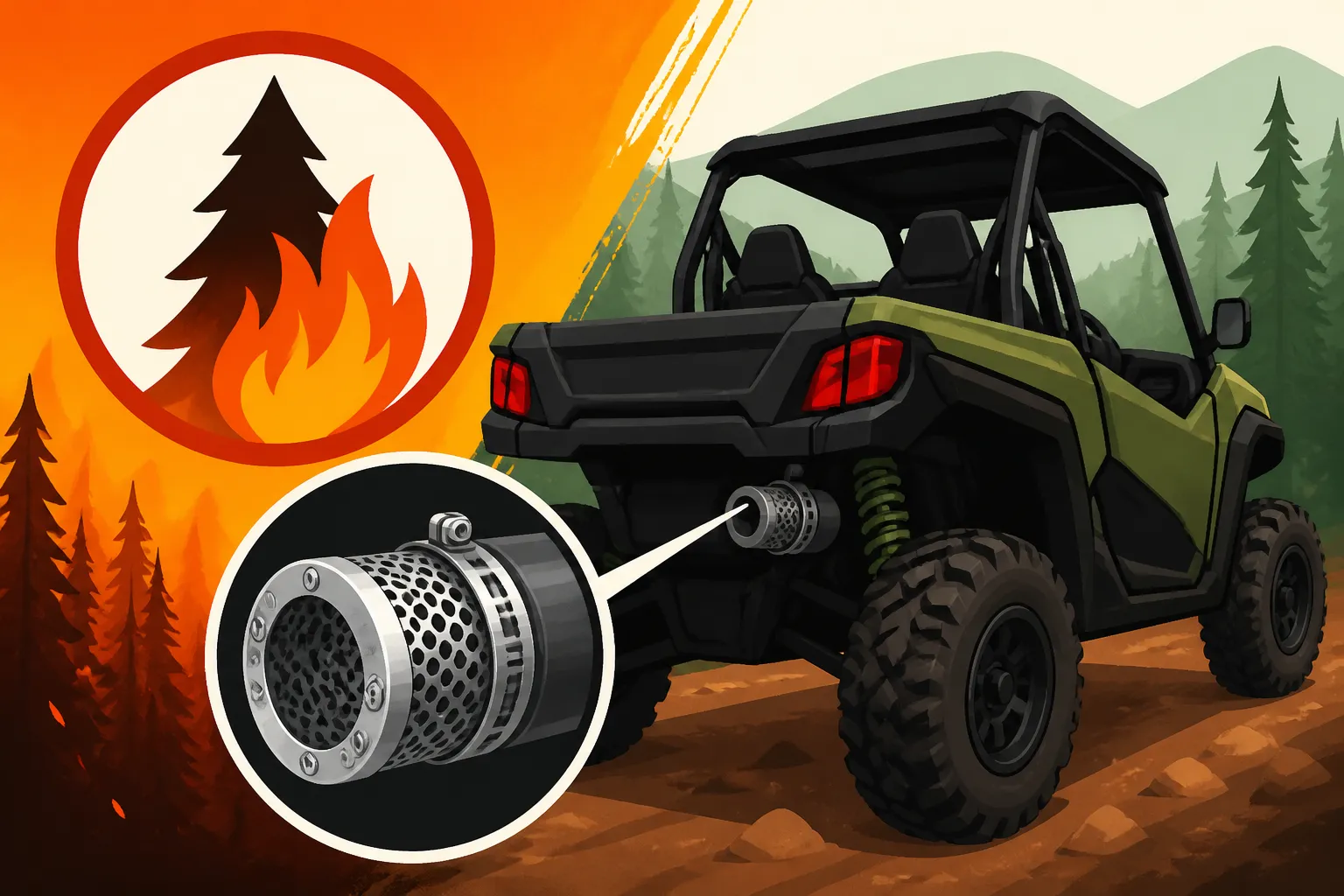
The requirement is about reducing the chance that hot particles from the exhaust will start a fire. An arrestor may use a screen or another design to trap or break up particles. A muffler, by itself, is not proof that a machine has an effective spark arrester. Nor does a screen become compliant simply because it fits inside the exhaust outlet.
The Wildfire Regulation includes the spark-arrester requirement, commonly referred to as section 8. The practical points for a rider are straightforward:
- The machine needs a suitable spark arrester for the exhaust system.
- The arrestor must be in good working order.
- It must not be removed, damaged, or altered in a way that defeats its function.
- Other restrictions may still prohibit riding, even if the arrestor is present and working.
That last point matters. An arrestor is one piece of fire prevention, not permission to ride during a closure or prohibition. Check the current requirements for your destination and the route you plan to use. BC Spark Arrestor Requirements explains the broader requirement, while Checking a Fire Ban Before You Ride in BC can help you think through the separate closure question.
What the rule does not mean
The rule does not mean that any metal mesh placed over an exhaust outlet is acceptable. It also does not mean that a rider can assume a machine is compliant because it has a muffler, catalytic converter, or quiet exhaust.
A factory-installed exhaust may include a spark-arresting component, but the machine’s specifications and the condition of the part matter. A replacement exhaust or a modification can change what was originally installed. If you cannot confirm the arrestor’s type or status, check the machine manual or ask the manufacturer or a qualified repair shop before riding in a regulated area.
A spark arrester also does not replace safe operating habits. Avoid parking hot machines in dry grass, keep the exhaust away from flammable material, and follow posted restrictions. A properly equipped ATV can still ignite dry vegetation if it is carelessly operated or parked.
Is there one required screen mesh size?
Riders often hear that a spark-arrestor screen must have openings of 0.023 inch, or about 0.58 millimetres. That figure is a familiar technical reference for some screen-style arrestors, but it should not be treated as a universal BC rule that makes any screen of that size compliant.
A mesh opening is only one part of an arrestor’s design. The material, construction, placement, fit, exhaust flow, and performance of the whole device can matter. A screen with small openings may still be unsuitable if it is installed incorrectly, has holes or gaps, does not match the exhaust system, or is not the specified part for that machine.
The safer way to interpret the question is:
| Question | Practical answer |
|---|---|
| Does BC require an effective spark arrester in the covered area? | Yes. The device must be suitable and in good working order. |
| Does a single mesh measurement prove compliance? | No. Mesh size alone does not establish that a screen is an approved or suitable arrestor. |
| Is 0.023 inch a useful clue? | It is a technical reference riders may encounter, but confirm it against the arrestor’s specifications rather than relying on the number alone. |
| Can a rider use a homemade screen as a substitute? | Do not assume so. A homemade screen may not be designed or tested as a spark arrester. |
| Does an arrestor allow riding during a fire closure? | No. A fire ban or area closure can prohibit riding regardless of the exhaust equipment. |
If a screen is specified by the manufacturer for your arrestor, use that specification and the correct part. Do not enlarge the openings, cut out sections, or remove the screen to improve exhaust flow. Those changes may undermine the device’s function and create compliance problems.
A replacement screen should be made for the particular arrestor or exhaust system, not selected only because its dimensions appear close. An online listing, including a listing on Amazon, is not proof that a product is suitable for your make and model or meets the applicable requirement. Check the manufacturer’s part information and installation instructions before buying or fitting a replacement.
For a fuller explanation of what the screen does, see How a Spark Arrestor Screen Actually Works. The important takeaway is that the rule concerns a functioning arrestor, not a number copied from a product description.
How to check the arrestor on your ATV or UTV
Start with the machine’s owner’s manual and the information for its exhaust system. Look for an explicit reference to a spark arrester or spark-arresting component, along with instructions for inspection and servicing. If the machine has been modified, do not assume the original information still describes the installed exhaust.
A practical check before riding can help spot damage or missing parts. It cannot certify a device that you cannot identify, but it can catch common problems.
- Identify the exhaust system. Check whether the exhaust is original or aftermarket, and note the manufacturer and model if available.
- Look for the specified arrestor. Use the manual, parts information, or manufacturer’s instructions to establish whether an arrestor is built into the system or installed as a separate component.
- Check the outlet and accessible parts. Look for a missing screen, loose fasteners, visible holes, cracks, heavy corrosion, or signs that someone has cut or altered the device.
- Confirm that the part is properly fitted. A screen or insert that rattles, sits crooked, or leaves an obvious gap may not be doing its job.
- Service it as directed. Some components need cleaning or inspection according to the manufacturer’s schedule. Follow those instructions rather than scraping, drilling, or modifying the part.
- Get help when its status is unclear. A qualified shop or the exhaust manufacturer can help identify the system and the correct arrestor or replacement screen.
Do not take apart a hot exhaust. Let the machine cool, follow the service instructions, and use suitable protection when handling components. If the arrestor is blocked or damaged, repair it before riding rather than removing it and continuing without it.
Look for identification on the muffler, arrestor, or related documentation, but remember that a stamp or label is useful only if it matches the installed part and remains in the condition intended by its maker. Finding the Spec Stamped on Your Muffler offers a focused way to approach that check. If you are unsure what an officer may look for during an inspection, When an Officer Checks Your Spark Arrestor Screen covers that issue.
Common problems to look for
A screen can fail to provide protection if it has been damaged, removed, or altered. Watch for:
- A screen or insert that has gone missing during maintenance.
- Holes, tears, broken welds, or a loose fit.
- A replacement part that does not match the arrestor model.
- An aftermarket exhaust installed without a suitable arrestor.
- Changes made to improve sound or exhaust flow that remove or bypass the arresting component.
- Ash or deposits that affect function because the part has not been serviced as directed.
A clean-looking outlet does not settle the question. Some arrestors are internal, and a rider may not be able to assess their construction by looking at the tailpipe. Use the manufacturer’s service information rather than trying to infer compliance from appearance alone.
A screen can also become clogged. Do not solve that problem by enlarging the openings or operating without it. Clean or replace the part according to the instructions for the installed system. If it cannot be restored to the specified condition, have the exhaust checked.
Fire restrictions still apply
A compliant arrestor does not override a fire prohibition, a motor-vehicle restriction, a site closure, or a posted rule. BC can impose restrictions in response to wildfire danger, and they can vary by location and change as conditions change. A route that was open on a previous trip may not be open now.
Before setting out, check current notices for the riding area and any connecting roads or trails. Confirm that the machine is allowed there, that the route is open to motorized use, and that no applicable fire restriction prohibits the activity. Do not rely only on old maps, a past trip report, or information from someone who rode there earlier.
If a prohibition applies, having a spark arrester does not make it acceptable to ride. Check BC Fire Centre Riding Bans and BC Motor Vehicle Closures and How to Find Them for the separate restriction issues that may affect a planned ride. The rules for a site or road can also differ from the rules that apply to the machine’s exhaust equipment.
Plan for changing conditions
Make the fire-restriction check part of the trip plan, not a last-minute guess at the trailhead. If you are riding in a group, share responsibility for checking the route and let everyone know what the restrictions require. A rider who turns back when a closure applies may save the group from a fine, a disrupted trip, or a much more serious fire risk.
Carry a way to check updates if conditions may change while you are away. In areas with limited service, check notices before leaving reliable coverage and make a conservative plan. If an official notice is unclear, do not assume the less restrictive interpretation. Confirm the rule with the responsible authority or choose a route where the conditions are clear.
A spark arrester is also not a substitute for checking the machine’s general condition. Secure loose cargo, keep the exhaust away from dry vegetation when stopped, and avoid riding through places where the machine could damage sensitive or fire-prone ground. Follow any additional site requirements, including rules on access, equipment, or temporary closures.
What to do if the screen is missing or the system is modified
Do not ride into an area covered by the requirement with a missing, damaged, or uncertain arrestor. First identify the exhaust system and obtain the correct repair or replacement information. If the exhaust is aftermarket, contact its maker or a qualified shop; the original ATV manual may not describe the modified system.
When replacing a component, keep the part information and installation instructions. They can help you explain what is installed and ensure the right screen or arrestor is used for future maintenance. Keep the exhaust in the condition intended by the manufacturer, and do not treat a generic insert as a safe substitute just because it fits into the outlet.
If a seller says an exhaust is “fire safe,” “screened,” or “approved,” ask what that claim means for the exact part and machine. Look for documentation that identifies the arrestor and its intended application. A vague description or a photo of mesh is not enough to verify performance.
If you bought a used machine, inspect the exhaust rather than assuming it is stock. Ask the seller whether the exhaust has been changed, whether an arrestor was removed during maintenance, and whether the original parts are available. If you cannot verify the setup, have it checked before riding in forest or grassland areas.
An officer may inspect the machine or ask questions about its equipment. Stay calm, explain what you know, and do not make unsupported claims about a mesh specification. If you discover a problem during a ride, stop using the machine in the regulated area and resolve the issue before continuing. The consequences of an equipment violation can be serious; BC Wildfire Penalties for Riders provides more context on enforcement.
Frequently Asked Questions
Does my ATV need a spark arrester in BC?
The wildfire rule requires a suitable, working spark arrester when operating a vehicle or engine in forest or grassland areas covered by the rule. Check the current requirements for the place where you plan to ride.
Is 0.023-inch mesh automatically legal?
No. That measurement is a technical reference associated with some screen-style arrestors, not proof by itself that a screen is suitable or compliant. Use the specification for the actual arrestor and exhaust system.
Is a muffler the same as a spark arrester?
Not necessarily. A muffler reduces exhaust noise; a spark arrester is designed to reduce the chance of hot particles escaping. Some exhaust systems may combine functions, so confirm what is installed using the manufacturer’s information.
Can I ride during a fire ban if my UTV has an arrestor?
Not if the applicable ban or closure prohibits riding. A working arrestor does not cancel an area restriction. Check current notices before travelling.
Can I install any replacement screen that fits?
Do not assume so. Use the correct part and follow the manufacturer’s installation and service instructions. A generic or homemade screen may not provide the intended protection.
Disclaimer
This article is for general informational purposes only and does not constitute professional advice. Laws, prices and regulations vary by location and change over time. Consult a qualified professional for guidance on your specific situation.