BC Manufacturer Age and Weight Rules
BC Manufacturer Age and Weight Rules
Choosing an ATV or UTV for a young rider is not just a matter of finding a machine with a low seat or small engine. In BC, the rider’s age, the manufacturer’s age and weight guidance, supervision rules, and passenger limits all matter. Here’s how to check whether a machine is an appropriate fit—and what to verify before riding.
What Manufacturer Age and Weight Guidance Means
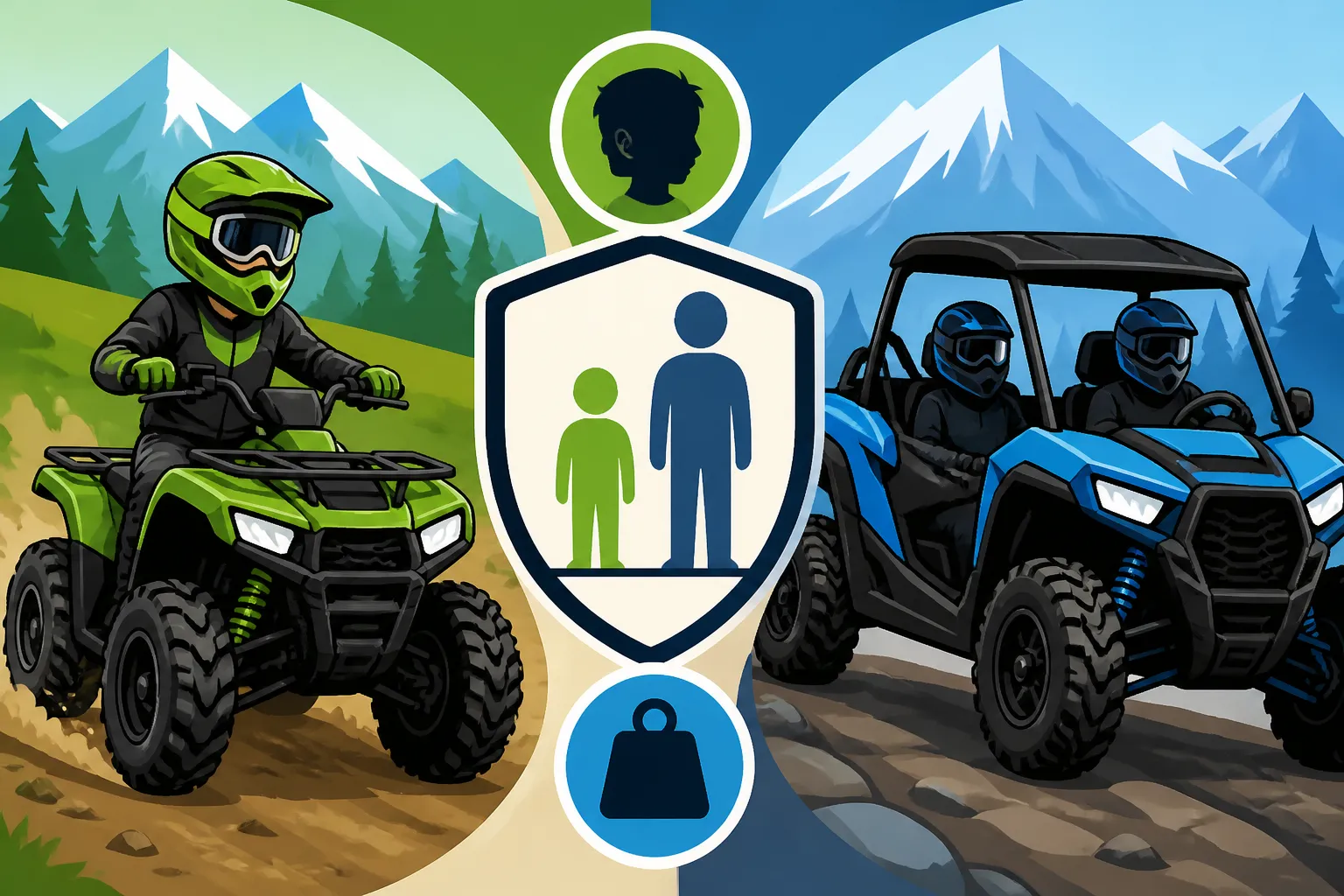
ATV and UTV manufacturers provide age and weight guidance for particular machines. It may appear on a warning label, in the owner’s manual, or in both places. The guidance is model-specific: there is no single age or weight that makes every machine suitable for every young rider.
Treat these instructions as a key part of the safety decision, not as a suggestion to ignore once a rider reaches a particular birthday. A machine intended for a smaller, younger operator can still be too powerful, heavy, or difficult to control for that rider. Likewise, a youth who is physically large for their age may not yet have the judgment or operating skills needed for a larger machine.
Age and weight are also different measures. Age guidance may reflect expected maturity, coordination, and ability to understand controls. Weight limits may relate to how the machine handles, how its suspension is designed, or the capacity of a particular seat. Neither number alone tells you whether a rider can safely operate it.
| What to check | Why it matters | Where to confirm it |
|---|---|---|
| Minimum recommended operator age | A youth’s legal permission to ride does not automatically make every model suitable | Machine warning label and owner’s manual |
| Operator weight guidance | A rider outside the stated range may not fit or handle the machine as intended | Owner’s manual and labels |
| Passenger age, size, and position | A machine with a passenger seat still has limits on who can ride there | Owner’s manual and passenger warnings |
| BC supervision requirements | Manufacturer guidance does not replace provincial youth rules | Current BC rules and the relevant linked guidance |
| Machine condition and controls | A poor fit or mechanical problem can undermine safe operation | Hands-on fit check and pre-ride inspection |
A label can be easy to overlook on a used machine, and some warnings may be on the machine rather than in the paperwork. If the label is missing, hard to read, or inconsistent with the manual, identify the exact make, model, and year and ask the manufacturer or a qualified dealer for the applicable instructions. Do not rely on a seller’s memory or assume that a similar-looking model has the same recommendations.
If you are comparing machines for a younger rider, start with Why Machine Size Matters More Than Age. It helps explain why engine size or a rider’s height, by itself, is not a reliable measure of fit.
How BC Youth Rules Work Alongside Manufacturer Guidance
BC’s youth operating rules and the manufacturer’s recommendations answer related but different questions. Provincial rules address whether a young person may operate an off-road vehicle under specified conditions. The manufacturer’s guidance addresses the suitability of a particular machine and how it is intended to be used.
Meeting one set of requirements does not cancel the other. For example, a young person who meets a legal age or supervision condition should not be placed on a machine whose instructions say it is not suitable for that operator. Conversely, a machine that is the right size does not mean a young rider can operate it without complying with BC’s supervision rules.
In general, a person under 16 must ride under the supervision rules that apply in BC. There are limited conditions for some 14- and 15-year-olds, including requirements involving written permission and qualifying training. Those conditions are not a blanket exemption for every young rider, every machine, or every riding situation. Check BC Supervision Required Under 16 and BC’s Written Permission Rule at 14 and 15 before deciding that a young person can ride without direct supervision.
A supervising adult must be able to meet the applicable legal test, not merely be somewhere in the general area. Practically, the adult should be able to keep the young rider in view, notice a problem promptly, and give direction when needed. The requirements can depend on the rider’s age and the conditions under which they are riding. Read BC’s Visible and Immediate Direction Test for a closer look at what effective supervision involves.
When assessing a youth rider, work through the questions in order:
- Is the ride permitted in that location? Registration, access, and operating rules still apply. A private property setting does not automatically remove every safety or legal requirement.
- Does the youth meet the applicable BC age and supervision conditions? Check the rule that applies to the rider’s exact age rather than relying on a general statement that children can ride.
- Does the specific machine’s age guidance allow that rider? Check the warning label and manual for the exact model.
- Is the rider within the manufacturer’s weight guidance? Check whether the stated limit applies to the operator, passenger, or combined load.
- Can the rider safely control the machine? Confirm they can reach and use the controls, understand how to stop, and respond to the terrain and other riders.
This approach avoids a common mistake: treating an age threshold as proof of readiness. A rider may satisfy a legal condition yet still lack the strength, coordination, experience, or judgment to manage a particular ATV or UTV. The reverse can happen too: a youth may seem capable, but still not meet the legal conditions for unsupervised operation.
For more context on the legal framework, see BC Youth Riding Rules Explained. If you are unsure whether a condition applies to your family’s situation, confirm it with an appropriate BC authority before riding.
Fit the Machine to the Rider, Not the Other Way Around
A good fit is more than whether a young person can climb onto a machine. The rider needs to sit securely and operate every essential control without stretching, twisting, or losing balance. Check the fit while the machine is off, on stable ground, and with an adult present.
For an ATV, assess whether the rider can:
- Sit in the intended position with a secure grip on the handlebars.
- Reach the brake and throttle controls and operate them smoothly.
- Keep both feet on the footrests while seated.
- Shift their weight without sliding off the seat.
- Turn the handlebars through their full range without losing control.
- Stop the machine predictably using the controls specified by the manufacturer.
For a UTV, check that the driver can reach and use the steering wheel, pedals, gear selector, and other controls while remaining properly seated and restrained. A child who can touch the pedals only by leaning forward or stretching may not have a safe driving position. The belt and seating position must work together as designed; do not improvise padding or restraint arrangements that alter how safety equipment fits.
A machine may feel manageable on a flat driveway but become difficult on a slope, loose gravel, mud, or a narrow trail. Weight and dimensions affect how a vehicle responds when turning, braking, climbing, or recovering from a bump. A young rider may not have the strength to correct a sudden shift in balance or the experience to choose a safe line through an obstacle.
Keep the first assessment conservative. If the rider cannot confidently demonstrate the basic controls in a controlled area, do not move on to a trail. Build skills gradually and follow the manufacturer’s instructions about operation, training, load, terrain, and maintenance. BC safety courses may also be useful; see BC ATV Safety Training Options for information about training choices.
Use the exact model’s information
Do not transfer age or weight guidance from one machine to another just because the vehicles are the same brand, have similar styling, or appear to be a similar size. Even machines in the same product family can have different controls, power, seat dimensions, passenger capacity, or intended age range.
For a used ATV or UTV:
- Locate the model and identifying information before searching for instructions.
- Read every safety label that remains on the vehicle.
- Ask for the owner’s manual, but do not assume it matches the machine unless the model details line up.
- Check for modifications that may have changed the throttle, suspension, seat, controls, or safety equipment.
- Ask a qualified dealer or the manufacturer when guidance is missing or unclear.
Be cautious of advice based only on engine displacement or a seller’s description such as “youth size.” Those descriptions are not a substitute for the specific manufacturer instructions. If the information cannot be verified, choosing a different machine is safer than guessing.
Account for clothing and gear
Protective gear can affect reach and movement. A helmet should fit properly, and gloves and boots should allow the rider to operate the controls. Heavy clothing may change how comfortably a rider sits or moves. Gear should never be used to compensate for an undersized or oversized machine.
A rider should be able to turn their head, see the controls and trail, and move without their clothing catching on parts of the vehicle. For an ATV, boots should stay supported on the footrests. In a UTV, the rider should be able to use the restraint system as intended. If the rider needs to sit in an unsafe position to reach a control, the machine is not a good fit.
Weight Limits, Passengers, and Cargo
A weight figure in a manual may refer to different things. It could be a limit for one seat, a combined occupant-and-cargo capacity, or a maximum load for the whole vehicle. Do not assume that a stated maximum is the recommended weight for a child operator. Read the surrounding text and any diagrams to see exactly what the figure covers.
Weight limits matter because extra load can change braking, steering, suspension response, and stability. Carrying a passenger or cargo may also shift the vehicle’s balance. A rider who is already near the machine’s stated limit may have less room for a passenger, equipment, or other carried items.
Never solve a capacity problem by putting a passenger on a rack, in a cargo area, or on an improvised seat. Only use a passenger position designed for that purpose, and follow the manufacturer’s instructions about who may sit there and how the machine must be equipped.
BC also has rules affecting young operators who carry passengers. A child operator cannot carry a passenger under the applicable youth rule, even if the machine has a passenger seat. That restriction is separate from the machine’s passenger capacity. See BC Child Operators Cannot Carry Passengers and BC Rules for Passengers on a Quad before allowing anyone to ride with a young operator.
For a UTV, count the occupants and gear and make sure every person has a proper designated seat and restraint. A vehicle’s advertised seating capacity does not mean an occupant can ride safely without the correct seat belt or in a position not intended by the manufacturer. Read BC Seat Belt Rules on a Side-by-Side for the relevant equipment considerations.
The same caution applies to cargo. Attach loads only as directed, keep them within the stated limits, and secure them so they cannot shift or interfere with controls, lights, or the rider’s view. A rack’s presence does not mean it can safely carry any load. When in doubt, reduce the load rather than treating the maximum as a target.
A Practical Check Before a Young Rider Goes Out
A calm, repeatable check before each ride can catch problems that a one-time machine purchase decision will miss. Rider growth, a different passenger, added cargo, or a new route can change whether the setup is appropriate.
Use this sequence:
- Confirm the machine. Match its model information to the manual and check the warning labels.
- Review the age and weight guidance. Make sure the young rider and planned use fit the manufacturer’s instructions.
- Check the BC requirements. Confirm the rider’s age category, supervision conditions, permission or training requirements, and passenger restrictions.
- Test the fit with the machine off. Have the rider sit in the intended position and demonstrate that they can reach and operate the controls safely.
- Inspect the vehicle and equipment. Look for damage, loose parts, worn tires, working controls, and properly fitting protective gear.
- Keep the first ride simple. Choose a controlled, suitable area and avoid traffic, steep slopes, unfamiliar trails, and other riders who may create pressure to go faster.
- Reassess as conditions change. A passenger, cargo, weather, terrain, or fatigue can make an otherwise manageable ride unsuitable.
For rides on public land, trails, or resource roads, the machine and rider may also need to meet registration, insurance, helmet, and access requirements. Age and weight fit do not replace those rules. Review BC Registration Before Riding Crown Land and BC Forest Service Road Requirements when planning a route beyond private property.
If the rider becomes tired, frightened, distracted, or unable to respond calmly, end the ride. A young person’s ability can vary from day to day, and a short ride is not automatically a safe ride. Avoid using another child’s confidence or experience as the standard: the right machine and supervision level depend on the individual rider and the actual conditions.
Frequently Asked Questions
Does BC set one minimum age for every ATV or UTV?
No single age makes every model appropriate for every young rider. BC’s youth operating and supervision rules apply alongside the manufacturer’s guidance for the specific machine. Check both before riding.
Can a young rider use a machine if they meet BC’s age rule but are below the manufacturer’s recommended age?
Do not treat legal eligibility as permission to ignore the manufacturer’s instructions. Verify the exact model guidance and choose a machine suited to the rider’s age, weight, ability, and experience.
Is a machine safe for a child if the child is under its weight limit?
Not necessarily. The weight limit is only one part of the assessment. The rider must also fit the machine, reach and operate its controls, meet BC’s applicable rules, and be able to handle the terrain and conditions.
Can a young ATV operator carry a passenger if the ATV has two seats?
A passenger seat does not override BC’s rules for young operators. Check the youth passenger restriction and the manufacturer’s passenger requirements before carrying anyone.
What if the age or weight label is missing?
Identify the exact make and model and obtain the correct manual or guidance from the manufacturer or a qualified dealer. Do not guess from a similar machine or rely only on what a previous owner says.
Disclaimer
This article is for general informational purposes only and does not constitute professional advice. Laws, prices and regulations vary by location and change over time. Consult a qualified professional for guidance on your specific situation.