Checking a Wildfire Blog for Updates
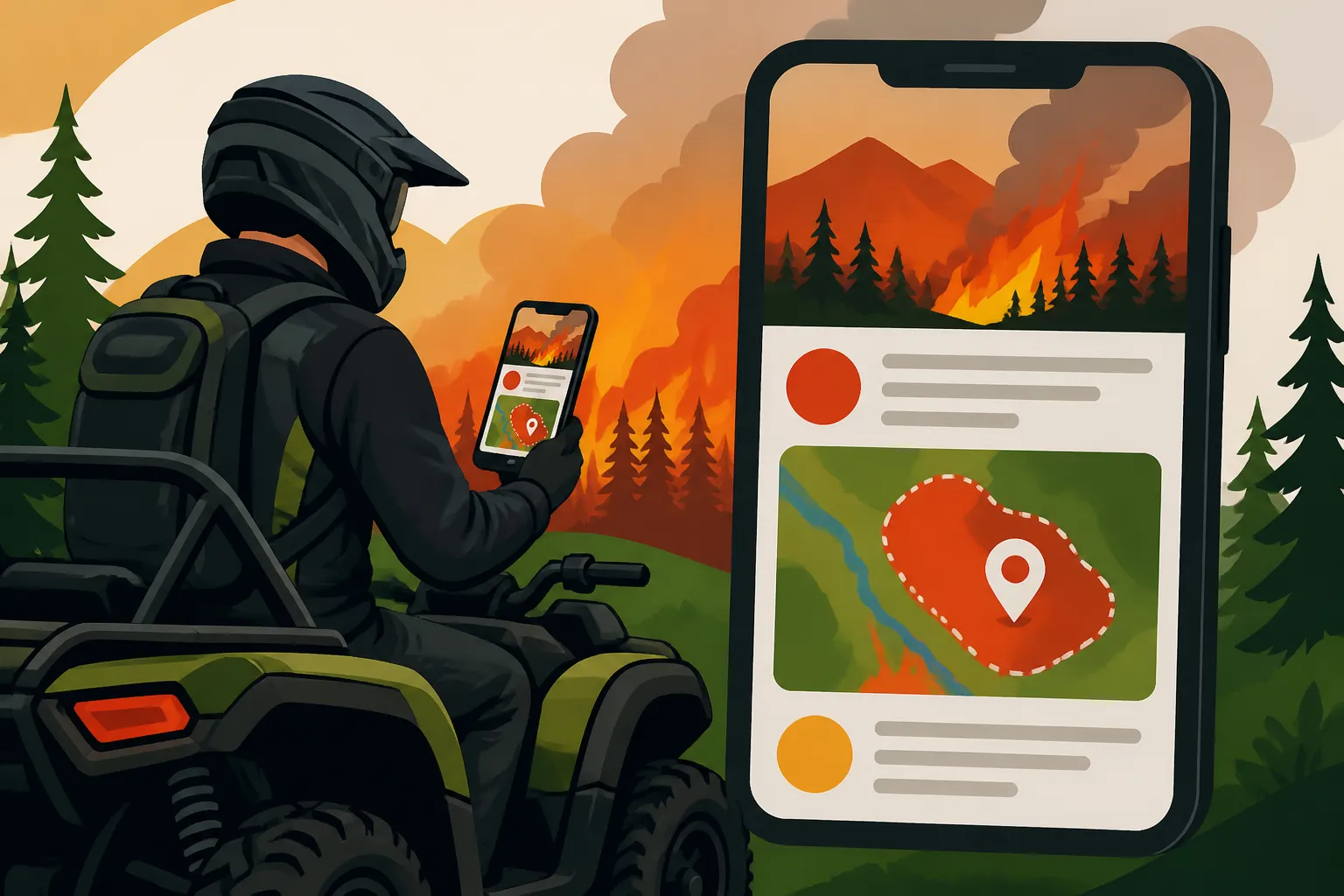
A wildfire blog can help you spot changing conditions before an ATV or UTV ride, but it may not tell you whether your trail or road is legally open. The practical approach is to use fire reports as an early warning, then confirm restrictions, closures and access with the official sources responsible for them. Here’s how to check updates without mistaking a nearby fire for a riding ban—or overlooking a closure.
Treat a Wildfire Blog as a Starting Point
A post about a new fire, smoke, crews or changing weather is useful, but it is not automatically a notice about every road or trail nearby. A wildfire update may focus on the fire itself: its location, response, behaviour and potential effects on people or property. It may not cover every recreational access decision.
Start with the official BC Wildfire Service information for the area. An official update can help you understand whether a fire is active and whether conditions are changing. Then look for the actual notice that governs your planned route. Depending on the location and situation, that could be an area restriction, a motor vehicle closure, a road closure, a park notice, or an access restriction posted by a land manager.
This distinction matters in both directions:
- A fire may be visible or close to a riding area without a blanket ban on all nearby riding. You still need to check the exact rules and route.
- A route can be closed or restricted even if a fire blog post does not mention your specific trail. Some restrictions are posted separately or change after the post is published.
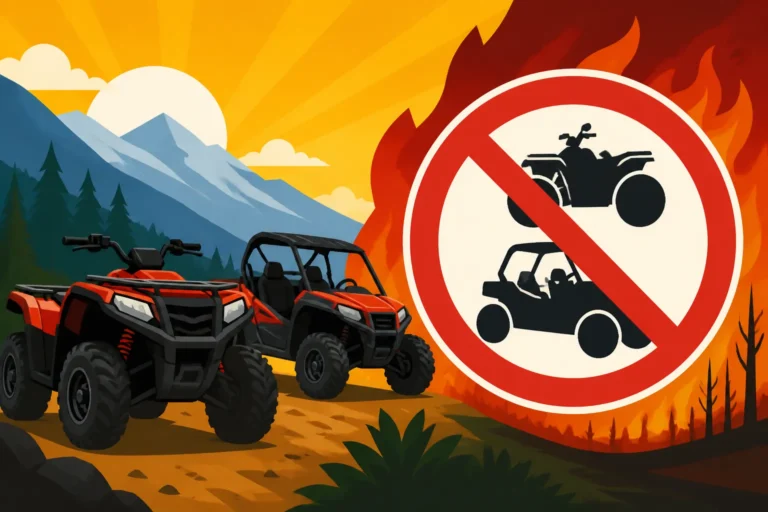
- A fire prohibition and a riding closure are not necessarily the same thing. A restriction on activities that can start a fire does not, by itself, tell you whether a particular road is open to vehicles.
- An evacuation order or area restriction is not a suggestion to find another way into the area. Follow the directions that apply to the location.
For a ride on Crown land, review BC Fire Centre Closures for ORVs and BC Crown Land Riding Explained. If the route uses an industrial or Forest Service road, check the rules for that route as well; BC Forest Service Road Rules for ORVs covers considerations beyond wildfire notices.
A blog is most useful as a prompt to check further. It can alert you to a developing situation, but don’t treat the absence of a blog post as proof that riding is allowed.
Verify the Restriction That Applies to Your Route
Before leaving, check the status of the entire route—not just the staging area or the destination. A ride may pass through more than one jurisdiction or management area. A trailhead can be open while a road farther along is restricted, or a planned loop can cross a boundary where different notices apply.
Use this order of checks:
- Pin down your route. Write down the staging area, the roads and trails you expect to use, and any alternate route. A place name alone may be too broad to match a map notice.
- Check official wildfire information. Look for the fire’s location, recent updates and any public safety directions. Note when the information was posted.
- Check for area restrictions and vehicle closures. Read the full notice, including its map, boundaries, dates and exceptions. Don’t rely on a headline or a cropped image.
- Check road and land-manager notices. A Forest Service road, managed recreation site, park or local riding area may have separate access information. Look for posted gates and signs when you arrive.
- Check again before setting out. If conditions are changing, an update you read the evening before may no longer describe the situation. Confirm the official status as close to departure as practical.
| What you find | What it tells you | What to check next |
|---|---|---|
| A wildfire blog or fire update | There is information about a fire or its response | Whether an official restriction or closure affects your route |
| A fire prohibition | Certain fire-related activities are restricted in the stated area | Whether vehicle access is separately restricted |
| An area restriction | Access to a defined area may be limited or prohibited | The boundary, dates, exceptions and official instructions |
| A motor vehicle closure | Vehicle use is restricted on the routes or land described | Whether your specific machine and route fall within the closure |
| A road or recreation-site notice | Access or use may be affected at that location | Any connected routes, alternate access or updated notices |
| Smoke or a nearby fire, with no closure notice found | Conditions may still affect safety and visibility | Current fire information, route conditions and any new official directions |
For the difference between a fire ban and an access restriction, see Checking a Fire Ban Before You Ride in BC. For route closures that apply to motorized travel, BC Motor Vehicle Closures and How to Find Them is a useful companion. These checks are related, but one does not replace the other.
Read the boundaries carefully. A notice may identify a defined area rather than every place in a region. If a route lies near the boundary, don’t guess based on a general map view. Use the notice’s detailed map and description, and contact the responsible office or land manager if the boundary is still unclear.
Also look for the notice’s effective period and any later amendments. A screenshot, saved post or shared social-media update may be out of date. If the official page points to a newer notice, use the newer information.
Read the Details, Not Just the Headline
A short post may say that a fire is “near” a riding area, or that crews are responding in a named region. That is a reason to investigate, not enough information to decide your route is safe or open.
Check these details before interpreting an update:
- Location: Is the fire near your intended route, or is it merely in the same broad region? Names of towns and recreation areas can refer to large areas.
- Time: When was the update published, and has a newer report appeared? A post can stay visible long after the situation changes.
- Map scale: Does the map show the actual route and restriction boundary, or just a regional overview?
- Access language: Does the notice say the area is closed, restricted, under an evacuation order, or simply affected by smoke? These terms can have different consequences.
- Who issued the notice: A fire update, road notice and recreation-site closure may come from different authorities. Confirm the source and follow the notice that governs the specific land or route.
- Exceptions: If a notice lists exceptions, don’t assume they apply to recreational riders. Read who is allowed and for what purpose.
- Route beyond the fire: Even if the staging area is unaffected, smoke, road closures, active response work or an access restriction may affect the rest of the ride.
Do not interpret a fire ban as a general green light to ride, or as an automatic closure of every trail. Check what the prohibition actually restricts. Separate vehicle restrictions may be in place, and restrictions can change as a fire develops. BC Fire Centre Riding Bans and BC Wildfire Season and Riding provide more context on how wildfire-related restrictions can affect riding.
The same caution applies to maps shared by other riders. A map can be a helpful clue, but if it lacks a date, an issuing authority or a link to the official notice, treat it as unconfirmed. Don’t rely on a forum comment or an old screenshot to establish that access is permitted.
If you cannot establish whether your route is included in a restriction, choose a route you can verify or postpone the trip. Uncertainty about the boundary is not a safe reason to ride through it.
Make a Practical Plan for Changing Conditions
Wildfire information can change between planning and arrival. Build a short update check into your trip rather than relying on a single look at a blog several days beforehand.
Before the ride, save the official pages and notices you used, along with the map or route details. Where practical, keep a copy available offline; cell service may be limited in remote areas. Offline information is for reference, not a substitute for checking whether a newer closure has been issued.
At the staging area, read posted signs and look for gates or restrictions that may not be obvious from a general online update. If a sign conflicts with an old post or map, don’t ride past it on the assumption that the online information is more current. Find out who manages the route and confirm the status before continuing.
If a wildfire develops while you are already riding:
- Stop in a safe place and check current official instructions if you have a reliable connection.
- Do not approach a fire to look, take photos or see whether a road is passable.
- Leave an area when directed, using an available safe route rather than pushing farther into the backcountry.
- Avoid blocking access for emergency crews or industrial traffic.
- Tell your group what you know and agree on a safe exit before anyone becomes separated.
- If you cannot verify that your planned route remains open, turn back or use a known, lawful route out.
Smoke can make a familiar ride less predictable. It may reduce visibility, make it harder to identify trail features and affect the comfort or safety of riders. If visibility is poor, conditions are changing quickly, or the route could put you between a fire and a safe exit, postpone the ride. A route being legally open does not guarantee that it is a sensible choice under current conditions.
Finally, don’t confuse a trail pass or club membership with permission to enter a closed area. A pass may cover access to a managed site under its rules; it does not override a wildfire restriction, road closure or evacuation direction. Check BC Passes Exist Only at Managed Sites if you need to understand what a managed-site pass does and does not cover.
A reliable pre-ride decision comes from matching the latest official information to the exact route you intend to use. Check the fire update, verify the restrictions separately, and be ready to change plans when the conditions—or the official direction—change.
Disclaimer
This article is for general informational purposes only and does not constitute professional advice. Laws, prices and regulations vary by location and change over time. Consult a qualified professional for guidance on your specific situation.