BC Wildfire Season and Riding
Wildfire season can change where an ATV or UTV may ride, sometimes with little notice. The tricky part is that a hot, dry day, a fire danger rating, a campfire ban and a vehicle restriction are not the same thing. Here’s how to check the rules that apply to your route, reduce ignition risks and respond if conditions change.
Why wildfire conditions affect ATV and UTV riding
Wildfire risk in British Columbia varies by region and weather. A route that is open and reasonable to ride in one set of conditions may be subject to restrictions or closures later. There is no single province-wide start and end date that tells riders when every area is safe or open. Local conditions and official orders matter.
It helps to separate three things that are easy to confuse:
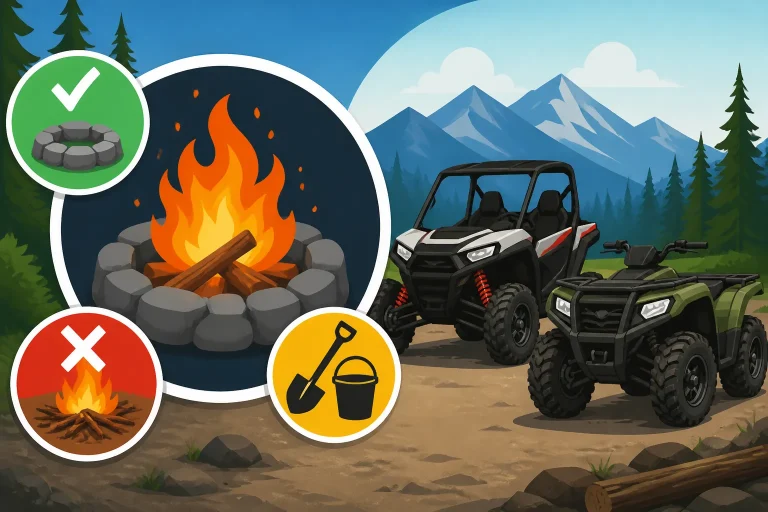
- Fire danger rating: An indication of how readily a fire may start and how it could behave. A high rating is a reason to take extra care, but it does not automatically mean a specific legal riding ban is in effect.
- Fire prohibition: A restriction on specified activities, which may include the use of certain equipment or motor vehicles in a defined area. The wording and boundary determine what is prohibited.
- Area, road or trail closure: A restriction on access or travel. It may be issued for wildfire risk, an active fire, emergency response, road conditions or another safety concern.
A campfire prohibition alone does not necessarily tell you whether an ATV can be operated. Likewise, an open trail listing does not override a current vehicle restriction or road closure. Read the actual order and map rather than relying on a short social media post, an old trail report or a general statement that “the area is open.”
Restrictions may be issued for a particular region, area or activity and can change as conditions develop. That means the practical question is not simply “Is there a fire ban in BC?” It is: Are there restrictions affecting the places, roads and activities on my planned ride today?
Start with current notices from the BC Wildfire Service, including the relevant fire centre information, then check road and trail access notices from the agencies or land managers responsible for the route. The topics covered in BC Fire Centre Riding Bans and Checking a Fire Ban Before You Ride in BC can help you understand what to look for. For broader access restrictions, see BC Motor Vehicle Closures and How to Find Them.
Wildfire restrictions can also change after you have planned a trip. Check again before leaving, especially if the ride is several hours from home or crosses into another fire centre. A restriction can apply to a section of your route even if the staging area remains accessible. Plan a lawful alternative rather than assuming you can turn around or take an unverified spur road when you reach a closure.
Check restrictions across the whole route
A useful pre-ride check follows the route from the trailer parking area to the riding area and back. Include any resource roads, Crown land access points, staging areas, trails and connecting routes. A map pin for the destination is not enough: the approach may be closed, subject to a different rule or affected by active firefighting.
Read the order, not just the headline
Look for the exact activity being restricted, the place where the restriction applies, when it takes effect and whether it has an end date or later update. If the notice uses a map, compare its boundary with your planned route. Do not assume a place is outside a restriction because it has the same community name as a nearby open area.
Pay attention to the difference between a fire-related restriction and an operational closure. An area might be restricted because crews need access, smoke limits visibility, fire behaviour is unpredictable or evacuation and public safety measures are in place. A route may also be closed for reasons unrelated to wildfire. In every case, posted controls and current official notices take priority over old trip plans.
If a road or trail passes through an area where the restriction is unclear, do not treat uncertainty as permission. Contact the responsible office or choose a route that is clearly open. A local club or operator may be able to point you toward current information, but confirm the order with the responsible agency.
Check roads and land access separately
A Forest Service Road or other resource road can be affected by active industrial traffic, road closures and wildfire-related orders. Check current notices for the road as well as for the destination. Where radio use is advised or required by road conditions, follow the posted instructions and use the appropriate local channel. See BC Forest Service Road Requirements and BC Resource Road Radio Practice for more on riding around industrial traffic.
Also consider whether access crosses private or leased land. A wildfire restriction does not provide permission to cross property, and permission from a landholder does not override a public closure. BC Crown Land Access Rules and BC Private Land Permission explain why access rights and fire restrictions are separate questions.
Before you set out, confirm:
- The route to the staging area is open.
- The road and trails you intend to use are not subject to a vehicle restriction.
- Your planned return route remains open and does not depend on a closed connector.
- The staging area and destination are not within an evacuation or emergency-control area.
- Any posted conditions for managed trails or recreation sites are understood.
- You have a fallback route or a nearby alternative area that is also open.
Keep a note of when you checked the official notices. That does not guarantee conditions will stay the same, but it gives you a clear starting point if you need to check for updates during the day.
Prepare the machine and reduce ignition risks
An ATV or UTV can have hot exhaust components and other sources of heat. Dry vegetation, litter and debris can make a small ignition a serious problem. Good preparation helps reduce avoidable risks, but it does not make riding permissible where an order prohibits it.
Check the exhaust and machine condition
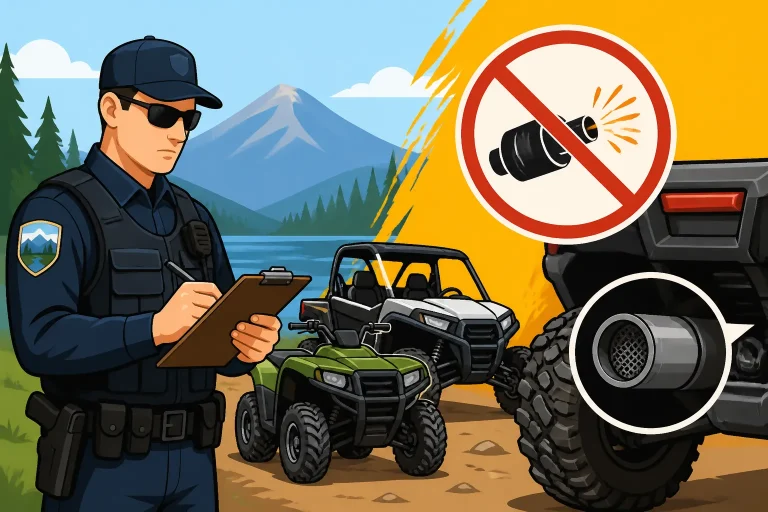
Keep the exhaust system and any required spark-arresting equipment in good condition. A damaged, missing or poorly fitted part may not perform as intended. Do not remove an arrestor or assume a stock exhaust remains compliant after a modification. Requirements can depend on the machine, location and applicable rules, so check BC Spark Arrestor Requirements and the conditions posted for a managed site.
Before riding, inspect the machine for:
- A damaged or loose exhaust component.
- Dry grass, leaves, mud or other debris caught near the exhaust, engine or underbody.
- Fluid leaks, damaged wiring or other mechanical problems.
- Loose parts that could contact hot components.
- A missing or damaged spark-arresting screen where one is required.
Let the engine and exhaust cool before clearing debris or doing maintenance. Avoid putting your hands near hot surfaces, and do not keep riding if a fault could create an ignition or mechanical hazard.
Avoid parking and stopping in dry vegetation
Choose a firm, cleared place to stop, park or unload. Keep the machine away from tall dry grass and brush, especially where hot components could contact vegetation. Avoid idling over dry material or making unnecessary stops on a narrow, grassy shoulder. If a safe stopping place is not available, continue only if the route is open and it is safe to do so.
A clean machine is easier to inspect. Before you leave, clear dry vegetation and other debris from the underbody, radiator area, exhaust and any guards. Recheck after riding through grass, brush or debris that could pack around hot parts. If you haul the machine on a trailer, inspect it after loading as well.
Carry sensible emergency equipment
Carry a charged phone, navigation tools and enough water and supplies to manage a delay. Cell coverage can be unreliable in backcountry areas, so consider how you would contact help if the phone cannot connect. A satellite messenger can be useful on remote routes, but know how to use it and do not treat it as a substitute for route planning.
A compact vehicle fire extinguisher may be a useful addition, but it needs to be suitable for the machine, securely mounted and accessible. If you are shopping through Amazon or another retailer, check the extinguisher’s rating, intended use and storage requirements rather than choosing by size alone. An extinguisher is for a small, manageable incident; it is not a reason to approach or fight a growing wildfire.
A practical kit may include:
- A suitable, secured fire extinguisher.
- A first-aid kit and basic repair supplies.
- Water and food for an unexpected delay.
- A charged phone and backup power.
- Offline maps or another way to navigate without data service.
- A satellite messenger for routes outside reliable cell coverage.
- Clothing appropriate for smoke, changing weather and a possible walk out.
Keep emergency gear where it can be reached quickly. Do not bury an extinguisher beneath cargo or put a phone somewhere that cannot be accessed while stopped safely.
Ride with a plan for changing conditions
A wildfire can affect visibility, access and emergency response even when the flames are not near your trail. Smoke may drift across a route, wind may shift and a road used for recreation may become important to crews or industrial traffic. A sensible plan includes the ability to leave early.
Before departure, tell someone where you plan to ride, which access route you expect to use and when you expect to check in. Agree on what they should do if they do not hear from you. For remote rides, leave enough time and fuel to turn back rather than pushing toward a destination late in the day.
During the ride:
- Watch for official signs, gates, barricades and instructions from responders.
- Do not ride around a closure or follow another rider through a restricted access point.
- Stop in a safe place to check an update; do not read your phone while operating.
- Turn around if smoke reduces visibility, makes navigation difficult or causes symptoms.
- Leave promptly if you see fire, receive an evacuation instruction or are told the route is closing.
- Keep clear of emergency vehicles and do not obstruct access roads or staging areas.
Do not approach a fire to take photos or check its distance. Smoke can obscure the fire’s location, while wind and terrain can change conditions quickly. If you encounter an active fire or a new ignition, move away from danger and report it through the appropriate emergency or wildfire reporting channel when it is safe to do so. Share clear location details if available, but do not delay leaving to gather them.
If a fire is nearby, do not try to extinguish it unless it is very small, you have the proper equipment and there is a safe escape route. For a spreading fire, your priority is to get away and alert authorities. Avoid driving into smoke or toward a fire crew’s work area. A UTV or ATV is not an emergency vehicle and should not be used to enter a closed area or assist crews without being directed to do so.
Riders on resource roads should be particularly alert to industrial traffic and emergency vehicles. Keep to the rules posted for that road, communicate as required and yield safely. A radio does not grant access to a closed road, and hearing no radio traffic does not prove the road is clear. More detail on this setting is available in BC Riders Meeting a Logging Truck.
When a restriction is issued or conditions worsen
If an official order takes effect before you leave, change the plan. Do not rely on an old trail report, a pass or a prior permission as an exception to a current restriction. A site pass is not permission to ride through an area that has been closed, and a club membership does not replace the need to follow official orders.
If a restriction is issued while you are out, read the notice only when stopped in a safe place. Follow its instructions, leave the affected area by a permitted route and avoid taking shortcuts across private property or closed roads. If authorities provide a specific evacuation route or direction, follow it.
There is an important difference between leaving an area and trying to reach your original destination. If smoke, fire, road closures or instructions make the planned route unsafe or unlawful, abandon the ride. A change in conditions is a good reason to turn back even before a formal closure is posted. Use judgment, but do not use judgment to override a clear legal restriction.
Once home, check your machine and trailer for debris, heat damage or a developing mechanical problem. If you rode in a managed area with extra site conditions, review those conditions before the next trip. Rules may vary by location, and a machine set up for one trail system may need attention before riding somewhere else.
Keep an eye on updates after the initial notice. Restrictions can be adjusted as conditions change, but do not assume a ban has been lifted until the responsible agency confirms it. For more on the difference between a broad fire prohibition and a local vehicle restriction, see BC Fire Centre Closures for ORVs and BC Trails Closed in Fire Season.
A final pre-ride decision can be simple:
- Check current wildfire notices and fire-centre information.
- Check closures and restrictions for every road and riding area on the route.
- Confirm the machine is clean, mechanically sound and equipped as required.
- Pack communication and emergency equipment you know how to use.
- Cancel or reroute if the order is unclear, access is restricted or conditions are unsafe.
Frequently Asked Questions
Does a high fire danger rating automatically ban ATV riding?
Not necessarily. A rating describes fire danger; a legal restriction depends on the applicable order and its wording. Check current notices for the precise area and activity.
Does a campfire ban mean I cannot ride my ATV?
Not automatically. A campfire prohibition and an ATV or UTV restriction are different measures. Check whether the current order specifically limits motorized vehicles or access to your route.
Can I ride if the trail is open but the access road is closed?
Do not use a closed road to reach an open trail. The access route has its own rules, and the closure may be in place for public safety or emergency operations.
What should I do if I see a wildfire while riding?
Move away from the fire and smoke, do not approach it, and report it through the appropriate channel when safe. Follow instructions from emergency personnel and keep access routes clear.
Disclaimer
This article is for general informational purposes only and does not constitute professional advice. Laws, prices and regulations vary by location and change over time. Consult a qualified professional for guidance on your specific situation.