BC Rules for a 16-Year-Old Rider
A 16th birthday changes which youth-specific rules apply to an ATV or UTV rider in British Columbia, but it does not make every machine or route fair game. The important distinctions are supervision, passengers, helmets, registration and access to roads. Here’s what changes at 16, what stays in force, and what to check before a ride.
What changes when a rider turns 16
In British Columbia, the special ORV supervision rules apply to operators under 16. Once a rider turns 16, those age-based requirements no longer apply: the rider does not need an adult supervisor under the youth rule, and the written-permission requirement for 14- and 15-year-olds no longer applies.
That is a change in the rules for youth operators, not a general permission to ride anywhere or on any machine. The rider still needs to follow the rules that apply to the type of ORV, the land or road being used, and the equipment carried on the machine.
| Issue | Under 16 | At 16 and older |
|---|---|---|
| Adult supervision | Required under the youth rules, with a supervisor who meets the age and supervision conditions | Not required by the under-16 supervision rule |
| Written permission | Required for riders aged 14 and 15 | Not required under that youth rule |
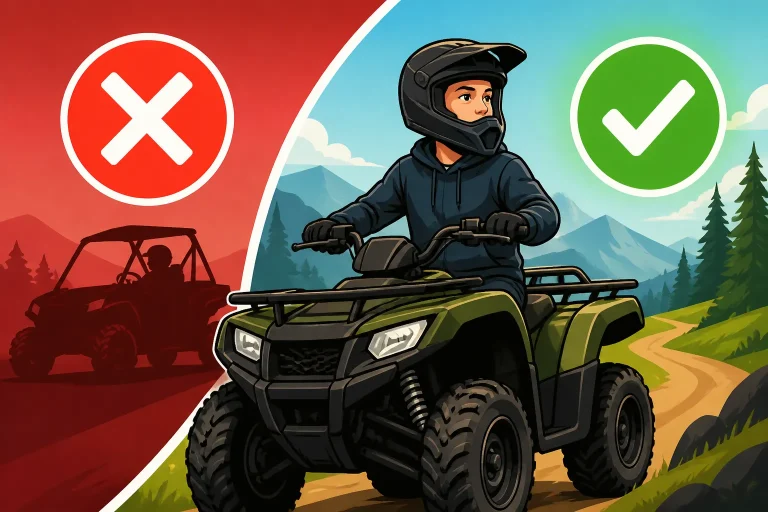
| Passengers | A rider under 16 cannot carry a passenger | The under-16 passenger restriction no longer applies, but the machine must be designed for passengers |
| Helmets and seat belts | Requirements depend on the machine type | The same machine-based requirements continue |
| Roads and highways | Special road rules still apply | Special road rules still apply |
These age rules concern ORVs covered by the applicable legislation. Not every off-road machine is treated the same way, and some equipment falls outside the ORV rules. For background on which machines are covered, see What the Off-Road Vehicle Act Covers in BC.
The change at 16 is about the rider’s age, not maturity or skill. A 16-year-old still needs to be able to control the machine, judge hazards and ride within their ability. A powerful quad, a side-by-side on a steep trail and a small youth machine present very different challenges.
The rider’s 16th birthday matters
The age threshold is 16. A rider who is still 15 remains subject to the rules for operators under 16, even if their birthday is close. For 14- and 15-year-olds, written permission from a parent or guardian is part of the requirements. A 16-year-old does not need that permission under the under-16 rule.
For the details that apply before a rider turns 16, see BC Youth Riding Rules Explained, BC Rules for a 15-Year-Old Rider and BC Rules for a Supervising Adult. A supervisor’s role is not simply to be somewhere on the same property; the youth rules set conditions for supervision and the ability to direct the young rider.
Turning 16 also does not automatically give a rider a driver’s licence. ORV operation off-highway and driving a licensed motor vehicle are different matters. A licence may be required for certain permitted use on a highway, but it is not a general prerequisite for riding an ORV on a trail.
No automatic exemption for a private property ride
Turning 16 does not replace the need for permission to use land. On private property, get the landowner’s permission and follow any restrictions they set. On public land, check whether the route is open to ORVs and whether any local closure or restriction applies.
The distinction between private land and public riding areas can be confusing. BC Rules for Riding Private Land explains the land-access question, while BC Rules for Riding Crown Land covers the rules relevant to public Crown land. Neither turning 16 nor having a parent present makes a closed area open for riding.
Passengers, machine size and protective equipment
At 16, the under-16 rule against carrying a passenger no longer applies solely because of the operator’s age. That does not mean a rider can take someone along on any quad. The machine must be designed and equipped to carry a passenger, and the rider and passenger must follow the manufacturer’s instructions and applicable safety rules.
A single-seat ATV is not made into a two-person machine by adding a cushion or asking a passenger to sit on the rack. A passenger needs a proper designated seat and a secure place for their feet. On a side-by-side, use the passenger seating position and restraint system supplied for that model. If the owner’s manual sets age, height or weight limits, take those seriously; a passenger who cannot sit securely or reach the footrests may be at risk even if the machine has a passenger seat.
Check the model manual before planning a two-person ride. If the manual is missing, look for model-specific manufacturer guidance rather than guessing from the machine’s appearance. A 16-year-old operating a vehicle built for one rider should ride alone.
Helmets and seat belts still apply
Age 16 does not remove protective-equipment requirements. For a ride-astride ATV or similar machine, riders need to comply with the helmet rule. A side-by-side with a seat belt and rollover protection has different requirements from a quad; occupants should use the belt and any other required restraint for that machine. The key is to match the equipment to the machine, rather than assume that turning 16 changes what must be worn.
A helmet should fit securely and meet an accepted standard. It should not shift around when the rider moves their head, and the chin strap should fasten properly. If shopping online, including on Amazon, check the helmet’s certification markings and return policy, then confirm fit before riding. A helmet that is the wrong size or is not appropriate for the type of riding is not a useful substitute for a proper fit.
Protective gear also matters beyond the legal minimum. Gloves, eye protection, boots that cover the ankles and clothing suited to the weather can reduce exposure to debris, cold and scrapes. They cannot prevent every injury, but they help address common hazards on an off-road ride.
Build machine choice around ability, not just age
A 16-year-old may no longer need a supervisor under the youth rule, but the rider still needs a machine they can operate safely. Consider the rider’s experience, strength, reach and ability to handle the machine under difficult conditions. A larger or heavier model can be harder to control on a slope, in ruts or when a trail surface changes unexpectedly.
Before heading out, check that the rider can use the controls and stop the machine predictably. Practise in an open, permitted area before taking on unfamiliar terrain. A safety course can help build good habits, though it does not replace legal requirements or make an unsafe route suitable.
For a younger rider who is not yet 16, supervision requirements are separate from training. A course does not remove the need for an eligible adult supervisor or, where required, written permission. See BC Safety Courses Are Voluntary for Adults for context on the role of training.
Registration, roads and riding areas still have rules
The age change does not cancel registration requirements. Whether registration is required depends on the machine and where it is operated. In particular, riding on Crown land can trigger registration requirements for an ORV. A rider should not assume that a parent’s ownership, a private sale or a machine’s age automatically removes those obligations.
Before riding, check that the machine’s registration is in order and that the required certificate is available. The rules on carrying documents are separate from the youth rules; see Carrying Your Certificate of Registration on Every Ride. If the machine is not yet registered, How to Register an ATV in BC explains the process.
Registration also does not make an ATV or UTV street legal. British Columbia’s rules distinguish off-road operation from travel on highways. An operation permit may allow limited use in specific circumstances, but it is not blanket permission to ride along a road. A rider may need to meet additional conditions, and a driver’s licence and insurance can be required for highway travel. A 16-year-old should not assume that being old enough to operate an ORV means they can ride it on pavement.
For a practical breakdown of the limits, read Can You Ride an ATV on the Road in BC? and BC Rules for Crossing a Highway. Follow the specific rules for a crossing or permitted road use, and do not treat a road shoulder as an informal trail.
Crown land, managed sites and local restrictions
A rider can be old enough to operate independently and still be prohibited from riding a particular route. Closures, posted restrictions, fire-related prohibitions and site-specific rules can limit access. Check the status of the route before setting out, especially when conditions may change or the ride crosses land managed by different authorities.
Managed recreation sites may also have their own requirements, such as a site pass or equipment rules. Those conditions are separate from the provincial age rules. A pass or club membership should not be treated as proof that every nearby road or trail is open.
A useful pre-ride check is to confirm:
- The landowner or managing authority allows ORV use on the route.
- The machine’s registration and required documents are in order.
- The machine is suitable for the rider and any passenger.
- Riders have the required helmet, seat belt or other protective equipment.
- The route has no current closure or restriction.
- The rider knows how to stop, communicate and respond if conditions change.
For a 16-year-old, independent operation makes planning more important, not less. Agree on the route and expected return time, carry a way to communicate where practical, and make sure the rider knows what to do if a trail is blocked or the machine has a problem.
A practical checklist for a 16-year-old rider
Before the first ride after a 16th birthday, treat the age change as one part of a larger safety and compliance check. The rider no longer needs supervision under the under-16 rule, but an experienced adult can still help with route planning, machine setup and safer riding decisions.
Use this checklist:
- Confirm the machine type. Identify whether it is an ATV, side-by-side or another vehicle and check the rules that apply to that class.
- Read the owner’s manual. Check the intended number of riders, passenger positions, restraint use and operating limits.
- Check the rider’s ability. Make sure they can reach the controls, steer, brake and handle the machine’s weight and power.
- Use the required protective equipment. Wear the helmet or seat belt appropriate to the machine and confirm it fits or fastens correctly.
- Check registration and documents. Confirm the machine is registered where required and carry the required certificate.
- Verify the route. Get permission where needed and check for closures, restrictions and managed-site conditions.
- Keep road use separate. Do not assume an ORV can be driven on a highway because the rider is 16.
- Set a plan. Choose a route that matches the rider’s experience, tell someone where the ride is going and set a check-in time.
If the rider plans to carry a passenger, add a separate check: confirm the vehicle has a designated passenger seat, use the supplied restraints, and make sure the passenger meets the manufacturer’s guidance. The passenger should understand how to sit, hold on or buckle up, and keep hands and feet inside the vehicle.
For an under-16 rider, the answer is different: supervision and, for 14- and 15-year-olds, written permission remain part of the youth rules. The birthday changes those specific requirements at 16, but safe operation still depends on the rider, the machine and the route.
Disclaimer
This article is for general informational purposes only and does not constitute professional advice. Laws, prices and regulations vary by location and change over time. Consult a qualified professional for guidance on your specific situation.