BC Court Fines Up to $1,000,000
BC’s $1,000,000 court-fine ceiling for off-road vehicle offences can sound like the likely cost of a mistake. It is not a routine ticket amount. This article explains what the maximum means, how it differs from administrative penalties and violation tickets, and what riders should do if enforcement action follows.
What BC’s $1,000,000 court fine means
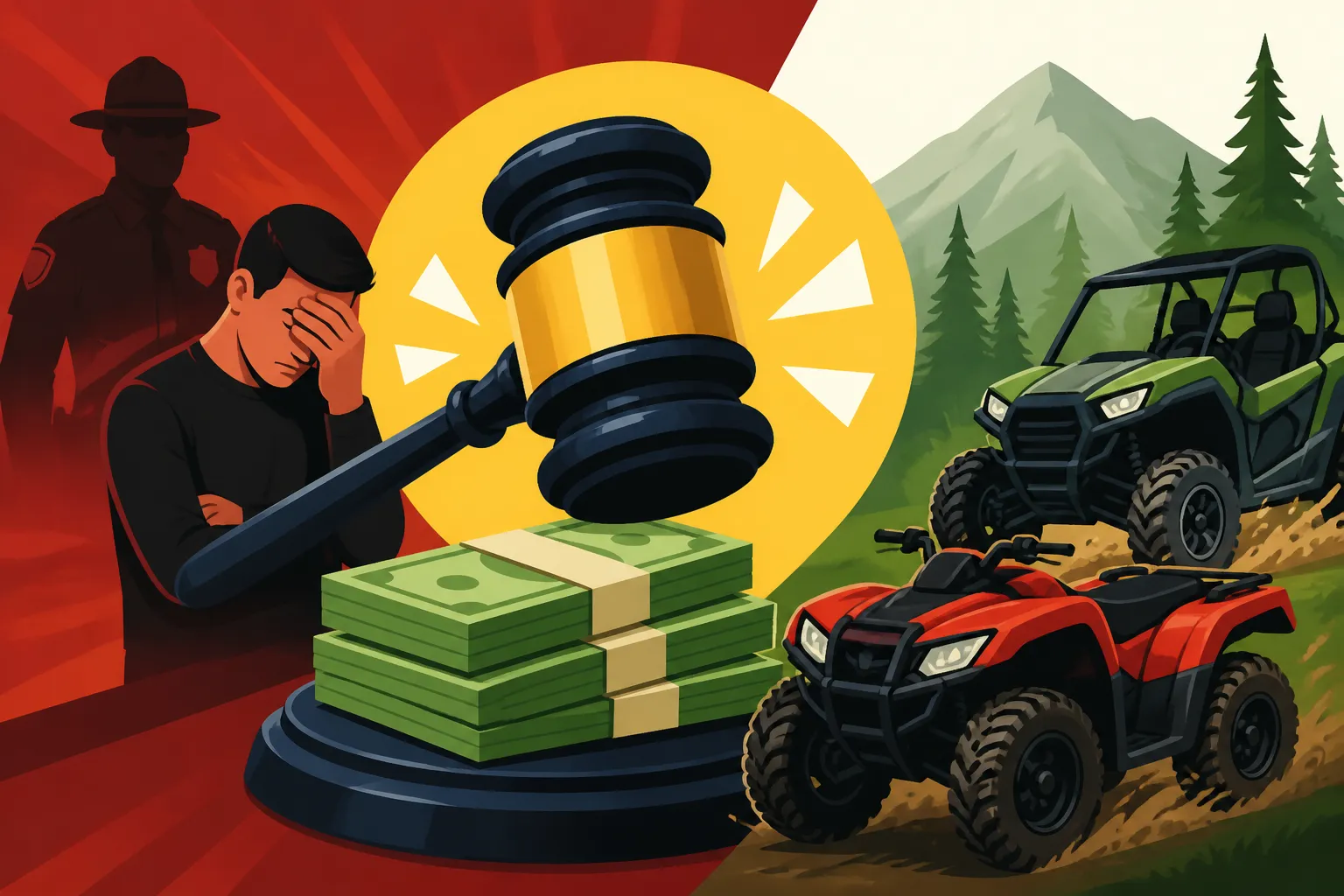
The Off-Road Vehicle Act sets a maximum court fine of $1,000,000 for an offence under the Act. That is a statutory ceiling, not a standard penalty or a figure an officer can simply write on a ticket. A court imposes a fine after a prosecution, and the result depends on the offence, the evidence and the applicable law.
The same legislation also allows imprisonment for up to three years for an offence. Those are maximum court penalties. They do not mean every rider who breaks a rule faces a million-dollar fine or jail. A less serious incident may be dealt with through a violation ticket or another enforcement process, depending on the conduct and the applicable provisions.
The distinction matters because several different consequences are sometimes described casually as “a fine.” They are not interchangeable:
| Enforcement route | What it generally means | What riders should understand |
|---|---|---|
| Violation ticket | A ticket alleging a specified offence, with a set penalty | The amount and options depend on the alleged contravention and ticket |
| Administrative penalty | A penalty imposed under an administrative process | It is separate from a court fine, and different rules govern it |
| Court prosecution | A charge is dealt with in court and may result in a conviction | The statutory maximum is not the expected outcome |
| Seizure or other enforcement action | A machine may be seized or restrictions may apply in some circumstances | This can be separate from the financial penalty |
For some contraventions, BC can impose administrative penalties of up to $10,000. That ceiling is also a maximum, not a routine charge. The administrative process and a court prosecution are different routes, so do not assume that the $10,000 administrative ceiling is the same thing as the $1,000,000 court-fine ceiling. Read the notice you receive and identify which process it describes. BC Administrative Penalties Up to $10,000
A court considers the offence before it, not the headline maximum in isolation. The facts might include what happened, the degree of risk or harm, whether the conduct was deliberate, and whether the person has prior relevant convictions. The exact legal factors depend on the offence and the circumstances. A maximum penalty tells you how high the law allows the court to go; it does not predict the sentence in a particular case.
It is also important not to treat all off-road vehicle rules as one offence. Registration, road access, equipment, fire restrictions, careless operation and conduct that damages property can involve different requirements and enforcement provisions. A rider who receives a ticket for a particular allegation should focus on that allegation and the corresponding law, rather than assuming that every ORV-related problem carries the same consequences.
For example, an unregistered machine and careless riding raise different issues. Registration rules apply to many off-road vehicles used in BC, while the careless-operation allegation concerns how a machine was operated. See BC Tickets for an Unregistered Machine and BC Fines for Careless Riding for those separate topics.
The practical takeaway is simple: the $1,000,000 figure is the maximum court fine stated for an offence under the Act, not an automatic bill, a routine ticket amount or a prediction of what a rider will pay. If you are facing an actual charge, the specific allegation and the process being used matter far more than the maximum in a headline.
What conduct can lead to serious enforcement
The Off-Road Vehicle Act and related rules cover more than whether a quad or side-by-side is registered. They regulate how and where off-road vehicles are operated, and other laws or orders may also apply to a particular ride. A serious enforcement matter can arise when conduct crosses from an ordinary mistake into a significant safety, access, environmental or compliance issue.
Riding where access is restricted
A rider cannot assume that every trail, road, cutline or piece of Crown land is open to motorized use. Restrictions may come from a closure, a prohibition, land-management rules or posted conditions. Some roads also have industrial traffic and access requirements that are easy to overlook if a rider treats them as ordinary recreational trails.
Before setting out, check the current access information for the exact route and area. A familiar trail can have changed conditions, and a machine being capable of travelling a route does not make that route legally open. BC Rules for Riding Crown Land and BC Forest Service Road Rules for ORVs explain important access distinctions.
Fire-related restrictions deserve particular care. A fire-centre prohibition can close areas to ORV use, and riding during a closure can bring enforcement consequences beyond the inconvenience of turning around. Confirm restrictions before the ride and again if conditions change. Do not rely only on an old map, a previous trip or a social-media post. For the enforcement distinction, see BC Fire Centre Prohibition Tickets.
Operating unsafely or causing damage
Careless operation can put other riders, workers, wildlife and people using the same access route at risk. Resource roads may carry loaded industrial vehicles with limited room to manoeuvre. Blind corners, dust, steep grades, poor visibility and narrow bridges all increase the importance of riding at a speed and position appropriate to conditions.
A careless-operation allegation is not the same as an allegation that a machine lacked registration or equipment. The circumstances of the operation matter. A near miss, a collision, deliberate dangerous behaviour or damage to property may be treated differently from a minor technical error, but riders should not try to predict a legal outcome from a brief description of an incident.
Some conduct can also raise issues under laws outside the ORV Act. For example, impaired operation can have consequences under the Criminal Code, and damage to land or property may create separate legal or financial exposure. The presence of an off-road vehicle does not make the usual safety and property rules disappear.
Ignoring equipment, registration or fire requirements
Registration and equipment requirements are common sources of tickets because they can be checked during a ride. Depending on where and how a machine is used, obligations may include registration, carrying required documents, displaying a plate properly and having equipment that meets applicable rules.
A rider should check the exact rule that applies to the machine and location. Requirements for a ride-astride quad may not match every requirement for a side-by-side, and operating on a resource road can bring additional considerations. Keep the registration certificate and other required proof accessible, and make sure the plate is visible rather than hidden by mud, cargo or an accessory.
Fire-season equipment matters too. Where a spark-arrestor requirement applies, a rider should not assume that a muffler or screen is compliant simply because the machine runs normally. Check the equipment and the relevant restriction before entering a managed area. [BC Spark Arrestor Fines] explains why the screen requirement deserves attention.
Seizure is not the same as a fine
A monetary penalty is only one possible consequence. In some circumstances, an officer may have authority to seize an off-road vehicle under the Act. Seizure can disrupt a ride immediately and create practical problems involving storage, recovery and later steps to get the machine back. It is a distinct enforcement power, not simply another name for a court fine. BC Seizure Powers Under the ORV Act
Do not assume that a machine will be returned as soon as a ticket is paid, or that a seizure proves guilt. The process and the available steps depend on the legal authority used and the facts. If a machine is seized, ask which authority applies, obtain the paperwork and follow the directions provided. If you are unsure what the paperwork means, get qualified legal advice promptly.
How the enforcement process differs
When a rider is stopped or receives a notice, the first practical task is to identify what kind of action has been taken. A ticket, an administrative-penalty notice, a court document and a seizure record can require different responses. Treating them all as a bill to pay can lead to missed deadlines or lost options.
Read the document, not just the amount
Check the document for:
- The alleged offence or contravention
- The law or provision identified
- The date, location and relevant circumstances
- The issuing authority and contact details
- Any payment, response or dispute instructions
- Any deadline stated in the document
- Whether the notice describes a court matter, a ticket, an administrative penalty or a seizure
If a document is unclear, contact the issuing authority using details you can verify independently. Avoid relying on an informal explanation from someone who was not involved in issuing it. Keep a complete copy of the paperwork and any related correspondence.
A notice can set out a process and a deadline that matter even when you disagree with the allegation. Do not ignore it because you believe the officer was mistaken or because the machine was being used recreationally. Instead, identify the response process and act within the time stated. Rules can depend on the type of notice and may change, so confirm current instructions with the appropriate official source.
A violation ticket is not the maximum court fine
A violation ticket usually identifies a particular contravention and sets out a process for paying or disputing it. The ticket amount is not the same as the Act’s maximum court-fine figure. A ticket may be resolved through the process that applies to that ticket, while a prosecution in court can involve a different decision-maker and different potential outcomes.
If you believe a ticket is wrong, read the dispute instructions carefully. Note the deadline and keep evidence that may help explain what happened. This could include photographs, location details, registration documents, relevant permits, maintenance records or the names of witnesses. Evidence is most useful when it is recorded promptly and kept in its original form.
Do not assume that a discussion with an officer cancels a ticket or changes a deadline. If you want to challenge the allegation, use the formal process described on the ticket. Disputing a Violation Ticket covers the practical distinction between paying and disputing a ticket.
Administrative penalties have their own process
An administrative penalty is not necessarily handled like a violation ticket or criminal prosecution. The notice should tell you which process applies and how to respond. A recipient should read the directions rather than relying on assumptions drawn from the amount or wording of a different kind of notice.
Administrative penalties can involve opportunities to respond or seek a review, but the available steps and time limits depend on the governing rules and the notice. Keep all records of submissions, delivery and decisions. If the issue is serious or unclear, get legal advice before deciding how to respond.
A maximum administrative penalty of $10,000 does not mean that the maximum will be imposed in every case. Likewise, the existence of an administrative route does not mean a court prosecution is impossible in every situation. The specific legal provision and the enforcement decision determine what options and consequences apply.
Court proceedings require a different level of attention
A court charge is more serious than an ordinary payment notice because it can expose the accused to a court-imposed fine and, where the law permits, other penalties. The statutory maximum can be substantial, but a court must deal with the actual charge and evidence before it. The prosecution must proceed through the applicable legal process; the headline maximum does not automatically apply just because a person has been accused.
If you receive court documents, note every appearance date and response deadline. Missing a date can create additional problems. Consider speaking with a lawyer, especially if the alleged conduct involved injury, significant property or environmental damage, repeated non-compliance, a machine seizure, or possible imprisonment.
Keep your account factual. Write down what happened while it is fresh, preserve relevant photos and messages, and do not alter or discard records that could be relevant. Avoid posting a detailed public account of an ongoing matter. Casual statements can be misunderstood or later become part of the record.
The right response depends on the charge, the evidence and the legal route. General online information can help explain terminology, but it cannot assess whether a specific defence is available or what outcome a court is likely to reach.
How to reduce the risk before and during a ride
Most riders can reduce enforcement risk by treating compliance as part of trip planning, not something to check only after being stopped. The goal is not to memorize every possible penalty. It is to verify the rules that apply to your machine, route and conditions, and to keep the evidence of compliance easy to produce.
Check the machine and documents
Before leaving, confirm that the machine’s registration is current where required and that the plate is secure and readable. Carry the required certificate and identification. If the machine has changed hands, make sure the ownership and registration paperwork is in order before the trip. A rider should not expect an officer to resolve a complicated paperwork gap on the roadside.
Check equipment against the type of machine and the place where it will be used. That may include lights, helmets or seat belts, spark arrestors, and other applicable safety requirements. Do not assume that a modification is compliant because it is common or sold as an accessory.
A useful pre-ride check includes:
- Confirm the route is open to your kind of vehicle.
- Check for current fire, road or land-use restrictions.
- Verify registration and required documents.
- Inspect the plate, lights and other required equipment.
- Carry any required insurance proof or permit.
- Share the route and expected return time with someone.
- Recheck conditions if weather, fire activity or road operations change.
This routine is especially valuable when visiting an area you do not know. A familiar machine does not make unfamiliar local restrictions obvious.
Treat resource roads as working roads
Resource roads are not simply wide trails. They may carry logging trucks, industrial vehicles and other traffic that cannot stop quickly. Before using one, understand the applicable rules, pay attention to posted restrictions and follow the road’s radio practices where required. A rider who has the right machine and registration can still create a serious problem by ignoring active hauling or road controls.
Yield early, remain predictable and avoid stopping where another road user cannot see you. Dust, blind corners and narrow bridges can hide approaching traffic. If road signs or conditions indicate that access is restricted, do not continue on the assumption that a recreational purpose overrides the restriction.
For a longer trip, plan fuel, communications and turnaround points. If the road is active, unfamiliar or remote, consider whether your group has the equipment and experience to travel it safely. These steps are not merely good etiquette; they reduce the chance of a preventable incident that can lead to an enforcement matter.
Check closures more than once
Closures and restrictions can change with fire risk, industrial activity, wildlife management or land conditions. Look for current information from the agency or authority responsible for the route, and check again near the time of departure. If a sign is posted at the access point, treat it as meaningful even if an online map appears to show the route as open.
When information conflicts, do not choose the source that gives the most convenient answer. Pause, contact the responsible authority if practical, or choose a route with clear access status. A short delay is usually less costly than entering a closed area and facing enforcement or causing damage.
Keep proof of any permit or pass where one is required, and make sure you understand what it authorizes. A trail pass at a managed site does not necessarily grant access to every nearby road or piece of land. Similarly, permission from a landholder does not automatically replace a public-law requirement that applies to the route.
Respond calmly if stopped
If an officer asks questions or checks documents, stay calm and follow lawful directions. Provide the required documents and do not obstruct the process. If you do not understand a request, ask politely for clarification. Do not argue about the million-dollar maximum at the roadside; it is not the same as the specific decision being made during the stop.
After the interaction, write down the date, location, names or identifying details you have, what was said, and what documents were issued. Preserve photos and any relevant records. If the matter involves a ticket, administrative penalty, seizure or court charge, follow the process that matches the document you received.
Paying attention to process is not an admission that the allegation is correct. It helps ensure that you do not lose the chance to respond because of a missed deadline or a misplaced notice.
Frequently Asked Questions
Is $1,000,000 the fine for every BC ATV offence?
No. It is a maximum court-fine ceiling under the Off-Road Vehicle Act, not a standard ticket amount. The specific offence, evidence and legal process determine the outcome.
Can an officer issue a $1,000,000 ticket on the trail?
The court-fine maximum is not an ordinary roadside ticket amount. A ticket, an administrative penalty and a court prosecution are separate processes with different rules.
Does a court fine have to be accompanied by jail?
No. The Act’s maximum fine and potential imprisonment are not automatic combined penalties. The court deals with the specific offence and circumstances.
What should I do if my machine is seized?
Get and keep the paperwork, find out which legal authority is being used, and follow the instructions provided. Because the process depends on the circumstances, consider obtaining legal advice promptly.
Disclaimer
This article is for general informational purposes only and does not constitute professional advice. Laws, prices and regulations vary by location and change over time. Consult a qualified professional for guidance on your specific situation.