BC Tickets for an Unregistered Machine
It’s a scenario no off-road enthusiast wants to face: you're out enjoying the stunning BC backcountry, revelling in the freedom of the trails, when suddenly you're flagged down by an enforcement officer. A simple check reveals your ATV or UTV isn't registered, and before you know it, you're holding a violation ticket. The confusion, the frustration, the feeling of being caught off guard – it’s a tough pill to swallow. This comprehensive guide will walk you through everything you need to know about tickets for unregistered machines in BC, from understanding the rules to avoiding common pitfalls and what to do if you unfortunately receive a fine.
The Unregistered Machine Ticket: What It Means for You in BC
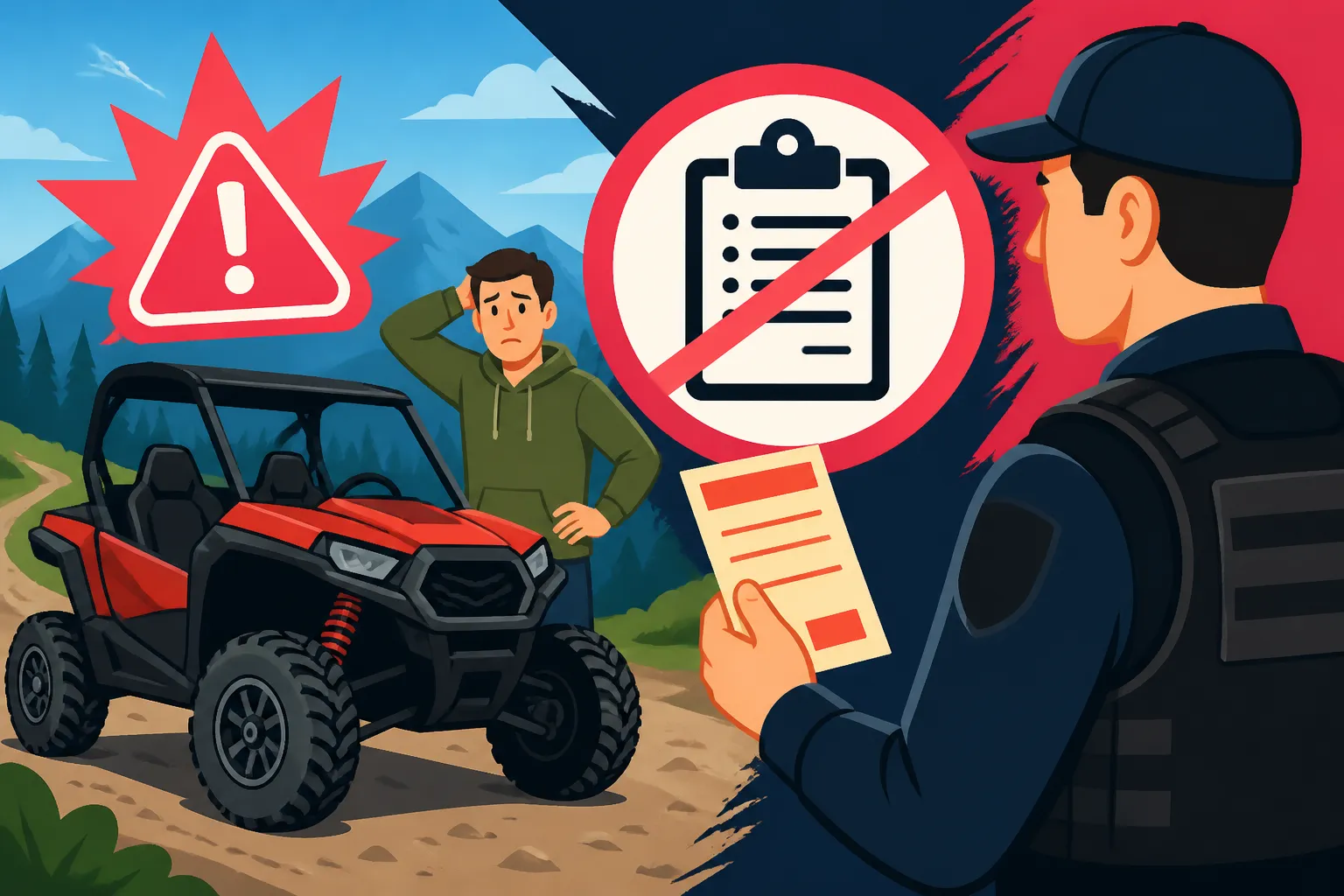
Imagine you've just loaded up your quad, fueled up, and driven a couple of hours out to a beautiful, remote area you've heard about – maybe an old logging road or a vast network of trails. You’re ready for a day of adventure, the air is crisp, and the scenery is breathtaking. You're riding along, feeling completely in your element, perhaps with a buddy just ahead or behind you. Then, a flashing light appears in your rearview mirror, or an officer steps out from behind a parked patrol vehicle. Your heart sinks a little, even if you think you’ve done nothing wrong. This is often how a ticket for an unregistered off-road vehicle (ORV) in British Columbia begins, and it can be a jarring end to an otherwise perfect day.
What Triggers the Ticket?
The primary trigger for needing your ORV registered in BC is riding on what's defined as "Crown Land." Now, this isn't always as obvious as it sounds. Many riders assume Crown Land means only designated provincial parks or vast wilderness areas. However, the definition is much broader and includes pretty much any public land that isn't private property or a public highway. This means most of those fantastic backcountry trails you love, the sprawling open areas you explore, and nearly all the [BC Forest Service Road Rules for ORVs] fall under the Crown Land umbrella. When an officer observes you operating an unregistered machine on any of these areas, that's their cue to check your paperwork.
This includes places like active or inactive resource roads, provincial forests, and designated recreation sites. If you’re riding on land managed by the provincial government, whether for forestry, mining, or public recreation, you are almost certainly on Crown Land. It’s not just about designated ATV parks either; it's about the vast majority of our stunning provincial landscape outside of towns and private holdings. Even if you're just driving a short distance to access a trail, if that short distance is on Crown Land or a resource road, you need to be registered. [BC Crown Land Triggers the Registration Rule] is a crucial concept to grasp.
The provincial government brought in the Off-Road Vehicle Act in 2015 precisely to formalize the use of these machines on public lands. Before that, it was a bit of a Wild West out there, with varying rules and a lot of ambiguity. The Act made it clear: if you’re riding off-highway in a public space, your machine needs to be identified. This helps with accountability, safety, and managing impacts on our shared natural resources.
The Immediate Consequences
So, you’ve been stopped, and your machine is found to be unregistered. What happens right then and there? Typically, you'll be issued a violation ticket. The fine amount for operating an unregistered ORV can be substantial, and it’s a direct hit to your wallet that could have been easily avoided. The officer will record your details, your machine's information, and the nature of the offence. This isn't just a slap on the wrist; it's a formal legal document requiring your attention.
Beyond the immediate financial penalty, there’s the interaction with law enforcement itself. It can be stressful, time-consuming, and puts a damper on your entire day. You might have your trip cut short, especially if the officer deems it unsafe for you to continue riding or if there are other contributing factors like careless operation. While an unregistered machine ticket might not directly lead to points on your driver's license, it’s a recorded infraction that shows non-compliance with provincial laws.
It’s important to remember that enforcement officers, whether from the RCMP, Conservation Officer Service, or other provincial agencies, are there to ensure everyone is following the rules for the safety of all users and the protection of the environment. While the ticket might feel frustrating, it's a consequence of not meeting the legal requirements for operating an ORV in BC.
The Bigger Picture: Why This Rule Exists
You might be thinking, "Why all the fuss over a sticker and a plate?" The provincial government's decision to implement mandatory registration in 2015 wasn't arbitrary. It was a move aimed at bringing order, safety, and accountability to the growing world of off-road vehicle recreation and industry in BC. Before this, tracking ownership of ORVs was often difficult, making it challenging to address issues like theft, environmental damage, and identifying operators involved in accidents.
The registration system helps in several key ways. Firstly, it aids in recovery efforts for stolen machines. With a registered VIN and ownership record, law enforcement has a much better chance of tracking down and returning a stolen ATV or UTV. Secondly, it provides a means of accountability. If a machine is involved in an incident – say, environmental damage, a collision, or reckless operation – the registration allows authorities to identify the owner and address the situation responsibly. This contributes to a safer, more respectful riding environment for everyone.
Finally, registration helps to fund the administration of the ORV Act itself, contributing to trail maintenance, safety education, and enforcement efforts that ultimately benefit the riding community. It’s about more than just a piece of paper; it’s about creating a framework for responsible off-road recreation that balances enjoyment with protection of our shared resources. [BC Registration Became Mandatory in 2015] to address these very issues.
Understanding BC's ORV Registration Law
The landscape of off-road vehicle rules in British Columbia can sometimes feel like a maze, especially with changes introduced in recent years. Many long-time riders, used to a more informal approach, found themselves scrambling to understand the new requirements. It’s easy to get confused, or even to hear conflicting information from well-meaning friends at the trailhead. But when it comes to registration, the rules are quite clear, and understanding them is your first line of defense against an unexpected ticket.
When Did Registration Become Mandatory?
The pivotal moment for ORV registration in British Columbia was November 1, 2015. This is the date the Off-Road Vehicle Act came into full force, making it legally required for nearly all ORVs operated on Crown Land to be registered with ICBC. Before this date, many machines were operated without any provincial record of ownership, leading to the challenges we discussed earlier regarding theft, accountability, and environmental protection.
For riders who had owned their ATVs or UTVs for years, or even decades, this meant a significant change. Suddenly, their trusty machine, which had always been perfectly legal to ride in the backcountry, needed official paperwork. This often led to challenges, especially for older machines where original bills of sale or previous ownership documents were long lost. The province understood these hurdles, which is why methods like [BC Statutory Declaration for an ORV] were introduced to help owners prove continuity of ownership.
The date is important because it marked a clear line in the sand. Any machine operated on Crown Land after November 1, 2015, without proper registration, became subject to violation. It wasn't about catching people out; it was about standardizing an activity that had become incredibly popular across the province, ensuring a baseline of safety and responsibility for all riders.
What Machines Are Covered?
The BC Off-Road Vehicle Act casts a wide net when defining what constitutes an "off-road vehicle" requiring registration. It's not just your typical quad or side-by-side. The Act specifically includes:
- All-Terrain Vehicles (ATVs): This covers your standard four-wheeled quads, whether they are utility machines, sport quads, or youth models.
- Utility Terrain Vehicles (UTVs) or Side-by-Sides: These increasingly popular machines, often with steering wheels and bench seating, are definitely included.
- Dirt Bikes: Off-road motorcycles that are not licensed for highway use fall under the ORV definition.
- Snowmobiles: While they have their own specific seasonal use, snowmobiles are indeed ORVs and require registration if operated on Crown Land.
- Amphibious Vehicles: Any vehicle designed to travel on land and water, if it meets the criteria of an ORV, would need to be registered.
It's crucial to understand that if your machine isn't already registered for highway use under the Motor Vehicle Act (like a dirt bike that's been modified and licensed for the street, or a side-by-side with specific provincial exceptions), then it falls under the ORV Act for off-highway use. There are some specific [BC Registration Exemptions Explained], such as certain agricultural or industrial equipment not primarily designed for recreational use, but for the vast majority of personal recreational machines, registration is a must. Don't assume your specialized vehicle is exempt without checking the regulations thoroughly.
What "Registration" Actually Entails
When we talk about "registration" for an ORV in BC, it's important not to confuse it with the "titling" process common in some other jurisdictions, particularly south of the border. In British Columbia, you do not get a "title" for your off-road vehicle in the same way you would for a car. Instead, what you receive is a Certificate of Registration. [Why BC Does Not Title an ATV] can be a point of confusion for new residents or those familiar with US systems.
The process involves visiting an [BC Autoplan Brokers Handle ORV Registration] office, which is the same place you'd go to insure your car. You'll need to provide proof of ownership for your machine, which can sometimes be the trickiest part, especially for older models. Once registered, you'll be issued:
- A Certificate of Registration: This is your official document proving that your machine is registered. It contains important information about your ORV and your ownership. [BC's Certificate of Registration Explained] goes into detail on what this document contains.
- An ORV Number Plate: This is a distinct plate, smaller than a standard vehicle plate, with a unique identifier. It must be prominently displayed on your machine.
- A Decal: This sticker is issued along with your plate and also needs to be affixed to your ORV.
Unlike passenger vehicles, there is no annual renewal sticker or fee for your ORV registration. Once you register your machine, it's registered for as long as you own it. [BC Registration Lasts as Long as You Own It] which is a pleasant surprise for many. However, if you sell the machine, the new owner must then complete a [BC Transfer of Ownership Explained] to update the registration in their name. This continuity of ownership documentation is vital, as any gap in the ownership chain can create significant headaches for future owners trying to register the machine.
The Places Where Registration is Required and Where It's Not
The biggest hurdle for many ORV riders in BC isn't necessarily the act of registration itself, but rather understanding where and when it's actually required. The rules aren't blanket; they depend heavily on the type of land you're operating on. Misunderstanding these distinctions is a common reason why riders find themselves with an unregistered machine ticket. Let's clear up some of that confusion.
Crown Land: The Primary Trigger
As we’ve touched on, Crown Land is the dominant factor determining whether your ORV needs to be registered. If you are operating your ATV, UTV, dirt bike, or snowmobile on any land owned by the provincial government, registration is mandatory. This includes the vast majority of recreational riding areas across British Columbia. Think about all those incredible trails, the expansive backcountry, and the resource roads that crisscross our province – these are almost universally Crown Land.
This isn't just about formally designated "off-road vehicle areas." It encompasses a huge percentage of BC's land mass. For example, [BC Forest Service Road Rules for ORVs] specifically state that you need registration to ride on these roads, as they are considered Crown Land. The same applies to most multi-use trails, areas managed by Recreation Sites and Trails BC, and any undeveloped public land. If you're heading out for a day of exploration and you're not on private property, assume you're on Crown Land and thus require registration.
Ignoring this rule not only puts you at risk of a ticket but also contributes to the perception of irresponsible riding, which can unfortunately lead to further restrictions on access for all ORV enthusiasts. Compliance helps everyone enjoy these incredible natural spaces.
Private Land: Your Own Backyard Exception
Here's where the rules change significantly. If you are operating your ORV exclusively on private land, you generally do not need to have it registered under the BC Off-Road Vehicle Act. "Private land" means property that is privately owned and not accessible to the public, like your own acreage, a friend's farm, or a leased industrial site where you have specific permission to ride.
For instance, if you have a quad that you only ever use on your own sprawling ranch in the Cariboo, for tasks like checking fences or herding cattle, and it never leaves your property onto a public road or Crown Land, then registration isn't required. The same applies if you're taking your kids for a spin on a closed-course track on private land. This is the "backyard" exception, and it's a common scenario for many rural residents. [BC Private Land and the Registration Question] explores this in more detail.
However, even on private land, you still have responsibilities. You must have the landowner's permission to ride there, and you are still subject to general laws regarding careless operation, noise bylaws, and environmental protection. Just because it's private land doesn't mean it's a free-for-all. Also, be mindful of any specific covenants or strata rules if your private land is part of a larger community.
Highway Crossings and Parking Lots
This is another common point of confusion. What if you need to cross a paved road or move your ORV in a parking lot to get to a staging area? The BC Off-Road Vehicle Act is very specific about interactions with public highways. Generally, ORVs are not permitted to be operated on highways. Highways are defined broadly and include the paved sections, shoulders, and ditches of provincial and municipal roads.
However, the Act does allow for very limited, specific exceptions for crossing a highway or using a highway shoulder for short distances to access a trail or private property. These crossings must be made safely, at right angles to the highway, and only when safe to do so. You cannot simply ride your ATV down the road to the next trailhead. [BC Rules for Crossing a Highway] lays out the specifics. If you are on a highway, even for a short cross, you generally need to have a driver's license and [BC Basic Autoplan on a Quad].
When it comes to parking lots, particularly those associated with trailheads or staging areas, the rules can be a bit ambiguous. If the parking lot is on Crown Land or is a publicly accessible lot, you're generally expected to have your machine registered even for the short distance of loading or unloading. However, if it's a completely private parking lot, like at a small resort or a friend's cabin, the private land rules might apply. Always err on the side of caution: if you're moving the machine under its own power in any publicly accessible area, having it registered is the safest bet to avoid an unregistered machine ticket.
| Location Type | Registration Required? | Notes |
|---|---|---|
| Crown Land (FSRs, Trails) | Yes | Includes most backcountry, resource roads, provincial forests. Primary trigger for registration. |
| Private Land (Your Property) | No | If used exclusively on private property with owner's permission. |
| Highway Crossing | Yes, if briefly driven | For brief, direct crossings. Basic Autoplan and driver's license likely required on pavement. |
| Public Parking Lot | Yes | If on public or Crown land, even for loading/unloading. |
| Managed OHV Site | Yes | Dedicated riding parks and recreation sites on Crown Land. |
| Leased Crown Land | Yes | Even if leased to a private entity, still considered Crown Land for ORV registration purposes. |
Beyond the Fine: Other Penalties and Complications
While the immediate sting of an unregistered machine ticket is typically a financial fine, the potential repercussions for operating an unregistered ORV in British Columbia can extend far beyond that initial penalty. Many riders don't realize that failing to comply with the ORV Act can lead to more severe consequences, including the potential loss of their machine, additional costs, and even future legal complications. It's not just about a single fine; it's about the broader implications for your property and your riding privileges.
Machine Seizure: A Real Possibility
One of the most serious consequences of operating an unregistered ORV, particularly if you are also engaged in other infractions or if it's a repeated offence, is the seizure of your machine. Yes, law enforcement officers in BC have the authority under the Off-Road Vehicle Act to impound your ATV, UTV, or dirt bike if it's being operated illegally, including if it's unregistered. This isn't a common occurrence for a first-time, standalone unregistered offence, but it absolutely can happen, especially if there are aggravating circumstances.
Imagine the scenario: you're ticketed for no registration, but you also don't have a valid driver's license, or you're riding in a prohibited area, or perhaps the officer suspects the machine is stolen (even if it isn't). In such cases, they may decide to impound the machine on the spot. This means your pride and joy is loaded onto a tow truck, taken to an impound yard, and you're left stranded, likely miles from home. It's a hugely disruptive and often humiliating experience that most riders would desperately want to avoid.
The power of [BC Seizure Powers Under the ORV Act] is a strong deterrent, meant to ensure compliance and uphold safety standards on Crown Land. It highlights that the provincial government takes ORV regulations seriously, and simply paying a fine might not be the end of your worries.
Impoundment Costs and Storage Fees
If your machine is seized, the financial pain doesn't stop with the violation ticket. Oh no, that's just the beginning. You will be responsible for all costs associated with the impoundment and storage of your ORV. This includes:
- Towing Fees: Getting your machine from the point of seizure to an impound lot can be expensive, especially if you're in a remote area.
- Storage Fees: Impound lots charge daily storage fees, which can quickly add up. The longer your machine sits there, the more you owe. These fees can escalate rapidly, making a relatively small initial fine seem trivial in comparison.
- Administrative Fees: There may be additional fees charged by the impound lot or the enforcing agency for processing the impoundment and release.
To get your machine back, you'll not only have to pay all these accrued fees but also typically have to resolve the initial infraction – meaning, you might need to show proof that the machine is now registered or that you've paid the ticket. Sometimes, the impoundment period itself is set for a minimum duration, regardless of how quickly you resolve the issue. These costs can easily dwarf the original fine, turning a few hundred dollars into thousands. This is a very real, and very unpleasant, consequence of non-compliance.
Future Riding Restrictions and Legal Troubles
Beyond the immediate financial and logistical headaches, an unregistered machine ticket, especially if it's not your first brush with ORV regulations, can lead to more far-reaching legal troubles. While a single unregistered machine ticket might not directly impact your driver's license or future ORV privileges in a broad sense, repeated offences can certainly flag you as a non-compliant operator.
If you accumulate several tickets for various ORV infractions, including registration, you could face stricter scrutiny from enforcement. In severe cases, or if combined with other violations like impaired operation or significant environmental damage, the penalties can escalate to higher court fines and even potential restrictions on your ability to operate ORVs in the province. [BC Impaired Riding and the Criminal Code] highlights how serious other offences can become. While this might seem extreme for just an unregistered machine, it underscores the importance of taking all ORV regulations seriously.
Ultimately, consistent disregard for the rules can jeopardize the reputation of the entire riding community and lead to more restrictive regulations for everyone. Being a responsible rider means understanding and adhering to all facets of the ORV Act, not just avoiding the most obvious infractions.
How to Avoid an Unregistered Machine Ticket
Nobody wants a ticket, especially when it's easily avoidable. The good news is that preventing an unregistered machine ticket in BC is straightforward. It primarily involves understanding the rules, taking a few proactive steps, and consistently carrying the right documentation when you ride. Think of it as your riding checklist – just as you wouldn't head out without checking your fuel or tire pressure, you shouldn't hit the trails without ensuring your paperwork is in order.
Registering Your Machine: Step-by-Step Guide
The most foolproof way to avoid an unregistered machine ticket is, quite simply, to register your machine! The process isn't overly complicated, but it does require some preparation. Here's a general guide:
- Gather Your Documents: This is often the trickiest part, especially for older machines. You'll need proof of ownership. This usually means a bill of sale from the previous owner, tracing back through previous owners if necessary, to prove a clear chain of ownership. If you've lost bills of sale or bought a machine years ago with just a handshake, you might need a [BC Statutory Declaration for an ORV]. This is a sworn statement, often prepared with resources like those found on LawDepot, attesting to your ownership. You'll also need personal identification.
- Locate a Broker: ORV registration is handled by ICBC Autoplan brokers, the same folks who deal with your car insurance. You can find nine hundred brokers province-wide, so there's likely one conveniently located near you. Not all brokers are equally experienced with ORV registration, so it can sometimes be helpful to call ahead and confirm they handle them regularly. [Where to Find an Autoplan Broker Near You] can help you with this.
- Visit the Broker: Bring all your paperwork and your personal identification. The broker will guide you through the forms and verify your documents. They may also need to visually confirm the Vehicle Identification Number (VIN) on your machine, so it's a good idea to know where your VIN is located and perhaps even have a clear photo of it.
- Pay the Fee: There is a one-time registration fee. Compared to the cost of a ticket, it’s a minor expense. [BC ORV Registration Cost] is a small investment for long-term peace of mind.
- Receive Your Documents and Plate: Once processed, you'll get your Certificate of Registration, your ORV number plate, and a decal. Make sure to affix the decal to your machine and mount the plate properly. [BC Plate Placement on Front, Back or Left] outlines the requirements.
Once registered, your machine is registered for life (or for as long as you own it). There are no annual renewal fees or stickers, which makes it incredibly convenient. [How to Register an ATV in BC] provides a deeper dive into this process.
Carrying Your Papers: Essential On Every Ride
Getting your machine registered is only half the battle. The other crucial step is ensuring you always carry the necessary documentation with you when you ride. It doesn't matter if your machine is perfectly registered if you can't prove it to an enforcement officer.
You must carry your Certificate of Registration with you every time you operate your ORV on Crown Land. This isn't optional; it's a legal requirement. It's often recommended to keep the original in a waterproof bag in a secure compartment on your machine, or a high-quality laminated copy. You should also carry valid photo identification, like your driver's license. [BC Riders Must Carry the Certificate] and [BC Riders Must Carry Photo ID] are non-negotiable rules.
Many riders keep these documents in a small, waterproof pouch that's easily accessible on their machine or in their riding gear. Imagine getting stopped, having your machine registered, but realizing your certificate is sitting on your kitchen counter at home. That could still lead to an unregistered machine ticket, or at the very least, a significant delay and inconvenience while the officer attempts to verify your registration. Don't let a simple oversight undo all your proactive efforts.
Understanding Out-of-Province Rules
If you're visiting British Columbia from another province or country and plan to ride your ORV on Crown Land, you need to understand the rules that apply to you. It's a common misconception that your home province's or state's registration is automatically valid in BC. While BC generally recognizes ORV registrations from other jurisdictions, there are specific conditions.
For visitors from Alberta, for example, their Alberta registration is typically recognized. However, for those from jurisdictions that do not have a formal ORV registration system, you must be able to prove ownership. This might mean carrying a bill of sale, or a formal document like a Certificate of Origin. [BC Riders From Alberta Use Alberta Plates] and [BC Riders From Washington Use Home Plates] are examples of how BC handles out-of-province visitors.
The key takeaway for any out-of-province visitor is this: do your homework before you arrive. Contact BC's ICBC or check the provincial government's ORV Act resources to confirm exactly what documentation you need to carry. An unregistered machine ticket will ruin your vacation just as quickly as it would a local's day trip, and ignorance of the law is not an acceptable defence.
Disputing an Unregistered Machine Ticket
Receiving an unregistered machine ticket can be incredibly frustrating, especially if you believe you were compliant or if there were extenuating circumstances. While it's always best to avoid a ticket in the first place, understanding your options for disputing one is important. It's your right to challenge a violation if you believe it was issued in error or unjustly.
Reviewing the Violation Ticket
The very first step when you receive a violation ticket for an unregistered machine is to thoroughly review the ticket itself. Don't just glance at the fine amount and put it away. Look for:
- Accuracy of Information: Is your name spelled correctly? Is the machine's VIN and description accurate? Are the date, time, and location of the alleged offence correct? Any significant inaccuracies could be grounds for disputing the ticket.
- Offence Description: Does the ticket clearly state the section of the Off-Road Vehicle Act you are alleged to have violated? Understanding the specific charge is crucial for building your defense.
- Officer's Notes: Sometimes, there are brief notes from the officer. Read them carefully.
- Instructions for Disputing: The ticket will always contain instructions on how to dispute the charge, including deadlines. Pay close attention to these, as missing a deadline can result in the ticket being upheld automatically.
It's common for tickets to have minor errors that don't necessarily invalidate them, but a pattern of inaccuracies or a fundamental error in the charging information could be significant. Take a clear photo of the ticket as soon as you receive it, and make sure to note the date and time you received it.
Gathering Your Evidence
If you decide to dispute the ticket, you'll need to gather evidence to support your claim. This is where your proactive efforts (or lack thereof) will really come into play.
- Proof of Registration: If you were ticketed for an unregistered machine but it was actually registered at the time of the offence (perhaps you just didn't have the certificate on you), your most vital piece of evidence will be your valid Certificate of Registration from ICBC. Make sure it clearly shows the date of registration and matches your machine's VIN.
- Witness Statements: If you were riding with others, and they can corroborate your story or specific circumstances, their written statements can be helpful. For example, if they witnessed you attempting to show the officer a valid registration that was later dismissed.
- Photos/Videos: If you have photos or videos of the incident, the location, or your machine (showing the plate and decal), these could be useful. For instance, if the ticket states you were on Crown Land but you believe you were on private property, photos of property markers or GPS data could be relevant.
- Correspondence: Keep records of any communication with ICBC or the enforcing agency regarding your registration status.
Building a strong case means being organized and having concrete proof. Remember, the burden of proof is generally on the prosecution, but you need to demonstrate why their case is flawed or why you meet the legal requirements. Utilizing templates or guides, potentially from resources like LawDepot, for drafting formal letters or statements can help ensure your documentation is clear and professional.
The Process: From Notice to Court
Once you've decided to dispute and have gathered your evidence, here's a general overview of what the process might look like:
- File Your Dispute: Follow the instructions on the violation ticket to formally notify the court that you intend to dispute the charge. This usually involves mailing in a specific form or using an online portal, always adhering to the specified deadline.
- Notice of Hearing: After you've filed your dispute, you will eventually receive a Notice of Hearing, informing you of the date and time your case will be heard in Provincial Court. This could take several months, as court dockets are often busy.
- Prepare for Court: On the day of your hearing, you will appear before a Justice of the Peace or a Provincial Court Judge. The officer who issued the ticket will also be there to present their side of the story. You will have the opportunity to present your evidence and explain your defense.
- Outcome: The Justice or Judge will hear both sides and make a ruling. They might dismiss the ticket, reduce the fine, or uphold the ticket. If the ticket is upheld, you will be responsible for the fine and potentially court costs. If dismissed, you walk away with no penalty.
It's a formal process, and while you don't need a lawyer for a simple violation ticket, being prepared and respectful in court is paramount. Sometimes, if you show up with compelling evidence of your registration, the officer or prosecutor might agree to drop the charge before it even gets to a hearing.
The True Cost of an Unregistered Machine
When you're out on the trails, the last thing you want to think about is bureaucracy and fines. But an unregistered machine ticket isn't just a random bit of bad luck; it's a consequence with real, tangible costs that often far outweigh the simple upfront fee of registration. Many riders make the mistake of viewing registration as an unnecessary hassle, failing to consider the true financial, emotional, and practical toll that non-compliance can inflict.
Comparing the Fine to Registration Costs
Let's do a quick comparison to really drive this home. The cost to register an ORV in British Columbia is a one-time fee. It's a single payment that covers your machine for as long as you own it, with no annual renewals or recurring charges. We can't give you the exact current number, but we can tell you it is a relatively modest amount, certainly less than a dinner out for two. [BC ORV Registration Cost] is truly minimal when you consider the lifespan of your machine.
Now, compare that to the cost of an unregistered machine ticket. These fines can be several hundred dollars. If you get one ticket, you've already paid many, many times over what you would have spent on registration. If you get two tickets – perhaps in different locations or on different days – you've basically thrown away a significant sum of money that could have been used for fuel, gear upgrades, or another riding trip. This is the classic "penny wise, pound foolish" scenario, where trying to save a small, one-time fee ends up costing you a substantial amount in fines.
Moreover, the financial pain of a ticket doesn't stop with the fine itself. You might have to take time off work to dispute it, pay for transportation to court, or even face the impoundment costs we discussed earlier. All of these add up, making the initial registration fee look like an absolute bargain.
Hidden Costs of Non-Compliance
Beyond the direct financial hit, operating an unregistered machine carries a host of "hidden" costs that can take a toll:
- Stress and Anxiety: The feeling of being caught, the uncertainty of what comes next, and the process of disputing a ticket can be incredibly stressful. It takes away from the enjoyment of your hobby and can linger in your mind long after the incident.
- Time Commitment: Disputing a ticket, even if successful, requires a significant investment of your time. This includes gathering documents, making phone calls, potentially visiting a broker, and attending court. Your time is valuable, and these hours are essentially lost due to non-compliance.
- Legal Fees: While you can dispute a ticket yourself, some people choose to seek legal advice. This is an additional cost that skyrockets the expense associated with an unregistered machine.
- Loss of Riding Time: If your machine is impounded, you're obviously not riding it. Even if it's not seized, the disruption and paperwork can put a serious damper on your riding plans, potentially ruining a long-awaited weekend trip.
- Reputational Damage: While not always quantifiable, repeated infractions or severe incidents can damage your personal reputation within the riding community or even with local authorities. This can have long-term impacts on how you're perceived.
These hidden costs often hit harder than the fine itself because they erode your peace of mind and steal your valuable time. The total price you pay for not registering your machine is almost always much higher than the registration fee, making it a truly unwise choice.
Peace of Mind: The Unquantifiable Benefit of Compliance
Perhaps the most significant, yet unquantifiable, benefit of having your ORV properly registered is the peace of mind it provides. When you know your machine is legal, you can head out to the trails, resource roads, and recreation sites with confidence. You don't have that nagging worry in the back of your mind every time you see a patrol vehicle or an enforcement officer.
This peace of mind allows you to fully immerse yourself in the experience of off-road riding – enjoying the scenery, the challenge of the terrain, and the camaraderie of your riding partners. You can focus on what you love about the sport, rather than being constantly on edge about potential legal trouble. This feeling of security is invaluable and allows you to truly relax and enjoy the incredible opportunities for ORV recreation that British Columbia offers.
Ultimately, registering your machine is a simple, one-time step that not only keeps you on the right side of the law but also protects you from significant financial penalties, time-consuming disputes, and unnecessary stress. It's a small investment for a major return in hassle-free enjoyment of your off-road adventures.
Disclaimer
This article is for general informational purposes only and does not constitute professional advice. Laws, prices and regulations vary by location and change over time. Consult a qualified professional for guidance on your specific situation.