Visiting From a Province That Registers Nothing
A visitor bringing an ATV or side-by-side to British Columbia may find that their home province does not register off-road machines at all. That does not necessarily mean the machine must be registered in BC, but it does mean you should be ready to show why you qualify for the visitor exemption and prove who owns the machine.
Does a visitor from a province without registration need BC registration?
BC’s off-road vehicle rules distinguish between BC owners and visitors from elsewhere. A visitor may be exempt from BC registration when the machine is not required to be registered in the jurisdiction where the owner lives. That matters for someone whose home province has no registration system for the type of ATV or UTV they are bringing.
The exemption is not the same as registering the machine in BC, and it does not make the machine legal to ride in every place. It concerns registration. You still need to meet the rules for the land or road you use, carry suitable proof of ownership, and comply with applicable safety and insurance requirements.
The key question is not simply whether your machine has a plate. It is whether your circumstances fit BC’s rules for non-residents. Be prepared to establish that:
- You live outside British Columbia.
- The machine is owned by you, or you have permission to use it.
- Your home jurisdiction does not require that machine to be registered.
- You are visiting rather than treating the machine as a BC-based vehicle.
Do not assume that “my province has no ATV registration” settles the question on its own. The rule may depend on the machine, the owner’s residence, how long it will be used in BC, and the wording of the current exemption. Check the current provincial requirements before travelling, especially if you are near a visit-duration limit or your situation is unusual.
This is different from a BC resident riding an unregistered ATV. BC’s registration rules generally apply to residents using an off-road vehicle in places covered by the law, including Crown land. The visitor exemption is a specific allowance for qualifying non-residents, not a general way to avoid registration. For the broader framework, see BC Non-Resident Riding Rules and BC’s Rule Keys on Whether Home Has a Registry.
Registration exemption does not mean unrestricted riding
Even when a visitor does not need BC registration, they are not automatically allowed to use highways, trails, resource roads, private property, or managed recreation sites. Each place can have its own conditions.
For example, a trail or recreation site may require a pass, restrict machine types, set noise limits, or close access seasonally. A private landowner’s permission may be needed for private land. Resource roads can have industrial traffic and separate operating requirements. A machine that qualifies for a visitor registration exemption can still be prohibited from a particular road or trail.
Keep the two questions separate:
- Does the machine need to be registered in BC? This is about your residence, your machine, and the registration rules.
- May you ride in this location, and what rules apply there? This is about access, permits, road use, insurance, safety equipment, and any local restrictions.
For an overview of the places where registration can matter, read BC Crown Land Riding Explained. To understand why some roads fall under that framework, see BC Resource Roads Count as Crown Land.
What to carry to show you qualify
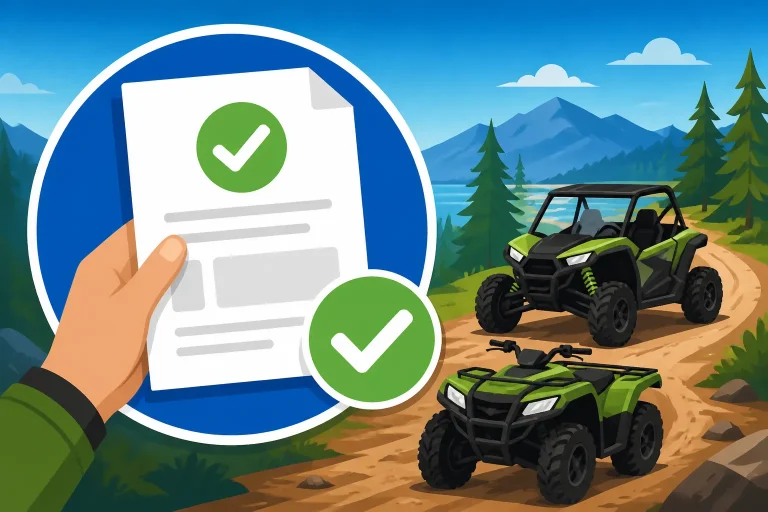
A visitor from a province without an ORV registration system may not have a registration certificate or plate to present. That makes it especially useful to carry clear documents that establish your identity, residence, and ownership.
Pack the documents before leaving home. A sensible set includes:
- Photo ID: Carry current identification that shows your name and supports your claim that you live outside BC. The name should match the ownership paperwork where possible.
- Proof of ownership: Bring a bill of sale, dealer invoice, gift document, estate paperwork, or other record showing how you acquired the machine.
- Machine details: Write down the make, model, year if known, and vehicle identification number or serial number. Take a clear photo of the number stamped on the machine.
- Evidence of the home-jurisdiction rule: If readily available, carry a government page or other reliable information showing that your home jurisdiction does not require registration for that class of machine. Do not rely only on a verbal explanation if you can document the point.
- Permission to use the machine: If you are borrowing it, carry written permission from the owner, along with the owner’s contact information.
- Insurance information: Carry the policy documents or proof of coverage relevant to the places where you plan to ride.
A sales receipt is still valuable even when a registration certificate is not available. It connects the machine to you and can help answer questions about its ownership history. If you bought the ATV second-hand and the seller had no paperwork, gather whatever records you can before the trip. The steps in BC Proof of Ownership for Visitors and BC Machines With No Paperwork can help you think through the documentation issue.
Make the documents easy to show
Keep digital copies on your phone and a paper copy in a dry bag or vehicle. A phone copy is convenient, but remote areas may have little or no cell service, and batteries can run down. If the machine is transported on a trailer, keep a copy of the paperwork in the tow vehicle rather than relying on a document stored somewhere inaccessible.
Make sure the VIN or serial number on your paperwork matches the machine. These numbers can be difficult to read because of dirt, wear, accessories, or an awkward location. Photograph the number clearly before departure and keep the picture with the ownership documents. If you cannot find a number, do not scrape, grind, or alter the area; ask a broker or the relevant authority how to proceed.
If the machine belongs to a family member, a short signed permission letter can prevent confusion about who owns it and who is allowed to operate it. If the ownership changed hands more than once, keep the available transfer records together rather than presenting disconnected documents without explanation. BC’s process can require a clear ownership history for a BC registration application, but a visiting machine should not be treated as though it automatically needs that application. See BC Registration and Proof of Address for related paperwork considerations.
The rules that still apply after the registration question
A visitor’s registration exemption does not replace other BC requirements. Before riding, check the rules for the specific route, road, or site and make sure the machine and its operator are ready for them.
Land access and road use
Confirm that motorized riding is permitted where you plan to go. Public access does not always mean motorized access, and a route that appears on a map may be closed by a sign, a seasonal restriction, active work, or a local rule. Permission is also needed to ride on private land unless the owner has clearly allowed access.
Forest Service roads deserve particular attention. Some are used by logging trucks and other industrial traffic, and conditions can change quickly. Check posted restrictions before entering, follow the road’s radio practices where applicable, and yield appropriately to industrial vehicles. The requirements for riding on a Forest Service road are not necessarily the same as those on an ordinary trail; see BC Forest Service Road Requirements.
A highway is a separate issue. An ATV or UTV that can be registered for off-road use is not automatically street legal. Do not ride along a highway or on its shoulder just because the machine is registered at home, has a plate, or is covered by insurance. Limited crossings and other permitted uses have their own conditions. Read Can You Ride an ATV on the Road in BC? before planning any route that touches pavement.
Insurance
Registration and insurance are different questions. A visitor may be exempt from BC registration and still need appropriate liability coverage for the place they ride. In particular, Forest Service roads can have specific insurance requirements. Check your policy wording and confirm that coverage applies to the machine, the operator, and the type of road or land involved.
Do not assume that a home policy covers every use in BC. Ask your insurer directly whether the policy provides the required liability protection for off-road use, including use on resource roads if that is part of the plan. Carry proof of coverage and know what the document actually covers. BC ATV Insurance Requirements explains the distinction between coverage requirements in different riding settings.
Helmets and passengers
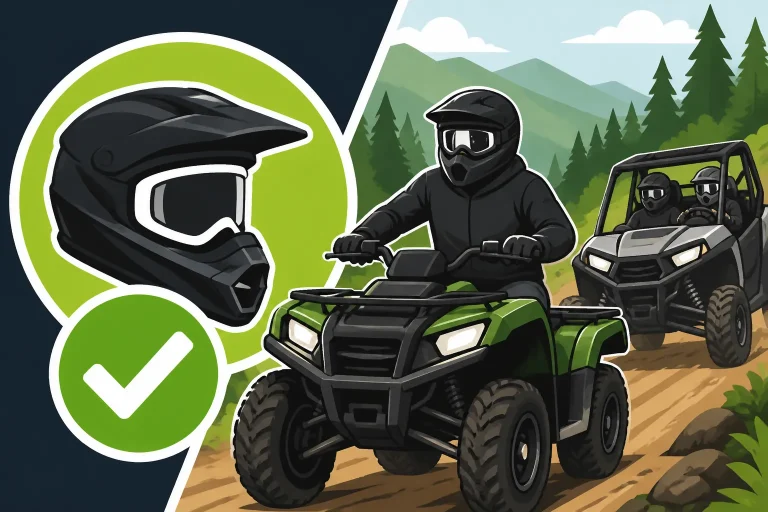
BC safety rules still apply to visitors. Helmet requirements depend on the type of machine and its protective features. A ride-astride ATV generally calls for an approved helmet; a side-by-side with a seat belt and protective enclosure may be subject to different rules. Check the requirements for your machine rather than relying on what is customary at home. See BC ATV Helmet Law Explained and BC Seat Belt Rules on a Side-by-Side.
Passengers must also fit the machine and its manufacturer’s guidance. A seat that looks large enough is not proof that the vehicle is designed to carry another person. Pay special attention to child passengers, age limits, and youth supervision requirements. More details are in BC Rules for Passengers on a Quad.
Fire conditions and site rules
Fire restrictions can affect whether riding is allowed, even when the machine is registered or exempt. Restrictions may apply to an area, a season, or particular activities and can change as conditions develop. Check current notices before driving to a trailhead, then look for signs on arrival. A route that was open on an earlier trip may not remain open.
Managed recreation sites can also set their own conditions, such as a required pass, machine restrictions, sound limits, or rules for staging and camping. A pass is not a substitute for registration, and an exemption from registration does not waive a site’s pass requirement. Check the operator’s current instructions for the exact location.
A practical check before you cross the border
Use this checklist to catch the common gaps while there is still time to fix them.
- Confirm your residence. The visitor rule is tied to being a non-resident. Make sure your identification and other records support where you live.
- Check the rule for your machine in your home province. Confirm that the machine class is not required to be registered there. If your province registers some ORVs but not others, check the rule for your particular type.
- Check BC’s current visitor exemption. Confirm any conditions or time limits that apply to non-residents. If the wording is unclear, ask an official source or a qualified local professional before riding.
- Gather ownership records. Bring the purchase document or another record linking the machine to its owner. If you are borrowing it, bring written permission.
- Record the VIN or serial number. Check that it is legible and matches the paperwork. Keep a photo with your documents.
- Review insurance. Confirm coverage for BC and for any Forest Service roads or other routes on your itinerary.
- Plan legal routes. Check closures, private land access, road restrictions, trail passes, and seasonal conditions.
- Check equipment and rider rules. Confirm helmet or seat-belt requirements, lighting where relevant, passenger limits, and youth supervision rules.
- Carry documents in more than one form. Keep digital copies and paper copies, and do not rely on cellular service in a remote area.
- Explain the situation plainly if asked. State that you are a visitor, identify where you live, explain that your home jurisdiction does not require registration for the machine, and show the records you brought.
| Question | What to verify | What to carry or do |
|---|---|---|
| Does the machine need BC registration? | Whether the visitor exemption applies to your residence and machine | ID and information supporting the home-jurisdiction rule |
| Can you prove ownership? | Whether the available documents connect the machine to its owner | Bill of sale, invoice, gift record, or written permission |
| Can you ride the planned route? | Access, closures, road restrictions, and site rules | Current route information and any required site pass |
| Is your insurance suitable? | Coverage for the type of land or road you will use | Policy details and proof of coverage |
| Are the machine and riders compliant? | Helmet, seat belt, passenger, and youth rules | Proper equipment and a suitable operating plan |
When a BC registration application may still be relevant
A visitor exemption is not a solution for every situation. If you become a BC resident, keep the machine in BC, or use it in a way that no longer fits the visitor conditions, you may need to consider the ordinary BC registration rules. A machine with an unclear ownership history can also require extra steps if a BC registration application becomes necessary.
If you are moving to BC rather than visiting, use the process for new residents and gather the documents needed to establish the machine’s ownership. BC ATV Registration for a New Resident covers that separate situation. If you are only travelling through or visiting, do not apply for BC registration automatically just because your home jurisdiction does not issue an ORV plate. First confirm whether the visitor exemption applies to you and whether the riding locations impose any separate requirements.
Frequently Asked Questions
Does a visitor from a province with no ATV registry need a BC plate?
Not necessarily. A non-resident may qualify for an exemption when their home jurisdiction does not require registration for the machine. Confirm the current conditions and any time limits before riding.
What if I have no registration paper to show?
Carry proof of ownership, photo ID showing that you live outside BC, and information supporting the absence of a home-jurisdiction registration requirement. A bill of sale or other acquisition record is useful even when no registration document exists.
Does the exemption let me ride on any BC trail or road?
No. It addresses registration, not access. You must still follow road restrictions, landowner permission requirements, trail or site rules, seasonal closures, and safety and insurance requirements.
Do I need insurance if the machine is exempt from registration?
Registration and insurance are separate. Confirm what coverage is required for the places you intend to ride, especially if your route includes a Forest Service road, and carry proof of applicable coverage.
What should I do if an officer questions the machine’s registration?
Stay calm, explain that you are visiting from outside BC and that your home jurisdiction does not require registration for the machine, then show your ID and ownership records. If you are unsure whether the exemption applies, resolve that question before riding rather than relying on an assumption.
Disclaimer
This article is for general informational purposes only and does not constitute professional advice. Laws, prices and regulations vary by location and change over time. Consult a qualified professional for guidance on your specific situation.