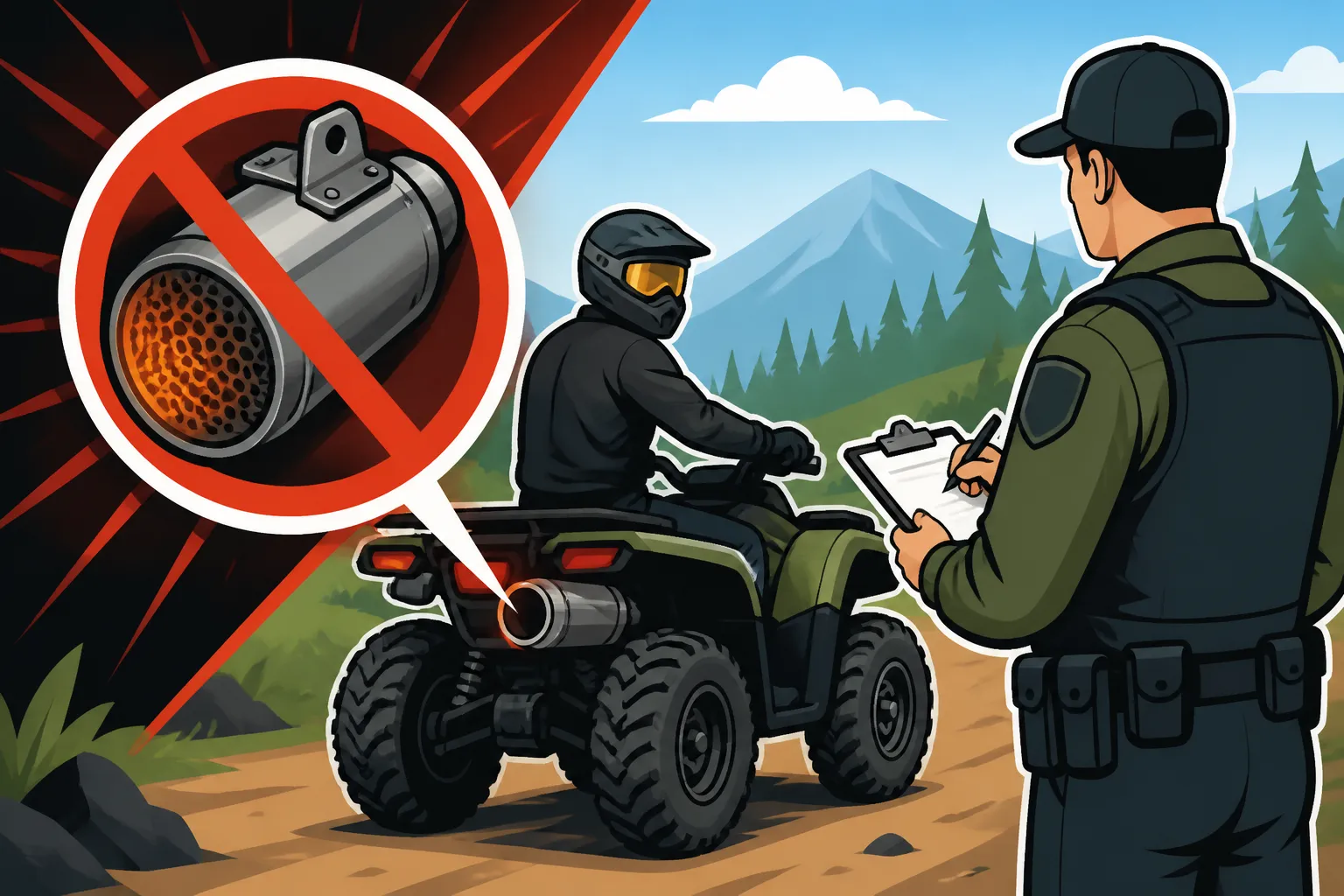
BC Spark Arrestor Tickets at $460
A spark arrestor is a small part of an ATV or UTV’s exhaust system, but riding without one can create both a fire risk and a ticket risk in British Columbia. The challenge is knowing what counts, where the requirement applies and how to check a machine before a ride. Here’s how to prepare—and what to do if an officer questions your equipment.
What BC’s spark arrestor rule means for ATV and UTV riders
A spark arrestor is designed to help stop hot particles from leaving an engine’s exhaust and igniting dry vegetation. It does not make a machine fireproof, and it does not replace other wildfire precautions. It is one part of reducing the chance that a machine will start a fire.
In BC, riders need to pay attention to the spark arrestor requirement when operating off-road vehicles in forested areas. The relevant rules are part of the province’s wildfire regulations. The details can depend on the machine and the place where it is being used, so confirm the current requirements before you ride, especially if you are travelling to a different area or riding during a period of heightened fire danger.
For riders, the practical takeaway is simple: do not assume a machine is compliant just because it is new, has a muffler or sounds quiet. A muffler reduces exhaust noise; a spark arrestor is intended to limit sparks and hot particles from the exhaust. One component may be integrated with another, but a quiet exhaust alone does not demonstrate that the required arrestor is present.
The rule also isn’t a general riding permit. A spark arrestor does not authorize you to ride on a closed road, enter a prohibited area or use a trail where motorized vehicles are not allowed. Fire restrictions and access restrictions can be separate from equipment requirements. Before a trip, check both the equipment rules and the current status of the area. BC Spark Arrestor Rules and Fines explains the broader rule and possible consequences, while BC Fire Centre Closures for ORVs covers closures that may affect where you can ride.
Why the rule matters even when fire danger seems low
An ATV or UTV can be used on dry grass, brush, forest roads and trails where a small ignition source may have serious consequences. Conditions change during a ride: a shaded route can lead into exposed ground, and vegetation that looked damp in the morning may dry in wind or sun. A working arrestor helps reduce one potential ignition source, but riders still need to avoid careless operation and follow any active restrictions.
The requirement is not just about a machine’s general condition. The exhaust part must be present and in suitable working order. A screen that is missing, damaged, altered or clogged may not provide the protection it is meant to provide. If your machine has been modified, do not rely on a seller’s assurance or the fact that it passed an informal check somewhere else. Confirm that the current exhaust setup meets the rules for where you plan to ride.
Spark arrestor compliance is also separate from registration, insurance and access passes. A registered machine may still be missing required equipment. A trail pass does not replace legal compliance, and a visitor’s home-province registration does not exempt a machine from BC’s operating rules. Riders coming from another province can read BC Non-Resident Riding Rules and BC Riders From Alberta Use Alberta Plates for the separate reciprocity questions.
The ticket amount is not the whole compliance picture
The title amount of $460 refers to a listed ticket amount associated with a spark arrestor offence. Ticket schedules and enforcement details can change, so check the current official information before relying on a particular figure. Other penalties may apply under different circumstances, and the consequences of a wildfire-related offence can be more serious than a single violation ticket. [BC Spark Arrestor Fines] and How an Administrative Penalty Differs From a Court Fine describe the distinction between ticket amounts and other potential penalties.
A ticket is not the only reason to inspect the exhaust. A missing or damaged arrestor can increase the chance of sparks escaping, while an improperly fitted part may fail when it is needed. Treat a ticket amount as a warning, not as a fee that buys permission to ride without the equipment.
How to check whether your machine has a spark arrestor
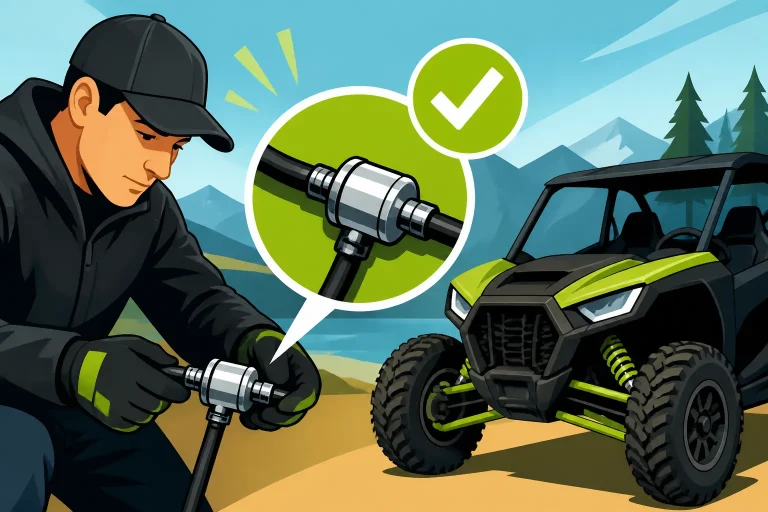
Start with the owner’s manual and the machine’s exhaust specifications. The manual may identify an original spark arrestor, its maintenance requirements and the correct replacement part. If the machine has an aftermarket exhaust, check the documentation for that exact system rather than assuming the original specification still applies.
A screen or arrestor may be inside the exhaust outlet or muffler assembly, so a quick look at the outside of the machine may not settle the question. Do not take apart a hot exhaust system. Let it cool completely, then follow the manufacturer’s instructions or ask a qualified repair shop to inspect it. If the exhaust has been modified and you cannot establish what is installed, have the system checked before riding in a place where the requirement applies.
Useful checks include:
- Find the machine and exhaust model information. Record the make, model and year, then identify whether the exhaust is original or aftermarket.
- Consult the manual or manufacturer’s specifications. Look for spark arrestor information and maintenance instructions for that exact exhaust.
- Inspect for obvious damage or alterations. Look for a missing part, a loose fitting, visible damage or evidence that the exhaust has been changed.
- Check the arrestor according to the manufacturer’s procedure. Some designs require periodic cleaning or inspection. Avoid guessing about mesh size or replacing parts with an improvised screen.
- Get an uncertain system checked before the trip. A dealer or repair shop familiar with off-road exhaust systems can help identify the correct part and whether the system appears intact.
Do not remove a screen because it is dirty or because the machine seems to run better without it. A clogged arrestor can affect performance, but taking it out can create a compliance and safety problem. Follow the manufacturer’s cleaning and service instructions. If cleaning does not resolve the issue, have the part inspected or replaced with a suitable component.
Original and aftermarket exhausts
An original exhaust does not automatically settle every question. The system may have been damaged, altered or partially replaced since the machine left the factory. On the other hand, an aftermarket exhaust is not automatically non-compliant. The important questions are whether the arrestor is present, appropriate for the system and maintained in working order.
Keep paperwork for an aftermarket exhaust or replacement arrestor. A product description may help you identify the part, but it is not a substitute for checking the installation and the applicable requirements. If you shop online, including through Amazon, compare the exact machine and exhaust specifications before ordering. A screen that fits the outlet physically may still be the wrong part or may not be approved for the intended use.
If the exhaust is unfamiliar, have a qualified shop identify it. This is especially useful for older machines, used machines with an unclear modification history and UTVs with exhaust components that are difficult to inspect without removing panels.
Cleaning and maintenance
Some spark arrestors need routine maintenance because soot and debris can build up. Follow the maintenance interval and method given by the manufacturer. Do not use a tool or cleaning method that can tear the screen, enlarge openings or loosen a fitting. If the screen is damaged, cleaning is not a repair.
Check the exhaust when the machine is cool. A hot muffler can cause burns, and debris may remain in the system after a ride. If you remove a serviceable part, reinstall it exactly as specified and check that it is secure. A loose component can become a hazard on the trail and may no longer work as intended.
Maintenance is easier to manage if it becomes part of a broader pre-ride inspection. Check the arrestor along with tires, brakes, lights, steering, belts and recovery gear. BC Spark Arrestor Requirements is a useful companion for understanding the equipment question, while BC Fire Centre Riding Bans helps riders separate an equipment check from restrictions that may close an area altogether.
Where the rule fits with fire restrictions, permits and trail access
Riders often use the word “permit” to mean several different things: permission to use a trail, an operation permit for a particular road situation, a site pass or approval to ride during a restriction. These are not interchangeable. A spark arrestor requirement is an equipment issue; a permit or pass concerns permission or access. Having one does not replace the other.
Before riding, check the status of the route and the land manager’s rules. A trail may be closed even when your machine has the required equipment. A managed recreation site may have its own conditions, such as sound limits or pass requirements. A road may also be subject to a fire-related closure or a restriction on off-road vehicle use. Confirm the exact area rather than relying on a general statement that the region is open.
Fire-centre restrictions can be updated as conditions change. Check for current closures and prohibitions close to the day of your ride, and check again if the trip spans more than one area. A route that crosses into another fire centre or management area may be subject to different notices. Checking a Fire Ban Before You Ride in BC and BC Wildfire Season and Riding cover the practical side of checking conditions.
A spark arrestor is also not a substitute for responsible riding. Keep the machine on approved routes, avoid unnecessary wheelspin in dry vegetation and do not park a hot machine in tall grass or brush. Follow posted instructions and any direction from land managers or enforcement officers. If conditions are dry and a restriction is in effect, postponing the ride may be the only sensible option.
Trail pass, operation permit and wildfire restriction
The differences are easier to see when each item is matched to its purpose:
| Item | What it generally addresses | What it does not replace |
|---|---|---|
| Spark arrestor | Equipment intended to reduce sparks leaving the exhaust | A trail pass, registration or permission to enter a closed area |
| Site pass | Access conditions at a particular managed site | Fire restrictions or required machine equipment |
| Operation permit | Specific authorized road use where applicable | General permission to ride anywhere on public roads |
| Fire restriction or closure | Whether specified activities or access are allowed in an area | The need to maintain compliant equipment when riding is allowed |
The exact conditions depend on where you plan to ride. If you are unsure whether a pass or permit applies, ask the site operator, land manager or relevant authority. For trail access, BC Passes Exist Only at Managed Sites explains why a site pass is not a province-wide requirement. For road use, BC Operation Permit Application Steps covers a separate process that does not make an ATV or UTV generally street legal.
Visitors riding in BC
A visitor may bring a machine registered in another province or state, but that does not remove the need to follow BC rules while riding here. Plan to carry the documents required for the machine and check local requirements for the places you intend to use it. Equipment rules, fire restrictions and road rules can apply in addition to whatever rules govern the vehicle at home.
Do not assume that an arrestor accepted in your home jurisdiction automatically answers every question in BC. Check the machine’s exhaust and the local requirements before travelling. If you are touring multiple areas, make a list of the trail systems and roads on your route, then check each one for closures, access conditions and any special equipment rules.
For a broader view of cross-border preparation, see BC’s Rule Keys on Whether Home Has a Registry. If you are planning to ride a Forest Service Road, do not treat the spark arrestor as your only checklist item; BC Forest Service Road Requirements covers other requirements relevant to that setting.
What to do if an officer checks your exhaust or issues a ticket
If an officer asks about the spark arrestor, stay calm and answer clearly. Do not remove parts or try to alter the system during a roadside interaction. If you have the owner’s manual, service records or documentation for an aftermarket exhaust, keep them accessible, but do not assume that paperwork alone proves the system is compliant. The machine itself must have the appropriate equipment in working order.
If the officer identifies a problem, ask what part of the system appears to be missing or defective and what rule or offence is being applied. Make a note of the date, location, machine details and the officer’s explanation. If you receive a ticket, read the document carefully and follow the instructions for payment or dispute. A disagreement with the ticket amount, or uncertainty about the mechanical condition, is a reason to get advice—not a reason to ignore the notice.
If you believe the machine was compliant, preserve relevant evidence. That may include clear photographs of the exhaust, the part number and the installation; maintenance records; and an inspection report from a qualified shop. Take photographs only when it is safe to do so, and do not disassemble a hot system. Keep the original ticket and any related paperwork together.
The process for disputing a ticket can depend on the offence and the notice. Follow the official instructions and deadlines printed on the ticket, and seek qualified legal advice if the consequences are significant or the facts are contested. Disputing a Violation Ticket explains the general considerations, while BC Seizure Powers Under the ORV Act addresses a separate enforcement power that should not be confused with an ordinary equipment check.
If your machine may be missing the arrestor
Do not continue into a forested riding area simply because the machine is already there or the group is ready to leave. If the arrestor is missing, damaged or uncertain, the safer option is to stop and resolve the issue before continuing. Depending on the situation, that may mean arranging a repair, transporting the machine out or changing plans. Do not improvise a replacement screen from household material.
If you discover the problem at a staging area, avoid running the machine near dry grass or brush while you work out what to do. If there is a posted restriction, follow it. Never assume a friend’s machine or a rental machine is compliant without checking. Rental operators should maintain their equipment, but riders still benefit from a quick inspection and a direct question before heading out.
A practical pre-ride checklist
A short check before loading can prevent a long interruption on the trail. It also helps separate the spark arrestor question from other requirements that often get mixed together.
Before you leave:
- Confirm the machine’s exhaust type and the presence of the specified arrestor.
- Check that the arrestor is secure and has not been damaged or modified.
- Follow the manufacturer’s cleaning and service instructions.
- Check current wildfire restrictions and closures for the exact route.
- Confirm whether the trail or managed site requires a pass or has additional equipment conditions.
- Carry the documents required for the machine and the ride.
- Make sure each rider understands where the group can and cannot travel.
- Recheck conditions if the route crosses into another management area.
A small maintenance record can help if questions arise later. Note when the arrestor was inspected or cleaned, what part was installed and who performed the work. For a used machine, ask the seller whether the exhaust is original and whether it has been modified. If the seller cannot say, treat the exhaust as unverified until you have checked it.
If you are buying parts, match the replacement to the machine and exhaust rather than choosing by appearance alone. Save the packaging or product details until you confirm fit and installation. A replacement that does not suit the exhaust can waste time and leave you with the same compliance question before the next ride.
Keep fire prevention in perspective. A spark arrestor is important, but it is not a guarantee that a machine cannot start a fire. Maintain the vehicle, obey closures, avoid careless operation and turn around when conditions or posted restrictions make riding inappropriate. That approach is more useful than treating the ticket amount as the only thing to manage.
Frequently Asked Questions
Is the spark arrestor ticket always $460?
The listed ticket amount associated with the offence is $460, but ticket schedules and enforcement details can change. Confirm the current amount with the official source, and remember that other penalties may apply in different circumstances.
Does a quiet muffler count as a spark arrestor?
Not necessarily. A muffler reduces noise; a spark arrestor is intended to limit sparks and hot particles from the exhaust. Check the machine and exhaust specifications rather than relying on sound.
Can I ride if I am not sure the arrestor is installed?
The prudent choice is to verify the exhaust before riding in an area where the requirement applies. Check the manual, inspect the system when it is cool or have a qualified shop examine it.
Does a trail pass allow me to ride during a fire closure?
No. A pass for a managed site does not override a fire restriction or closure. Check current notices for the specific area before setting out.
Does the spark arrestor rule apply to visitors?
Visitors should check BC’s requirements and follow applicable local restrictions while riding in the province. Home registration or equipment rules do not automatically answer every BC operating question.
Disclaimer
This article is for general informational purposes only and does not constitute professional advice. Laws, prices and regulations vary by location and change over time. Consult a qualified professional for guidance on your specific situation.