How an Adult Trail Pass Differs From a Youth One
An adult trail pass and a youth trail pass may look like two versions of the same purchase, but the difference can affect who needs a pass, what it covers and how you prove it. In BC, managed riding sites set their own pass terms. Check the site’s rules before you go, and don’t confuse a youth pass with permission to ride without supervision.
What an adult and youth trail pass usually mean
BC does not have one province-wide ATV trail pass that covers every riding area. Passes are generally tied to a particular managed site or trail system, and the organization responsible for that area sets the available pass types and conditions. A pass bought for one site should not be assumed to work at another. For more on this distinction, see BC Has No Province-Wide Trail Pass and BC Passes Exist Only at Managed Sites.
Where a site offers adult and youth passes, the categories usually identify the rider, not the machine. An adult pass is for an adult using the managed area; a youth pass is for a rider who meets that site’s youth definition. The pass may provide access to trails or facilities covered by the site’s program, subject to its rules. It is not registration for the ATV or UTV, insurance, a general riding permit or a substitute for permission to use land.
The exact age boundary and pass conditions are not necessarily the same everywhere. A site might define youth differently from another site, and its definition may not match the age categories used in BC’s rules for supervising young riders. Read the site’s terms rather than relying on the word “youth” alone.
| Question | Adult pass | Youth pass |
|---|---|---|
| Who is it for? | A rider who meets the site’s adult category | A rider who meets the site’s youth category |
| Who sets the age category? | The managed site or pass issuer | The managed site or pass issuer |
| Does it register the machine? | No | No |
| Does it replace youth supervision rules? | Not applicable to an adult pass | No |
| Where does it apply? | The site or area named in the pass terms | The site or area named in the pass terms |
| Can it be used at other sites? | Only if those sites accept it | Only if those sites accept it |
A pass is also not automatically the same as club membership. A club may manage trails, sell or administer passes, or use membership dues to support trail work. But membership and a site pass can be separate purchases with different purposes. Check Why Club Membership Is Not the Same as a Pass before assuming that joining a club gives every rider access to a managed area.
The practical difference is simple: an adult pass and youth pass may be priced, issued or checked differently, but neither should be treated as a universal credential. The pass issuer’s current terms decide who qualifies, what access is covered and what proof a rider must carry.
How to find out which pass a rider needs
Before paying, identify the specific trail system and look up its pass rules. A nearby club or recreation site may operate under terms that differ from another area a short drive away. Check the pass issuer’s own information, rather than relying only on an old social media post, a message from another rider or a pass from a previous season.
Confirm these details:
- The age definition. Find the exact age range for adult and youth passes. If a child is close to the stated age cutoff, ask the issuer how it applies the rule on the day of the ride.
- Who must hold a pass. Some programs may require each rider to have a pass; others may structure access differently. Do not assume that one adult pass covers a child riding with that adult.
- What the pass covers. Check whether it applies to trails, a staging area, camping facilities or only certain parts of a managed site. A pass does not necessarily cover every amenity.
- The pass period. Sites may offer different options, such as access for a limited visit or a longer period. Check the validity dates and whether the pass is tied to a named rider.
- How to show proof. Find out whether the issuer accepts a digital confirmation, a printed copy, a physical pass or another form of evidence. Mobile service may be unreliable at a trailhead, so plan accordingly.
- Site conditions. Look for rules about machine types, group use, noise, spark arrestors, closures and other restrictions. A pass does not override them.
If the information is unclear, contact the organization responsible for that trail system before the trip. Ask plainly: “Does this rider need their own pass, and which age category applies?” That is more reliable than guessing from a pass label.
Some sites offer options for younger riders, while others may not use separate adult and youth products. “Youth pass” is not a standardized province-wide product with a single set of terms. If the site does not show a youth option, ask whether a young rider is covered under another arrangement or whether a pass is not required for that rider. See Do BC Kids Need Their Own Pass? for the related question of whether a child needs an individual pass.
When buying online, keep the confirmation where it can be accessed on the ride. If the site accepts a phone as proof, save the confirmation for offline viewing or carry a printed copy as backup. The details are covered further in Proof Carried on a Phone and Carrying a Printed Confirmation.
A youth pass does not change BC riding rules
A pass gives only the access described by its issuer. It does not determine whether a child may operate a particular machine, ride without supervision or carry a passenger. Those questions are governed by separate rules and may depend on the rider’s age, the machine and the place where the riding occurs.
BC’s under-16 rules are not the same thing as a trail site’s youth-pass category. A site might use “youth” for pass administration, while the provincial rules use age thresholds for supervision and other riding requirements. Do not infer that someone who qualifies for a youth pass is automatically allowed to ride alone, or that someone who qualifies for an adult pass has met every legal requirement.
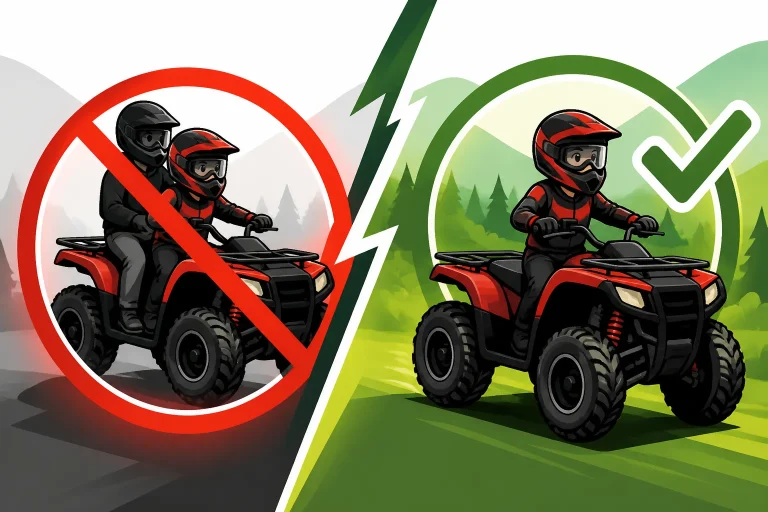
For the requirements that apply to younger operators, review BC Youth Riding Rules Explained, BC Rules for a Supervising Adult and BC Rules for Passengers on a Quad. In particular, check what supervision is required, who may supervise, whether written permission is needed for the rider’s age, and what restrictions apply to passengers. A trail pass cannot waive those requirements.
The same separation applies to the machine. A pass is not ATV registration and does not replace any registration requirement that applies to riding on the land in question. BC has no province-wide trail pass, and the rules for registration and land access are separate from a managed site’s fee or pass program. If you are unsure about registration, see Do You Need to Register an ATV in BC?. If your planned ride includes Crown land, review BC Crown Land Riding Explained as well; access rules can depend on closures, permissions and the type of land.
A pass also does not guarantee that every trail is open. A managed site may close a route or restrict use because of conditions, maintenance, wildfire risk or another reason. Check the site’s notices before setting out, even if your pass is valid.
Plan the purchase and the ride around the site’s terms
For a family ride, settle the pass question before you arrive at the staging area. Make a short checklist for each rider: age category, pass requirement, proof of purchase and applicable riding rules. This prevents a common mix-up—buying an adult pass for the person who paid for the trip and assuming it covers the rest of the group.
If an adult and a young rider are both going, check whether each needs a separate pass and whether the issuer requires names or other rider details. Don’t assume that a youth pass is transferable between siblings or that one can be shared because only one child is riding at a time. The issuer’s conditions decide whether a pass is personal, transferable or valid for more than one person.
If you are comparing a day option with a longer-term option, compare only what the site actually includes: valid dates, access area, eligible riders and proof requirements. A longer period does not necessarily mean broader access, and a pass for one managed site does not automatically include another. For general purchasing pointers, see Buying a Site Pass Straight From a Club and BC Day Passes at a Managed Site.
A useful pre-ride routine is:
- Choose the exact managed area and check that it is open.
- Read its current pass terms, including adult and youth age definitions.
- Confirm whether every rider needs an individual pass.
- Purchase the correct pass for each person who needs one.
- Save or print proof in the format the issuer accepts.
- Check youth supervision, passenger and machine rules separately.
- Review closures, site restrictions and access conditions again before leaving.
If you already have a club membership, an old pass or a pass purchased for another family member, verify whether it covers this particular rider and visit. Familiarity with a site is helpful, but pass terms and access conditions can change. The safest assumption is that the issuer’s current rules control.
The adult-versus-youth distinction is therefore less about the machine and more about the person and the site’s pass policy. Confirm the age category and individual-pass requirement with the issuer, then treat registration, supervision and trail access as separate questions.
Disclaimer
This article is for general informational purposes only and does not constitute professional advice. Laws, prices and regulations vary by location and change over time. Consult a qualified professional for guidance on your specific situation.