BC Visitors From Idaho
A visitor from Idaho can bring an ATV or UTV to British Columbia, but an Idaho plate or OHV sticker does not answer every BC riding question. The key is whether the machine is properly registered under Idaho’s rules, what proof you carry, and where you plan to ride. Here’s how to check reciprocity and avoid confusing registration with access permits, insurance or road-use permissions.
How BC treats an ATV or UTV from Idaho
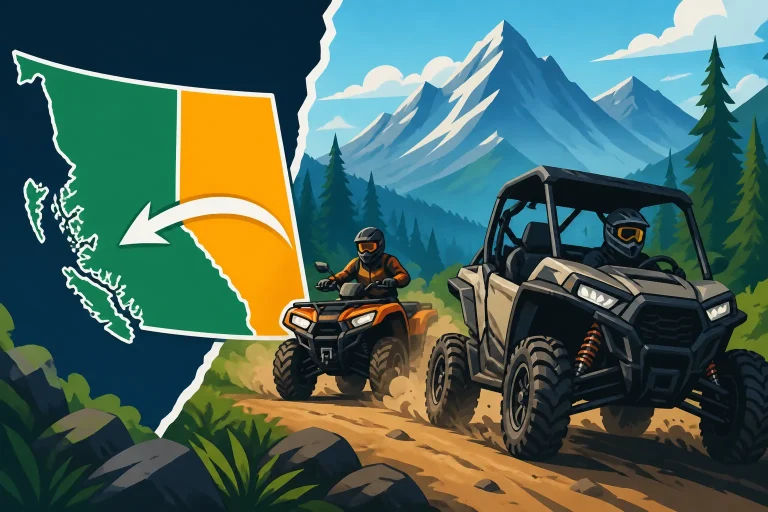
British Columbia generally does not ask visiting riders to register an off-road vehicle in BC when it is properly registered in its home jurisdiction. That is a reciprocity arrangement, not a blanket exemption from BC rules. The details turn on whether Idaho requires the particular class of machine to be registered and whether your machine is registered as required. See BC’s Rule Keys on Whether Home Has a Registry for the basic distinction.
An ATV or UTV may have different paperwork depending on its type, use and where it is operated. An Idaho registration or OHV credential may be relevant, but don’t assume every sticker, title or road plate automatically serves as proof of registration for BC purposes. Check the Idaho requirements that apply to your exact machine, then confirm with a BC Autoplan broker or the relevant provincial authority that the document you plan to carry is suitable. More on the visitor rule is covered in BC Non-Resident Riding Rules.
BC registration and Idaho registration are also different from permission to ride a trail or road. A machine accepted under the visitor rules may still be prohibited from a particular road, trail, park or managed recreation site. It may also need to meet separate insurance, helmet, equipment and operating requirements.
| Question | What to check before travelling |
|---|---|
| Does BC require a separate registration? | Whether the machine is properly registered under the Idaho rules that apply to it |
| What should I carry? | Current registration or other applicable proof, ownership documents and photo ID |
| Can I ride any BC trail? | No. Check closures, posted restrictions, land access and site-specific pass requirements |
| Can I drive on a public road? | Not generally. Highway crossings and limited road use have separate rules |
| Is my Idaho insurance enough? | Confirm that your coverage meets the requirements for the BC roads you plan to use |
This is why “reciprocity” should be understood narrowly: it can address the machine’s registration status, but it does not make an Idaho ATV or UTV street-legal in BC, grant access to private land, or replace a site pass. BC Riders From Alberta Use Alberta Plates describes the same kind of home-jurisdiction question for another group of visitors.
Documents to carry from Idaho
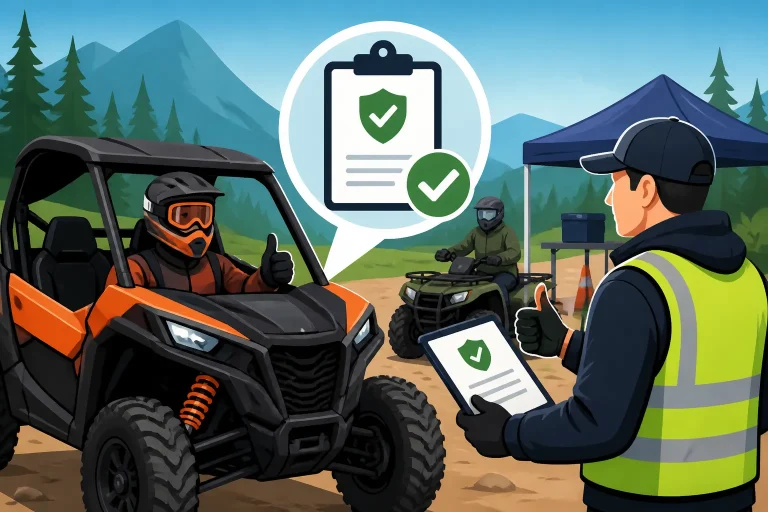
Bring documents that establish both the machine’s status and your connection to it. A rider may be asked to show evidence of registration, ownership and identity, so keep the papers together and accessible rather than packed beneath luggage.
Useful documents include:
- The current Idaho registration or other credential required for that machine in Idaho.
- A bill of sale, title or other ownership record if you have one.
- Photo identification for the rider.
- Written permission if you are riding a machine owned by someone else.
- Insurance documents that identify the machine and show the coverage in force.
- Any site-pass confirmation or other access document required for your destination.
BC’s registration system does not use an ATV title in the same way some vehicle systems do. For visitors, the practical priority is to carry the valid home-jurisdiction documents that apply to the machine and reliable proof that you are entitled to use it. The checklist in BC Proof of Ownership for Visitors can help you decide what to keep on hand.
If your machine is borrowed, rented or owned by a family member, make sure the permission is clear. A registration document in another person’s name does not necessarily show that you have permission to take the machine across the border and ride it. For a privately owned machine, carry written permission and the owner’s contact details. If ownership paperwork is incomplete or the machine has changed hands, resolve that before you leave rather than expecting a trail-side explanation to fix it.
Keep a digital copy as a backup, but do not rely on a phone alone. Cell coverage can be limited, and a dead battery or lack of signal can make a document hard to produce. A paper copy stored separately from your phone is a simple backup. BC riders are expected to carry registration and photo ID; visitors should take the same practical approach. See Carrying Your Certificate of Registration on Every Ride and Photo ID Carried With the Certificate.
Before departure, check that the vehicle identification number on the machine is legible and matches the paperwork. If the number is difficult to find, photograph it before loading. A mismatch or unreadable serial number can complicate a roadside check or a question about ownership.
Permits, passes and access are separate questions
A registration document does not give you permission to ride everywhere. In BC, the places where you ride determine which additional rules matter. Crown land and forest service roads have different practical considerations from private property or a managed recreation site.
For Crown land, confirm that the route is open to motorized use and that no seasonal, wildlife, fire-related or other closure applies. The general access rules are explained in BC Rules for Riding Crown Land. A map showing a road or trail is not, by itself, proof that riding is allowed. Look for current closure notices and posted signs, and respect gates and restrictions.
Managed recreation sites may require their own pass even when your vehicle is properly registered in Idaho. BC does not have one province-wide trail pass that covers every riding area. A local club or site operator may collect a pass fee or set conditions for that site. Check the destination’s rules before travelling; BC Passes Exist Only at Managed Sites explains the difference between site access and vehicle registration. Keep any required pass confirmation with you, including a printed copy if you expect limited cell service.
Private land requires the landholder’s permission. Do not treat a route shown on a map, an open gate or a track made by other riders as permission to cross. Leased Crown land can also involve a separate access question, so check before entering land that appears to be used for ranching, forestry or another permitted activity.
Forest service roads require particular care because they may carry industrial traffic and have their own insurance and operating requirements. Before using one, check the road’s posted restrictions and whether active logging or other work is underway. Review BC Forest Service Road Requirements and BC Resource Road Radio Practice if your route includes resource roads. A road being open to public traffic does not mean an ATV or UTV can ignore its rules.
Highway travel is another separate matter. An ATV or UTV is not automatically allowed to travel along a BC highway because it has Idaho registration or insurance. Limited crossings and certain local permissions have their own conditions. Do not use a highway shoulder as a convenient connection unless the applicable rules permit it. For crossing requirements, see BC Rules for Crossing a Highway. If a route requires extended pavement travel, plan a legal detour or transport the machine instead of assuming a visitor document creates road access.
Insurance, equipment and a pre-ride checklist
Insurance is not the same as registration, and the policy that is valid in Idaho may not meet the requirements for every BC road or riding situation. Ask your insurer specifically whether your coverage applies while operating the machine in British Columbia, whether it covers the machine type and riders using it, and whether it meets requirements for any forest service roads on your itinerary.
Forest service roads have a specific liability insurance requirement for ORVs. Confirm the required coverage and get clear proof from your insurer before riding one. A policy card that only shows the vehicle is insured may not answer a question about liability limits or where coverage applies. If you are unsure, obtain written confirmation from the insurer and carry it with your other documents. For more detail, see BC Forest Service Road Insurance.
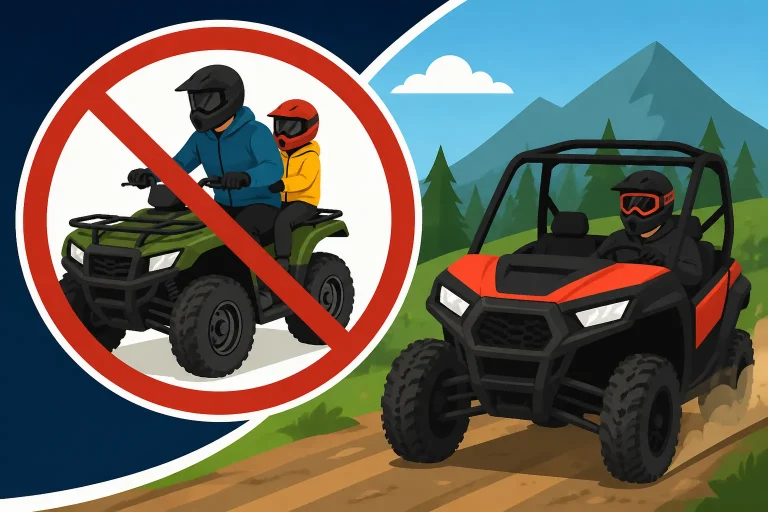
Equipment rules can also depend on the machine and where it is operated. Riders should check helmet requirements, lighting rules and passenger restrictions rather than assuming Idaho rules are enough. On a side-by-side, check seat-belt requirements and ensure every occupant can be seated and restrained as required. For a quad or another ride-astride machine, review BC ATV Helmet Law Explained. Follow posted restrictions and the machine manufacturer’s guidance on passenger capacity.
A practical pre-trip sequence is:
- Identify the machine. Note its type, VIN and Idaho registration status. Check the applicable Idaho requirements for that exact machine.
- Confirm reciprocity. Make sure the credential you carry is the one that applies to the machine, and ask a BC broker or provincial authority if the situation is unusual.
- Gather ownership and permission documents. Carry registration, proof of ownership, photo ID and written permission if the machine is not yours.
- Contact your insurer. Confirm coverage in BC and ask specifically about forest service roads and liability limits.
- Choose legal riding areas. Check current access rules, closures, private-land boundaries, site passes and posted road restrictions.
- Check the route and machine. Confirm equipment requirements, road conditions, fuel range and whether active industrial traffic is expected.
- Keep documents available. Carry paper copies, with digital backups where practical, and make sure the VIN is readable.
If your machine does not have the Idaho credential that BC expects for a properly registered visitor vehicle, do not assume you can simply buy a BC plate at the border or ride without paperwork. Ask about the exact class of machine and the documents available before travelling. The safest plan is to settle the registration question before the trip, then treat each ride as a separate access and safety decision.
Disclaimer
This article is for general informational purposes only and does not constitute professional advice. Laws, prices and regulations vary by location and change over time. Consult a qualified professional for guidance on your specific situation.