BC Visitors From Ontario
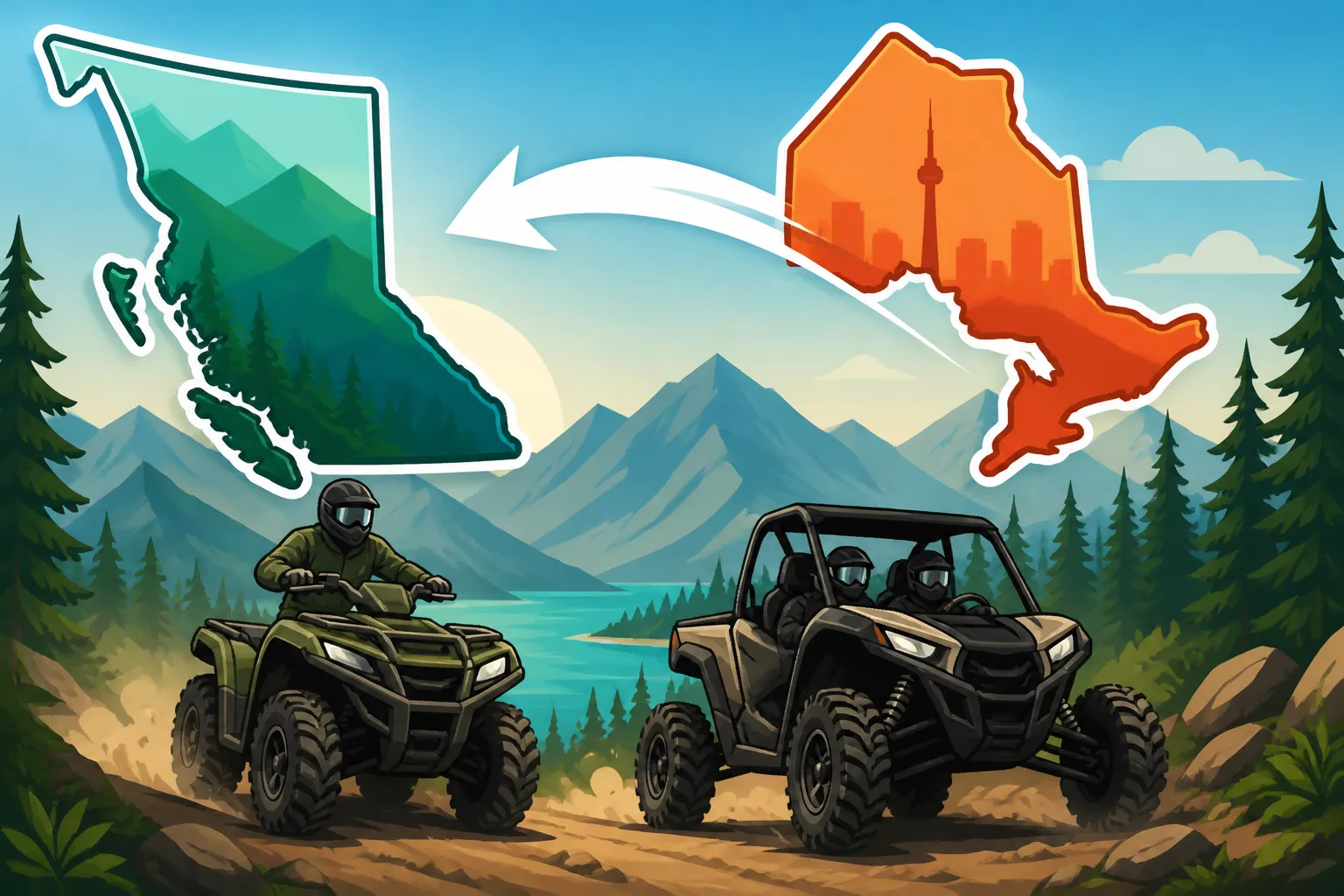
Ontario riders planning to bring an ATV or UTV to British Columbia often wonder whether their Ontario registration works there, or whether they need a second plate or permit. In most cases, the key is keeping the machine properly registered at home and carrying proof. That does not replace BC’s separate rules for roads, insurance, safety, and trail access.
How Ontario registration works in BC
BC generally does not register an off-road vehicle that belongs to a visitor from another province. Instead, reciprocity means a visitor can generally rely on valid registration from a home jurisdiction that requires the machine to be registered. An Ontario rider should keep the machine’s Ontario registration current and bring the registration document on the trip.
This is not the same as a blanket exemption from registration rules. If a machine is not registered in Ontario when it is required to be, being temporarily in BC does not necessarily solve the problem. Likewise, carrying a receipt alone may not substitute for the documents that show the machine is registered. For background on how the distinction works, see BC Non-Resident Riding Rules and BC Visitors From Ontario.
Before travelling, confirm the current Ontario requirements for the specific machine. Rules can depend on what type of vehicle it is and how it is used. Do not assume an ATV, side-by-side, dirt bike, snowmobile, and farm or industrial machine all have identical registration treatment.
| Before the trip | What to check |
|---|---|
| Ontario registration | Confirm the machine is registered as required at home and the document is current |
| Proof of ownership | Bring paperwork linking you to the machine, especially if the registered owner is someone else |
| Plate and identification | Make sure any required home plate is attached and readable |
| Insurance | Check what your policy covers in BC and whether it meets requirements for the roads you plan to use |
| Trail access | Check for site-specific passes, closures, and vehicle restrictions |
| Safety equipment | Check BC requirements for helmets, lights, and seat belts where applicable |
Carry the original registration document if practical, or a clear copy if the issuing authority allows one. Also bring photo identification and proof of ownership, such as a bill of sale or other transfer record. If the machine is registered to a family member, company, or other person who is not travelling with you, ask whether you need written permission to use it.
A phone photo can be useful as a backup, but it is unwise to rely on a phone as the only record. Remote areas may have no service, a device can run out of power, and an image may not satisfy every request to see the original document. Keep papers somewhere dry and accessible. A waterproof document pouch from Amazon can help protect them from rain, dust, and mud; it does not replace the actual registration or ownership paperwork. More detail is available in BC Proof of Ownership for Visitors.
BC’s registration requirement is particularly relevant when a machine is used on Crown land, which includes many areas riders may think of simply as backcountry. A resource road can also be Crown land, and its road rules may apply in addition to the registration rules. Private property is a different situation, but permission to ride on private land does not give permission to use connecting public roads or trails. See BC Rules for Riding Crown Land for the broader access question.
Do not confuse the vehicle’s registration with a recreation-site pass, club trail pass, road-use permission, or insurance policy. They serve different purposes. A machine can be properly registered at home and still be barred from a trail, subject to a local pass requirement, or inadequately insured for a particular road.
What to carry and check before riding
Make a small document pack for each machine and keep it with the towing vehicle or riding group. At a minimum, be prepared to show:
- The machine’s current Ontario registration document, where registration is required.
- Proof of ownership or a clear chain of ownership if the registration is not in your name.
- Your photo identification.
- Insurance documents and the insurer’s contact information.
- Written permission if you are using a machine owned by someone who is not on the trip.
- Any site pass or permit required for a managed riding area.
A bill of sale is especially useful when the machine was bought recently, has changed hands several times, or is registered to another person. It can help explain who owns and operates it, but it should not be treated as a substitute for required registration. If the ownership documents do not line up, sort that out before crossing the border or heading to a remote riding area.
Check that the machine’s identifying numbers are visible and legible. Dirt, corrosion, accessories, or repairs can make a vehicle identification number difficult to inspect. Photograph the number before departure and keep the image with your trip records. A photo is a backup reference, not a replacement for the number stamped on the machine.
Riders should also prepare for the possibility of being asked to produce documents during a ride. Keep the registration and identification protected, but do not bury them under cargo where they cannot be reached. BC riders are expected to carry the registration certificate and photo ID when riding; visitors should be ready to show their equivalent home documents. Carrying Your Certificate of Registration on Every Ride explains the practical reason for keeping the paperwork with you.
For a group trip, check every machine rather than assuming one person’s papers cover the whole convoy. A family may have several ATVs registered to different owners. A rental, borrowed, or company machine may have different documents from a privately owned quad. Make sure the person operating each vehicle can explain who owns it and show the relevant paperwork.
BC rules still apply to Ontario visitors
Reciprocity concerns registration. It does not make an Ontario-registered ATV or UTV exempt from BC’s operating rules. Visitors need to understand the rules for the places they intend to ride, because riding on a managed trail, Crown land, a forest service road, private land, or a highway can involve different restrictions.
Crown land and forest service roads
BC’s registration framework applies broadly to off-road vehicles used on Crown land, including many resource roads. A road being gravel, remote, or used by industrial traffic does not automatically make it an informal trail. Before setting out, check road signs, closures, industrial activity, and whether the road is a forest service road. BC Forest Service Road Requirements covers the additional considerations for those routes.
Insurance is a separate issue from registration. BC requires third-party liability coverage when an ORV is operated on a forest service road, and the required coverage level should be confirmed before the trip. On other Crown land, the insurance rules may differ; do not assume that a policy covering recreational riding elsewhere is sufficient for every road. Ask your insurer specifically about riding in BC, including forest service roads and any exclusions for off-road use. See BC Resource Road Insurance for more on this distinction.
A road may also be active for logging or other industrial traffic. Riders should follow posted instructions, yield appropriately, and avoid closed roads. A registration document does not grant access where signs, closures, land-use restrictions, or a road manager prohibit riding.
Helmets, passengers, and vehicle type
BC safety requirements apply to visitors as well as residents. A ride-astride machine, such as a typical ATV, requires a helmet that meets the applicable standard. Side-by-sides have different occupant-protection considerations, including seat belts where fitted or required. Check the vehicle-specific rules before riding; do not assume that a helmet practice or passenger arrangement permitted at home is automatically permitted in BC. BC ATV Helmet Law Explained and BC Rules for Riding a Side-by-Side provide more detail.
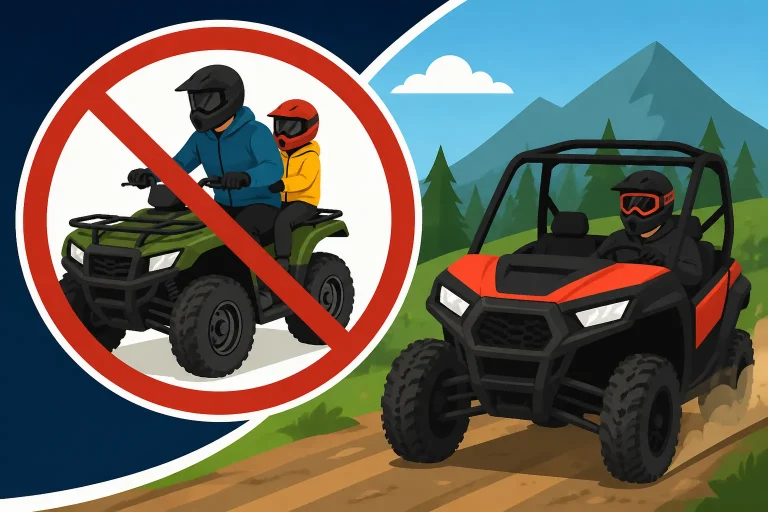
Passengers must be carried only where the vehicle is designed for them and the manufacturer’s requirements are met. Do not put a passenger on a single-seat quad, on a cargo rack, or in a position without a proper seat and handholds. For a side-by-side, use the designated seats and restraints. A passenger’s age, size, and ability to sit securely can matter, especially when a child is involved.
A visitor’s driver’s licence does not make an ATV street legal. BC does not provide a general street-legal path for ordinary ATVs to travel along public highways. Limited highway crossings or specific authorized travel are different from riding along a road. If your route involves pavement, check the rules in advance rather than following a mapping app or assuming a short connector is allowed. Can You Ride an ATV on the Road in BC? explains the distinction.
Some police-issued operation permits may authorize narrowly defined highway travel under particular conditions. They are not a general licence to ride an ATV on roads, and an Ontario plate does not replace such permission. If you think your route needs one, contact the appropriate local police detachment before the trip and ask what conditions apply. See BC Operation Permit Application Steps.
Trail passes and local restrictions
BC does not have one province-wide trail pass that automatically opens every riding area. A managed recreation site or local organization may require a day pass or another form of site-specific permission. Other places may be closed to motorized use, restricted by a seasonal order, or subject to fire-related restrictions. Your Ontario registration does not count as a BC site pass.
Check the rules for the particular trailhead or area, including whether the vehicle’s size or type is permitted. A route open to quads may not be suitable or authorized for a wider side-by-side. Check for gates, signs, posted closures, fire restrictions, and current access information before unloading. If the trail is managed by a club or recreation site, confirm pass requirements directly with that site. BC Passes Exist Only at Managed Sites explains why a pass for one area should not be treated as a general BC riding permit.
Private-land access also requires care. Ownership of a machine and its Ontario registration do not grant access across private property or leased Crown land. Get permission from the landholder or leaseholder where required, and do not treat an open gate or an old track as an invitation to ride.
A practical arrival checklist
Use this sequence before the first ride. It helps catch problems while you still have time to fix them.
- Confirm the machine’s Ontario status. Check whether it must be registered at home, whether its registration is current, and whether the required plate or identifying information is present.
- Match the paperwork to the machine. Carry the registration and proof of ownership. If the registered owner is not travelling, bring permission to use the machine and confirm with the relevant authority or insurer whether more documentation is needed.
- Call your insurer. Ask whether the policy covers the machine in BC and on the exact types of roads you plan to use. Confirm any required third-party liability coverage for forest service roads and ask about exclusions.
- Choose legal routes. Identify whether each planned segment is a managed trail, Crown land, a forest service road, private land, or a public highway. Check access restrictions for each.
- Check local passes and closures. A site pass, road authorization, or seasonal closure is separate from vehicle registration. Verify the requirements with the relevant site or authority.
- Inspect safety equipment. Confirm helmet fit and compliance for ride-astride machines, seat belts for side-by-sides, lights where required, and secure passenger seating.
- Pack documents where they can be shown. Keep registration, identification, insurance details, and pass confirmation dry and accessible. Save important phone records for offline use, but carry paper backups when possible.
- Review conditions again before departure. Fire restrictions, road closures, and industrial activity can change. A route that was open when planned may not be open on the day of the ride.
If a registration, ownership, or insurance detail is unclear, ask before travelling rather than trying to resolve it at a remote trailhead. A broker or the relevant provincial authority can help clarify documentation, while the trail manager or road authority can answer questions about local access. Keep the answers with your trip notes, but remember that verbal advice does not override a posted closure or a legal requirement.
The simplest way to think about the trip is that Ontario paperwork handles the machine’s home-jurisdiction registration, while BC rules govern how and where you operate it in the province. Bring proof, confirm insurance, and check access at each riding area. That approach avoids treating one document as a substitute for every other permission the ride may require.
Disclaimer
This article is for general informational purposes only and does not constitute professional advice. Laws, prices and regulations vary by location and change over time. Consult a qualified professional for guidance on your specific situation.