BC Supervisors Must Be 19 or Older
BC’s minimum age for an off-road vehicle supervisor can catch families and riding groups by surprise: the supervisor must be at least 19. This article explains who the rule applies to, what meaningful supervision looks like, and when a 14- or 15-year-old may qualify for an exception. It also separates the age rule from registration, trail access and other riding requirements.
The BC rule: a supervisor must be 19 or older
In British Columbia, a person under 16 generally must be supervised when operating an off-road vehicle. The person supervising must be at least 19 years old. A parent, older sibling or family friend does not qualify simply because they are responsible for the young rider; they must meet the age requirement and be able to supervise in practice.
The rule concerns the person operating the machine, not just who owns it or whose name appears on its registration. If a young rider is driving a quad, dirt bike, snowmobile or side-by-side, check the youth-riding requirements for that vehicle and situation. A passenger riding with an adult is a different scenario from a child operating the controls.
The age threshold is a minimum, not a recommendation about which adult is best suited to supervise. A 19-year-old can meet the age test, but the adult still needs to pay attention, understand the terrain and be in a position to respond if the young operator needs help. For practical advice on the broader rules, see BC Youth Riding Rules Explained.
| Rider’s age | General rule in BC | What to check |
|---|---|---|
| Under 14 | Must be supervised by a person who is at least 19 | The adult must be able to supervise effectively; the machine must also suit the child |
| 14 or 15 | Must be supervised unless the rider qualifies for the specific exception | Confirm the written-permission and training requirements before relying on the exception |
| 16 or older | The under-16 supervision rule no longer applies | Other requirements, including registration, equipment and access rules, still apply |
The age rule is not permission to ride anywhere. A young rider may meet the supervision requirement and still be prohibited from using a particular road, trail or area. Registration, land access, local restrictions and machine-specific rules are separate questions. For instance, riders using Crown land should also understand BC Crown Land Riding Explained, and those riding on a Forest Service Road should check BC Forest Service Road Requirements.
The same distinction matters when someone is visiting from another province. A visitor’s home rules do not automatically replace BC’s rules for riding in BC. See BC Rules for a Visiting Alberta Rider for the visitor context, and confirm the requirements that apply to the place and type of ride you are planning.
What effective supervision looks like
Being 19 or older meets only the supervisor’s age requirement. Supervision also has to be real. The adult should be able to keep the young operator under observation and give direction promptly. If the adult cannot see what the child is doing or cannot respond when something changes, the arrangement may not provide effective supervision.
That can be harder to manage on a winding trail, in thick trees, on a steep slope or across a large open riding area than it is in a controlled practice space. A group spread over a long distance can also make supervision difficult. Plan the ride so the adult and child stay close enough for the adult to monitor the child, communicate and intervene when necessary.
Staying in view and able to give direction
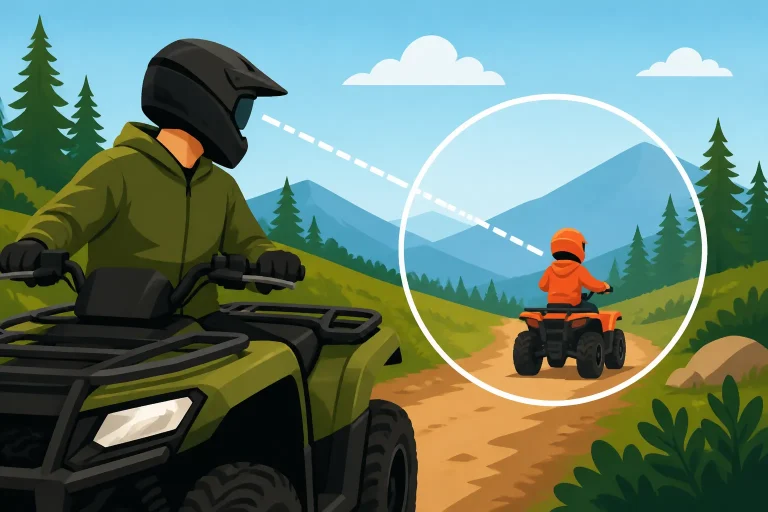
A practical test is whether the adult can see the young operator and provide immediate direction. That does not mean an adult should assume they can supervise from a distant staging area, from a truck parked out of sight or by checking in occasionally by phone. Those arrangements may leave a child operating without the attention the rule is meant to require.
There is no one distance that works in every setting. A clear, level practice area is different from a forest trail with blind corners. Choose a position and pace that let the adult stay attentive and close enough to act. If the adult loses sight of the child, the safest response is to stop and regroup rather than continue on the assumption that supervision is still happening.
A supervisor may be riding another machine rather than sharing the young rider’s vehicle, but that arrangement only makes sense if the adult can still meet the practical supervision test throughout the ride. Riding far ahead, leaving a child behind or having several children spread across a trail can make it harder to keep everyone in view. For the specific supervision standard, see BC’s Visible and Immediate Direction Test.
The adult needs to be available, not merely present
An adult’s attention matters. A person who is occupied with another task, managing a separate group or unable to respond quickly may not be in a position to supervise the child. Before setting out, agree on simple instructions: where the child should ride in relation to the adult, what to do if the group stops, and how to signal for help.
Supervision should adapt to the terrain and the rider’s ability. A beginner may need the adult close by and moving slowly. A more confident young rider still needs oversight, but may be able to follow a suitable route with more space. Confidence is not a substitute for the legal requirement, and a child’s previous experience does not remove the age rule.
Supervision also does not make an unsuitable machine safe. Check the manufacturer’s age and size guidance, the child’s ability to reach and use the controls, and whether the machine’s power and weight are appropriate. The rules on passengers are separate as well; a young operator may not be allowed to carry a passenger. See [BC Manufacturer Age and Weight Rules] and [BC Children Cannot Carry Passengers].
When a 14- or 15-year-old may qualify for an exception
The general rule requires supervision for a rider under 16, but BC has a specific exception for some 14- and 15-year-olds. It is not a general permission for any teenager to ride alone. The rider must meet the applicable conditions, which include written permission from a parent or guardian and qualifying safety training for the relevant class of off-road vehicle.
Because the exception depends on meeting its conditions, do not treat a parent’s note by itself as enough. Before allowing a 14- or 15-year-old to ride without a supervisor, confirm that the training is recognized for the vehicle class and that the written permission meets the current requirements. If any condition is missing or unclear, use the general rule and have a supervisor who is at least 19 accompany the rider.
This is one area where a little preparation can prevent an avoidable disagreement on the trail. Keep the permission and evidence of qualifying training available during the ride. Do not assume that a course for one type of vehicle automatically qualifies a rider to operate another type. Check the rules for the class and the course provider; Which Rider Course Providers Are Actually Recognized explains what to verify.
The exception should also be understood narrowly. It does not make every 14- or 15-year-old eligible to ride without an adult, and it does not erase other rules. Registration, access restrictions, equipment requirements and any applicable local rules continue to matter. A rider who qualifies for the age exception still needs to obey those requirements.
If a family is uncertain whether the young rider has completed the right course or has the right written permission, it is safer to arrange adult supervision until those details are confirmed. This is especially sensible for a first ride, a new machine or an unfamiliar area. For broader information on permission and the age-specific rule, see BC Written Permission Letters and BC Rules for a 14-Year-Old Rider.
How the rule applies to different machines and places
The supervisor’s age rule is part of BC’s off-road vehicle framework. It can be relevant to the operator of an ATV or quad, a side-by-side, a dirt bike or a snowmobile, depending on the vehicle and circumstances. A vehicle’s size or family use does not by itself make the youth rule disappear. A side-by-side may have a steering wheel and seat belts, but the adult still needs to check the requirements for a young operator. See BC Rules for Riding a Side-by-Side.
The place of the ride matters too. Private property is not a reason to assume that every off-road vehicle rule stops applying. Permission from the landowner may address access, but it does not necessarily remove the youth supervision requirement. Land access and operator rules are separate matters. For the private-property question, see BC Rules for Riding Private Land.
Similarly, registration is not the same as permission for a child to ride alone. A registered machine may still be subject to the youth rule, and an adult’s supervision does not make an unregistered vehicle lawful to use where registration is required. Check Do You Need to Register an ATV in BC? alongside the rules for the planned route.
A ride that includes public roads needs additional care. BC does not treat an off-road vehicle as automatically street legal, and operating on a highway or crossing one can involve separate restrictions and requirements. Do not infer that a child may ride on a road because an adult is supervising. Review Can You Ride an ATV on the Road in BC? and the specific rules for crossings before including any road section in a route.
For visiting families, it is useful to check requirements before bringing a machine across a provincial or international border. BC’s rules apply to riding in BC, while registration and proof-of-ownership questions may depend on where the machine is registered. A visiting young rider should not rely on a familiar home-province practice without confirming what BC requires.
Planning a ride with a young operator
A short check before unloading can help make the age rule workable rather than stressful. Identify which adult is supervising each young rider, make sure that adult is at least 19, and agree on how the group will stay together. If a 14- or 15-year-old plans to use the exception, verify the written permission and qualifying course before leaving home.
Use this checklist:
- Confirm the rider’s age. A rider under 16 generally needs supervision unless a 14- or 15-year-old meets the specific exception.
- Choose a qualifying adult. The supervisor must be at least 19, not merely a parent or guardian.
- Set a realistic riding arrangement. Keep the child within view and close enough for prompt direction, taking terrain and experience into account.
- Check the vehicle. Follow manufacturer guidance on age, size and passenger limits. Confirm the child can operate the controls safely.
- Check the route. Look for road sections, closures, access restrictions and hazards that call for different rules or a change of plan.
- Bring relevant documents. If relying on the 14- or 15-year-old exception, keep the required permission and course evidence accessible.
- Reassess during the ride. If the adult can no longer supervise effectively, stop and regroup or change the plan.
Common situations are easier to assess when the age rule is separated from other questions:
| Situation | Practical approach |
|---|---|
| A 13-year-old rides a quad with a parent | The parent must be at least 19 and provide effective supervision; also check machine suitability and passenger rules |
| A 15-year-old wants to ride without an adult | Confirm the specific exception’s written-permission and qualifying-training conditions; do not rely on permission alone |
| A 17-year-old rides independently | The under-16 supervision rule does not apply, but other operating and access rules still do |
| A 12-year-old is on private land | Do not assume private property removes the supervision requirement; check land access and youth rules separately |
| An adult rides ahead while a child follows out of sight | Stop and adjust the group; the adult needs to be able to observe and direct the young rider |
| A visiting child rides a family machine in BC | Check BC youth requirements as well as the machine’s registration, permission and route restrictions |
Group rides deserve extra planning. If one adult is responsible for several children, consider whether the adult can actually observe and direct all of them at once, especially on a route with forks, traffic, steep sections or limited visibility. A plan that works on an open practice area may not work once the group enters a narrow trail. Keep the group small enough that the adult’s attention is not stretched beyond what the terrain allows.
It also helps to distinguish a supervisor from a ride leader. Someone leading a group may be focused on navigation, radio calls or other riders and may not be in a position to supervise a particular child. Name the adult responsible for the young operator, and make sure that adult understands the child’s experience and the route.
If the group is riding on a resource road, supervision is only one part of the safety plan. Industrial traffic, posted restrictions, insurance requirements and road practices may also apply. For example, BC Resource Road Radio Practice covers communication considerations, while BC Forest Service Road Requirements explains the separate requirements associated with those roads.
Common misunderstandings
“The child’s parent is supervising, so the age does not matter.”
The supervisor must be at least 19. A younger parent or guardian does not meet that minimum simply by being the child’s legal guardian.
“The adult is somewhere in the group, so the child is supervised.”
Being on the same ride is not enough if the adult cannot keep the child in view or respond promptly. The arrangement needs to provide effective supervision.
“A 14- or 15-year-old only needs a signed note.”
The exception has conditions beyond simply having a note, including qualifying training. Confirm all requirements before relying on it.
“A slow or small machine is exempt.”
A machine that seems manageable still falls under the rules applicable to its vehicle class and the rider’s age. Check the vehicle’s requirements rather than relying on its size or speed.
“Private land is outside the rules.”
Landowner permission and youth-operation requirements are different issues. Do not treat one as a substitute for the other.
“Once the rider turns 16, no other rules apply.”
The under-16 supervision rule no longer applies, but registration, access, equipment and other operating rules may still apply to the rider and machine.
If an officer or other official asks about the arrangement, be ready to explain who is supervising the child and how the group is keeping the young rider in view. If relying on the exception for a 14- or 15-year-old, keep the relevant documents available. For additional information about showing documents while riding, see Carrying Your Certificate of Registration on Every Ride.
Frequently Asked Questions
Does a supervisor have to be the child’s parent?
No. The important points are that the supervisor is at least 19 and can supervise effectively. A parent, relative or other responsible adult may serve, provided they meet the age and supervision requirements.
Does the supervisor have to ride on the same machine?
Not necessarily, but the adult must still be able to observe and direct the young rider. If riding separate machines makes that difficult on the route, choose a closer arrangement or stop and regroup.
Can a 14- or 15-year-old ride alone in BC?
Some 14- and 15-year-olds may qualify for an exception to the general supervision rule. They must meet the applicable conditions, including written permission and qualifying safety training. Confirm the current requirements before relying on the exception.
Does the age rule apply on private land?
Do not assume that private land removes the supervision requirement. Permission to use the land and the rules for a young operator are separate questions.
Does an adult supervisor need an off-road vehicle licence?
The supervisor’s age requirement is separate from rules about operating on a highway or other restricted area. Check the requirements for the specific route and activity rather than assuming that supervision makes road use lawful.
Disclaimer
This article is for general informational purposes only and does not constitute professional advice. Laws, prices and regulations vary by location and change over time. Consult a qualified professional for guidance on your specific situation.