BC Non-Resident Riding Rules
Visiting British Columbia with an ATV or UTV raises a practical question: does your machine need BC registration, and what papers should you bring? In general, non-residents use the registration or ownership documents from home rather than registering again in BC. You still need to meet local rules for insurance, safety, roads and trail access.
Registration and proof of ownership for visitors
BC does not register non-resident machines under its regular off-road vehicle system. Visitors generally rely on the registration or comparable proof issued where the machine is based. That does not mean you can arrive with no paperwork: carry documents that connect you to the machine and show its status at home.
What to bring depends on your home jurisdiction. A registration certificate and plate may be the normal proof in one place; somewhere without an ORV registry, a bill of sale or other ownership document may be more useful. If you are borrowing a machine, carry the owner’s registration or proof of ownership and written permission to use it. Keep the documents accessible during the ride, not packed at the bottom of a trailer.
| Where the machine is based | Practical documents to carry in BC |
|---|---|
| A jurisdiction that registers or plates the machine | Current home registration and the plate or identification required there |
| A jurisdiction without an ORV registration system | Proof of ownership, such as a bill of sale, plus identifying information for the machine |
| A machine borrowed from someone else | The owner’s relevant documents and clear permission to ride it |
| A machine recently purchased | The available sale documents and any registration paperwork, even if the home jurisdiction has not issued updated documents yet |
Requirements can differ by home jurisdiction and by machine type. Confirm what counts as current proof where the machine is registered, and bring original documents or a legible copy that you can show if asked. A photo on a phone can be a useful backup, but do not assume it will replace documents required by your home jurisdiction or accepted by an officer. Keep a second copy somewhere separate from the originals.
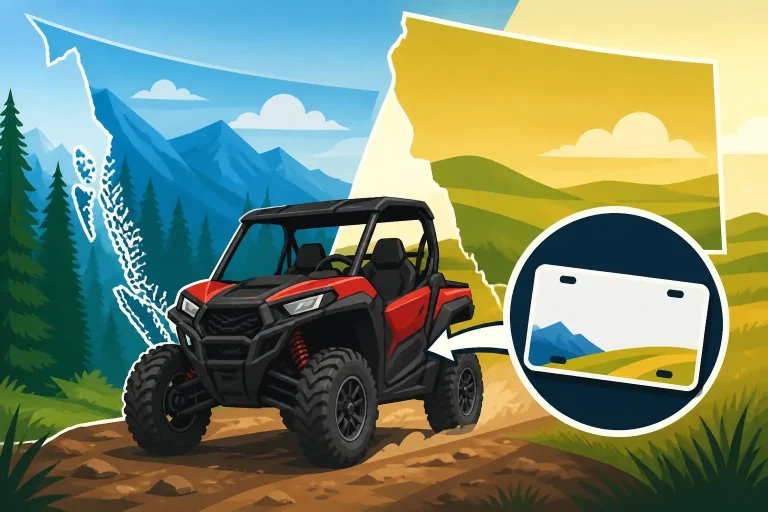
Visitors from Alberta generally use their Alberta registration and plate rather than obtaining BC registration. The same general approach applies to visitors from Washington: carry the machine’s home paperwork and follow the requirements that apply there. Visitors from places where machines are not registered should be ready to show ownership proof. For background on these cases, see BC Riders From Alberta Use Alberta Plates, BC Riders From Washington Use Home Plates and BC Proof of Ownership for Visitors.
A home plate is evidence of the machine’s status where it is based; it is not a pass to ride anywhere in BC. Nor does it turn an ATV or UTV into a highway vehicle. Registration, proof of ownership, road authorization, insurance and access permission are separate questions. If you are unsure whether a document is enough for your situation, check with the relevant BC authority or a local Autoplan broker before heading out. The distinctions covered in BC Does Not Register Non-Resident Machines and BC’s Rule Keys on Whether Home Has a Registry can help you frame that question.
Insurance, roads and crossings
A visitor’s insurance policy may not automatically cover every kind of riding in BC. Before travelling, ask your insurer to confirm in writing that the policy covers the machine while it is being operated in British Columbia, including the types of roads and land you plan to use. Check the policy’s liability limit, geographic coverage, exclusions and conditions. A policy that covers a machine at home may treat road use, commercial areas or travel outside the home jurisdiction differently.
Pay particular attention to Forest Service Roads. BC has specific insurance requirements for ORVs on these roads, and a policy that does not clearly cover your intended use can leave you exposed. Confirm that your coverage meets the BC requirement and that the insurer recognizes the machine and riding activity. Do not assume that a homeowners policy, trailer policy or vehicle policy provides the needed liability protection. See BC Forest Service Road Insurance and BC Requires $200,000 on a Forest Service Road for more on this distinction.
Riding on a road is not the same as riding on a trail. An ATV or UTV is not generally street legal just because it has a home registration plate, lights or insurance. Highway use is restricted, and specific rules apply to crossing a highway or using a road under an authorization. Before crossing, check the route, signage and applicable requirements. A permit issued for a particular road use does not authorize general highway riding. BC Rules for Crossing a Highway and BC Has No Street-Legal Path for an ATV explain why it is important to separate a short crossing from travel along a road.
Resource roads may be shared with logging and other industrial traffic. A road that appears quiet can have active hauling, blind corners, gates or restrictions. Follow posted signs, yield appropriately and check local road conditions before riding. If you plan to use a resource road, learn its radio practices and traffic expectations; BC Resource Road Radio Practice and BC Riders Meeting a Logging Truck provide related preparation.
Safety and access rules still apply
Home registration does not exempt a visitor from BC’s operating rules. Plan for helmet or seat-belt requirements based on the machine, passenger position and riding conditions. A ride-astride ATV operator and passenger must follow helmet rules. In a side-by-side with a seat belt and protective structure, the applicable rules differ; occupants should use required restraints. Check the current requirements for your machine rather than relying on what is customary at home. See BC ATV Helmet Law Explained and BC Seat Belt Rules on a Side-by-Side.
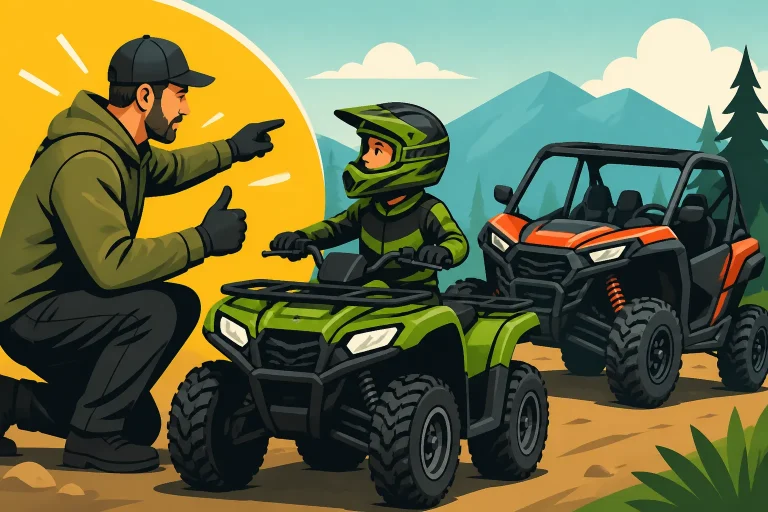
Rules for young riders also apply to visitors. Minimum age guidance from the manufacturer matters, and BC has supervision requirements for riders under 16. A child’s experience or permission to ride at home does not automatically satisfy BC requirements. Before bringing a young rider, review BC Youth Riding Rules Explained and BC Rules for a Supervising Adult.
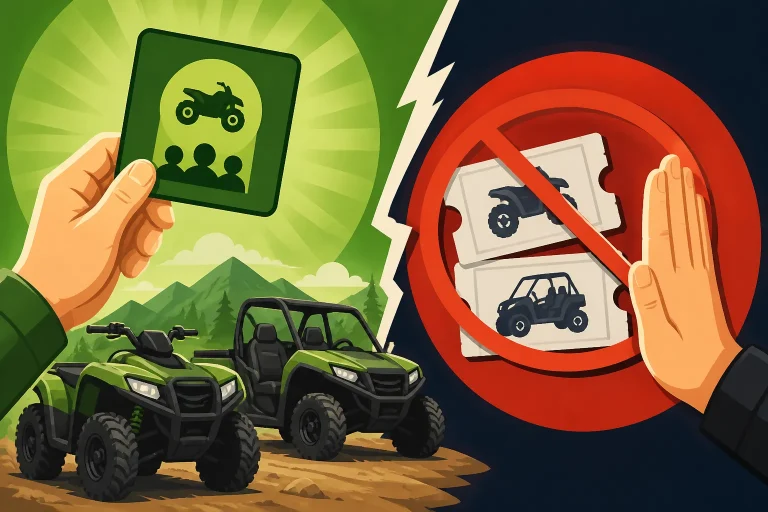
Access depends on the land and road, not simply on whether the machine is registered. Crown land, leased land, private property, recreation sites, provincial parks and managed riding areas can each have different restrictions. Get permission where needed, obey posted closures and verify that motorized riding is allowed on the route. Some managed sites require their own pass; buying a pass for one area does not grant access to other places. BC does not have a province-wide trail pass, so check the specific site or club information before you travel. BC Crown Land Riding Explained, BC Private Land Permission and BC Passes Exist Only at Managed Sites cover these separate access questions.
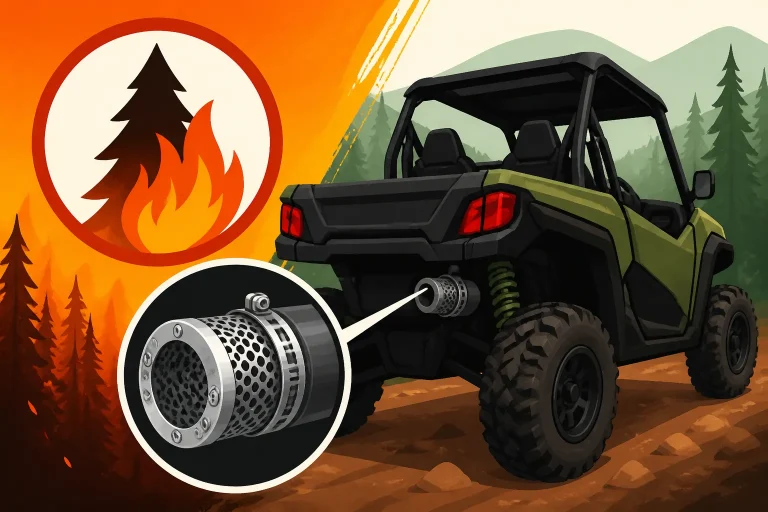
Wildfire restrictions, seasonal closures and active road work can change where riding is allowed. Check current notices for the area shortly before departure, and again if your trip is several days long. A route that was open on a previous visit may now be closed or subject to a temporary restriction. Carry a map or offline route information in case cell service is poor, and do not use an old track as proof that a road remains open.
Prepare before bringing a machine into BC
A short check before departure can prevent a long delay at a trailhead or a difficult conversation during a stop.
- Confirm the machine’s home documents. Bring its current registration if the home jurisdiction issues one. If it does not, carry reliable proof of ownership and any available identifying paperwork.
- Check the VIN or serial number. Make sure the number on the machine is readable and matches your documents. Photograph it before travel as a backup, but do not treat a photo as a substitute for the required paperwork.
- Ask your insurer about BC use. Describe where you intend to ride, especially if your route includes a Forest Service Road. Confirm coverage in writing and keep proof available.
- Map the planned route and confirm access. Check road restrictions, park rules, land permission and any managed-site pass requirement. Do not rely solely on a navigation app or an old trip report.
- Review safety requirements for everyone riding. Check helmet, seat-belt, passenger and youth rules for the particular machine. If you are buying a helmet online, including through Amazon, check the certification label and fit rather than relying only on a listing description.
- Carry documents where you can reach them. Keep proof of ownership, registration, insurance and any site-pass confirmation protected from water and available during the ride.
If you are travelling with more than one machine, prepare a separate document set for each. A single bill of sale or insurance card may not identify every ATV or UTV in a group. Make sure the operator knows which documents belong to which machine and who is authorized to ride it.
If your machine is newly purchased, borrowed, inherited or missing paperwork, resolve the gap before leaving home if possible. A visitor’s situation can be less straightforward when the home jurisdiction expects registration but the machine has not been transferred into the new owner’s name. Keep purchase records and ask the relevant home authority or insurer what evidence is acceptable. BC registration procedures for residents do not necessarily solve a non-resident’s missing-document problem; the visitor should be prepared to establish ownership through the proper channel.
The main takeaway is straightforward: bring the paperwork that applies where your machine is based, but do not treat it as a substitute for BC insurance, safety or access rules. Check the road and riding area separately, because a machine permitted on one route may not be allowed on another.
Disclaimer
This article is for general informational purposes only and does not constitute professional advice. Laws, prices and regulations vary by location and change over time. Consult a qualified professional for guidance on your specific situation.