Being Able to Direct a Child at Once
A child riding an ATV or UTV in British Columbia may need adult supervision, but being somewhere nearby is not necessarily enough. The supervising adult must be in a position to see the young rider and give immediate direction. Here’s what that means in practical terms, how to set up a ride, and when a change in terrain or visibility can make supervision ineffective.
What “able to direct a child at once” means
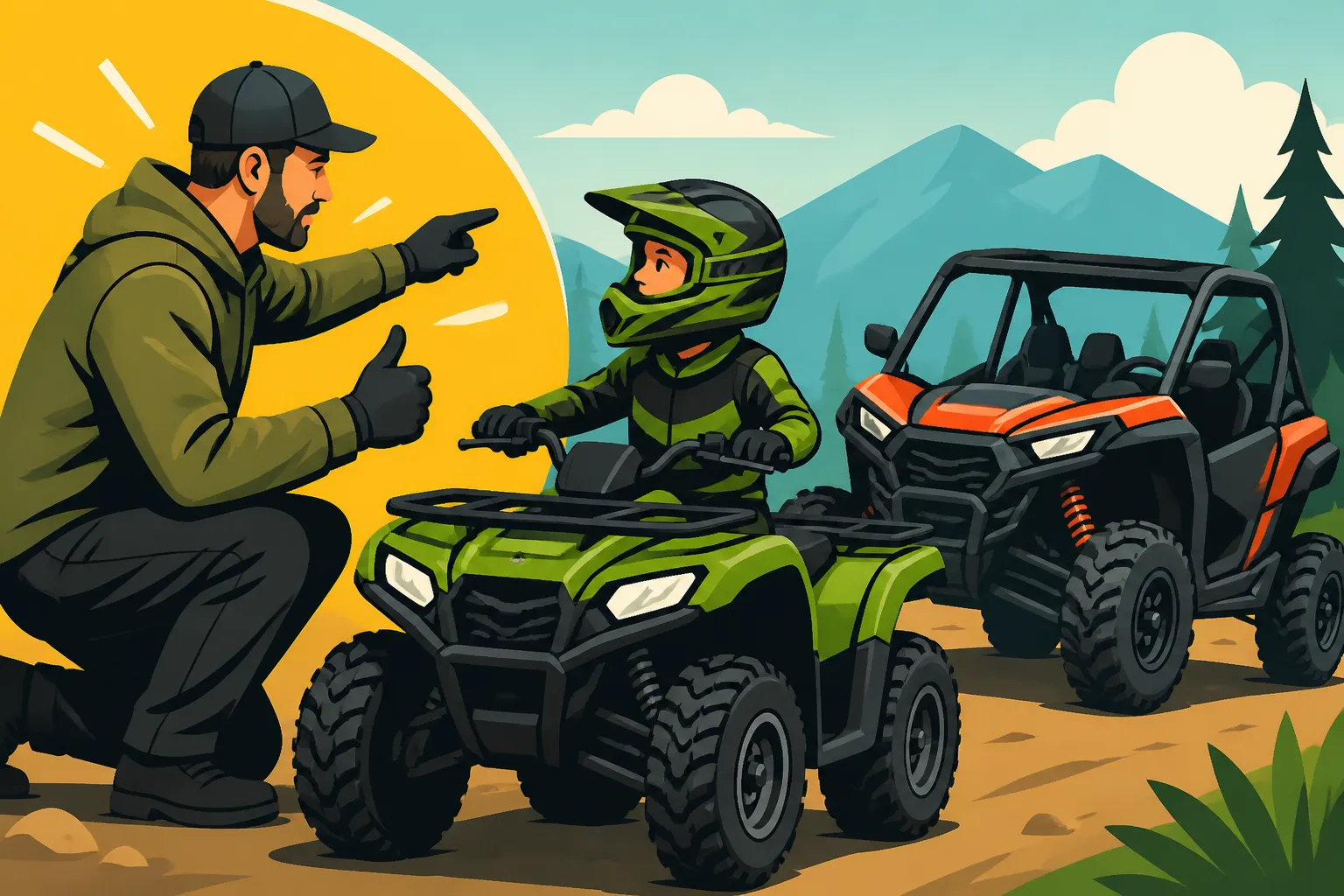
For a young off-road vehicle rider in British Columbia, supervision is not just a responsible adult’s name on a permission note or someone waiting back at camp. The adult must be able to see the child and give immediate direction while the child operates the machine. In practice, that means keeping the ride within a range where the adult can notice a problem and respond without delay.
A supervisor may be able to give direction by calling out, using a suitable communication device, or moving closer. But a phone or radio is not a substitute for the ability to see the child if the rule requires the supervisor to be able to see the rider. If a hill, trees, dust, distance, or a bend in the trail blocks the view, the adult may no longer be in a position to supervise effectively.
The rule is about the supervisor’s ability to respond in the moment, not about how carefully the child usually rides. A confident young rider can still meet an unexpected obstacle, encounter another trail user, or make a poor decision. If the adult can see what is happening and intervene promptly, supervision can be meaningful. If the adult only learns about a problem after a phone call or radio message, that is a different level of oversight.
The requirement is part of a broader set of youth riding rules. Age, written permission, training, and the type of machine can also matter. For the overall age-related rules, see BC Youth Riding Rules Explained and BC Rules for a Child Under 16. The main point here is narrower: when supervision is required, the adult needs to remain able to observe the child and give direction without a meaningful delay.
Supervision is active, not just nearby
Being at the same riding area does not automatically mean an adult can supervise a child. An adult unloading a trailer, cooking at camp, or riding far ahead may be close in a general sense but unable to see what the child is doing. Likewise, following a child from so far behind that dust or terrain hides the machine may leave the adult unable to act promptly.
A useful test is to ask: If the child stopped, took the wrong branch, approached a hazard, or needed to be told to slow down, could the adult notice and give a clear instruction right away? If the honest answer is no, change the arrangement before continuing.
This is why clear sightlines matter. A short, uncomplicated trail may allow an adult to keep a child in view while staying at a safe distance. A winding trail with dense trees may not, even if the group is moving slowly. The relevant question is not just how many metres separate adult and child. It is whether the adult can actually see and direct the rider in the conditions at that moment.
The adult must be old enough to qualify
British Columbia’s youth rules specify an age threshold for the supervising adult. The supervisor must be at least 19. A capable older teenager does not meet that adult-age requirement merely because they have more riding experience than the child.
That adult-age condition is separate from whether the person is actually supervising well. A 19-year-old who rides out of sight is not providing effective supervision simply because they meet the age threshold. Conversely, an adult who is watching carefully still needs to meet the applicable age and other legal requirements.
For detail on the role and age of a supervisor, see BC Rules for a Supervising Adult. The requirements can also differ with the child’s age and other circumstances, so do not assume that adult supervision alone settles every question about whether a particular child may operate a particular machine.
What effective supervision looks like on a ride
Good supervision is planned before the machine starts moving. The adult and child should agree on where to ride, where to stop, what signals to use, and what to do if they lose sight of each other. A simple plan is more useful than relying on the child to improvise after the group becomes separated.
| Riding situation | What the adult should consider | Practical response |
|---|---|---|
| Open, visible trail | Can the adult see the child and respond quickly? | Keep the child within clear view and agree on stopping points. |
| Blind corners or dense trees | Will a turn or vegetation block sight? | Slow down, close the gap, or use a suitable route with better visibility. |
| Dusty conditions | Can the adult still see the child and the trail? | Increase spacing only as needed for dust safety, and stop if the child disappears from view. |
| Steep or rough terrain | Could the child encounter a hazard beyond the adult’s view? | Choose a manageable route and position the adult where the child can be observed. |
| Group ride | Could other riders separate the adult from the child? | Keep the adult-child pair together and agree that the group waits at junctions. |
| Weak or unreliable radio signal | Can the adult give direction without relying on the device? | Do not treat a radio as a replacement for required visual supervision. |
The table is not a legal distance chart. There is no single spacing that works in every location. An adult may need to stay quite close on a narrow, twisting trail, while an open area may allow more room. Visibility, speed, noise, terrain, and the child’s experience all affect how quickly the adult can respond.
Position the adult to keep the child in view
There is no universal rule that the adult must always ride directly ahead or directly behind. The best position depends on the route and the child’s ability. If the adult rides ahead, they may be able to choose a safe line and indicate where to go, but should avoid getting so far ahead that the child is left to negotiate obstacles alone. If the adult follows, they may see how the child handles the trail, but dust, corners, and distance can make it difficult to keep the child in view.
On a group ride, it can help to place the child between the supervising adult and another experienced rider, but the supervising adult should not assume that someone else in the group has taken over their responsibility. Agree clearly on who is supervising the child and keep that person close enough to maintain sight and give direction.
Stop before junctions, blind corners, or confusing sections if the adult and child cannot remain together through them. A child who takes a different trail may quickly become invisible, even if the trail network is familiar to the adults.
Agree on simple directions and stop signals
Instructions are most useful when they are short and agreed upon in advance. For example, the adult and child can decide that a raised hand means stop, that the child waits at every junction, and that neither rider continues after losing sight of the other. The child should know that stopping is the right choice when unsure, rather than guessing which way to go.
The adult also needs to be able to communicate over the actual sound and conditions of the ride. Engines, helmets, wind, and distance can make a shout hard to hear. A signal that works in a quiet driveway may not work on a busy trail. Test the plan in a safe place before relying on it in unfamiliar terrain.
Communication equipment can be useful for coordinating a group, but it does not make an out-of-sight arrangement equivalent to direct supervision. A device can fail, lose connection, or be hard to understand. If the adult cannot see the child, reconsider the route or position rather than depending on a call for help after something has gone wrong. The visibility part of the rule is explained further in BC’s Visible and Immediate Direction Test and Keeping a Child in Clear View.
Adjust when conditions change
Supervision is not a one-time decision made at the trailhead. Dust can thicken, weather can reduce visibility, traffic can increase, and a familiar trail can become harder to ride after rain or damage. If the adult loses sight of the child, the right response is to stop and re-establish a safe arrangement, not to continue on the assumption that the child will catch up.
The same applies when the child becomes tired or upset. A rider who was following instructions earlier may need closer attention later. Stop if the adult cannot watch the child and the trail at the same time, or if the child is moving faster than the adult can safely follow.
Common supervision mistakes and how to avoid them
Most supervision problems are not caused by a lack of concern. They happen because riders confuse being nearby with being able to intervene, or because a plan that worked on one section of trail is carried into a more difficult section without adjustment.
Treating a phone or radio as the whole plan
A phone or radio can help an adult and child communicate, especially on a longer ride. But it cannot show the adult what the child is doing, and it may not work in remote areas. If the child can ride out of view and the adult expects a call if something goes wrong, the adult may not be able to give direction immediately.
Use communication devices as an extra tool, not as a reason to allow the child to ride beyond sight. If a machine stops or the child needs help, the adult should be able to reach them without first searching a network of trails.
Letting the group pull the child away
On a group ride, adults may assume that the person in front is watching the child, while the person behind assumes the same about someone else. Avoid that ambiguity. Name the supervising adult before the ride and make sure that person can keep the child in view.
Set a rule that the group waits at junctions and does not leave a child behind. The supervising adult should not be separated from the child by faster riders, a long gap, or a route choice made without checking in.
Choosing a route that outmatches the child
A route can become unsafe for supervision if the child cannot keep up, if the adult must focus entirely on their own difficult riding, or if obstacles repeatedly block the adult’s view. Choose terrain that gives the adult enough attention to observe and direct the child as well as manage their own machine.
The machine itself matters too. Follow manufacturer age and size guidance, and consider whether the child can operate the controls, reach them properly, and stop the machine reliably. Supervision does not make an unsuitable machine safe or satisfy separate rules that may apply to the child or vehicle.
Assuming the supervisor must ride on the same machine
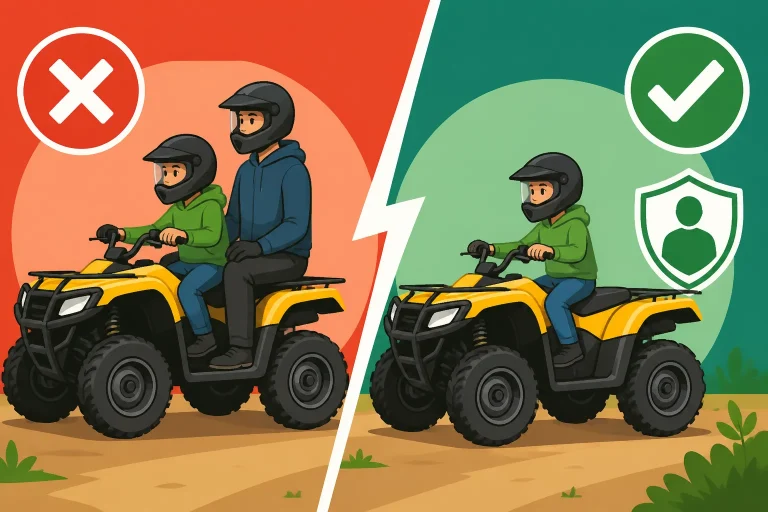
Whether the adult must ride along with the child is a separate question from whether the adult must be able to see and direct them. Do not assume that a passenger seat automatically provides the required supervision, or that an adult must always be on the same machine. The answer depends on the applicable rules and the specific arrangement. See Does the Supervising Adult Have to Ride Along? for that distinction.
Whatever the arrangement, the adult still needs to be able to watch the child and give immediate direction. Riding together does not help if the adult cannot see what the child is doing or cannot respond safely.
A practical check before letting a child ride
Before setting out, make sure the legal requirements for the child’s age and situation are met. The supervision rule is only one part of the picture. Written permission, training, machine suitability, passenger restrictions, helmet use, registration, and where the machine will be ridden may also matter. For a broader overview of the rules, see BC Supervision Required Under 16 and What the Off-Road Vehicle Act Covers in BC.
Use this check before starting:
- Confirm who is supervising. Identify the adult who will keep the child in view and be able to give direction. Confirm that the adult meets the applicable age requirement.
- Choose a suitable route. Avoid sections where the child will disappear around corners or where the adult cannot watch without compromising their own safe operation.
- Agree on signals and stopping points. Tell the child to stop and wait at junctions, if the adult is no longer visible, or whenever the child is uncertain.
- Set a realistic pace. Ride at a speed that allows the adult to observe the child and respond. Do not let a group’s pace dictate the child’s.
- Check conditions as you go. If dust, weather, traffic, or terrain makes it hard to see the child, stop or change the arrangement.
- Review the plan after breaks. Make sure the child still understands where to go and who to follow before restarting.
If the adult cannot maintain sight of the child, the practical choice is to stop, regroup, and change the plan. A clear view and timely direction matter more than keeping the group moving. For other youth-related issues, including age-specific conditions and the supervisor’s responsibilities, see BC Rules for a 14-Year-Old Rider and BC Rules for a 15-Year-Old Rider.
Disclaimer
This article is for general informational purposes only and does not constitute professional advice. Laws, prices and regulations vary by location and change over time. Consult a qualified professional for guidance on your specific situation.