Can an Adult Ride Behind a Child Operator?
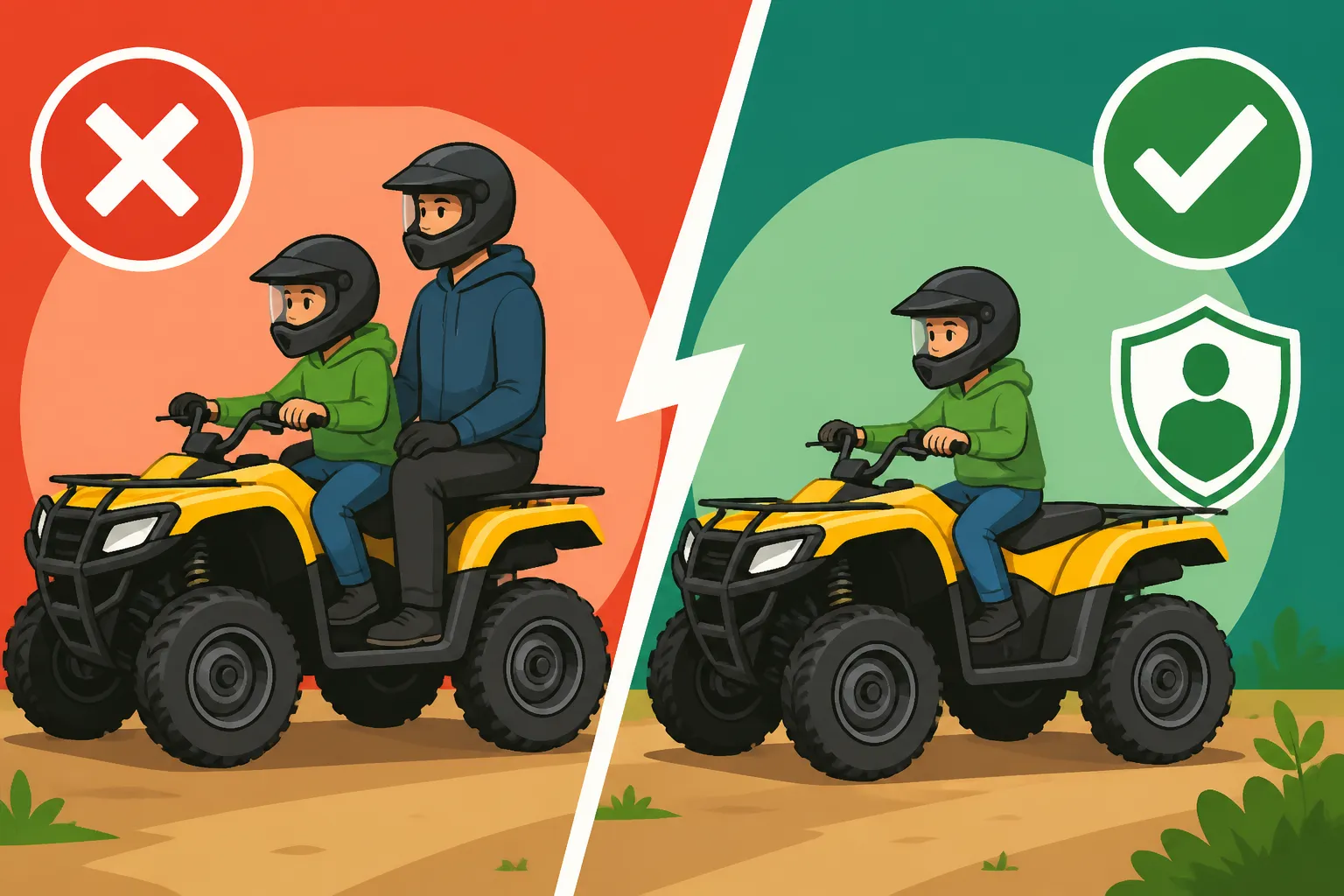
An adult should not ride as a passenger behind a child operating an ATV or UTV in BC. The passenger’s age does not change the rule for a child operator. The safer, lawful approach is for the responsible adult to supervise from a separate machine, while checking the child’s age-specific requirements and the vehicle’s passenger limits before riding.
Can an adult ride as a passenger behind a child operator?
In general, no. A child operator under 16 cannot carry a passenger on an off-road vehicle in BC, whether that passenger is another child or an adult. That includes an adult sitting behind the child on a quad and an adult in a passenger seat of a side-by-side driven by a child.
The rule is about the operator carrying someone, not about whether the passenger is capable, experienced, or willing to accept the risk. Being a parent or guardian does not create an exception. Nor does adding a passenger seat belt or having an adult nearby make it acceptable for the child to drive with a passenger.
This is a separate question from whether the vehicle is built to carry two or more people. A machine’s seating capacity does not cancel the restriction that applies to a child operator. A two-seat quad or four-seat UTV may be designed for passengers, but that does not mean a child under 16 may drive it with someone aboard.
| Situation | Practical answer |
|---|---|
| An adult rides behind a child on a quad | Not allowed when the child is the operator and the passenger restriction applies |
| An adult sits beside a child driving a side-by-side | The extra seat does not remove the child-operator restriction |
| A child rides alone while an adult supervises nearby | May be possible if the child meets the applicable age and supervision requirements |
| An adult operates the machine and carries a child passenger | Check the vehicle’s passenger design, the child’s size and the applicable passenger rules |
| A rider has turned 16 | The under-16 passenger restriction no longer applies in the same way; other rules and machine limits still matter |
The table is a quick guide, not a substitute for checking the requirements that apply to the specific rider, machine, and riding area. For the broader age rules, see BC Youth Riding Rules Explained and BC Children Cannot Carry Passengers. The rules for BC Rules for Passengers on a Quad and BC Rules for a Child Passenger are also useful if the child will be a passenger with an adult driver instead.
A common point of confusion is the phrase “ride behind.” It can mean a passenger riding on the same quad, or it can mean an adult following the child on a separate machine. Those are different situations. The restriction is on the child carrying a passenger. An adult following on another machine may be able to supervise, provided the adult meets the supervision requirements and stays close enough to do so effectively.
How supervision works when the child rides alone
For a child to ride without a passenger, the parent or responsible adult needs to think about more than simply staying somewhere in the area. BC’s youth rules include supervision requirements for riders under 16. The details depend on the child’s age and the circumstances, so check the specific rules before setting out. The information for BC Rules for a Child Under 16, BC Rules for a 14-Year-Old Rider, and BC Rules for a 15-Year-Old Rider can help clarify the age-specific requirements.
A supervising adult must be at least 19 and able to keep the child in view and provide immediate direction. That is why riding on a separate machine is often the practical option: the adult can follow the child, watch how they handle the terrain, and intervene if conditions change. The adult should not be so far ahead, behind, or out of sight that meaningful supervision becomes impossible. For more detail, see BC Supervisors Must Be 19 or Older and Does the Supervising Adult Have to Ride Along?.
Being on the same machine as a passenger may feel like closer supervision, but it does not solve the passenger restriction. If the child is driving, the adult should not use the passenger seat as a workaround. Instead, consider whether the child can ride alone under the applicable rules, or have an adult operate the vehicle while the child rides as a passenger where the machine and child’s size allow.
Age is not the only test. A child must be able to control the particular machine and ride safely in the conditions. A powerful or heavy ATV can be difficult for a young rider to manage, even if the child is legally permitted to operate an off-road vehicle. Check the manufacturer’s age and weight guidance for that model; BC Manufacturer Age and Weight Rules covers why a machine’s fit matters.
Before allowing a child to ride alone, consider these practical questions:
- Is the child legally permitted to operate this type of machine? Confirm the requirements for the child’s age, including any written permission or supervision conditions that apply.
- Can the child control this machine? Check the manufacturer’s guidance and consider the child’s strength, reach, judgment, and experience, not just their age.
- Can the supervisor keep the child in view? Choose terrain and a pace that allow the adult to watch closely and give direction promptly.
- Is the route suitable? Avoid trails with traffic, steep slopes, deep water, or other hazards the child is not ready to handle.
- Is the equipment ready? Check controls, brakes, tires, protective gear, and any required vehicle equipment before riding.
- Does the riding area allow this use? Confirm access, closures, and any site-specific conditions. A route that looks open may have restrictions or hazards.
Supervision is not just a formality. A child may need an adult’s direction when approaching another vehicle, a steep section, a blind corner, or a change in trail conditions. If the adult cannot see the child or respond quickly, the group should change its route or setup rather than assuming that being somewhere nearby is enough.
It is also worth separating supervision from instruction. A child who is still learning needs room to practise basic control without pressure from a passenger or a group trying to keep pace. Starting on a familiar, open area and building up gradually can help the child develop judgment as well as vehicle-handling skills.
Safer options for families riding together
If the goal is for an adult and child to share a ride, the straightforward option is usually for the adult to operate a machine that is designed and appropriate for carrying a passenger. The child can ride as a passenger only when the vehicle’s seating, the child’s size, and the applicable rules allow it. A passenger seat is not automatically suitable for every child, and a child should be able to sit securely and use the restraint system as intended.
The other option is for the child to operate an appropriate machine alone while the adult supervises from a separate vehicle. This keeps the adult close without placing a passenger on the child’s machine. It also lets the adult choose a pace and route that match the child’s ability. If the adult cannot maintain effective supervision on the planned trail, choose a simpler route or a different activity.
For a UTV, do not assume that a roll cage and seat belt make every passenger arrangement acceptable. Confirm the machine’s designated seating positions, follow the manufacturer’s instructions, and make sure each occupant can use the required restraint properly. For an ATV, avoid carrying a passenger unless the machine is designed for one and the applicable passenger rules are met. The child-operator restriction remains the key issue when a child is driving.
Protective equipment matters in either arrangement. Riders and passengers should use properly fitting gear suitable for the machine and conditions. A helmet should have an appropriate certification mark and fit securely; if ordering through Amazon or another marketplace, check the actual product details and certification rather than relying only on a listing headline. Clothing, eye protection, gloves, and boots should also suit the ride.
Plan the route around the least experienced rider. A child should not be expected to follow an adult through terrain that is beyond their control or to keep up with a faster group. Agree on simple signals and stopping points, keep the group together, and stop if the child becomes tired, uncomfortable, or unsure. A passenger is not a substitute for a suitable route, close supervision, or the right machine.
If the child has just turned 16, do not treat that birthday as a complete clearance for every passenger situation. The specific under-16 restriction changes, but the operator still needs to ride within the law and the machine’s design limits. Passengers must use the intended seats and restraints, and the driver remains responsible for safe operation. Other requirements may apply based on where the group is riding.
When the circumstances are unclear, ask a knowledgeable local authority or qualified professional about the rules for the specific machine and riding area before the trip. The most useful details to have ready are the child’s age, the machine type, its designated seating, and whether the route is on private land, Crown land, or a resource road. Do not rely on a seller’s description of a vehicle as “two-up” or “family-sized” to settle a legal question about who may operate it with a passenger.
Disclaimer
This article is for general informational purposes only and does not constitute professional advice. Laws, prices and regulations vary by location and change over time. Consult a qualified professional for guidance on your specific situation.