BC’s Rule Keys on Whether Home Has a Registry
BC’s Rule Keys on Whether Home Has a Registry
Bringing an ATV or UTV to British Columbia can raise a simple but important question: do you need BC registration, or does your home paperwork count? The answer depends largely on whether your home jurisdiction has a registration system for off-road machines. Here’s how visiting riders can prepare, what to carry, and which BC rules still apply.
What BC’s reciprocity rule means
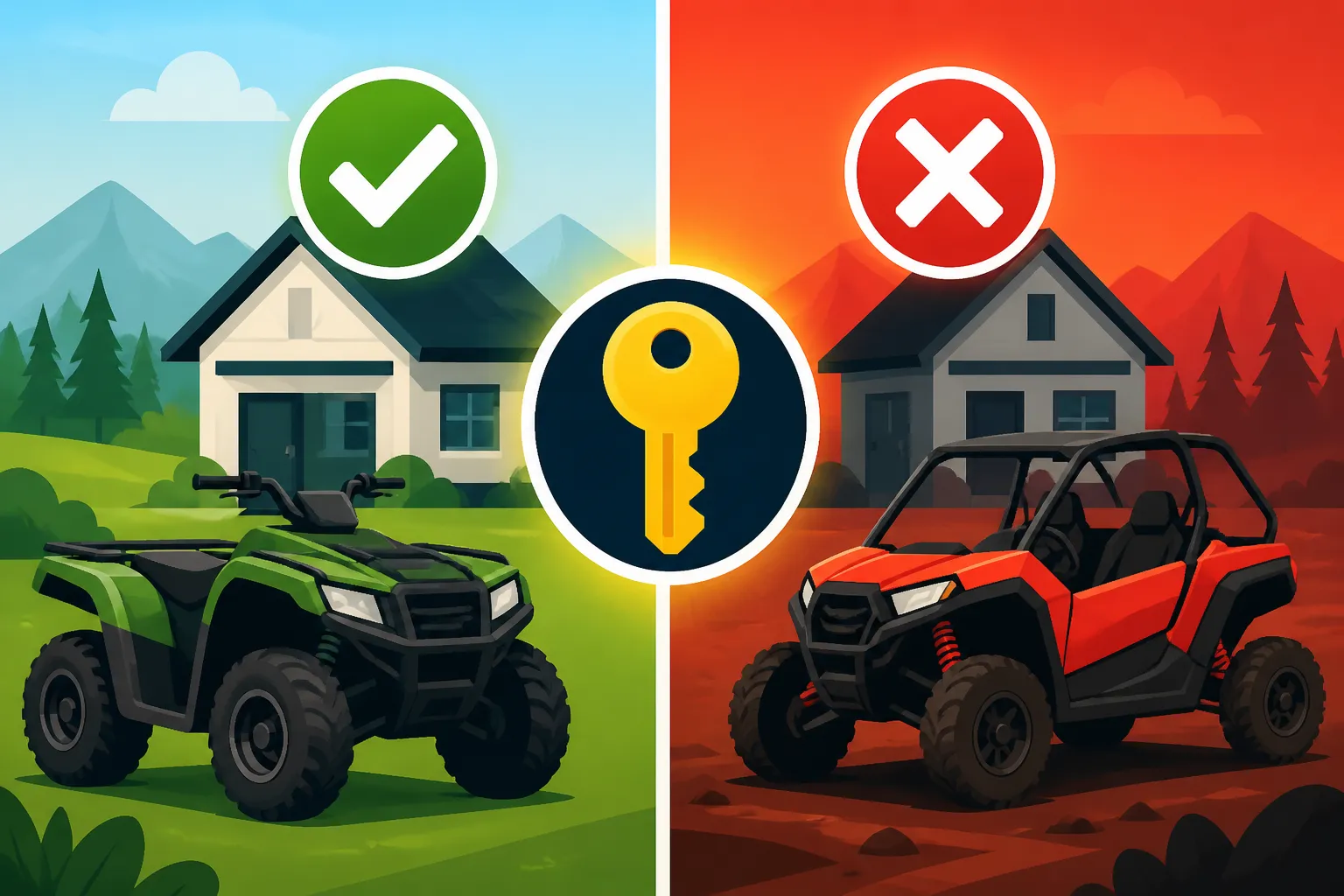
British Columbia does not register off-road vehicles owned by non-residents. Instead, the rules for a visiting machine generally turn on how its home jurisdiction treats that type of vehicle. If the home jurisdiction requires registration, a visitor should keep the machine registered there and carry the relevant proof. If the home jurisdiction has no registration requirement for that machine, the visitor should be ready to show other proof of ownership.
That is the practical idea behind reciprocity: BC recognizes that visitors arrive under different systems, rather than requiring every out-of-province owner to obtain BC registration. It does not mean that a visitor can ignore the rules at home, ride without documents, or assume that every machine qualifies for the same treatment. The machine type, the owner’s residency, and the rules where the machine is normally based all matter.
This approach is different from registering a machine as a BC resident. BC residents may need to register a qualifying off-road vehicle when using it in circumstances covered by the provincial rules. A non-resident generally does not apply for BC registration for a visiting machine. For background on that distinction, see BC Does Not Register Non-Resident Machines and BC’s Rule Keys on Whether Home Has a Registry.
Reciprocity also has limits. Home registration or proof of ownership does not grant permission to ride wherever you like, replace insurance required for a particular road, or make an ATV street legal. It addresses the registration question—not every legal requirement connected with operating a machine in BC.
A useful way to think about the rule is to separate three questions:
- Does your home jurisdiction require your machine to be registered? If it does, keep that registration current and bring the proof.
- If it does not, can you clearly show that you own or are entitled to use the machine? Bring paperwork that connects you to the machine.
- Where and how will you ride in BC? Check the separate rules for Crown land, Forest Service roads, trails, private property, insurance, equipment, and permits.
Those questions are related, but one answer does not settle the others. A visitor with valid home registration can still be riding in a closed area. A visitor whose machine is not subject to home registration may still need to show ownership and follow the same local operating restrictions as other riders.
Registration is not the same as a trail pass
Some managed recreation sites require a site-specific pass or proof of permission. That is separate from vehicle registration and from any home-jurisdiction plate. BC does not have one province-wide ATV trail pass that automatically covers every managed site. Check the rules for the particular area before you set out; a valid home plate does not necessarily pay for access or satisfy a local pass requirement.
Likewise, a club membership is not automatically a pass. Where a site requires a pass, confirm what it covers, which riders or machines it applies to, and how to show proof if there is little or no cell service. BC Passes Exist Only at Managed Sites explains why access requirements can differ from one riding area to another.
How the answer changes with your home jurisdiction
The simplest way to prepare is to check the law that applies where the machine is normally registered or kept, not to guess based on the province or state you are visiting from. Registration systems differ, and a rule for a road-registered vehicle may not apply to an ATV or side-by-side used off road.
| Home-jurisdiction situation | What to bring | What to check before riding |
|---|---|---|
| Your machine must be registered at home | Current registration document and the plate or identifier required at home | Whether the registration applies to your exact machine and whether your insurance covers the planned BC use |
| Your home jurisdiction does not require registration for your machine | Proof of ownership, plus any home documents that identify the machine | Whether the machine is genuinely outside the home registration requirement and what BC expects a visitor to show |
| The machine is borrowed, leased, or company-owned | Home registration or ownership documents, plus written permission or authorization to use it | Whether your permission covers travel and riding in BC and who is responsible for insurance |
| You have recently moved or the machine came from another jurisdiction | Current documents from the jurisdiction where it is registered, if applicable, and records of the move or purchase | Whether you are still a non-resident for the relevant rules and whether your home documents remain valid |
| The machine has no plate or paperwork | Purchase records, transfer documents, and other reliable ownership evidence | Whether the lack of documents reflects a lawful exemption or a problem with ownership history |
These are planning categories, not a substitute for checking the actual rules where your machine comes from. In particular, do not assume that a machine is exempt from registration simply because it is used off road, has never been registered, or was bought second-hand. Confirm whether the home jurisdiction requires registration for that specific class of machine.
Visitors from provinces and states with registration systems
If your home jurisdiction registers your ATV or UTV, bring the documents that show the registration is in force and that it belongs to the machine you are transporting. Keep the required home plate or identifying mark attached and visible as required by the home rules. Do not remove it just because you are riding in BC.
For example, the guidance for visitors from Alberta is not the same as the guidance for someone arriving from a place with no off-road registry. Alberta visitors generally rely on their Alberta paperwork and plate, rather than applying for BC registration. Washington visitors likewise need to follow the rules that apply to their machine at home and carry the relevant home documents. See BC Riders From Alberta Use Alberta Plates and BC Riders From Washington Use Home Plates for those visitor-specific situations.
A plate alone may not answer every question. If an officer or land manager asks who owns the vehicle, the plate may identify its registration status but not establish that the person riding it has permission to use it. Carry the registration document and, if the machine is not registered in your own name, permission from the registered owner.
Visitors from places without a registration requirement
Some jurisdictions do not require registration for certain off-road machines. In that case, there may be no home registration paper or plate to present. That does not automatically mean the visitor should try to obtain BC registration. BC does not register non-resident machines simply to fill a gap in another jurisdiction’s system.
Instead, carry paperwork that credibly establishes ownership and identifies the machine. A bill of sale, dealer invoice, transfer document, or other record may help. If the machine belongs to someone else, carry written authorization. If the paperwork uses a serial number or vehicle identification number, check that it matches the number on the machine.
The key is to be able to explain why there is no registration document and to support that explanation with records. Do not rely on a verbal claim that “this place doesn’t register quads.” Check the rule for the machine class and keep accessible proof. BC Proof of Ownership for Visitors covers the kinds of records that can help when a home system does not issue registration papers.
Recently moved, borrowed, or purchased machines
A recent move can make the situation less clear. Your previous address, the location where the machine is registered, and your current residency may point in different directions. Before riding, confirm whether you are still treated as a visitor for the relevant BC rules and whether the machine’s existing documents remain valid. A transport receipt or moving paperwork may help explain the circumstances, but it does not necessarily replace required registration.
Borrowed machines need their own preparation. A friend’s registration document does not automatically prove that you have permission to take the machine across a border or ride it in BC. Ask the owner for written authorization, and make sure the machine’s registration and insurance are valid for the planned trip.
For a business-owned or rental machine, bring whatever authorization the operator or employer provides and follow its instructions on registration, insurance, and permitted riding areas. Do not assume that a company decal or rental agreement replaces official vehicle documents.
What paperwork visitors should carry
A well-prepared rider should be able to show both the machine’s status and the rider’s right to use it. Keep documents in a waterproof pouch or another secure place, and make sure everyone in the group knows where they are. Digital copies can be useful backups, but do not rely on a phone as the only copy if you may be riding outside cell coverage or could lose power.
A practical document set includes:
- Home registration, if your jurisdiction requires it for the machine.
- Proof of ownership, such as a bill of sale or dealer invoice, especially if the machine is not registered in a system that applies to it.
- Written permission, if you are borrowing, leasing, or operating a machine owned by another person or business.
- Identification, so the name on your paperwork can be connected to you.
- Insurance documents, including evidence of any coverage required for the roads or land you plan to use.
- Pass or access confirmation, if a managed riding site requires one.
- A record of the machine’s identifying number, which can help if paperwork is questioned or the machine is lost or stolen.
Make sure documents agree with each other. A registration paper with one serial number and a machine displaying another can create avoidable questions. If the machine’s identification number is hard to read, photograph it before the trip and keep the photo with your records. A photograph is not a substitute for an unreadable or altered number, but it can help you confirm what the machine should show.
If you bought the machine recently, bring the transfer documents as well as the registration. A registration in the seller’s name may not clearly establish that you bought it. If you inherited the machine, borrowed it from a relative, or acquired it through a business, carry records that explain the relationship. BC Ownership Proof for Visitors and BC Machines With No Paperwork are useful background for understanding why a clear ownership trail matters.
Keep originals safe and copies accessible
There is a trade-off between carrying original documents and protecting them from damage or loss. Follow any rule that requires you to carry a particular original document, but consider keeping a secure copy separate from it. A phone photo can be a convenient reference, yet a flat battery, damaged phone, or lack of signal can make it unavailable when needed.
For a group ride, do not put every person’s paperwork in one vehicle or one rider’s pack. If the group separates, each operator should know how to identify the machine they are using and where its required documents are kept. This is especially helpful when several machines look alike or when one rider is operating a borrowed vehicle.
Before leaving home, check that the document names match the actual arrangement. If the registration is in a parent’s name, for instance, take written permission if another family member will operate the machine. If a company owns the machine, ask the employer or rental business what document it expects riders to carry.
BC rules that still apply to visiting riders
Reciprocity answers only the registration question. Once you arrive in BC, you still need to follow the rules for the land and road where you ride. Those rules can apply regardless of whether your machine carries a BC plate, an Alberta plate, a Washington plate, or no home plate because its class is not registered there.
Know where you are riding
Crown land is an important part of the registration and access picture, but Crown land is not one unrestricted riding area. Some roads and places may be closed to motor vehicles, subject to seasonal restrictions, or managed under specific conditions. Private land requires the owner’s permission. Parks and other protected areas may prohibit motorized recreation.
Before a ride, identify the route and check for posted signs, closures, gates, and local restrictions. A route shown on a map is not necessarily open to motorized use today. Resource roads can also carry industrial traffic or have active work underway. For more on land status and access, see BC Crown Land Riding Explained and BC Motor Vehicle Closures and How to Find Them.
Do not assume that a trail pass grants access to adjacent roads or private property. Ask who manages the site and what the pass actually covers. If the route crosses leased Crown land or an operating work area, additional permission or restrictions may apply.
Registration does not make an ATV street legal
A home plate or proof of ownership does not authorize ordinary highway driving. BC’s off-road vehicle rules do not create a general path for riding an ATV or UTV along public streets. A narrow, permitted crossing or a specific police-issued operation permit is not the same as being licensed for regular highway use.
Plan transportation to the trailhead rather than assuming you can ride a machine on pavement between locations. If your trip involves a highway crossing or a road connection, check the applicable rules before setting out. Can You Ride an ATV on the Road in BC? explains the distinction between an off-road vehicle and a highway-legal vehicle.
Check insurance for the actual route
Insurance requirements can change depending on where you operate. Riding on a Forest Service road, using a highway under a permitted exception, and riding elsewhere on Crown land are not necessarily treated alike. Your home policy may have exclusions or territorial limits, so do not assume that coverage follows you simply because the machine is registered.
Contact your insurer before travelling and describe the intended use accurately. Ask whether the policy applies to the machine in BC, whether it covers the roads you plan to use, and what proof you should carry. If a particular road requires liability coverage, make sure your policy satisfies that requirement before you ride there. BC ATV Insurance Requirements and BC Forest Service Road Requirements provide more detail on these separate questions.
A registration document is not proof of insurance unless it specifically contains the information required for that purpose. Keep insurance evidence separate and easy to show.
Follow equipment and rider rules
Visitors must also comply with BC requirements that apply to helmets, passengers, lighting, and safe operation. Requirements can differ according to the machine’s design. For example, a ride-astride ATV and a side-by-side with seat belts and a protective structure may be subject to different helmet provisions. Follow the rules for the machine you are operating rather than relying on what is customary at home.
Children and young operators are subject to additional requirements. The machine’s size, the operator’s age, adult supervision, and passenger restrictions may all matter. A parent’s permission does not cancel statutory requirements, and a machine that is appropriate for one child may not be appropriate for another. Review BC Youth Riding Rules Explained before bringing a young rider.
At a minimum, make sure each person knows who may operate each machine, who is responsible for supervision, and what to do if the group becomes separated. A safe plan should cover the route, communication, weather, fuel, and an emergency response—not just the paperwork.
A simple pre-trip plan for out-of-province riders
A short check before loading the trailer can prevent a stressful conversation on the trail. Use this process for each machine, not just one representative vehicle in the group.
- Identify the machine and its home rules. Confirm the machine’s class and whether its home jurisdiction requires off-road registration.
- Gather the right proof. Bring current home registration if required. If not, bring clear ownership records and any authorization needed to use the machine.
- Match the papers to the machine. Check names, registration details, and the identifying number against the vehicle.
- Confirm insurance. Ask the insurer about BC use and the specific roads or areas on the route.
- Check the ride area. Look for access rules, closures, managed-site passes, private property, and industrial activity.
- Review operating rules. Confirm the requirements that apply to your machine, passengers, young riders, equipment, and any road crossings.
- Carry documents so they can be produced. Keep them protected, accessible, and backed up where practical.
If you cannot establish whether your machine has a home registration requirement, ask the relevant authority in your home jurisdiction before the trip. If the question is about BC land access, local road restrictions, or the application of a provincial rule to a particular machine, seek confirmation from the appropriate BC authority or a qualified local professional. Do not treat a forum post or another rider’s experience as a substitute for checking the situation that applies to your own machine.
It is also sensible to keep a plan B. A closure, fire restriction, or access limitation can make the planned route unavailable even when all your papers are in order. Identify alternate legal routes, check conditions close to departure, and be prepared to turn around if signage or conditions differ from what you expected.
Frequently Asked Questions
Does a visitor need BC registration for an ATV or UTV?
BC does not register non-resident machines. A visitor generally relies on the registration system that applies in their home jurisdiction, or carries proof of ownership when that jurisdiction does not require registration for the machine. Confirm the rules for the machine and home location before travelling.
What if my home jurisdiction does not register off-road machines?
Carry documents that establish ownership and identify the machine, such as a bill of sale or dealer record. If the machine belongs to someone else, bring written permission. Verify that the home jurisdiction truly has no registration requirement for that specific type of machine.
Is my home plate enough to ride on every BC trail or road?
No. A home plate addresses registration status; it does not automatically grant land access, satisfy a managed site’s pass requirement, provide insurance, or permit highway use. Check the rules for each route and riding area.
Can I rely on a photo of my documents?
A digital copy can be a useful backup, but it may not replace a document you are required to carry. Keep the required paperwork accessible in a durable form and consider a separate copy in case your phone is unavailable.
Disclaimer
This article is for general informational purposes only and does not constitute professional advice. Laws, prices and regulations vary by location and change over time. Consult a qualified professional for guidance on your specific situation.