Radio Channels on a Resource Road
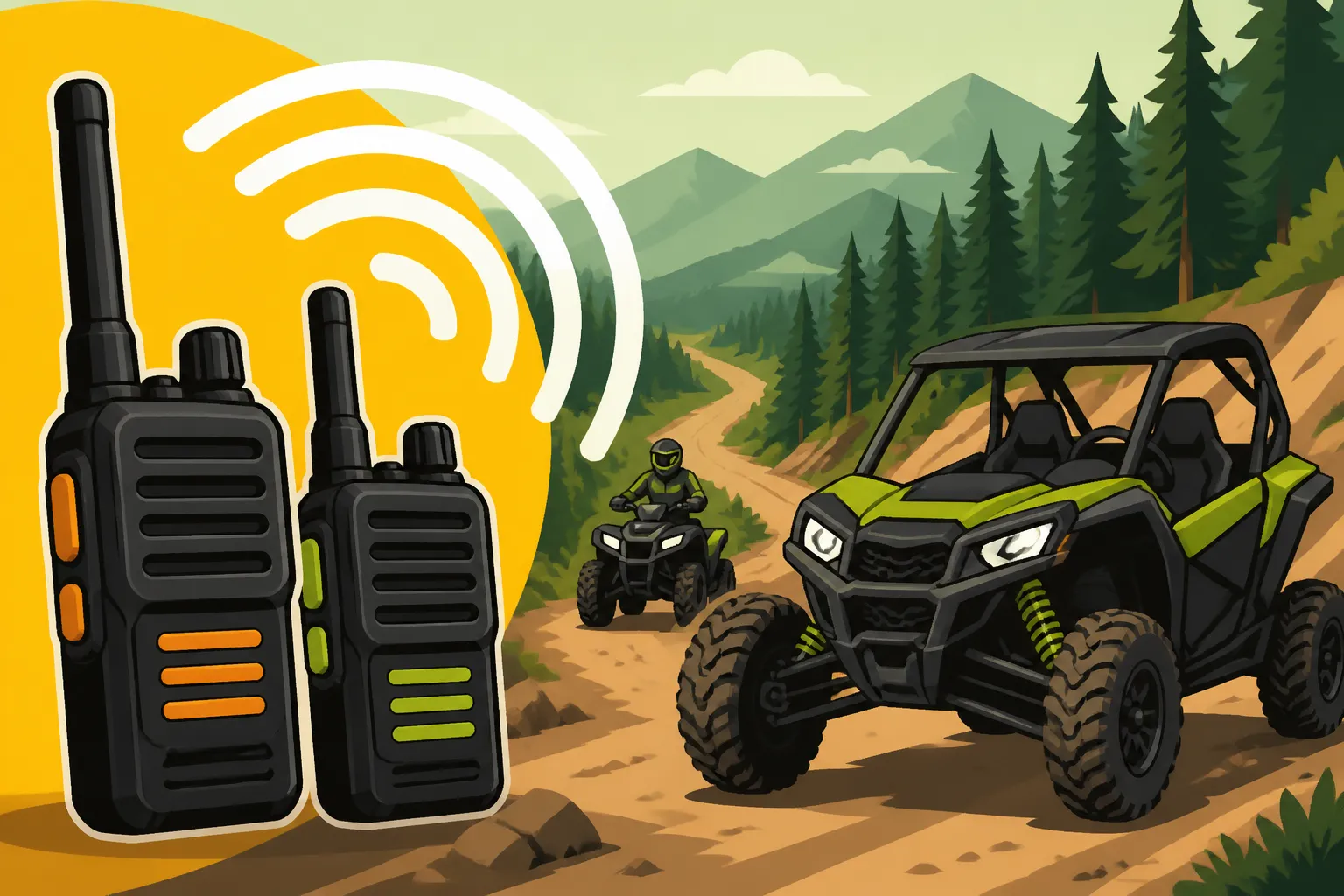
A resource road can feel quiet right up until a loaded logging truck appears around a blind corner. If you are riding an ATV or UTV in BC, knowing which radio channel to use—and what to say on it—can make the trip more predictable. This guide explains how to find the road’s channel, make clear calls, and avoid relying on a radio where it cannot protect you.
How to Find the Right Radio Channel on a BC Resource Road
Look for road-specific signs before choosing a channel
There is no single radio channel you can assume is used on every resource road in British Columbia. The channel may vary by road, section, or active industrial operation. Look for signs at the entrance and along the route. They may identify the channel to use and provide instructions for calling your location or direction of travel.
Do not rely on a channel you used somewhere else, or on a number another rider remembers from a different road. A familiar channel may be wrong for the road you are on. If traffic is working on a separate channel, your call may not reach the drivers who need to hear it.
Make checking for signs part of your arrival routine. Before you unload, look over the entrance area and any posted notices. If the road is signed with a channel and call procedure, follow those directions rather than substituting a habit from another riding area. The practical details in BC Resource Road Radio Practice are useful to review before a trip.
Ask locally when signs are missing or unclear
If the channel sign is absent, damaged, or hard to read, do not guess. Ask a local forestry office, road operator, resource-road user, or nearby riding club whether they can clarify the current practice for that specific road. A fuel stop or small-town shop may also be a useful place to ask, particularly if you are unfamiliar with the area. For remote trips, Renting a Radio in a Small Town can help you think through how to arrange equipment before you leave.
Keep in mind that a radio channel is not the same thing as permission to travel. A road can have a posted radio procedure and still be closed, restricted, unsafe, or unsuitable for your machine. Confirm road access and conditions separately. Checking a Road Before You Go is a useful reminder to check for restrictions and changing conditions rather than treating radio instructions as an all-clear.
A mapping app such as onX Offroad can help you plan a route and understand where roads and trail connections appear to go. Use that information as a planning aid, not as confirmation that the road is open or that a particular radio channel is in use. Verify both with posted instructions or a reliable local contact.
What to Say on the Radio
Listen before transmitting
When you reach a road entrance or another safe place to stop, turn on the radio and listen before making a call. This gives you a chance to hear whether industrial traffic is already communicating and to avoid speaking over another user. If you hear a call that sounds relevant to your location, pause and listen for the response.
If the road has a posted procedure, use it. Some roads or operators provide a preferred way to identify your location and direction of travel; others may have specific calls for particular sections. Follow the instructions on the sign rather than assuming every road uses identical wording.
Keep the message brief and plain. A useful call usually tells other road users who is calling, where you are, and which way you are heading. Avoid long explanations, jokes, or several riders transmitting at once. If you need to repeat a message because it was not acknowledged, wait for a clear moment and say it again calmly.
Make your location and direction easy to understand
A call is only helpful if the person listening can work out where you are. Use the location markers or kilometre references used on that road, and say whether you are travelling toward or away from a recognizable point. If the road has no obvious markers, use a clear landmark or junction that other users are likely to know.
For example, a short call might identify your group, give the nearest marked kilometre or junction, and state your direction of travel. Avoid vague descriptions such as “we’re up the road” or “coming through.” A truck driver may be several turns away and cannot see you, so a precise location matters. See Calling Kilometres on a Channel for more on making location calls that are easier to interpret.
| Situation | Helpful radio practice | What to avoid |
|---|---|---|
| Entering a signed road | Read and follow the posted channel and call procedure | Assuming the channel used on another road applies |
| Preparing to travel | Listen first, then make a concise location and direction call | Transmitting over another conversation |
| Passing a junction or marker | Use the road’s marker or a recognizable landmark | Giving a vague location such as “somewhere up ahead” |
| Meeting a truck or other traffic | Follow the road’s posted procedure and give the other user room | Treating a radio call as a substitute for yielding |
| Losing radio contact | Stop somewhere safe and reassess the route and conditions | Continuing blindly because you made an earlier call |
Keep group calls orderly
If you are riding with friends, agree on who will make the group’s calls before you set off. Having one person speak for the group reduces repeated transmissions and makes it easier for other road users to understand what is happening. Make sure everyone knows the selected channel and can hear instructions from the lead rider.
A group should not assume that one radio call covers every situation for the rest of the trip. If your location or direction changes in a way the road procedure requires you to report, make the appropriate call. If the group separates, the riders who are now travelling independently need to know how to communicate and where to regroup.
Before leaving the staging area, check that the radios are on, charged, set to the agreed channel, and working between riders. A quick check in a safe place can reveal a dead battery, an incorrect setting, or a microphone problem before you are deep into a remote route.
Radio Use Does Not Replace Safe Road Behaviour
Treat resource roads as working roads
A resource road may carry logging trucks, service vehicles, and other industrial traffic. These vehicles are large, may be travelling with loads, and may need significant distance to slow or stop. A radio can help you communicate, but it does not give you control of the road or guarantee that a driver has heard you.
Stay alert even when the channel is quiet. A radio may be switched off, out of range, set incorrectly, or not monitored by a particular road user. Dust, curves, vegetation, and changes in elevation can also limit what you can see or hear. The broader risks are covered in Resource Roads and Industrial Traffic and BC Riders Meeting a Logging Truck.
When you encounter a loaded truck, give it plenty of room and follow the road’s posted rules and conditions. Do not assume a brief radio exchange means it is safe to pass, stop in its path, or continue into a narrow section. If you are unsure who should move or where to wait, stop in a safe place where you are visible and not blocking the road.
Use radios alongside the rules for your route
Radio procedures are one part of preparing for a ride, not a replacement for the rules that apply to the road. Check whether the route is open to ORVs, whether any restrictions are posted, and what equipment or insurance requirements apply. BC Forest Service Road Rules for ORVs can help you separate road-use requirements from general radio etiquette.
Some roads have active industrial use or temporary restrictions that can change the practical risk of a ride. If signs indicate a closure or limit access, do not treat a working radio as permission to continue. Turn around or follow the directions provided by the road operator or posted authority.
Maps can support your planning, especially when you are comparing route options or trying to understand where a road leads. onX Offroad may be useful for reviewing a planned route before you leave, but a map display cannot confirm that a resource road is open today or tell you which channel its users expect you to monitor. Check the road itself and get local information where needed.
Prepare Before You Ride
Check the radio, route, and group plan
A little preparation at the staging area can prevent a frustrating scramble later. Charge radios fully, carry a spare battery if you have one, and check that each rider knows how to change the channel and use the push-to-talk control. If you are borrowing or renting equipment, ask how it has been configured and whether it is appropriate for the intended road. Do not assume that any handheld radio will communicate with every industrial radio system.
Agree on a simple group plan. Decide who makes calls, what channel the group will use, where to stop if riders become separated, and how to respond if the radio stops working. If one person is carrying the map, share the route and key junctions with the others as well. onX Offroad can be part of that planning process, but do not make one rider’s phone the group’s only source of route information.
Keep a paper note or offline copy of important route details where practical. Cell service may be unreliable in remote areas, and a navigation app does not necessarily provide radio communication. Before setting out, confirm you can identify the road entrance, know where you plan to turn around, and have a backup plan if conditions change.
If the radio fails, slow down and reassess
If you cannot hear other users or your calls receive no response, do not assume the road is empty. First check the simple things: the radio’s power, channel setting, volume, microphone connection, and battery. Move to a safe place off the travelled portion of the road before troubleshooting.
If you still cannot communicate, consider whether continuing is sensible given the road’s traffic, visibility, and conditions. You may need to return to the entrance, find a safer route, or wait until you can confirm the local procedure. A map app—including onX Offroad—can help you understand your location relative to a planned route, but it will not tell an approaching driver that you are there.
The key habit is to treat the radio as one layer of awareness. Read signs, listen before transmitting, give clear location calls, and leave room for industrial traffic. If you cannot verify the channel or understand the road’s procedure, pause and get reliable local guidance before proceeding. That is much safer than guessing and hoping someone hears you.
Disclaimer
This article is for general informational purposes only and does not constitute professional advice. Laws, prices and regulations vary by location and change over time. Consult a qualified professional for guidance on your specific situation.