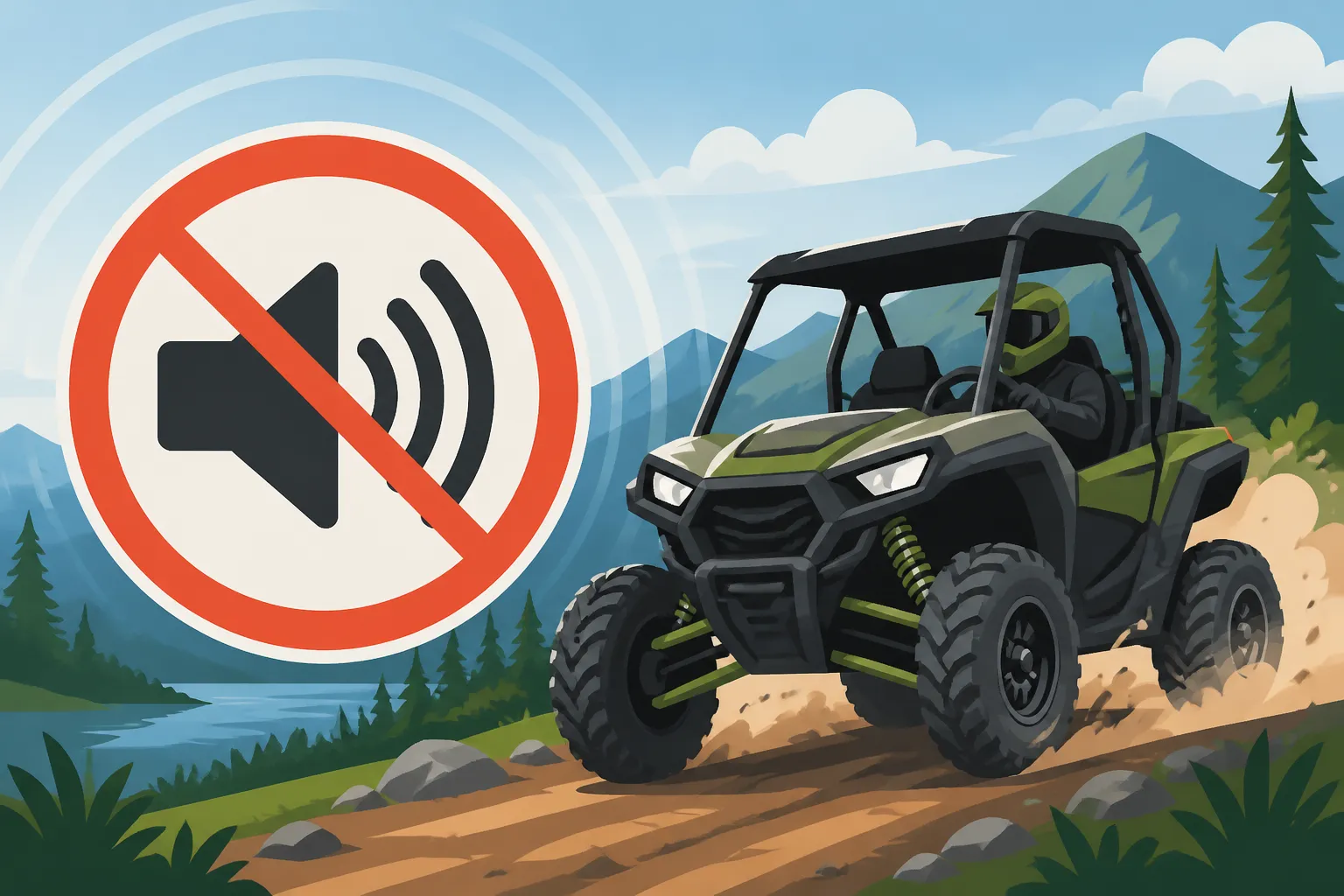
BC Sound Limits of 96 Decibels
A loud ATV or side-by-side can spoil a quiet trail day, irritate nearby residents and create problems at managed riding areas. In British Columbia, the often-cited 96-decibel limit is important, but it does not mean every trail has one province-wide noise rule. This guide explains where the limit may apply, how to reduce exhaust noise and what to check before riding.
What the 96-decibel limit means in BC
It is a managed-site sound rule, not a universal trail guarantee
The 96-decibel figure is associated with some managed off-road recreation sites in British Columbia. It is not a promise that every Crown land road, informal trail or riding area uses the same standard. A site may have its own posted requirements, and riders should treat signs, notices and instructions from the site operator as the practical rules for that location.
That distinction matters when you plan a trip. A machine that is accepted at one managed area may not meet the rules at another. Conditions can also differ between a designated recreation site and a nearby forest road, even if both are part of the same day’s ride. Before unloading, look for posted sound limits and check the site’s current guidance.
The rule is part of a broader expectation that riders minimize the disturbance they cause. Noise can affect other visitors, campers, people living near an access road and wildlife. Being under a posted limit does not make it considerate to rev repeatedly beside a campground or ride aggressively through a quiet area.
A decibel number does not describe loudness in a simple way
Decibels are a logarithmic measurement, not a straightforward scale where each extra point represents the same small increase in perceived sound. Two machines with sound readings a few decibels apart may not seem only a little different to someone standing nearby. Engine speed, exhaust condition, terrain, distance and how sound reflects off trees or rock all affect what people hear.
A reading also depends on how and where the sound is measured. The person holding a meter, the machine’s position, background noise and testing procedure can influence the result. That is why guessing from how loud a machine sounds in the garage is not a reliable way to confirm compliance.
For riders, the useful takeaway is practical: do not assume a quiet-sounding machine automatically passes a formal test, or that a noisy machine is acceptable because it is only being ridden briefly. Follow the site’s stated process if a sound check is required, and ask the operator how compliance is assessed.
The 96-decibel figure is not a substitute for local rules
A number circulating among riders can become detached from the place and conditions where it applies. If a managed site posts a 96-decibel limit, treat that as a site requirement. If another location posts a different standard or a complete restriction on certain machines, follow that instead. When there is no sign, do not assume there are no noise-related rules or expectations.
Local access can involve more than sound. A trail may have seasonal restrictions, permit requirements, a pass system or rules about spark arrestors. For example, [BC Passes Exist Only at Managed Sites] explains why a site pass requirement should not be assumed to apply everywhere, while [BC Spark Arrestor Rules and Fines] covers a separate equipment requirement that can matter on managed land.
The best approach is to confirm the specific riding area before leaving home. A general map can help you find a destination, but it may not show every temporary closure or site-specific condition. Check official notices and the recreation site’s own information where available.
Where the sound limit may apply
Managed recreation sites can have their own operating conditions
Managed riding sites are places where an organization or operator may maintain facilities, manage access or set rules for visitors. These may include staging areas, designated trails, campgrounds or other recreation infrastructure. A sound limit can be one part of the site’s conditions, alongside speed expectations, trail etiquette, parking arrangements and restrictions on certain types of equipment.
Do not treat the name of a riding area as proof that every road and trail around it has identical rules. A large riding destination may include several access points, land types or managed facilities. The requirements posted at a staging area can be especially important if you plan to ride from there, even if you later travel onto a different route.
If you are unsure whether a sound standard applies to the exact place you intend to ride, ask the site operator or local club before arriving. A quick check can prevent the awkward situation of unloading a machine only to discover that its exhaust setup does not meet the site’s requirement.
Crown land and forest roads have different access considerations
Many BC ATV trips include Crown land or forest roads, but those labels do not automatically tell you which sound standard applies. Rules can vary with the land manager, the road’s purpose, posted restrictions and the specific recreation site. On a resource road, noise is only one part of riding responsibly; industrial traffic, visibility and radio practices may matter just as much.
For background on access, see [BC Crown Land Riding Explained] and [BC Forest Service Road Rules for ORVs]. These topics help distinguish the broad access setting from the rules at a particular managed site. A route that crosses different kinds of land may require you to pay attention to more than one set of instructions during the same ride.
Planning tools can help you understand the route, but they should not replace official notices. For example, onX Offroad can help riders explore routes and save navigation information, but a mapped route is not confirmation that a trail is open or that a machine meets a site’s noise conditions. Use it alongside information from the land manager or site operator.
Signs and local notices deserve a fresh check
A familiar riding area can change. A site may update its operating conditions, add signs or restrict access during a particular period. Riders who visited last season should still look for current notices rather than relying on memory or a friend’s old account of the rules.
Pay attention at the staging area as well as at the entrance road. A notice may be posted where riders unload, at a trail junction or near a managed facility. If the sign is unclear, take a moment to ask a site representative or contact the operator instead of assuming the most convenient interpretation.
It also helps to make the sound check part of your pre-ride routine. Before starting the machine, scan for site rules, confirm that the exhaust is intact and discuss any restrictions with the group. That small pause is easier than sorting out a problem after everyone has geared up and the trailers are parked.
How to reduce ATV and UTV exhaust noise
Start with the exhaust system and basic maintenance
A damaged or altered exhaust can make a machine noticeably louder. Check for loose joints, missing fasteners, cracks, rust holes, a poorly fitted muffler or a silencer that has been removed. Even a small leak can change the sound and may worsen over time, especially after repeated vibration on rough trails.
Follow the manufacturer’s maintenance guidance for the exhaust and related components. If the machine has a removable quieting component, confirm that it is installed correctly and in good condition. A part that is clogged, worn or incorrectly fitted may not work as intended, so replacing it with a suitable component is often more sensible than trying to improvise a repair.
If you are buying a used ATV or UTV, listen carefully before purchase and inspect the exhaust. Ask whether the system has been modified and whether the original components are available. A machine that sounds aggressive in a driveway may become a practical headache at a managed riding area where noise conditions are enforced.
Choose compatible parts rather than chasing a louder sound
Aftermarket exhausts can differ in sound output, fit and intended use. A part marketed for performance is not automatically appropriate for every trail or managed site. Before buying, check the product’s fitment and intended application, and ask a qualified shop whether it is suitable for the machine and the places you ride.
Avoid removing a muffler insert or making other changes simply to increase volume. Besides creating conflict with sound limits, a louder machine can make group rides less pleasant and make it harder to hear people, wildlife or other traffic. A quieter setup is especially considerate around trailheads, cabins and campsites, where people may be close to the riding route.
When a machine has a sound issue, a repair shop can help identify whether the problem is a worn component, a leak or an unsuitable modification. Bring the machine’s make, model and any relevant exhaust information. If you ride at a site with a specified testing process, ask the shop whether it can help you assess the machine in a way that relates to that process.
Riding habits affect how loud your group sounds
Even a mechanically sound machine can create unnecessary noise when its rider repeatedly revs the engine, accelerates hard or spins the tires. Keep the throttle measured near staging areas, campsites and other visitors. Avoid prolonged idling when you are waiting for the group to regroup; if it is safe to do so, switch the machine off.
Spacing can also help. A close line of riders climbing a hill at high engine speed may create a much louder burst of sound than machines moving at a steady pace with room between them. Follow trail etiquette, keep a sensible pace and avoid riding back and forth over the same stretch just for practice near a quiet recreation area.
A little courtesy changes how a group is experienced by others. If campers are nearby, slow down before passing, avoid unnecessary acceleration and keep conversations at the staging area rather than shouting over running engines. That kind of behaviour will not replace compliance with a posted sound standard, but it helps reduce disturbance wherever you ride.
How to prepare for a sound check
Inspect the machine before you leave
A pre-trip inspection gives you time to address problems at home rather than at the trailhead. Check that the exhaust is secure, the silencer is present if required, and there are no obvious leaks or damaged sections. Listen for a new rattle or a change in exhaust tone that might indicate a loose part.
If you have recently changed the exhaust, do not wait until the day of a ride to find out how it sounds. Test the machine in a suitable setting and review the specifications for the riding area you plan to visit. Keep receipts or product information for components if that helps you answer questions about what is installed, but do not treat paperwork as proof that a machine passes a site test.
For a group trip, let everyone know ahead of time that noise rules may apply. This avoids singling someone out at the staging area and gives riders an opportunity to repair or replace a noisy component before the trip. It is much easier to discuss the issue in a driveway than after a long drive to the trail.
Follow the site’s instructions during testing
If staff or a site operator conduct a sound check, follow their directions about where to position the machine, how to operate it and where to stand. A test can be affected by inconsistent positioning or background noise, so do not argue over a reading based solely on what the machine sounded like to you. Ask politely how the test is being conducted and what the next step is if there is a concern.
Avoid trying to influence a result by changing the test setup or revving differently from the instructions. The purpose of a consistent process is to assess machines under comparable conditions. If the operator provides a written standard or testing procedure, read it carefully and ask a straightforward question if a detail is unclear.
If your machine does not meet the site’s requirement, respect the operator’s decision and do not ride it there unless the issue is resolved and the site allows you to return. Depending on the location’s rules, the response may involve being asked to leave or not to use a particular area. The most useful next step is usually to identify the cause and correct it before your next visit.
Carry useful information, but do not assume it settles the question
It can be helpful to have the machine’s manual, exhaust details or maintenance records available, especially if you recently replaced a component. These details can make it easier to explain the setup to a shop or site representative. They are not a substitute for meeting the actual requirements at the riding area.
Navigation apps can also help with trip planning. onX Offroad may be useful for organizing routes and keeping track of planned riding areas, but its map information should be treated as a planning aid rather than an official decision about access, current closures or sound compliance. Verify site conditions through the relevant land manager or operator.
For a trip that crosses several areas, write down the key requirements before you go: where you will unload, whether a pass is needed, whether the route includes a resource road and whether any local sound standard is posted. A short checklist is easier to use at the trailhead than trying to recall details from a long discussion in the truck.
| Before the ride | What to check | Why it matters |
|---|---|---|
| Choose the destination | Confirm which site or land manager controls the area | Different locations may have different conditions |
| Read current notices | Look for sound limits, access restrictions and closures | Rules can change and may be posted at the site |
| Inspect the exhaust | Check for leaks, damage, loose parts and missing components | A mechanical problem can increase noise |
| Review modifications | Confirm that aftermarket parts are suitable for the machine and riding area | Performance parts may not suit every site |
| Brief the group | Ask riders to avoid excessive revving and idling | Considerate habits reduce disturbance |
| Plan navigation | Use maps as aids, then verify access with official information | A mapped route does not guarantee permission or compliance |
Common mistakes and how to avoid them
Assuming the same number applies everywhere
The most common mistake is treating 96 decibels as a single rule for all BC off-road riding. The figure is associated with managed sites, but local conditions matter. A route may include a managed staging area, Crown land, a forest road and private land, each with different access expectations.
To avoid confusion, identify the site where you will unload and the routes you intend to use. Check the rules for those specific places rather than relying on a general statement from a forum or an old ride report. If you are riding with a club, ask the organizer which site conditions they have confirmed.
This same habit helps with other requirements. Registration, insurance, permits and access restrictions may depend on where and how the machine is being ridden. For related preparation, [BC Trail Etiquette Locals Expect] is useful for understanding how considerate riding helps protect access, while [Checking a Fire Ban Before You Ride in BC] covers another condition that can affect a planned outing.
Judging compliance by ear alone
People often compare a machine’s sound with another ATV in the group and decide that both are “about the same.” That comparison can be misleading. Different engine types, exhaust designs, rider behaviour and distance from the listener all change how loud a machine seems.
A quieter-sounding machine may still be over a measured limit, and a machine that sounds loud to one person may be judged differently under a consistent procedure. Do not use a phone sound-meter app as definitive proof unless the site specifically accepts that method. Consumer devices and measurement conditions may not match the site’s process.
If you are concerned, inspect the exhaust and contact the site operator before travelling. Ask what the limit applies to and whether there is a particular test procedure. Getting a clear answer in advance is better than relying on a rough guess after the machine is unloaded.
Thinking a new muffler solves every noise problem
Replacing the muffler can help, but it will not necessarily solve a problem caused by a leak, incorrect fitment or another modified component. A new part can also be louder than expected if it is intended for a different use. Check the complete exhaust system rather than focusing only on the visible muffler.
Likewise, riding more gently cannot compensate for a machine that fails a site’s formal requirement. Good trail manners matter, but mechanical condition and compliance are separate issues. Riders should address both instead of assuming that careful throttle use makes any exhaust setup acceptable.
If repeated repairs do not resolve the noise, ask a qualified technician to inspect the system and confirm that the components are appropriate for the machine. Keep in mind that a site’s own operator determines how its requirements are applied. The most dependable preparation is a well-maintained machine, a current check of local rules and a willingness to follow the instructions at the riding area.
Treating noise rules as an inconvenience instead of part of access
A sound limit can feel frustrating if you have driven a long way or paid for a site pass and then discover a problem. But managed access depends on balancing riding with the experience of other visitors and nearby communities. Persistent noise complaints can make riding areas harder to manage and may contribute to tighter restrictions.
That is why preventing the problem is better than debating it at the gate. Maintain the exhaust, avoid unnecessary modifications, ride considerately and confirm the requirements before leaving. If you see another rider creating avoidable disturbance, a calm reminder is more likely to help than an argument in the staging area.
The goal is not to make every ATV or UTV silent. It is to keep machines within the rules that apply at the location and reduce unnecessary noise wherever possible. That makes a ride more enjoyable for your group and helps preserve access for other riders.
Disclaimer
This article is for general informational purposes only and does not constitute professional advice. Laws, prices and regulations vary by location and change over time. Consult a qualified professional for guidance on your specific situation.