BC Spark Arrestors on Managed Sites
A spark arrestor can look like a small piece of hardware, but riding without a suitable one can create a serious fire risk—and may put you out of compliance with rules that apply on forest land or at a managed riding site. This guide explains what the device does, how to check yours, and what to verify before heading out.
What a spark arrestor does
How it reduces fire risk
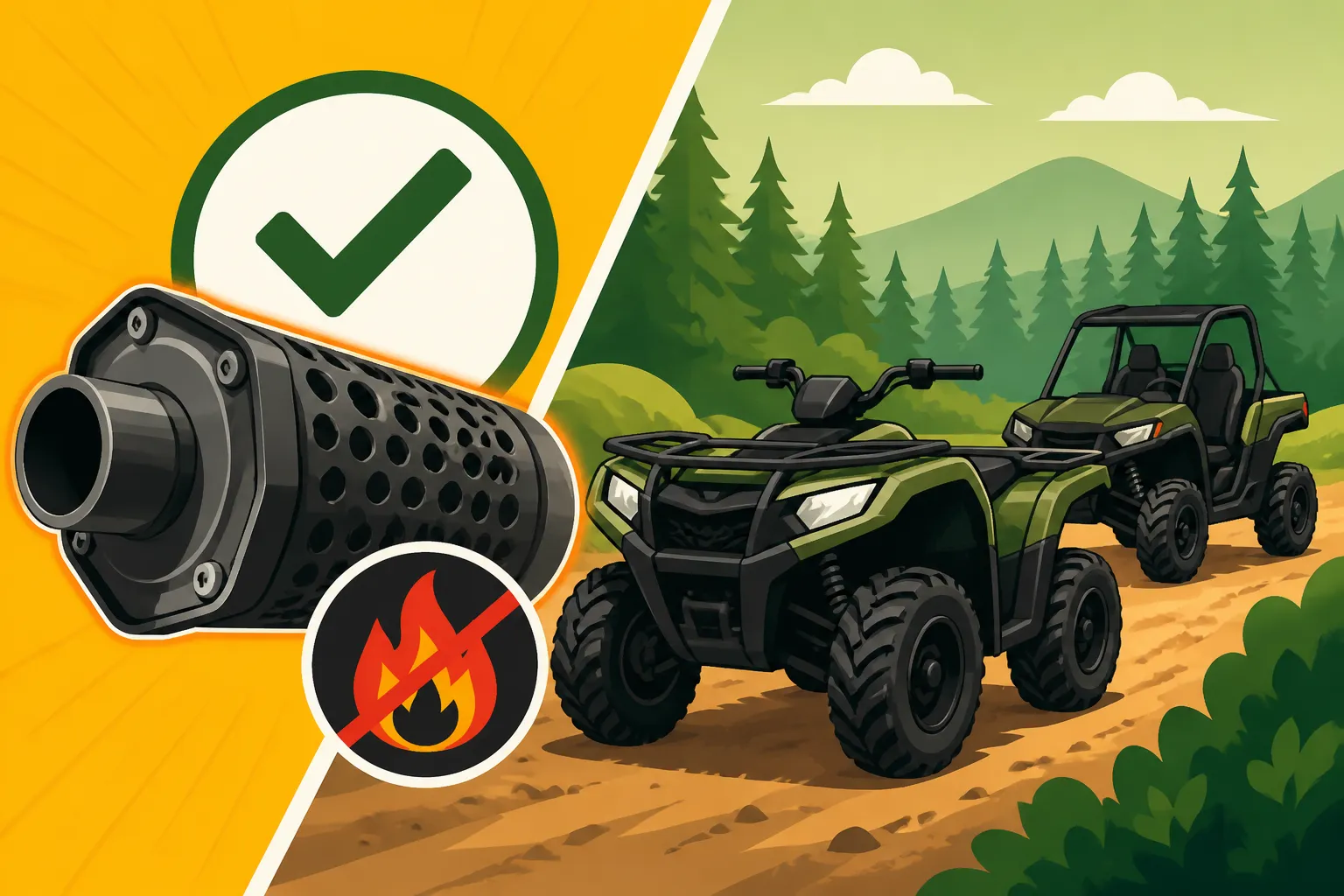
A spark arrestor is part of a machine’s exhaust system. Its purpose is to help prevent hot particles from leaving the exhaust and landing in dry grass, needles, leaves or other combustible material. It does not make an ATV or UTV fireproof, and it cannot eliminate every possible ignition source, but it is an important part of reducing risk.
The concern is easy to underestimate when you are focused on the trail. A machine may be running normally, with no visible flames or obvious exhaust problem, while the area beside the trail is dry enough to catch a tiny hot particle. A stop on a grassy shoulder or a break beside dry slash can put the exhaust close to easily ignited material.
Risk can also change over the course of a ride. A damp morning in a shaded forest does not guarantee that exposed ground, dry brush or roadside debris will remain damp later. Heat, wind, recent weather and the kind of vegetation around the route all matter. The safest approach is to ride with a functioning arrestor and follow any fire restrictions that apply to the area.
What the screen and exhaust system do
Many arrestors use a screen or other internal structure to help retain hot particles. The exact design depends on the exhaust system. Some machines have a removable screen that can be inspected and cleaned; others use a different arrangement. A screen that is missing, damaged, badly clogged or altered may not provide the protection intended by the manufacturer.
A spark arrestor is not simply an accessory that can be judged by appearance. A mesh insert from a hardware store, for example, is not automatically suitable because it fits inside an exhaust outlet. The arrestor needs to be designed for the machine’s exhaust system and kept in working order.
It is also different from a muffler’s noise-control function. A quieter machine is not necessarily equipped with a suitable spark arrestor, and an arrestor does not necessarily bring a machine within a site’s sound limits. Managed sites may have both fire-safety requirements and separate noise rules. For more on the latter, see BC Sound Limits of 96 Decibels is not permitted syntax; internal links must be title-only. So use: [BC Sound Limits on a Managed Site].
Why the requirement matters at a managed site
A managed recreation site has an operator responsible for the site and its facilities, such as staging areas, trails, signs or campsites. These sites may be subject to provincial requirements as well as site-specific rules. A rider should not assume that a familiar trail has the same conditions as another managed area, or that a previous visit means the rules have not changed.
A spark arrestor matters even when a ride is short or the machine stays near the staging area. The risk comes from operating the engine in a setting where sparks or hot particles could ignite vegetation—not from how many kilometres you plan to cover. A machine that is transported to a trailhead still needs to be ready for the riding conditions where it will be operated.
For practical planning, treat the arrestor as part of the same pre-ride check as your tires, lights and first-aid supplies. If you are uncertain whether your exhaust system has one, check the owner’s manual or ask a qualified service shop before riding. Do not rely on a quick glance at the outlet to establish that the correct part is installed.
Where BC spark arrestor rules can apply
Provincial rules and site rules are not identical
BC’s wildfire-related rules can apply to operating equipment in forest land or grassland, and managed sites may also have conditions of use. These are related but not interchangeable. A provincial requirement sets a broader baseline; a site operator may communicate additional conditions, restrictions or operating directions for that particular area.
That distinction can be confusing when a sign at the trailhead uses plain language while a regulation uses defined terms. If a sign says spark arrestors are required, follow it. If there is no sign, do not assume the absence of a sign cancels requirements that apply under provincial rules. Check the relevant regulations and site information before riding.
The conditions at a managed recreation site can also change with fire danger, maintenance work or other operational needs. A site may have a temporary restriction or closure even when the machine itself is properly equipped. An arrestor is not permission to ride during a closure or fire prohibition.
Do not assume every trail has the same management
BC riding areas include managed recreation sites, forest roads, Crown land routes and other settings. The rules and responsible authorities can differ. For example, a ride might begin at a managed staging area and continue onto a road or land managed under a different set of restrictions. The boundary may not be obvious from the seat of a machine.
Before leaving home, identify the riding area and check who manages it. Start with the site’s own notices and any relevant government information about closures or fire restrictions. A mapping app such as onX Offroad can help you understand the route and nearby land features, but treat it as a planning aid rather than proof that a road is open or that a particular rule does not apply.
This is especially important when a route crosses multiple areas. A trail shown as continuous on a map may pass through land with different access conditions, seasonal closures or local restrictions. Check [BC Crown Land Riding Explained] and [BC Motor Vehicle Closures and How to Find Them] as part of your route planning.
Use current notices, not last season’s assumptions
A rider who visited a site last summer may remember a trailhead sign, a pass requirement or a route that was open. That memory is useful, but it is not a substitute for checking conditions before the next trip. Wildfire restrictions and site notices can change, and a road that was accessible on one visit may be closed later.
Build a simple check into your routine: confirm the site is open, read posted fire-related restrictions, and check whether the route includes a road or area with separate requirements. If you are uncertain, contact the site manager or the relevant authority before unloading. This is often easier than discovering a restriction at the gate after towing several hours.
onX Offroad can be useful for reviewing a planned route and noting where it approaches roads, trailheads or boundaries. Pair it with official notices and signs, since a route line on a map is not the same as confirmation that access is currently permitted. For broader closure guidance, see [BC Fire Centre Closures for ORVs] and [Checking a Fire Ban Before You Ride in BC].
How to check and maintain an arrestor
Start with the owner’s manual and exhaust design
The first question is whether your particular ATV or UTV is equipped with a spark arrestor. Check the owner’s manual, the manufacturer’s information for the exhaust system, or ask a dealer or qualified mechanic. Do not assume that every stock exhaust has the same design, especially on an older machine or one with a replacement muffler.
If the machine has an aftermarket exhaust, find out whether the complete system includes a suitable arrestor and whether it is approved for the intended use. A muffler described as “quiet” or “performance” does not, by that description alone, establish that it contains an arrestor. Keep the paperwork or product details where you can refer to them later.
It can help to record the exhaust model and the location of its arrestor or screen. If a riding partner borrows the machine, they can then confirm what to inspect rather than guessing. When a machine has been modified over time, a service shop can help identify whether a required component has been removed or replaced.
Inspect for damage, blockage and tampering
Before a ride, look for visible damage around the exhaust outlet and any accessible arrestor screen. Check for loose fasteners, cracks, missing pieces, heavy carbon buildup or signs that the exhaust has been altered. If the design includes a removable screen, follow the manufacturer’s cleaning and reinstallation instructions.
A blocked screen can affect engine operation, while a missing or damaged screen can undermine its intended function. Avoid solving either problem by removing the screen and riding anyway. If you cannot restore the system correctly, postpone the ride until it has been repaired or checked.
Do not inspect a hot exhaust immediately after riding. Let the machine cool fully and use the maintenance steps recommended by its manufacturer. Protective gloves and eye protection are sensible when handling dirty exhaust components, but the key point is to avoid improvised repairs that could leave the arrestor loose or ineffective.
Keep maintenance records for modified machines
If you have installed a different muffler, had exhaust work done or bought a used machine with modifications, keep a record of the parts and service. The previous owner may have changed the exhaust without leaving the original equipment, and the machine may look complete while lacking a component that is not obvious from outside.
A service receipt or product information does not guarantee that a system is compliant in every setting, but it gives you something concrete to check. If the mechanic confirms the arrestor’s type and installation, note the date and any maintenance instructions. This is particularly useful for a shared family machine or a fleet where different people handle repairs.
For a machine you are buying, ask whether the exhaust is original and whether the arrestor has been inspected. If the seller cannot answer, treat it as a maintenance question to resolve before riding. A low purchase price can quickly become less attractive if the machine needs an exhaust repair before it is usable at the areas you intend to visit.
A practical pre-ride checklist
Before loading the machine
A little preparation at home is more reliable than trying to diagnose an exhaust issue at a busy staging area. Confirm that the arrestor is present and in the condition required by the manufacturer. If the machine has a replacement exhaust or an unclear service history, resolve that uncertainty before the trip.
Check the destination’s access information and any restrictions for the day. If you are planning a route that crosses managed and unmanaged areas, identify the transitions and make sure you have not mistaken a mapped route for an open one. onX Offroad may help you visualize the planned route, but verify access and restrictions through the relevant official or site-managed information.
Use this quick checklist:
| Check | What to confirm | If something is unclear |
|---|---|---|
| Arrestor presence | The exhaust system has the intended spark-arresting component | Check the manual or ask a qualified service shop |
| Arrestor condition | The screen or mechanism is secure and not visibly damaged or blocked | Follow manufacturer maintenance instructions |
| Exhaust changes | Any aftermarket parts are identified and suitable for the machine | Find product details or have the system inspected |
| Site status | The destination is open and any posted conditions are understood | Contact the site manager or relevant authority |
| Fire restrictions | No applicable prohibition or temporary restriction prevents riding | Check current official notices before departure |
| Route boundaries | Planned roads and trails do not cross into a closed or restricted area | Review maps, signs and land-manager information |
A checklist is not a substitute for reading the rules, but it reduces the chance of missing a basic issue while you are rushing to meet friends or make a long drive. It is particularly helpful when riding early in the season, returning after a long storage period or taking a machine that has recently been serviced.
At the trailhead
Read signs before unloading or starting the machine. Look for instructions about closures, fire restrictions, sound limits and equipment. If the sign is hard to interpret, take time to clarify it rather than deciding that it probably does not apply. The cost of a delay is usually much lower than the consequences of riding into a prohibited area or creating a fire hazard.
Keep the exhaust away from dry vegetation when parking. Avoid idling over dry grass, needles or slash, and choose a firm, clear spot where practical. This is a basic precaution even when the machine has a functioning arrestor, because the exhaust and engine remain hot.
If you see smoke, a fresh burn mark or another sign of fire, stop safely and respond promptly. Do not continue riding past a small fire on the assumption that someone else will handle it. Follow local emergency guidance, report the location and give clear directions that another person could use to find it.
On the route
Ride in a way that limits unnecessary contact with dry roadside material. Avoid pulling over in tall grass if there is a firm, cleared turnout nearby. When taking a break, consider where the exhaust is pointing and whether hot components are close to brush or debris.
Pay attention to changing conditions. A route can move from shaded, damp forest into an exposed, dry section, and the safest place to stop may change with it. Wind can also carry a small ignition source into dry material. Good riding habits reduce risk, but they never replace equipment requirements or closures.
Stay on permitted routes and obey signs along the way. If a trail is closed, turning around is the right decision, even if the machine is properly equipped and the route appears passable. [Signs That Restrict ORV Use in BC] and [BC Trails Closed in Fire Season] are useful related topics when planning a ride.
Common spark arrestor mistakes
Treating a screen as optional equipment
A rider may remove a screen because it is dirty, damaged or affecting performance, then intend to replace it later. That temporary fix can turn into a whole riding season without the component. If the arrestor needs cleaning or repair, deal with it before heading out rather than treating its absence as a minor maintenance detail.
Another common mistake is assuming that a visible mesh insert must be the correct arrestor. Appearance alone does not confirm its design, fit or condition. Use the manufacturer’s documentation or get the system checked if there is any doubt.
Avoid modifying the exhaust to create more power or a different sound without understanding what happens to the arrestor. A change that seems small may remove or bypass the component. If an exhaust modification has already been made, verify the complete setup before riding in areas where spark-arresting equipment is required.
Confusing fire equipment with noise compliance
An arrestor and a sound-control system serve different purposes. Riders sometimes hear that a site has a decibel limit and assume that a stock muffler or quiet exhaust addresses every equipment rule. It does not necessarily do so. Likewise, a functioning arrestor does not automatically mean a machine meets a managed site’s noise requirements.
Managed sites may set sound conditions to reduce disturbance to other riders, nearby residents or wildlife. Requirements can be site-specific, so check what applies at your destination instead of relying on a general assumption. [BC Spark Arrestor Rules and Fines] and [Meeting the Ninety-Six Decibel Limit at a Managed Site] provide related context.
The safest approach is to consider each requirement separately: fire-related equipment, sound limits, access rules and temporary closures. A machine can satisfy one and still fail another. A quick review of the site’s information before leaving helps prevent that mix-up.
Assuming a managed-site pass covers every rule
A day pass or annual pass, where required, typically concerns access or use of a particular managed site. It should not be treated as an exemption from provincial requirements, fire restrictions or posted operating rules. Payment for access does not make a closed route open, and it does not correct a missing piece of equipment.
Likewise, club membership and site passes are not necessarily the same thing. Check what each one covers and whether the particular site requires a separate pass. For related information, see [BC Passes Exist Only at Managed Sites] and [Why Club Membership Is Not the Same as a Pass].
If you are unsure what a pass or site notice means, ask the site manager. A clear answer before unloading can save an awkward conversation after a ride has already begun.
How to plan a lower-risk ride
Choose a route with the conditions in mind
A good route plan accounts for more than distance and difficulty. Consider vegetation, exposed stretches, staging arrangements, road access and whether the route enters areas with different rules. Use a map to orient yourself, then verify access and conditions with official notices and local signs.
onX Offroad can help you review a route and keep track of nearby features while planning, but no digital map should be treated as the final word on a closure. Maps can be useful for spotting where a planned loop approaches a road or boundary; signs and current land-manager information determine what you should follow on the ground.
For a group ride, share the route and the key restrictions before the day. This avoids having one rider arrive with different assumptions about where the group can go or what equipment is needed. It also makes it easier to turn around together if a road is closed or conditions have changed.
Carry out basic fire-safe habits
Keep the machine maintained, avoid unnecessary idling in dry vegetation and park with care. Carry appropriate communication and emergency supplies for the remoteness of the ride, and make sure someone outside the group knows the general plan when you are heading into an area with limited service.
Do not assume that wet weather earlier in the week makes every trail safe from fire risk. Conditions can vary sharply by elevation, exposure and vegetation. Follow current restrictions even if the ground at the staging area looks damp.
Be thoughtful about where you stop, refuel and make camp. A riding plan that includes a break in a cleared area is better than improvising beside dry brush. If the route crosses a managed recreation site, follow its posted rules for both riding and camping.
Make the decision to turn around early
Sometimes the right choice is to postpone a ride. A fire restriction, damaged arrestor, unclear closure or unexpected change in conditions can make the original plan unsuitable. That is frustrating when everyone has already loaded up, but changing plans early is far better than forcing a ride that should not happen.
Agree on a group decision rule before setting out. For example, decide that anyone can raise a concern about a closure or equipment problem, and that the group will stop to check rather than pressure that person to keep going. This matters especially when riders have different experience levels or are visiting an area for the first time.
The most useful habit is to make spark-arrestor checks routine. Confirm the equipment at home, read the destination’s notices, follow signs and treat fire safety as part of route planning—not as a last-minute detail at the trailhead.
Disclaimer
This article is for general informational purposes only and does not constitute professional advice. Laws, prices and regulations vary by location and change over time. Consult a qualified professional for guidance on your specific situation.