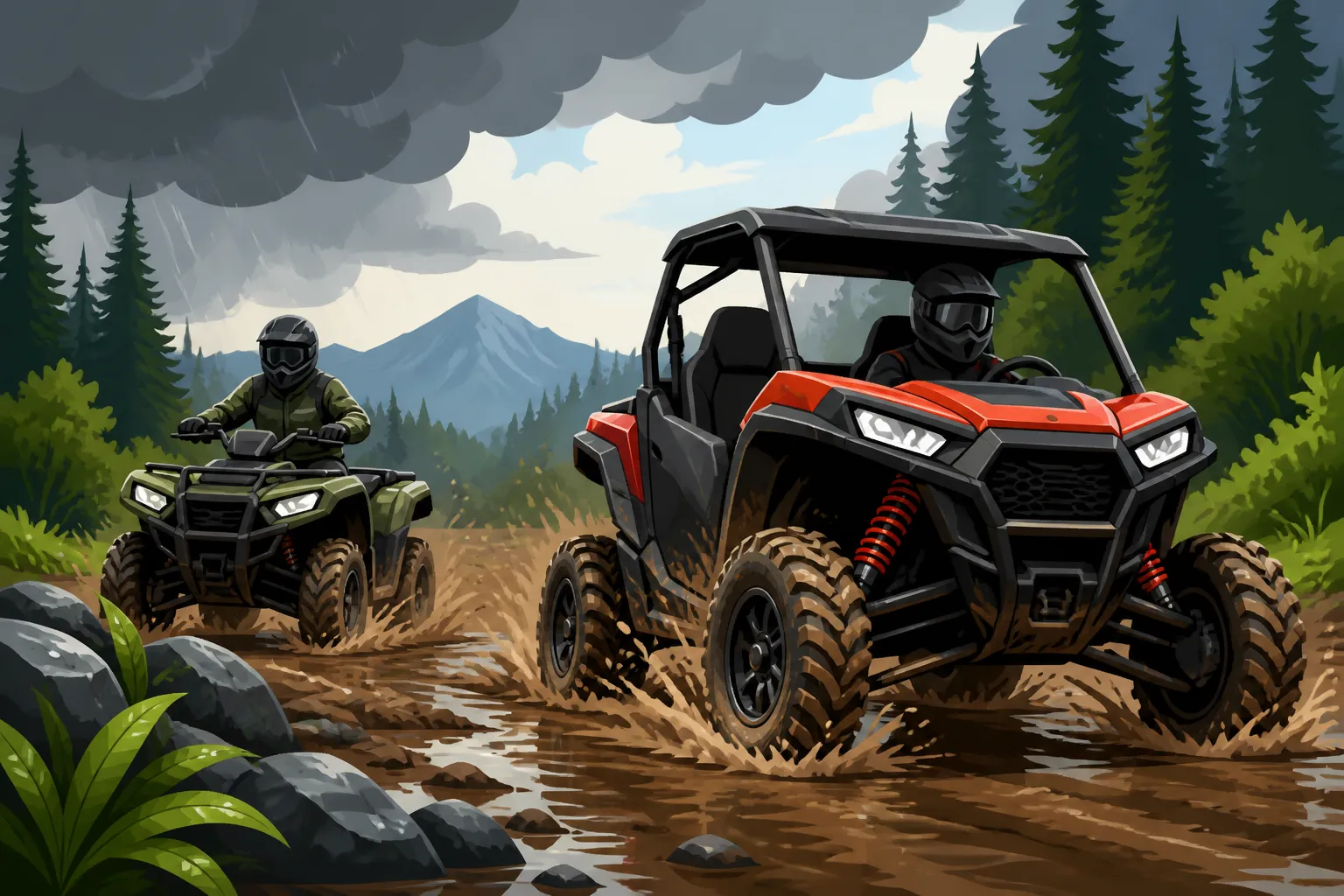
BC Riding After Heavy Rain
Heavy rain can turn a familiar BC ATV route into a muddy, rutted, or unexpectedly hazardous ride. The tricky part is knowing whether the trail is merely wet or whether riding it could cause damage or put your group at risk. This guide explains how to assess conditions, choose a safer route, and decide when it is better to wait.
Why heavy rain changes BC riding conditions
Mud is only one part of the problem
A trail that looks passable from the staging area can change quickly after prolonged rain. Water may collect in low spots, soften the trail surface, and hide rocks, holes, or branches. On sloped ground, runoff can wash loose soil across the route or create narrow channels that are hard to see until you are close.
The surface matters. A rocky route may drain more quickly than a low, clay-heavy track, while a forested trail can stay slick beneath the trees even after open ground starts to dry. Coastal areas and interior regions have different terrain and drainage patterns, so there is no single waiting period that makes every route safe again.
Ruts are another concern. When tires spin in soft ground, they can deepen existing grooves or push mud and soil to the sides. A rider trying to get through a wet patch may end up widening the trail to avoid a rut, creating more damage than the original muddy section. If you find yourself needing repeated attempts, aggressive throttle, or a detour around a puddle, take that as a reason to stop and reassess rather than keep forcing your way through.
Water can hide hazards and weaken the route
Heavy rain can change creek crossings, gullies, and roadside drainage. Water may be deeper or faster than it was on a previous visit, and a familiar entry point may have loose gravel or a cut bank beneath the surface. Never assume that a crossing is safe just because you rode it before the storm.
On a steep section, wet soil and rock can reduce traction when climbing, descending, or turning. A machine can slide sideways, and a rider who loses momentum may be left in a poor position to recover. Side-by-sides also need room to maneuver; a narrow, wet track bordered by trees or a ditch may leave little margin for correction.
Look beyond the trail itself. Rain can bring down branches, loosen slopes, and wash debris onto roads. A route that is technically rideable may still be a bad choice if a blocked section would leave your group far from help or force a risky turnaround. For broader planning, review [BC Trail Closures After a Storm] and [BC Riparian Areas to Avoid] before heading out.
How to decide whether a trail is ready
Check closures and access before leaving home
Start by checking the status of the specific riding area, road, and trail network you plan to use. A recent storm can lead to a temporary closure, damage, or a change in access. Conditions can also vary between nearby routes: one trailhead may be usable while another has a washout or active work.
Check available updates from the land manager or the organization responsible for the site. Look for notices about closures, road damage, fire conditions, logging activity, and other restrictions. A map can help you understand where a route goes, but it does not replace current closure information. If you use a navigation app such as onX Offroad, treat it as one planning tool, then check the relevant official or local updates separately.
Give your group a realistic go-or-no-go decision point before the ride. For example, agree that you will turn around if the road is washed out, the trail is closed, water is moving strongly across the route, or the first muddy section requires spinning tires to get through. Setting that boundary in advance makes it easier to avoid the “we’ve already driven all this way” pressure that can lead to poor choices.
| What you find | Safer response |
|---|---|
| A posted closure or restricted route | Do not enter; choose an open alternative |
| Water moving across the trail | Stop well back and assess; turn around if depth, speed, or footing is uncertain |
| Deep, soft ruts | Avoid adding more damage; turn around or use a clearly permitted alternative |
| A blocked or damaged road | Do not attempt to bypass the blockage through vegetation or private land |
| Wet but stable, durable surface | Proceed cautiously, leave space between machines, and reassess often |
| Changing weather or worsening conditions | Shorten the ride and return while the route remains manageable |
For route planning, [BC Motor Vehicle Closures and How to Find Them] and [BC Crown Land Riding Explained] can help you think through access and restrictions. On Crown land, access does not mean every route is open in every condition. Posted closures and other restrictions still matter.
Read the ground as you ride
At the trailhead, check the surface before committing the whole group. Watch how water moves, whether the soil holds a tire track, and whether the route has fresh washouts or exposed roots. A small test of the ground on a wide, safe section can tell you more than relying on how the trail looked during your last visit.
Keep a generous gap between machines on soft or slippery terrain. If one rider stops suddenly, the person behind needs room to brake without sliding into them. Avoid following another machine’s deepest rut simply because it is already there; that rut may be deeper than it appears, and repeated traffic can make it worse.
If the route becomes more difficult, do not let pride or group momentum make the decision. A sensible turnaround can feel frustrating, especially after packing the trailer and driving to a staging area, but it is usually better than getting stuck, damaging the trail, or creating a recovery problem in worsening weather. [BC Trail Etiquette Locals Expect] offers useful context for making choices that respect the riding area and other users.
Ride with less risk and less trail damage
Choose durable routes and avoid sensitive ground
After heavy rain, favor routes that appear firm, well-drained, and wide enough for your machine. Avoid cutting across the edge of a trail to get around mud. The vegetation and soil beside the route may be more fragile than the established surface, and a short detour can create a new track that encourages others to follow.
Be especially cautious around creeks, wetlands, soft banks, and other water-adjacent ground. Tires can disturb soil that drains into waterways, while bank edges may be unstable after rain. If a crossing looks different from what you remember, do not try to “see how it goes” by entering it. Turn around or choose a safer route that is open and permitted.
In the mountains, wet ground can remain vulnerable even when the sky clears. A sunny break does not mean a trail has drained, and exposed alpine areas can be particularly sensitive to damage. The guidance in [BC Riding Above the Treeline] is worth considering when a route climbs into open, high-elevation terrain. If conditions are soft enough to leave deep marks, postponing the ride is the more responsible choice.
Plan for roads, communication, and recovery
A ride after rain needs a little more planning than a dry-weather outing. Tell someone where you expect to go and when you plan to be back. Bring suitable clothing, water, basic repair and recovery equipment, and a way to navigate if cell service is weak. OnX Offroad can help with route awareness when used with maps saved for offline access, but do not rely on a phone app as your only source of directions or emergency communication.
If your route includes a Forest Service Road, remember that it may be used by industrial traffic and may have changing conditions after a storm. Watch for posted restrictions, damaged surfaces, and work activity, and be ready to yield or turn around. Review [BC Forest Service Road Rules for ORVs] and [Checking a Road Before You Go] as part of your trip preparation.
Think through what you will do if a machine gets stuck or the group has to turn around. A recovery attempt on slick ground can put riders at risk, especially if the machine is near a ditch, steep slope, or moving water. Keep people clear of tensioned recovery equipment, avoid standing downhill from a machine, and do not improvise a recovery that exceeds your equipment or experience.
A map tool such as onX Offroad may help you keep track of your intended route, but route lines do not tell you whether the ground is firm today or whether access has changed. Before leaving, make sure everyone knows the turnaround plan, the nearest practical exit, and who will lead if the group needs to change course. On a wet ride, a conservative route and an early return are often signs of good judgment, not a failed outing.
A practical after-rain decision routine
Before the ride
- Check for closures, access notices, and relevant local updates for your intended area.
- Look at the forecast and consider whether more rain, rising water, or poor visibility could affect the return trip.
- Choose a shorter route with reasonable exit options rather than planning around a single difficult crossing or steep section.
- Tell someone your plan, including your expected return time.
- Pack for wet conditions and make sure your group has the equipment and experience for the route.
If your usual destination has had heavy rain, consider postponing or choosing a different area with firmer ground. A ride is not automatically a good idea just because the staging area is open. Be prepared to change plans after arriving if the first part of the route shows fresh damage.
During the ride
- Stop before entering unfamiliar water, a deep rut, or a visibly damaged section.
- Watch the machines ahead without crowding them, and leave enough space to stop safely.
- Use steady, controlled inputs rather than spinning tires or accelerating hard through mud.
- Stay on established routes and do not create a bypass around a wet patch.
- Turn back if conditions worsen, the route is restricted, or your group cannot proceed without risking damage or injury.
After the ride, inspect your machine for packed mud, debris, damaged tires, or issues that may affect your next trip. If you see a serious washout, fallen tree, or other hazard, note its location and report it through an appropriate local or land-management channel. Avoid sharing an unverified route as “open” simply because you managed to pass through it; conditions can change again with the next rainfall.
It is also worth washing your machine where facilities are available and permitted. Mud can carry seeds or debris between riding areas, and cleaning after a ride helps you spot damage before the next outing. For planning around facilities, see [BC Riding Areas With Wash Stations].
Disclaimer
This article is for general informational purposes only and does not constitute professional advice. Laws, prices and regulations vary by location and change over time. Consult a qualified professional for guidance on your specific situation.