BC Trail Etiquette Locals Expect
A ride can turn sour quickly when dust blankets the group behind you, a logging truck appears around a blind corner, or someone opens a gate and leaves it swinging. Good trail etiquette in British Columbia is more than being pleasant: it helps prevent collisions, protects access, and makes it easier for riders and other trail users to share the same places safely.
Before You Ride, Plan for the Place You’re Visiting
Check access, closures, and local conditions
A route shown on a map is not automatically open to motorized use. Access can be affected by posted restrictions, temporary closures, active logging, wildfire conditions, or land-use rules. Before leaving home, check the latest information available for the specific area, and pay attention to signs at the staging area and along the route. If a road or trail is marked closed, don’t treat the sign as a suggestion or assume the closure applies only to someone else.
This matters even on familiar ground. A route that was open last month may be closed after a storm, during fire restrictions, or while industrial work is underway. Use [BC Trail Closures After a Storm] as a reminder to check conditions rather than relying on memory alone. If you’re planning a trip around a managed recreation site, confirm its rules and any pass requirements before you unload.
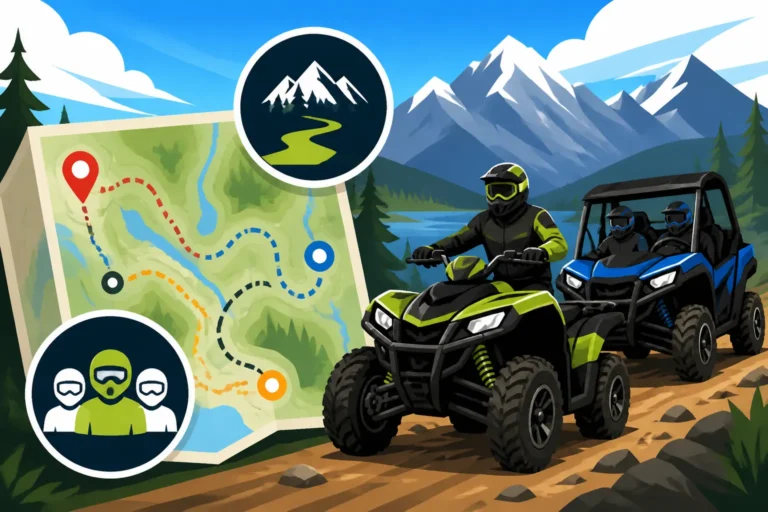
Digital maps can help you plan, but they should be one part of your preparation, not the final authority on access. Some riders use onX Offroad to look over possible routes and keep their trip planning organized. Compare what you see there with current signs and reliable local information; if the two disagree, don’t ride through uncertainty just because a line appears on a screen.
Choose a route that fits your group
A trail that feels easy to one experienced rider may be stressful for a new rider, a young operator, or someone on a different kind of machine. Consider the narrowest, steepest, muddiest, or most exposed section—not just the first kilometre. A side-by-side may be too wide for a route that a smaller ATV can manage, and a stock machine may not be suited to the same obstacles as a modified one.
Before setting out, agree on a route that everyone can complete comfortably. Talk about experience, machine capability, fuel range, and how the group will handle a breakdown or a rider who wants to turn back. [BC Trail Difficulty Ratings] can help you think about how trail conditions and skill level affect a ride, but ratings and descriptions are not a substitute for honest judgment on the day.
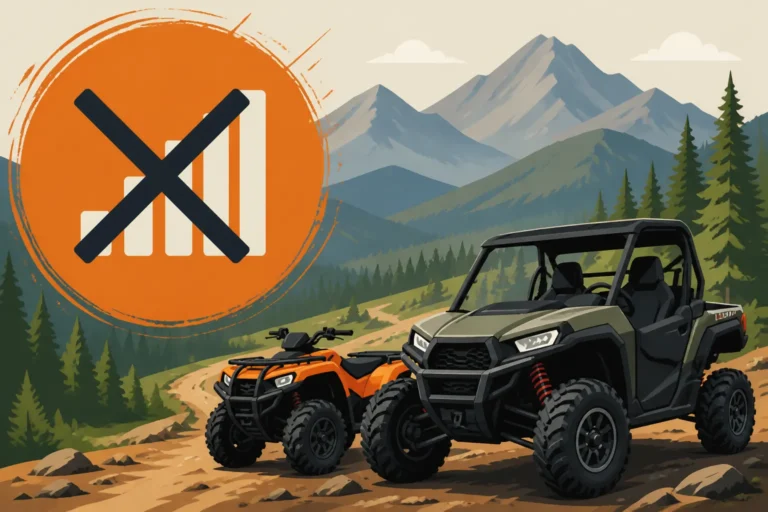
Share the plan with someone who isn’t riding, especially if your route is remote or cell service may be unreliable. A planning app such as onX Offroad can be useful as a supplementary reference for discussing route options with your group. Still, carry a practical backup plan: know your intended return route, agree on a turnaround point, and don’t assume every rider will have a working phone signal.
Share Trails With Other Riders and People on Foot
Slow down, give room, and pass with care
A trail is not a racetrack, even when it looks empty around the next bend. Reduce speed where sightlines are short, near trailheads, around campsites, and anywhere you might meet hikers, cyclists, horseback riders, or another motorized group. Approaching slowly gives everyone time to see one another and decide how to pass without panic.
When you meet someone coming the other way, ease off the throttle and leave enough room for a calm exchange. On a narrow section, one rider may need to stop in a safe, stable spot while the other passes. Avoid forcing another person toward a steep edge, soft shoulder, ditch, or unstable slope. If you’re not sure who should move first, communicate clearly and choose the safest option rather than insisting on a rigid rule.
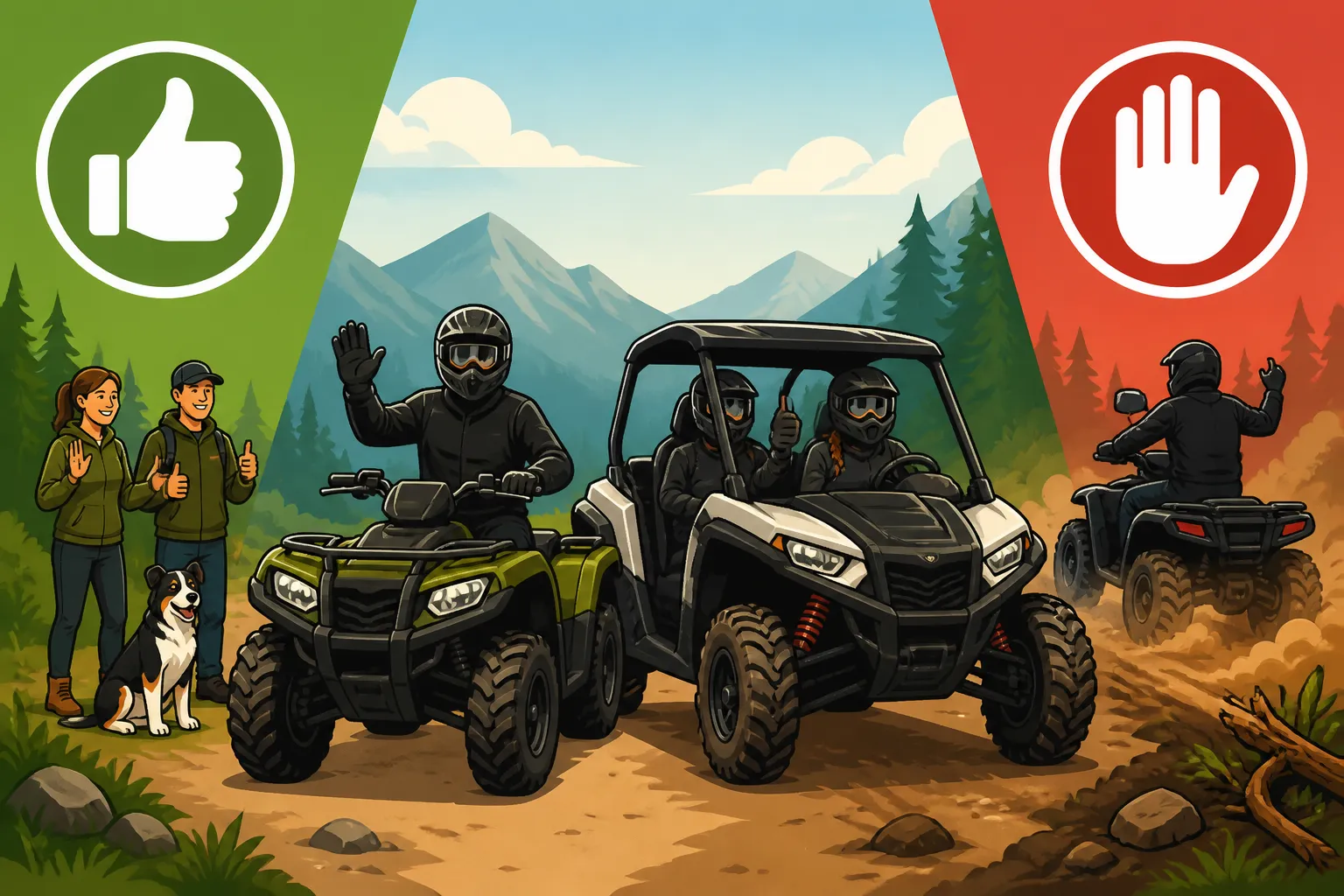
Keep dust in mind, too. Riding close behind another machine can leave the rider in front with poor visibility and make the person behind breathe a steady cloud of dirt. Leave a generous gap, especially on dry roads, and slow down when passing people on foot. A quick wave is friendly; a fast, noisy pass that startles someone is not.
Keep the group together without blocking the trail
A large group can occupy a surprising amount of trail. If you stop to regroup, move fully out of the travel path where it is safe to do so. Avoid gathering around a blind corner, at a narrow bridge, or beside a sign where other users need space to pass. If the group needs time to sort out a route or fix a machine, choose a wider, visible spot.
Use a simple plan for regrouping before the ride begins. Decide whether the group will wait at major junctions, trailheads, or other agreed landmarks. That way, a rider who falls behind doesn’t feel pressured to speed up to catch the others. [BC Group Ride Planning] is a useful companion topic when you’re organizing a trip with riders who have different experience levels.
Keep the group’s pace appropriate for the least experienced rider, not the fastest one. If the group is stretched out, stop somewhere safe and bring everyone back together. Don’t send riders ahead without making sure they know the route, where to wait, and what to do if the group gets separated.
Use Resource Roads and Industrial Routes Carefully
Treat work roads as active work sites
British Columbia resource roads may be used by logging trucks, service vehicles, and other industrial traffic. A quiet road can become busy without much warning, and a loaded truck may need substantial room to stop or manoeuvre. Watch for signs, stay alert around corners and junctions, and never assume that a road is safe simply because you haven’t seen traffic yet.
When you meet industrial traffic, slow down and make space. Follow posted instructions and local radio practices where they apply. If you use a radio, know the relevant channel and the accepted calling procedure before you ride; don’t improvise a call on a channel you haven’t checked. [BC Resource Road Radio Practice] offers more context on communicating on these routes.
Give loaded trucks room, especially on narrow grades or dusty roads where visibility is limited. Don’t pull out to pass unless you can see well ahead, have a clear path, and can complete the manoeuvre without forcing anyone to brake or move suddenly. If you’re unsure what the driver intends, slow down and let the larger vehicle proceed safely. The practical rule is simple: be predictable, visible, and patient.
Keep road etiquette separate from trail assumptions
A resource road can feel like a trail when it is quiet, but it may have different risks, signage, or requirements. Don’t block a gate, staging area, or pullout, and don’t park where a truck needs room to turn. If you stop to check a map, move to a safe area rather than standing in the middle of the road with your group gathered around a machine.
For route planning, onX Offroad may help you review a proposed ride, but it can’t tell you whether a road is currently active, closed, or suitable for your machine. Confirm conditions through signs and relevant local information before committing. For more on the access context, see [BC Crown Land Riding Explained] and [BC Forest Service Road Rules for ORVs].
A courteous rider also remembers that industrial users may be working under pressure and may not expect recreational traffic at every bend. Keep your speed controlled, avoid dusting workers or parked vehicles, and follow directions from people managing the road. If a road is posted closed or a worker asks you to stop, don’t argue your way past.
Protect the Trail, Wildlife, and Future Access
Stay on the established route
Cutting corners around puddles, riding beside a trail to avoid mud, or making a new bypass can widen damage quickly. The softer edge may be wet ground, a drainage area, or fragile vegetation that takes a long time to recover. Stay on the designated route and avoid spinning tires for fun. If a section is too muddy, steep, or rough for your machine, turn around rather than creating another line around it.
Close gates behind you if they were closed when you arrived, and leave barriers and signs as you found them. A gate may be there to manage livestock or access, not to inconvenience riders. Don’t remove, move, or damage trail markers because they seem confusing or inconvenient. If a sign is down or a route appears damaged, make a note of the location and report it to the appropriate land manager or local trail organization.
Pack out everything you bring in, including food scraps, broken straps, and small pieces of repair gear. A wrapper that blows away from a parked machine can become litter well beyond the trailhead. Good trail behaviour also means leaving staging areas clean and avoiding unnecessary noise while people are camping or preparing for a ride.
Give wildlife and other land users room
Slow down when you see wildlife, and don’t chase animals for a closer look or a photograph. Keep your distance and let them move away without being surrounded by machines. The same patience applies around livestock: reduce speed, avoid sudden revving, and follow any posted instructions or requests from the people responsible for the animals.
Be considerate around homes, cabins, campsites, and other places where people may be resting. Keep noise down when starting or warming up machines, especially early in the morning or late in the evening. A loud exhaust, repeated high-speed passes, or idling in one spot can affect how local residents and land users feel about motorized access.
Trail access depends in part on how riders behave over time. Local clubs and volunteers often contribute effort to maintaining riding areas, and respectful behaviour helps support those relationships. If you want to give back, [BC Trail Volunteer Days] can point you toward the kind of work that helps keep routes usable. A good ride is not only one where your group gets through; it’s one where the trail is left in a condition that others can enjoy too.
| Situation | Better trail etiquette | Avoid |
|---|---|---|
| Meeting another trail user | Slow down, communicate, and pass with room | Rushing past or forcing someone onto an unsafe edge |
| Riding in dust | Leave a generous following distance | Tailgating or passing without clear visibility |
| Stopping as a group | Regroup in a wide, visible place off the travel path | Blocking a junction, bridge, gate, or blind corner |
| Using a resource road | Follow signs, stay alert, and yield space to industrial traffic | Assuming a quiet road has no work traffic |
| Finding mud or an obstacle | Stay on the established route or turn around | Creating a bypass or spinning tires |
| Seeing a closure sign | Stop and choose another route | Riding around a barrier or treating the sign as optional |
Make Courtesy Part of Your Ride Routine
Good etiquette is easiest when you decide on it before the machines start. At the staging area, talk through the route, the group’s pace, where you’ll regroup, and how you’ll handle an unexpected closure or a machine problem. Ask whether anyone is new to the area, and make it easy for that person to say when they need a break or want to turn back.
During the ride, make small adjustments early. Slow down before a blind corner, leave more space when the trail is dusty, and move your group out of the way before stopping. These habits reduce stress for everyone, including your own group. They also make it less likely that a minor surprise—such as an approaching truck or a rider who has lost sight of the group—will become a dangerous situation.
After the ride, take a moment to check that the group has left the staging area clean and that no one has forgotten gear or rubbish. If you noticed a damaged sign, a blocked route, or a hazard, report it through an appropriate local channel. When riders treat access as something to care for rather than something to consume, they help make future trips possible.
For more ideas on choosing a suitable destination, start with [BC ATV Trails: Where to Ride]. And before setting off in dry, hot conditions, check [Checking a Fire Ban Before You Ride in BC]. Thoughtful planning, patient passing, and respect for closures are small choices, but they make a real difference to the safety and welcome riders experience across British Columbia.
Disclaimer
This article is for general informational purposes only and does not constitute professional advice. Laws, prices and regulations vary by location and change over time. Consult a qualified professional for guidance on your specific situation.