Resource Roads and Industrial Traffic
Riding your ATV or UTV in British Columbia offers some of the most spectacular scenery and incredible backcountry experiences imaginable. But when you venture off the designated trails and onto resource roads, you're entering a very different world—a shared industrial corridor where massive logging trucks and heavy equipment often have the right-of-way. Navigating these working roads safely and respectfully requires a whole new level of awareness and preparation. This guide will walk you through everything you need to know to share BC's resource roads with industrial traffic, ensuring your adventures are both thrilling and safe.
The Unique World of BC Resource Roads: More Than Just a Dirt Track
Many riders assume a gravel road is just a gravel road, but in British Columbia, resource roads are a distinct category with their own rules, risks, and inherent purposes. These aren't just scenic routes maintained for recreational use; they are the arteries of BC's natural resource industries.
What Exactly Qualifies as a Resource Road?
In British Columbia, a "resource road" typically refers to roads built and maintained to facilitate resource extraction, primarily logging and mining, but also hydroelectric projects, oil and gas, and silviculture. These are often gravel roads, sometimes well-maintained, sometimes rough as guts, winding deep into the province's vast wilderness. Legally speaking, the vast majority of these roads are located on Crown land. When you're riding on these public lands, specifically [BC Crown Land Triggers the Registration Rule], it activates the requirements of the Off-Road Vehicle Act. It's not just about the type of road; it's about the land it traverses. So, when you hear someone say [BC Resource Roads Count as Crown Land], they're hitting on a key legal point.
It's easy to mistake a resource road for a quaint country lane, especially when the sun is shining and the views are breathtaking. However, these aren't leisure highways. They are commercial routes, and that distinction dictates everything from traffic flow to vehicle priorities. They can stretch for hundreds of kilometres, connecting remote logging camps to mills, or mines to processing plants. While they offer incredible access to untouched areas for outdoor recreation, they come with a responsibility to understand their primary function and the dangers that accompany it.
Why They're Different From Your Paved Highways
The biggest difference between a resource road and a paved highway is who owns it and who uses it. Paved highways are public infrastructure, designed and maintained for general public use, with clear rules and traffic management. Resource roads, while often accessible to the public, are primarily for industrial operations. This means different standards of maintenance, different traffic patterns, and different expectations for drivers and riders. There are often active work sites, heavy machinery operating, and frequently, no cell service for miles. You won't find regular highway patrols or convenience stores along these routes, either.
Unlike public roads, many resource roads are privately maintained by resource companies, even if they're on Crown land. This can lead to varying conditions—some are meticulously graded, while others are full of potholes, washouts, and unexpected debris. Speed limits might be posted, but they often reflect industrial vehicle capabilities, not necessarily recreational ATV speeds. And because they're part of a working landscape, you might encounter gates, active blasting zones, or temporary closures with little warning. The expectation is that you, as a recreational user, are entering a hazardous, active industrial zone and are responsible for your own safety and awareness.
Navigating the Industrial Jungle: Safety First on Resource Roads
The thrill of riding deep into the backcountry on a resource road is undeniable, but that thrill comes with significant risks, primarily from the sheer size and speed of industrial traffic. Your small, agile ORV is no match for a fully loaded logging truck.
The Looming Presence of Loaded Logging Trucks
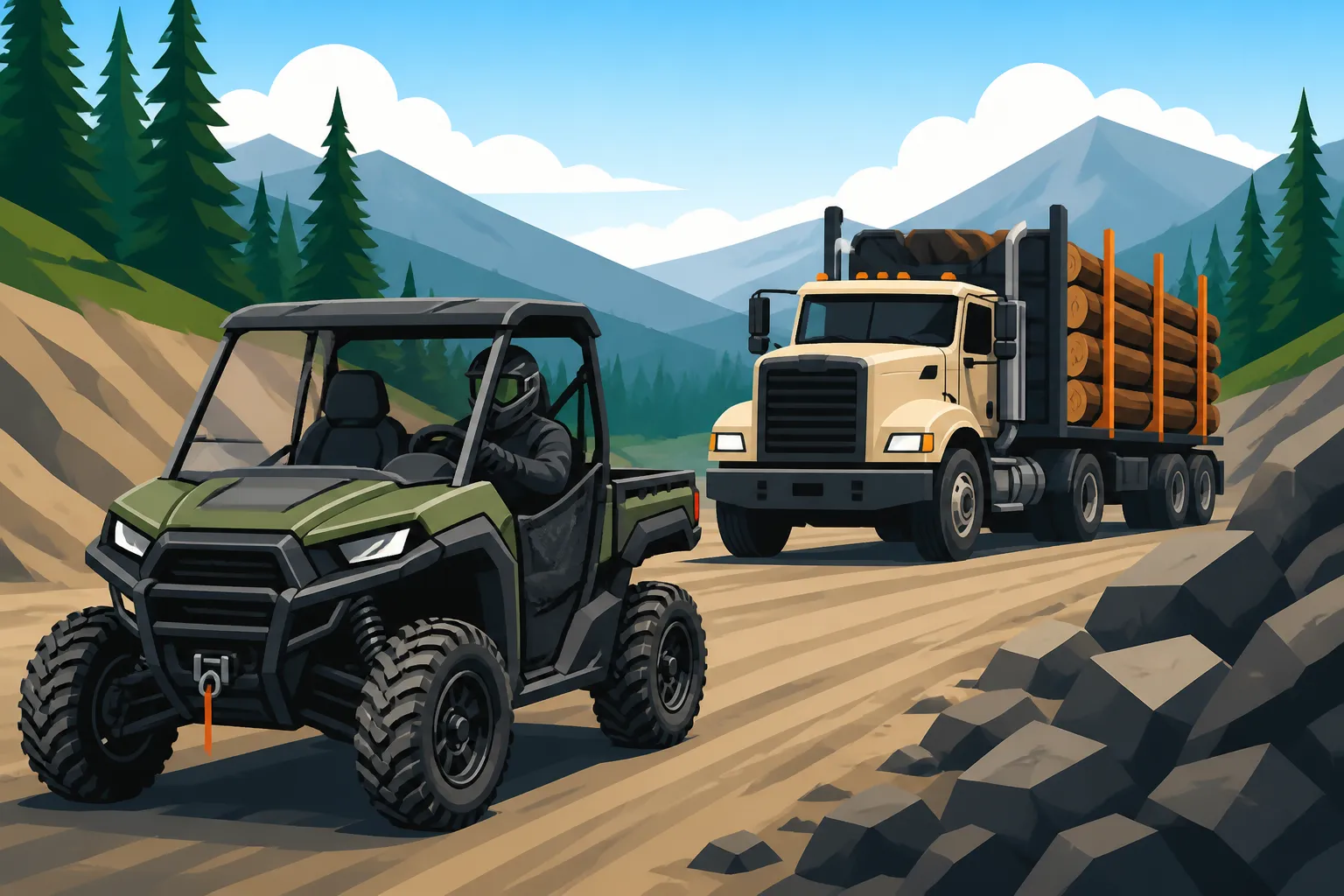
If there's one image that defines resource road safety, it's the logging truck. These behemoths are the kings of the resource road, often travelling at considerable speed, especially when empty. When loaded, they are incredibly heavy and require a huge amount of distance to stop or manoeuvre. They kick up enormous dust clouds in dry weather, which can completely obscure your vision, and they throw up rocks that can damage your machine or injure you. The critical thing to remember is that these operators are often working on tight schedules, and while they want to avoid accidents, their focus is on their job.
A crucial piece of advice for any ORV rider heading onto these roads is to anticipate and yield to industrial traffic. [BC Riders Meeting a Logging Truck] is not a casual encounter; it requires immediate and decisive action. Pull over to the side of the road, well clear of the travelled lane, and stop. Make yourself visible, if possible, by turning on your headlights. Do not assume the truck driver sees you, especially around blind corners or in dusty conditions. These trucks are wide, long, and can't swerve or stop quickly. Your safety depends on your vigilance and willingness to give them ample space. Think about your sight lines—if you can't see far enough ahead to know what's coming, slow down significantly or even stop.
Essential Communication: The Role of Radios and Signage
Communication is paramount on active resource roads. While cell service is often non-existent, many industrial operators use two-way radios to communicate their position and direction of travel. This is particularly true for logging trucks and other heavy equipment. Understanding [BC Resource Road Radio Practice] can be a literal lifesaver. Resource roads often have designated radio channels, and operators will "call kilometres" (e.g., "Logging truck, northbound, 10-kilometre mark") to announce their position. If you're going to be a frequent user of these roads, investing in a compatible radio and learning the local protocols is highly recommended. Always assume industrial traffic is running a radio.
Beyond radios, pay close attention to all signage. Resource roads aren't always signed like public highways, but you'll often see warnings for active hauling, upcoming junctions, or speed reductions. Look for signs indicating "Yield to Industrial Traffic" or "Active Logging Ahead." These aren't suggestions; they're vital safety instructions. Some roads also have "sign-in" sheets or radio-controlled gates to manage access and track who is on the road. Respecting these systems is not only safe but also shows courtesy to the industries that maintain these vital routes. Without these roads, a lot of the province's amazing backcountry would be completely inaccessible.
Your ORV and the Rules of Engagement on Resource Roads
Riding an ORV on a resource road isn't quite the same as riding on a dedicated trail. There are specific legal requirements, safety considerations, and etiquette rules that come into play, especially when sharing the space with heavy industrial vehicles.
Registration, Insurance, and Helmet Requirements
First and foremost, your ORV must be properly registered. Since [BC Registration Became Mandatory in 2015], riding an unregistered machine on Crown land, which includes most resource roads, can lead to serious fines. You can even face [BC Tickets for an Unregistered Machine]. So, before you even load up, make sure you have your [BC's Certificate of Registration Explained] on hand. Remember, registration is a one-time thing in BC, not an annual renewal like a car.
Beyond registration, insurance is a critical, often misunderstood, component. While basic third-party liability insurance is voluntary for most Crown land riding, it becomes mandatory on Forest Service Roads (FSRs) that are also designated as resource roads. You'll need at least [BC Resource Road Insurance of $200,000] in third-party liability coverage. This can usually be obtained through an Autoplan broker, often at the same time you register your machine. And regardless of where you're riding, if it's a ride-astride machine (like most ATVs and dirt bikes), [BC Helmets Required on an FSR]. This isn't just a recommendation; it's a legal requirement under the Off-Road Vehicle Act, which largely covers [What the Off-Road Vehicle Act Covers in BC]. For side-by-sides with roll cages and seatbelts, helmets are often not strictly required, but seatbelts are, and helmets are still a smart choice.
Etiquette, Awareness, and Avoiding Conflict
Riding on resource roads requires a heightened sense of situational awareness and a commitment to responsible riding. Industrial traffic always has the right-of-way. This isn't just a courtesy; it's a fundamental safety principle. Always be prepared to pull over and stop. Keep your speed appropriate for the conditions, especially around blind corners, crests of hills, and in dusty conditions. Assume there's always something coming around the bend.
Consider the impact your riding has. Avoid churning up excessive dust, especially near active work sites or residential areas. If you encounter active work zones, respect all barriers and instructions from workers. Remember that resource roads are often vital access points for local communities, hunters, and other recreational users, not just industrial operations. Everyone is sharing these spaces, and maintaining good relationships means being a responsible and considerate user. This also includes respecting any posted [BC Trail Closures After a Storm] or due to fire hazards. Sometimes these roads are temporarily shut down for maintenance or safety reasons, and ignoring these closures can have serious consequences.
Gearing Up for Resource Road Adventures: Pre-Ride Checks and Preparedness
A successful and safe trip on BC's resource roads starts long before you even leave your driveway. Proper machine maintenance and personal preparedness are non-negotiable for tackling these challenging routes.
Machine Preparedness: Beyond the Basics
Your ORV needs to be in tip-top shape for the rigours of resource road riding. While regular maintenance is a given, consider the specific demands of these rough, unpaved routes. Tires are crucial: ensure they are in good condition with plenty of tread and appropriate air pressure for the terrain you expect. A flat tire deep in the backcountry can ruin your day, so carrying a repair kit and a way to re-inflate is wise.
Beyond tires, inspect your suspension, brakes, and steering components. The constant jarring and bumps of resource roads can take a toll. Robust underbody protection, like skid plates, can save you from costly damage from rocks and debris. Companies like SuperATV offer heavy-duty skid plates and other accessories that can significantly enhance your machine's durability and protection on rough terrain. Make sure all your lights are functional, especially if you might be out at dusk or in low visibility conditions. [BC Lighting and Seat Belt Requirements] are in place for a reason; good visibility is key to being seen by larger vehicles.
A properly functioning spark arrestor is also mandatory for riding on Crown land in BC. This prevents sparks from your exhaust from starting a wildfire, which is a serious concern, particularly in dry seasons. Always double-check this before you head out.
Personal Preparedness: What to Carry
When heading onto resource roads, you are venturing into remote areas, often without cell service. This means you need to be self-sufficient and prepared for emergencies. Pack a comprehensive first-aid kit that goes beyond a few band-aids; think about trauma, burns, and allergic reactions. Carry enough food and water for longer than you expect to be out, plus extra in case of delays.
Beyond basic survival gear, reliable communication is essential. A satellite messenger or an InReach device allows you to send and receive messages, track your location, and, critically, send an SOS in an emergency, even when there's no cell signal. A good map (paper or downloaded offline maps on a GPS device) of the area is also vital, as your phone's GPS might not work without signal. [BC Forest Service Roads Worth Riding] are often remote and complex, so knowing your route and having backup navigation is smart. Always let someone know your planned route and expected return time. Carrying tools specific to your machine, a small shovel, tow rope, and a spare spark plug can also save you a long walk out. Being prepared means you can focus on the incredible experience of exploring BC's vast and beautiful backcountry.
| Item Type | Essential for Resource Roads | Why It's Crucial |
|---|---|---|
| Machine | ORV Registration | Mandatory on Crown Land (most resource roads); avoids [BC Tickets for an Unregistered Machine]. |
| Minimum $200K Liability Insurance | Mandatory on FSRs/resource roads; covers accidents with third parties. | |
| Helmet (Ride-astride ORVs) | Mandatory on FSRs/resource roads for safety. | |
| Functional Head/Tail Lights | For visibility, especially in dust or low light. | |
| Spark Arrestor | Prevents wildfires; legally required on Crown land. | |
| Robust Tires & Repair Kit | Prevents flats; SuperATV skid plates protect undercarriage from debris. | |
| Two-Way Radio (e.g., FSR channel) | For communicating with industrial traffic and other riders. | |
| Personal | Comprehensive First-Aid Kit | For medical emergencies in remote areas. |
| Satellite Messenger/InReach | Critical for SOS and communication outside cell service. | |
| Offline Maps/GPS device | For navigation when cell service is unavailable. | |
| Food & Water (extra) | For unexpected delays or emergencies. | |
| Warm Layers & Rain Gear | Weather can change rapidly in BC backcountry. | |
| Basic Tool Kit & Tow Rope | For minor repairs or getting unstuck. | |
| Bear Spray | For wildlife encounters in remote areas. | |
| Photo ID & Certificate of Registration | Required by law to carry these documents when riding. |
Disclaimer
This article is for general informational purposes only and does not constitute professional advice. Laws, prices and regulations vary by location and change over time. Consult a qualified professional for guidance on your specific situation.