Manufacturer Minimums by Model
A child’s age alone does not tell you whether a particular ATV or side-by-side is suitable. The manufacturer’s minimum age, weight and operating instructions matter, and BC’s youth-riding rules apply too. The safest way to decide is to identify the exact machine, check its manual and labels, then compare those requirements with the rider’s abilities and the rules for the place you plan to ride.
What a manufacturer minimum means
There is no single age that makes every ATV or UTV appropriate for a young rider. Manufacturers set guidance for individual models, and the minimum can differ between machines that look similar. A small youth quad and a larger adult ATV may have very different controls, power, braking demands and weight.
The manual or warning labels may state a minimum operator age, a minimum rider weight, or both. They may also give limits for passengers, maximum load, or how the machine should be used. Treat those details as model-specific instructions, not as a general recommendation for every machine from the same brand.
A minimum age is a starting point, not proof that a particular child is ready. A rider who meets the stated age may still be too small to reach the controls comfortably, too light to operate the machine as intended, or not ready to make safe decisions. Conversely, being tall or confident does not make a child eligible to use a machine below its stated minimum.
| What to check | Why it matters | What to do |
|---|---|---|
| Exact model and model year | A manufacturer’s limits can vary between models and versions | Match the machine’s identification information to its manual |
| Minimum operator age | The machine may not be intended for younger riders | Do not rely on a different model’s age guidance |
| Minimum or maximum weight | Size and weight affect control and fit | Check the manual and warning labels for every stated limit |
| Passenger instructions | Some machines have specific passenger and seating requirements | Follow the instructions for that model and rider |
| BC youth rules | Meeting the manufacturer’s minimum does not replace legal requirements | Check the age, supervision and permission rules that apply |
| Riding location | A trail, road or private property can involve different restrictions | Confirm access rules as well as machine requirements |
Manufacturer instructions may use terms such as “operator,” “rider” or “passenger.” Read the definitions and warnings in context. A minimum age for operating a youth ATV does not automatically tell you whether that child can ride as a passenger on a different machine. Passenger fit, seating design and the machine’s instructions need their own check.
Likewise, do not assume that a machine described as a youth model is suitable for any child. The model designation is not a substitute for the manual. If the machine is used, the manual is missing, or its warning decals are unreadable, find the correct instructions before allowing a child to ride.
How to check the requirements for a specific model
Start with the machine itself rather than a seller’s description or a general age chart. A listing may omit the exact model year, combine details from several versions, or call an ATV “youth-sized” without showing the manufacturer’s requirements.
Use this process:
- Identify the exact machine. Record the make, model name and model year. Check the identification label or serial number location described in the owner’s manual. If the machine’s identity is unclear, do not guess based on appearance.
- Find the correct owner’s manual. Look for the manual from the manufacturer or an authorized source. Confirm that it matches the model and year, rather than a similar-looking machine.
- Read the operator-age and weight information. Search the manual for safety warnings, age recommendations, weight limits and rider-fit instructions. Read the surrounding text, not just a search result or a single label.
- Inspect the machine’s warning labels. Look for labels on the bodywork and near the controls. If a label conflicts with information you found elsewhere, pause and ask the manufacturer or a dealer to clarify.
- Check the passenger instructions separately. Confirm whether the model is designed to carry a passenger and what the manufacturer requires for that passenger. Never add a passenger to a machine that is intended for one operator only.
- Compare the requirements with the actual rider. Consider age, weight, reach, strength, coordination and ability to understand instructions. A child should be able to use the controls without stretching, leaning awkwardly or losing a stable riding position.
- Keep a record. Save the manual or take a copy on your phone, and note where the age and weight information appears. This is useful when more than one adult supervises the child or the machine is shared.
If you cannot find an exact manual, contact the manufacturer or a dealer and provide the identifying information. Do not use a manual for a machine that only looks similar. Changes between model years can affect controls, equipment and warnings, and the details are not always obvious from a photograph.
For an older machine, the owner’s manual may not be easy to locate online. Check the machine’s paperwork, ask a dealer familiar with that make, and compare the identification information carefully. A handwritten note from a previous owner or a general internet discussion is not a reliable substitute for model-specific instructions.
The condition of the machine matters too. A correctly sized ATV can still be unsuitable if its brakes, throttle, tires or safety equipment are damaged or poorly maintained. Before a child rides, inspect the machine and make sure the controls work as intended. For a broader preparation checklist, see BC ATV Safety Training Options.
How manufacturer guidance fits with BC rules
A manufacturer’s minimum and BC’s youth-riding rules are separate checks. Satisfying one does not cancel the other. If the manual sets a higher minimum age than a rule would otherwise allow, follow the manufacturer’s limit. If BC law requires supervision or permission, those requirements still apply even when the child meets the manufacturer’s minimum.
BC’s youth rules include requirements for riders under 16, with different conditions relevant to age and written parental permission. Where supervision is required, the supervising adult must meet the legal age requirement and be able to keep the child in view and give immediate direction. Confirm the current details before riding; BC Youth Riding Rules Explained and BC Rules for a Supervising Adult cover those questions.
A supervising adult is not a substitute for training, fit or attention. The adult should be close enough to see what the child is doing and respond promptly, not simply be somewhere in the same riding area. The child also needs clear instructions about where to ride, when to stop and how to respond to changing conditions. For more detail on what supervision involves, see BC’s Visible and Immediate Direction Test.
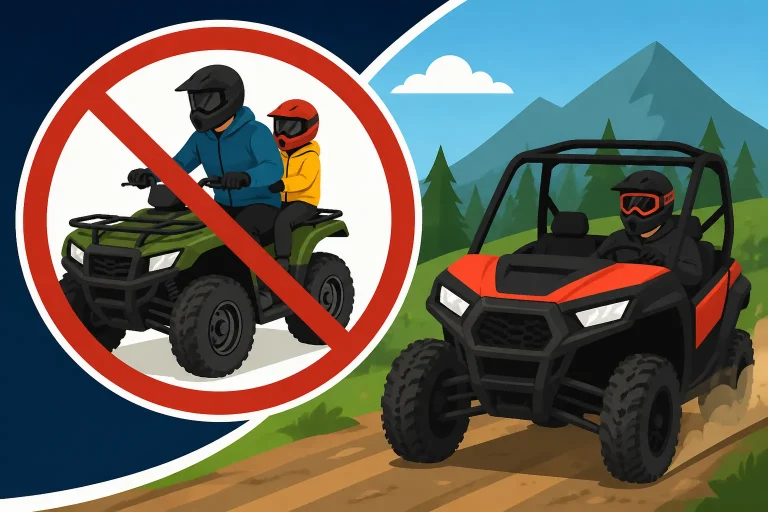
The machine’s passenger design matters under BC rules as well. A child operator cannot carry a passenger where the youth rule prohibits it, and manufacturer guidance may impose additional restrictions. Do not assume that an adult can ride behind a child simply because the seat appears large enough. Check BC Children Cannot Carry Passengers and the machine’s own instructions before carrying anyone.
Written parental permission, where it is relevant, does not override a manufacturer’s minimum age or make a child physically ready. It is also not a general waiver of other requirements. The child still needs an appropriate machine, any required supervision or permission, and lawful access to the place where the ride will happen. See BC Written Permission Letters for the permission question.
Rules can vary by riding environment. Private land, Crown land and forest service roads do not necessarily have the same access conditions, and a machine’s registration or insurance obligations may also depend on where it is used. Check the relevant rules for the route and property instead of assuming a youth machine is automatically allowed wherever an adult ATV can go. BC Rules for Riding Private Land and BC Rules for Riding Crown Land explain those location-specific issues.
Decide whether the rider and machine are a safe match
Once you have checked the manual and BC rules, assess whether the child can operate that particular machine safely. Do this before the ride, in a quiet setting, rather than at a busy trailhead or after the group has started moving.
Check the rider’s fit with the machine turned off. The child should be able to sit in a stable position, reach and operate the controls, and move their hands and feet without losing balance. If the child has to stretch for the throttle or brake, cannot operate a control firmly, or cannot maintain a secure posture, the machine is not a suitable fit.
Then consider the machine’s behaviour. A child may be able to reach the controls but still struggle with acceleration, braking, steering or the weight of the ATV. A larger machine can be harder to stop or manage, especially on a slope or uneven ground. A confident child can also overestimate their ability, so set limits based on what the rider can control consistently rather than what they say they can handle.
Before the ride, make sure the child knows how to:
- Start and stop the machine as instructed.
- Use the throttle and brakes smoothly.
- Turn without leaning or reaching in a way that affects control.
- Stop safely if asked, and follow the adult’s directions.
- Recognize when to slow down or stop because of an obstacle, another rider or changing terrain.
Start in an appropriate, controlled area and keep the ride within the child’s demonstrated ability. Do not use a public road or an unfamiliar trail as a test course. Riding conditions can change quickly: loose gravel, mud, slopes, visibility and other trail users all affect how demanding a route is.
A helmet and other suitable protective gear are important, but they do not make an undersized or oversized machine safe. BC requires helmets for ride-astride machines, and the helmet must fit the rider. Review BC ATV Helmet Law Explained for the helmet requirement and Buying a Helmet That Passes in BC for fit and certification considerations.
Before each outing, use a short checklist:
- Confirm the exact machine and the manual’s age and weight guidance.
- Make sure the rider meets the manufacturer’s instructions.
- Confirm any required BC supervision or written permission.
- Check that the child can reach and operate the controls while seated correctly.
- Verify the machine has no passenger if the rules or manual prohibit one.
- Inspect the brakes, throttle, tires, lights and other essential equipment.
- Fit the rider with a properly sized helmet and appropriate clothing.
- Confirm that the riding area is open to the machine and suitable for the child’s ability.
If the requirements are unclear, postpone the ride and get an answer from the manufacturer, a dealer or a qualified professional. Waiting is safer than relying on a guessed age chart or treating permission as proof that the machine fits.
Disclaimer
This article is for general informational purposes only and does not constitute professional advice. Laws, prices and regulations vary by location and change over time. Consult a qualified professional for guidance on your specific situation.