Written Permission From a Parent
A parent’s note can help a young rider qualify to operate an ATV or UTV in BC, but it is not a general permission slip for every machine or situation. The key is knowing which age-based rules apply, what training may be required, and what proof to carry before heading out.
When written permission matters in BC
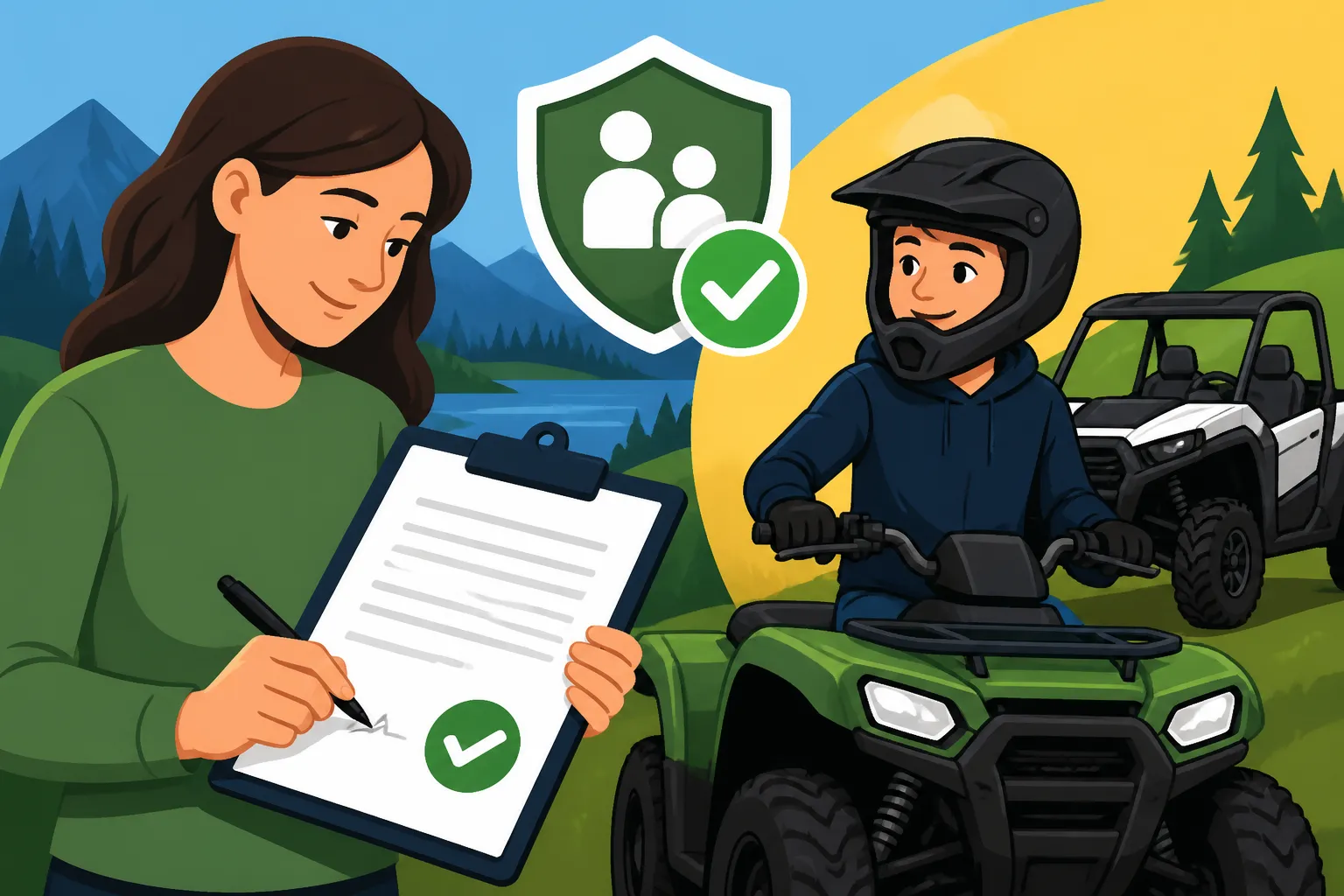
BC’s youth riding rules generally require riders under 16 to be supervised by someone at least 19 years old. A limited exception may apply to a 14- or 15-year-old who meets the applicable training requirement and has written permission from a parent or guardian. Permission alone does not necessarily let a young rider operate without supervision.
That distinction matters. A signed note is one part of a specific exception, not a substitute for checking the full rule. A rider who does not qualify for the exception still needs the required supervision. The details can depend on the rider’s age and the class of machine, so confirm the current requirements before treating a permission letter as authorization to ride independently.
The rule is also not limited to recreation rides. BC’s off-road vehicle requirements can apply to ATVs and UTVs used for work as well as leisure. Whether the machine is a quad, dirt bike or side-by-side, check its category and the rules that apply to its operator. BC Youth Riding Rules Explained provides an overview of the age and supervision requirements.
| Rider’s situation | What to check | What written permission does |
|---|---|---|
| Under 14 | Adult supervision and the machine’s minimum age or size guidance | It does not replace supervision |
| Age 14 or 15 | Whether the rider qualifies for an exception, including any required approved training | It may be one required part of qualifying for the exception |
| Age 14 or 15 without the required qualification | Supervision by an adult who meets the legal requirement | It does not independently authorize unsupervised operation |
| Age 16 or older | Rules that apply to the machine, location and activity | A parent’s note is generally not the youth exception at issue |
The table is a practical summary, not a replacement for checking the current regulation. For details about the conditions that may apply to 14- and 15-year-olds, see BC’s Written Permission Rule at 14 and 15 and Can a 14-Year-Old Ride Alone in BC?.
What a permission letter should say
A useful letter makes it easy to identify the rider, the parent or guardian giving permission, and the machine covered by that permission. Before writing it, check whether the relevant rule or training provider specifies a form or particular wording. Do not assume that a generic note will satisfy every requirement.
If no prescribed format applies, include clear information such as:
- The young rider’s full name and date of birth
- The parent’s or guardian’s full name and a way to contact them
- A direct statement giving permission to operate an off-road vehicle
- The make, model and vehicle identification number, if available
- Any limits the parent is setting, such as permitted locations or dates
- The date the letter was signed
- The parent’s or guardian’s signature
Name the machine rather than relying on a vague statement such as “permission to ride.” If the rider will use more than one machine, confirm whether permission and training requirements apply to each class. A letter referring to one quad may not clearly cover a different, larger machine or a side-by-side.
Keep the wording factual. A parent’s permission does not grant access to private property, override a road or trail closure, or make an otherwise unlawful ride legal. It also does not change the machine’s passenger limits or the rules for protective equipment. If permission is limited to riding with a particular adult, on a certain property or during a defined period, spell that out so there is less room for confusion.
Have the rider carry the signed letter when it is relevant to the exception being used. Keep another copy with the parent or guardian, and store a clear image on a phone as a backup. A phone copy can be useful, but it is sensible not to rely on it alone in an area with poor service, a flat battery or a damaged device. A paper copy is a straightforward backup.
For more on the adult’s role, including what supervision means in practice, see BC’s Visible and Immediate Direction Test and Why a Supervisor Has to Be Nineteen.
Training, supervision and machine limits still matter
A letter does not prove that the rider has completed any training required for the exception. If the rider is relying on a training-based exception, verify that the course is recognized for the rule and that its certificate covers the right machine class. A course completion document and a parent’s permission letter serve different purposes; carry both when needed. Which Rider Course Providers Are Actually Recognized explains why confirming the provider and course matters.
Do not treat age as the only test of whether a young rider can safely operate a machine. Check the manufacturer’s minimum age and weight guidance for the specific model, along with the rider’s experience and ability to control it. A machine that is physically too large or powerful for a young operator can be unsafe even if the rider has parental consent and meets a legal exception. Manufacturer Minimums by Model and Why Machine Size Matters More Than Age offer related guidance.
A young operator also cannot use the permission letter to get around passenger restrictions. In particular, a child operating a machine may be prohibited from carrying a passenger. Check the rules for the operator’s age and the machine type before adding a passenger, even if that passenger is a parent or another adult. BC Children Cannot Carry Passengers covers this issue.
Helmet, seat-belt and other equipment rules depend on the machine. A ride-astride ATV and a side-by-side do not necessarily have the same requirements. Check the applicable rules before the trip, and make sure every rider uses the protective equipment required for that machine. Permission from a parent does not waive those obligations.
Supervision is not just being nearby
Where adult supervision is required, simply having an adult somewhere at the staging area or elsewhere on the property may not be enough. The adult needs to meet the legal definition of supervision, including being able to see the child and give direction promptly when required. A parent’s letter cannot replace that role if the rider has not qualified for an exception.
Plan the ride so the adult can maintain the required oversight. Keep the young rider within clear view, choose terrain appropriate to their ability, and avoid sending them ahead around corners or out of sight. If the group separates, stop and regroup rather than assuming that phone contact satisfies supervision.
Before setting out, check more than the permission letter. Confirm registration requirements, land access, trail or road restrictions, and insurance rules for the route. For example, riding on a forest service road can involve requirements that differ from riding on other land. The article BC Rules for a 14-Year-Old Rider can help with age-specific questions, while BC Forest Service Road Requirements covers a different part of trip planning.
A simple pre-ride check can prevent the most common misunderstandings:
- Confirm the rider’s age and whether they will be supervised.
- If relying on an exception, verify the current training and permission requirements.
- Check that the training applies to the machine class being ridden.
- Review the manufacturer’s age, weight and passenger guidance.
- Carry the signed letter and any relevant training proof.
- Check location rules, registration and insurance before leaving.
If a parent is uncertain whether a letter is enough, the safer option is to arrange qualifying adult supervision until the requirement is confirmed. Do not rely on a note as a way to bypass a condition the young rider has not met.
Disclaimer
This article is for general informational purposes only and does not constitute professional advice. Laws, prices and regulations vary by location and change over time. Consult a qualified professional for guidance on your specific situation.