BC Safety Course Cost
The cost of an ATV or UTV safety course in British Columbia can vary with the provider, course format and what is included. The harder question is often whether you need training for your situation, and whether a particular course meets a legal requirement. Here’s how to compare options and avoid paying for a course that does not fit your needs.
What an ATV safety course may cost
There is no single province-wide price for every BC ATV and UTV safety course. Providers set their own fees, and a classroom session, online module or practical riding course may have different costs. Some courses are offered through clubs or training organizations, while others are run by providers that specialize in work-related off-road vehicle training.
Ask for the full amount payable before enrolling. A listed course fee may not tell you whether practical instruction, use of a machine, course materials or a certificate is included. You may also have travel, accommodation or equipment costs if the course is not offered nearby.
| Cost factor | What to check before you book |
|---|---|
| Course format | Whether instruction is online, classroom-based, practical, or a combination |
| Machine use | Whether you bring your own ATV or UTV or the provider supplies one |
| Equipment | Whether a helmet and other required riding gear are included |
| Course materials | Whether manuals, assessments and certificate processing are covered |
| Travel | Whether the location adds fuel, lodging or other expenses |
| Course purpose | Whether it is general rider education, workplace training or a course intended to meet a specific requirement |
| Cancellation terms | Whether you can reschedule or receive a refund if plans change |
When comparing quotes, compare the same type of training. A low-cost online course and a supervised hands-on course may teach different skills and may not be interchangeable for a legal or workplace purpose. If you are considering training for a young rider, confirm that the course is recognized for the specific exception or requirement you have in mind. A certificate from any course should not be assumed to meet every rule.
For background on what training can cover and how to choose a provider, see BC ATV Safety Training Options and BC Safety Course Providers. If you are looking for workplace instruction rather than recreational rider education, ask whether the course is designed for the machine and tasks involved.
Do you need to take a course in BC?
For adults, recreational ATV safety courses are generally voluntary. That does not make them pointless: training can help riders build practical habits before a trip, especially if they are new to a machine, returning after a long break, or moving from a quad to a side-by-side.
Youth rules are a separate issue. BC has supervision requirements for younger operators, and a qualifying course may be relevant to an exception in some circumstances. The course must meet the applicable requirements; simply completing a class does not automatically remove the need for supervision. Confirm the current rule and whether the provider’s course qualifies before enrolling. BC Youth Riding Rules Explained gives more detail on the supervision rules, and BC Rules for a 14-Year-Old Rider covers a specific age group.
A course is also not a substitute for other responsibilities. Registration, insurance, helmet use, passenger limits and access rules depend on the machine and where you ride. A course certificate does not make a machine road-legal or grant permission to ride on a closed road or private property. Review Do You Need to Register an ATV in BC? and BC ATV Insurance Requirements if you are still sorting out the basics.
Match the course to your reason for taking it
Before paying, identify what you want the course to do:
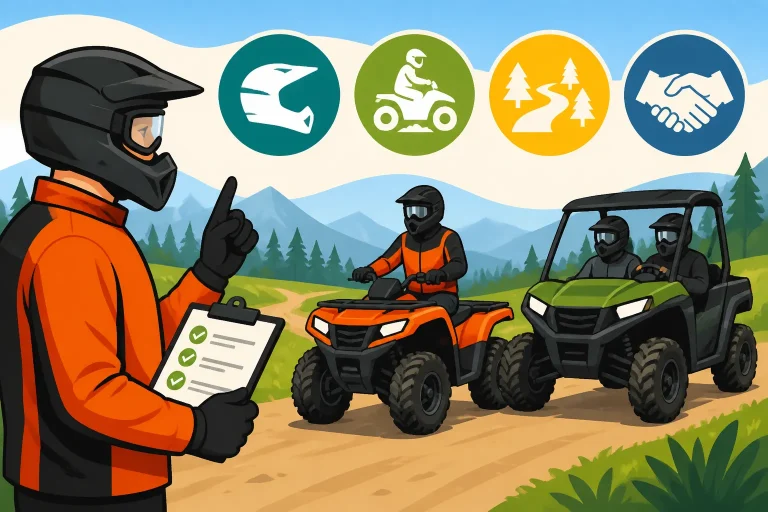
- Build basic skills: Look for instruction that includes safe controls, starting and stopping, turns, hills, terrain, and basic hazard awareness.
- Meet a youth-related requirement: Ask the provider to confirm in writing whether the course satisfies the specific rule or exception you are checking.
- Prepare for work: Choose training that addresses the machine, worksite and operating conditions involved. A recreational course may not satisfy an employer’s training requirements.
- Learn a different machine type: Check whether the instruction covers an ATV, a side-by-side, or both. Skills overlap, but controls, passenger arrangements and protective equipment can differ.
- Refresh skills: Ask whether the course has a refresher option or whether it is intended only for first-time learners.
If the answer about legal recognition is unclear, check with the relevant official authority before registering. It is better to confirm the requirement in advance than to rely on a course description that only says it is “recognized” without explaining by whom and for what purpose.
What the fee should include, and what to ask
Course descriptions can use similar labels for different levels of instruction. One provider may offer an online knowledge course, while another combines instruction with supervised practice. Neither format is automatically right for everyone; the useful question is whether the course teaches what you need and meets any requirement you are trying to satisfy.
A practical course may include time on a machine, but check whether you need to bring your own. If you do, ask about the required machine condition and whether the course accepts your model. If the provider supplies equipment, ask which machine types are available and whether there are restrictions based on rider size or experience.
Before booking, ask:
- What is the total fee, and are there any additional charges?
- What topics and riding exercises are included?
- Is the course online, in person, or a combination?
- Do I need to bring a machine, helmet or other equipment?
- What type of ATV or UTV is covered?
- What certificate or proof of completion will I receive?
- Is this course accepted for the particular legal, employment or insurance purpose I have?
- What happens if I need to cancel, reschedule or miss a session?
Get clear answers in writing, particularly when the course is being taken to satisfy a youth rule or an employer’s requirement. “Safety training” is a broad description, not proof that a course qualifies for a specific purpose.
Also consider the total cost of attending, not just the tuition. A course held far from home may require transport and an overnight stay. Bringing your own machine can add hauling and preparation costs. If you need to buy protective equipment, that is another separate expense. Ask which items are mandatory for the course and which are recommended so you can budget sensibly.
How to choose a course that is worth the cost
A useful course should make expectations clear before you pay. Look for a description that names the machine type, learning goals, instruction format and what the student must bring. If the course includes practical riding, ask how much of the session is hands-on and how learners are supervised. For a young rider, confirm age eligibility and any size or experience limits before booking.
Do not judge value only by course length or the lowest fee. A short course may be enough for a focused introduction, while a more substantial course may suit a rider who needs supervised practice. The best fit depends on your experience, machine and reason for training. A certificate alone does not tell you how much practical instruction a course provided.
It can help to check with a local club or a provider that works specifically with off-road riders. Ask what the course does not cover as well as what it does. For example, a general safety class may not teach you how to communicate on an active resource road, assess a difficult trail, or prepare for a remote ride. Those skills may require separate instruction and preparation. BC Forest Service Road Requirements and BC Resource Road Radio Practice can help with the rules and habits relevant to those routes.
If your main goal is to ride more confidently, consider whether a supervised course is a better fit than a short online module. If you only need information on rules, a course may not answer every registration, insurance or access question. The course provider should be able to explain the boundaries of the training rather than imply that completion covers all aspects of legal riding.
A simple way to compare providers
Make a short list of the courses available to you and compare them using the same questions. Note the total fee, location, format, machine type, practical instruction and certificate details. Then check any claim about legal or workplace recognition with the authority or employer that requires it.
Choose a course when its purpose is clear, its scope matches your needs and the total cost is reasonable for what it includes. If a provider cannot explain whether its certificate meets your specific requirement, pause and verify before paying. For adult recreational riders, training is generally a voluntary investment in safer operation; for younger riders or workplace operators, confirm the applicable requirements first.
Disclaimer
This article is for general informational purposes only and does not constitute professional advice. Laws, prices and regulations vary by location and change over time. Consult a qualified professional for guidance on your specific situation.