Carrying Bear Spray on a Ride
A bear encounter on a BC trail can happen quickly, especially when engine noise, wind, or dense brush makes it hard to notice wildlife early. Carrying bear spray where you can reach it—not buried in a pack or strapped to the machine—gives you a practical deterrent if a bear approaches. This guide covers choosing, carrying, and using it thoughtfully on an ATV or UTV ride.
Choose bear spray that is suitable for the ride
Check the label before you buy
Choose a product specifically labelled as bear deterrent, and read its instructions before heading out. The label explains how the canister is intended to be carried and used, along with any precautions that matter for that particular product. Don’t assume a small personal-protection spray or a canister meant for dogs will work as bear spray.
Canister design and directions can vary, so get familiar with the safety clip, grip, and spray pattern before you need them. If you’re new to bear spray, an inert practice canister can help you rehearse drawing it and removing the safety without releasing the active product. Practice somewhere safe, and follow the trainer’s instructions.
Bear spray is an emergency deterrent, not a way to keep bears away from camp or a trail. Never spray it on your clothes, ATV, tent, or food as a preventative measure. That can create a new problem by leaving residue where people or wildlife may encounter it.
Match the canister to the way you ride
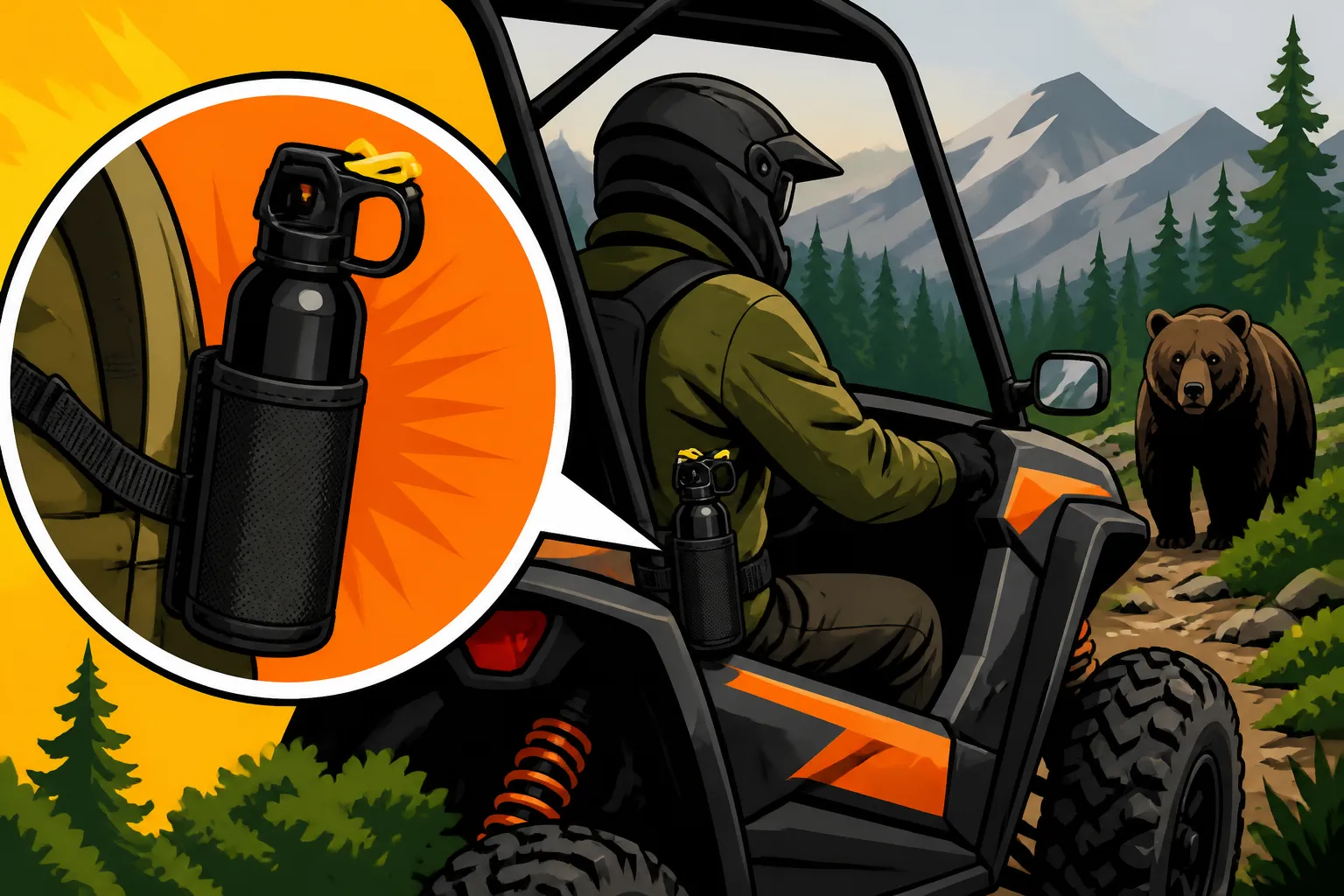
A canister is useful only if it stays with you and is easy to reach. Think about your riding position: a waist holster that works when standing may be awkward under a seat belt, jacket, or UTV door. Try your setup while wearing your usual riding gear and sitting in the machine.
| Riding situation | Practical carry consideration | What to check before leaving |
|---|---|---|
| Riding an ATV | Keep the canister secured to your body where you can reach it without digging through a pack | Make sure it does not interfere with controls or catch on branches |
| Riding a UTV | Decide where the driver and each passenger will carry their own spray | Check that seat belts, doors, and clothing do not block access |
| Stopping for a break | Keep the spray with you when you step away from the machine | Don’t leave it on a seat or buried in a bag |
| Riding in wet or brushy conditions | Use a secure holster that protects the canister from being knocked loose | Confirm the safety clip is secure and the canister is accessible |
A common mistake is securing the spray to a rack or storing it in a cargo box. That may feel convenient while riding, but it can leave you separated from it if you stop suddenly or need to move away from the machine. Keep it on your person, secured in a way that is comfortable and does not impede riding.
For a longer trip, look at the whole route, not just the trailhead. An offline map in onX Offroad can be useful for checking your planned route before you enter an area with limited service. The map does not replace local notices or good judgment, but knowing where you intend to go can make it easier to plan stops and avoid getting distracted by navigation when conditions change.
Carry bear spray so it is ready to reach
Keep it accessible without making riding unsafe
“Accessible” does not mean loosely clipped where it could fall out, or positioned where it catches on the machine. It means you can reach the canister promptly while keeping control of yourself and your vehicle. A secure belt or chest holster may work for one rider; another may prefer a different position that is compatible with their jacket, helmet, and seat belt.
Before setting off, sit in your usual riding position and check that you can reach the spray without leaning dangerously, unbuckling, or taking your attention away from the trail for too long. On a UTV, the driver and passengers should each think through their own setup. A canister within the driver’s reach is not necessarily within a passenger’s reach.
If the spray is clipped to a pack, consider what happens if you take the pack off during a break or need to move quickly. The same goes for attaching it to a machine: it may be separated from you at exactly the wrong moment. When you read BC Bear Encounters While Riding, use that guidance to think about the kind of situations you may face, not just the storage arrangement you prefer.
Check condition and storage before a trip
Before each ride, inspect the canister and its holster. Check the expiry information and condition, and make sure the safety mechanism is present and secured as directed. Replace a canister that is damaged, badly corroded, leaking, or past the date stated on its label. Don’t wait until a remote weekend trip to discover that the canister has been sitting in a wet gear bag all season.
Follow the label’s storage instructions, particularly around temperature and direct heat. A canister left in a hot vehicle, exposed to strong sun, or stored carelessly can become a safety concern. Don’t leave it loose in a glove compartment or cargo area where it can roll around, get crushed, or be forgotten.
Pack with the same care you would use for other emergency equipment. Keep the spray separate from food, and make sure everyone in your group knows who is carrying it and where. If you are riding with children, don’t assume they can or should handle a canister; have a responsible adult carry it and explain the basic safety plan in an age-appropriate way.
Respond calmly if you encounter a bear
Notice the situation before reaching for the canister
Bear spray is a last-resort deterrent, not a substitute for staying alert. Slow down where visibility is poor, around bends, near dense vegetation, or wherever the terrain limits your view. Engine noise may reduce your ability to hear wildlife, so don’t treat a quiet stretch of trail as proof that it is clear.
If you see a bear, avoid approaching it for a closer look or to take a photo. Give it space, stay calm, and avoid sudden movements. The right response depends on the bear’s behaviour, distance, and what is happening around you. Keep your group together and follow current wildlife guidance for the situation rather than trying to apply one rule to every encounter.
Reach for the spray if the bear’s behaviour makes you believe an encounter is becoming dangerous, and use it only as directed on the label. Wind, terrain, and the bear’s movement can affect what happens when spray is deployed. Don’t test it casually or spray it toward people, animals, or the trail as a warning. If you do use it, leave the area when it is safe and report the encounter through the appropriate local channels.
For broader awareness of animal activity and trail manners, BC Wildlife on the Trail and BC Trail Etiquette Locals Expect are useful subjects to review before a group ride. They also help put bear spray in perspective: it is one part of a plan that includes giving wildlife room and not creating an unnecessary encounter.
Avoid relying on the machine as your safety plan
An ATV or UTV can make it tempting to think you can simply accelerate away from wildlife. That is not a dependable plan. The trail may be narrow, steep, blocked, or slippery, and a sudden move can put you or another rider at risk. Keep the machine under control and don’t drive toward a bear or try to push it off the trail.
If you are with a group, agree ahead of time on how you will communicate a stop. Riders should leave enough space to avoid crowding one another, and nobody should rush forward to investigate a bear while others are still approaching. A calm pause and a clear group response are safer than several machines moving unpredictably at once.
Use BC ATV Safety Training Options as a prompt to think about emergency decision-making generally. Even if a course does not focus on bear encounters, practicing how your group stops, communicates, and regroups can reduce confusion when something unexpected happens.
Plan for wildlife and limited service before you ride
Check the area and route conditions
A familiar route is not automatically a predictable one. Wildlife activity, trail conditions, and access can change, while cell service may disappear well before you reach a remote staging area. Check local information before leaving, tell someone where you expect to ride, and set a realistic return plan.
When riding Crown land, understand where you are and whether the route is open to motorized use. BC Crown Land Riding Explained offers useful context, while BC Motor Vehicle Closures and How to Find Them can help you think about checking closures rather than assuming a road or trail is open. A map app, including onX Offroad, can help you review your intended route in advance; download or prepare the information you need before service drops, and confirm access with current local notices where appropriate.
Don’t let the map become a reason to press on when conditions feel wrong. If a trail is blocked, visibility is poor, or the group is uneasy, turn around or choose another route. For planning in a known dead zone, BC Cell Dead Zones in the Interior and BC Riding Areas With Cell Service can help you consider how much communication backup your trip may need. Keep a charged phone, but don’t rely on a phone alone where coverage is uncertain.
Make a simple group plan
Before the ride, tell everyone where the bear spray is carried and agree on what to do if a bear is spotted. Decide how the group will stop and communicate, especially if riders are spread out or the trail is noisy. A simple plan—stop, alert the group, give wildlife room, and avoid crowding the scene—is easier to follow than a complicated set of instructions made up in the moment.
For a remote trip, consider whether your group has a suitable way to call for help if a rider is injured or separated. An offline map such as onX Offroad can support navigation preparation, but it is not a substitute for a communication plan. Make sure someone outside the group knows the general route and when you expect to return.
Finally, remember that carrying bear spray is about being prepared, not seeking out wildlife or feeling invulnerable. Keep the canister in good condition, practise with an inert trainer if needed, stay alert, and give bears room. Those habits make the spray more useful as a last resort and help keep the ride focused on the trail rather than a preventable close encounter.
Disclaimer
This article is for general informational purposes only and does not constitute professional advice. Laws, prices and regulations vary by location and change over time. Consult a qualified professional for guidance on your specific situation.