BC Safety Courses Are Voluntary for Adults
For adults riding an ATV or UTV in British Columbia, a safety course is generally voluntary under the province’s off-road vehicle rules. That does not make training pointless, or remove other legal and site-specific requirements. Here’s how to decide whether a course is worthwhile, what to check before booking, and when a rule for another rider could change the answer.
What voluntary means for adult riders in BC
An adult does not generally have to complete a safety course just to operate an off-road vehicle in BC. The important distinction is between a general provincial course requirement and the separate rules that still apply to the machine, the place you ride, and the people with you.
Voluntary means a course is not a universal legal prerequisite for every adult ORV rider. It does not mean that riding is unregulated, that training has no value, or that every trail, employer, club, event, or rental operator must accept an untrained rider.
Before heading out, make sure you have considered the requirements that apply to your ride:
- Registration: Check whether your machine needs to be registered for the area where you plan to ride. Do You Need to Register an ATV in BC?
- Insurance: Requirements can depend on the type of road or land. In particular, check the rules before using a forest service road. BC ATV Insurance Requirements
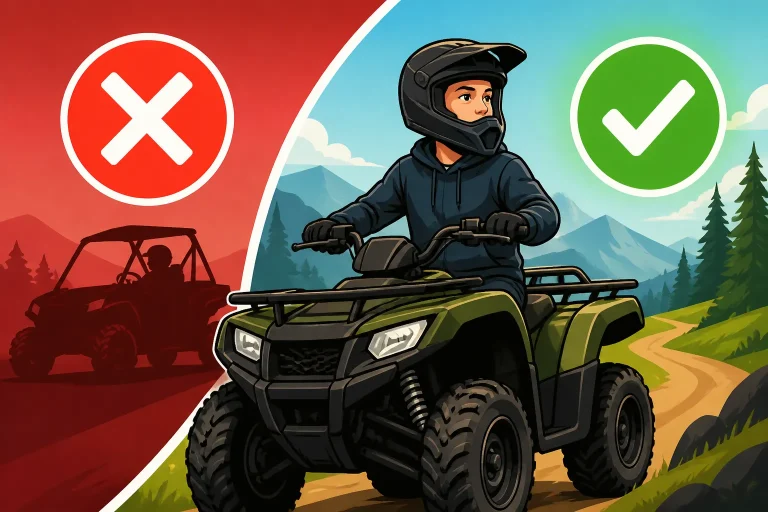
- Protective equipment: Helmet and other equipment rules depend on the machine and riding conditions. A course does not replace legally required gear.
- Access: A legal machine and a course certificate do not grant permission to ride on private land, a closed road, or a restricted area.
- Local conditions: Managed recreation sites can have their own pass, equipment, noise, or access rules. Confirm what applies at the specific site.
A course certificate is also not the same thing as registration, insurance, an operating permit, or a trail pass. These serve different purposes. A course can help you build skills and understand safe practices; the other documents or permissions address legal use, financial risk, or access.
| Question | What a voluntary adult course does | What it does not automatically do |
|---|---|---|
| Can an adult ride without taking a course? | Generally, yes, under the broad provincial rule for adult operators | It does not remove other laws or access conditions |
| Does it register the machine? | Nothing by itself | It does not replace registration documents |
| Does it provide insurance? | Nothing by itself | It does not replace coverage required for a particular road |
| Does it grant trail access? | It may help you prepare to ride responsibly | It is not a site pass or permission to enter |
| Does it qualify a young rider? | A course may be relevant to a youth rule, depending on the circumstances | An adult certificate should not be assumed to meet that rule |
| Can an employer or operator require training? | A course may help meet a separate condition | The general provincial rule does not prevent another organization from setting its own requirement |
The practical takeaway is simple: adults can generally choose whether to take formal training, but they still need to check every other requirement that applies to their machine and route. For more on the rules that apply to riding locations, see BC Rules for Riding Crown Land and BC Forest Service Road Requirements.
What a rider safety course can teach
A good course is more than a quick overview of the controls. Its value is giving riders a structured chance to understand how a machine behaves, practise core skills, and recognize situations where a ride should slow down, change direction, or stop.
Course content varies by provider and format. Ask what the specific course includes rather than assuming every program covers the same topics. Depending on the course, it may cover:
- Pre-ride checks: Identifying visible damage, checking controls, and confirming that the vehicle is appropriate for the planned trip.
- Controls and handling: Understanding how steering, braking, throttle, shifting, and body position work on the machine being taught.
- Terrain awareness: Adjusting speed and technique for slopes, loose ground, ruts, mud, gravel, and other changing surfaces.
- Riding decisions: Keeping a safe margin around other people, avoiding risky manoeuvres, and recognizing when conditions exceed a rider’s ability.
- Group communication: Agreeing on spacing, signals, regrouping points, and what to do if someone falls behind or a machine stops.
- Passenger considerations: Understanding that an ATV designed for one rider should not be treated as a two-person machine, and that UTV passengers need to use the vehicle as designed.
- Backcountry planning: Thinking ahead about route conditions, fuel, weather, communications, and what the group will do if a problem arises.
The exact balance between classroom discussion and hands-on riding can differ. A course may be useful even for an experienced rider if it addresses unfamiliar equipment or terrain. Conversely, a short introductory course may not prepare someone for every technical trail, deep-water crossing, steep slope, or remote trip. Training builds competence; it does not make difficult conditions safe by default.
Look for instruction that matches the machine you plan to use. A quad and a side-by-side have different seating, controls, passenger arrangements, and rollover risks. A rider moving from one kind of vehicle to another should not assume their experience transfers perfectly. BC Rules for Riding a Side-by-Side covers a separate set of considerations for UTV operators and passengers.
Also consider whether the course teaches practical skills or mainly presents general information. If you are new to ORVs, supervised practice with an instructor can help you learn how a machine responds before you encounter uneven terrain or a group ride. If you have years of experience, you may value a course that fills a specific gap, such as riding with passengers, using a radio on industrial roads, or preparing for a remote route.
When an adult course is especially worthwhile
Not having to take a course is different from having nothing to gain from one. Formal instruction can be a sensible choice when the machine, terrain, group, or consequences are unfamiliar.
You are new to ORVs
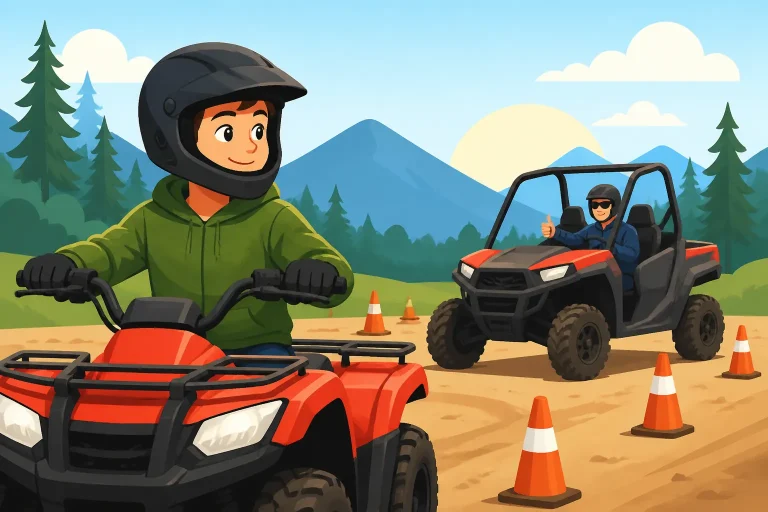
A first ride can feel straightforward on flat, open ground, but terrain changes the demands on the rider. Braking distance, traction, balance, visibility, and the ability to stop safely can all change with the surface and slope. A course gives a novice a chance to learn the basics before trying to keep pace with more experienced friends.
New riders should be cautious about starting with a powerful machine or a difficult route. A course cannot turn an unsuitable vehicle into a good fit, and a beginner should be honest about comfort and ability when choosing where to ride.
You are changing machines
Experience on a quad does not automatically prepare you to operate a side-by-side, and experience in a UTV does not necessarily translate to an ATV. Even machines in the same broad category can feel different because of their size, handling, controls, seating, and intended use.
If you are borrowing, renting, or buying a different machine, ask whether instruction or an orientation is available. Take time to understand the controls and safety features before setting out, especially if you will be carrying passengers.
You ride with children or supervise young riders
Adult course participation may be voluntary, but youth operation has separate rules. Depending on the young rider’s age and circumstances, requirements can involve supervision, written permission, training, or the machine’s suitability. Do not assume that because the supervising adult does not need a course, the young rider has no training or supervision conditions.
Check the specific requirements before allowing a young person to ride. BC Youth Riding Rules Explained is a useful starting point, and the details for a particular age group may be addressed in BC Rules for a 14-Year-Old Rider or BC Rules for a 15-Year-Old Rider. Ask the relevant authority or course provider whether a particular course meets any training condition that applies. Do not rely on a course title alone.
Even where no formal course is required for an adult supervisor, an adult who understands the machine and can assess hazards is better placed to give useful guidance. Supervision should not be treated as simply following behind. The supervising adult needs to be able to keep track of the young rider and respond when necessary, as required by the applicable rules.
You ride in a group or on unfamiliar routes
A course can help a group adopt consistent habits before leaving the staging area. Riders may have different expectations about following distance, passing, signals, pace, and regrouping. Agreeing on those basics can prevent confusion when visibility drops or someone encounters a hazard.
For remote or industrial routes, riding skill is only part of preparation. The group may need to understand road restrictions, traffic risks, communications, and how to respond to active hauling or a blocked route. Check the road’s conditions and requirements before going; a course certificate does not authorize access or guarantee that a route is open.
You use an ORV for work
A course may be voluntary under the general adult riding rule while still being required by an employer, site operator, contract, or workplace policy. Work use can involve different hazards from recreational riding, including repetitive trips, loads, long hours, passengers, unfamiliar terrain, or industrial traffic.
If the machine is used for work, ask the employer or site manager what training and documentation are required. Do not treat the general rule for adult recreational riding as a substitute for workplace direction.
You want confidence before a more demanding ride
A course may be worthwhile when you are planning a ride that is longer, steeper, more remote, or more technical than your usual outing. It can help you identify skills to practise and questions to resolve beforehand. It cannot tell you that a particular route will be safe on a particular day. Weather, road use, closures, fire conditions, and machine condition can change the plan.
How to choose a course that fits
Because adult training is generally optional, you can focus on finding a course that meets your actual needs rather than taking the first available option. Before enrolling, ask the provider direct questions and verify details with any organization that may require the training.
- Identify your goal. Are you learning to ride, changing machine types, supervising a young rider, meeting an employer’s condition, or preparing for a specific kind of terrain? A clear goal makes it easier to judge whether a course is relevant.
- Confirm which machine is covered. Ask whether instruction applies to an ATV, UTV, or another ORV, and whether the course uses the same type of machine you plan to operate.
- Ask about practical instruction. Find out whether the course includes supervised riding, what skills are practised, and what experience participants are expected to have.
- Check the provider’s recognition. If you need training for an employer, site, youth rule, or organization, ask that organization which providers and course credentials it accepts. A provider’s claim that a course is recognized may not answer what a particular authority requires.
- Understand what completion means. Ask what proof of completion you receive and what the certificate does and does not establish. Do not assume it is a licence, an operating permit, or a universal qualification.
- Review the practical arrangements. Confirm what equipment you need, whether the provider supplies a machine, and what clothing or protective gear is expected. Requirements can differ by course.
- Check current details before paying. Course availability, content, scheduling, and cost can change. Confirm the current information directly with the provider.
BC has several kinds of training providers and programs, and a course that suits one rider may not suit another. Which Rider Course Providers Are Actually Recognized can help frame the questions to ask when recognition matters. If the course is purely for your own learning, recognition may be less important than instruction quality, practice time, and relevance to your intended riding.
You can also check with a local club or riding group about training opportunities. A club may be able to point you toward a course or explain the conditions at a managed site, but membership and course completion are not substitutes for checking the actual rules. A local recommendation is a useful lead, not a guarantee that a course meets every workplace, site, or legal requirement.
Build safe habits whether or not you take a course
A course is one way to improve safety, but it is not the only one. Riders who do not take formal instruction can still prepare carefully, practise in appropriate settings, and avoid riding beyond their ability.
Before each ride:
- Check the machine for obvious problems and confirm it is suitable for the number of riders and the planned terrain.
- Make sure riders understand the controls and agree on a route and regrouping plan.
- Check whether the route is open and whether access, insurance, registration, or equipment rules apply.
- Consider weather, visibility, daylight, fuel, communications, and the distance to help.
- Tell someone outside the group where you are going and when you expect to return, particularly for remote trips.
- Set a pace that allows riders to stop or respond safely, rather than pressuring less experienced operators to keep up.
On the trail, leave space between machines, slow down when visibility is limited, and avoid assuming that the rider ahead has seen a hazard. Do not use speed to compensate for unfamiliarity with the terrain. If someone is struggling, stop in a safe place and reassess the route rather than letting the group stretch out.
For a side-by-side, make sure occupants use the vehicle’s designed seating and restraints. For an ATV, follow the manufacturer’s instructions about seating and passenger use. A course can explain safe operation, but the machine’s design and the rules that apply to it still matter.
Safety also includes knowing when not to ride. Turn around if conditions worsen, a route is closed, a machine develops a problem, or a rider is tired or uncomfortable. A course certificate should never become a reason to take on a route that exceeds your skills or the group’s equipment.
Frequently Asked Questions
Do adults need an ATV safety course to ride in BC?
Generally, no. A safety course is voluntary for adults under the broad provincial off-road vehicle rules. Other requirements, such as registration, insurance, protective equipment, and access restrictions, may still apply.
Does a voluntary course make me legally qualified to ride anywhere?
No. Course completion does not grant permission to ride on restricted land, replace required documents, or guarantee access to a trail or road. Check the requirements for the specific route and site.
Can an adult course meet a young rider’s training requirement?
Do not assume it can. Youth rules can depend on the rider’s age and circumstances. Confirm with the relevant authority or course provider which training, if any, is accepted for the young rider.
Can my employer or a riding site still require a course?
Yes. An employer, site operator, event organizer, or other organization may set its own training conditions even when a course is not generally required for adult riders under provincial rules. Confirm what that organization accepts.
Is a course useful if I already know how to ride?
It can be, especially if you are changing machine types, preparing for unfamiliar terrain, riding with passengers, or supervising a young rider. Choose training that addresses a real gap rather than assuming every course will cover every situation.
Disclaimer
This article is for general informational purposes only and does not constitute professional advice. Laws, prices and regulations vary by location and change over time. Consult a qualified professional for guidance on your specific situation.