Finding the Spec Stamped on Your Muffler
A muffler can look completely stock and still leave you unsure whether its spark arrestor meets the requirements for a BC ride. The marking may be small, dirty, or hidden by a heat shield, and a noise label is not the same thing as proof of spark-arrestor compliance. Here’s where to look, how to interpret what you find, and what to do if there’s no clear marking.
What a muffler marking can tell you
A stamped mark can help identify an exhaust component or show that it was tested or built to a stated specification. But markings differ by manufacturer, and there is no single stamp that you can assume every ATV or UTV must carry. Some exhausts have a model or part number; others have a certification mark, label, or no readily visible compliance marking at all.
That distinction matters in BC. Rules and site conditions can require an effective spark arrestor, but a noise rating, emissions label, or general manufacturer name does not automatically prove that the exhaust has one. Nor does a stamp by itself show that the current exhaust is still intact or configured as approved. For the broader requirements and their limits, see BC Spark Arrestor Requirements and What Exhaust Screen the Wildfire Rules Require.
Treat the muffler marking as a starting point for identification, not a complete answer. You may need the machine’s make, model and year, the exhaust part number, and documentation from the manufacturer to confirm what the part is and whether it includes a spark arrestor.
A marking may refer to one of several things:
- The exhaust manufacturer or brand. This identifies who made the system, but may not establish whether it has an arrestor.
- A part or model number. This is useful for looking up the exhaust in a parts catalogue or contacting the manufacturer.
- A sound or emissions certification. This may describe noise or emissions performance, not spark-arrestor construction.
- A spark-arrestor specification or approval reference. This may be more relevant, but you still need to confirm what the reference means for that exact exhaust.
- A production code or serial number. This can help a manufacturer trace the component, but it may not be a compliance mark.
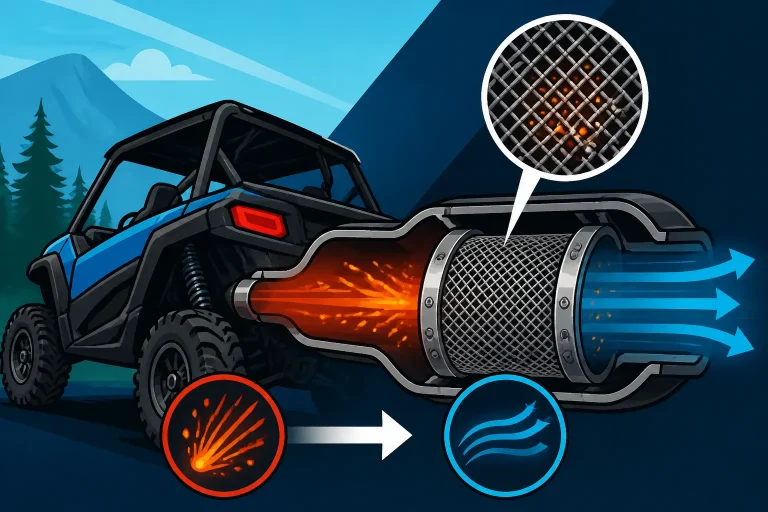
A stamp on the muffler is also different from the arrestor itself. The arrestor is generally a screen or other device designed to stop hot particles from leaving the exhaust. It may be inside the muffler or in another part of the exhaust system. Understanding the difference helps avoid mistaking a logo or noise mark for evidence of an intact arrestor; How a Spark Arrestor Screen Actually Works explains the device itself.
Where to look and how to read the stamp
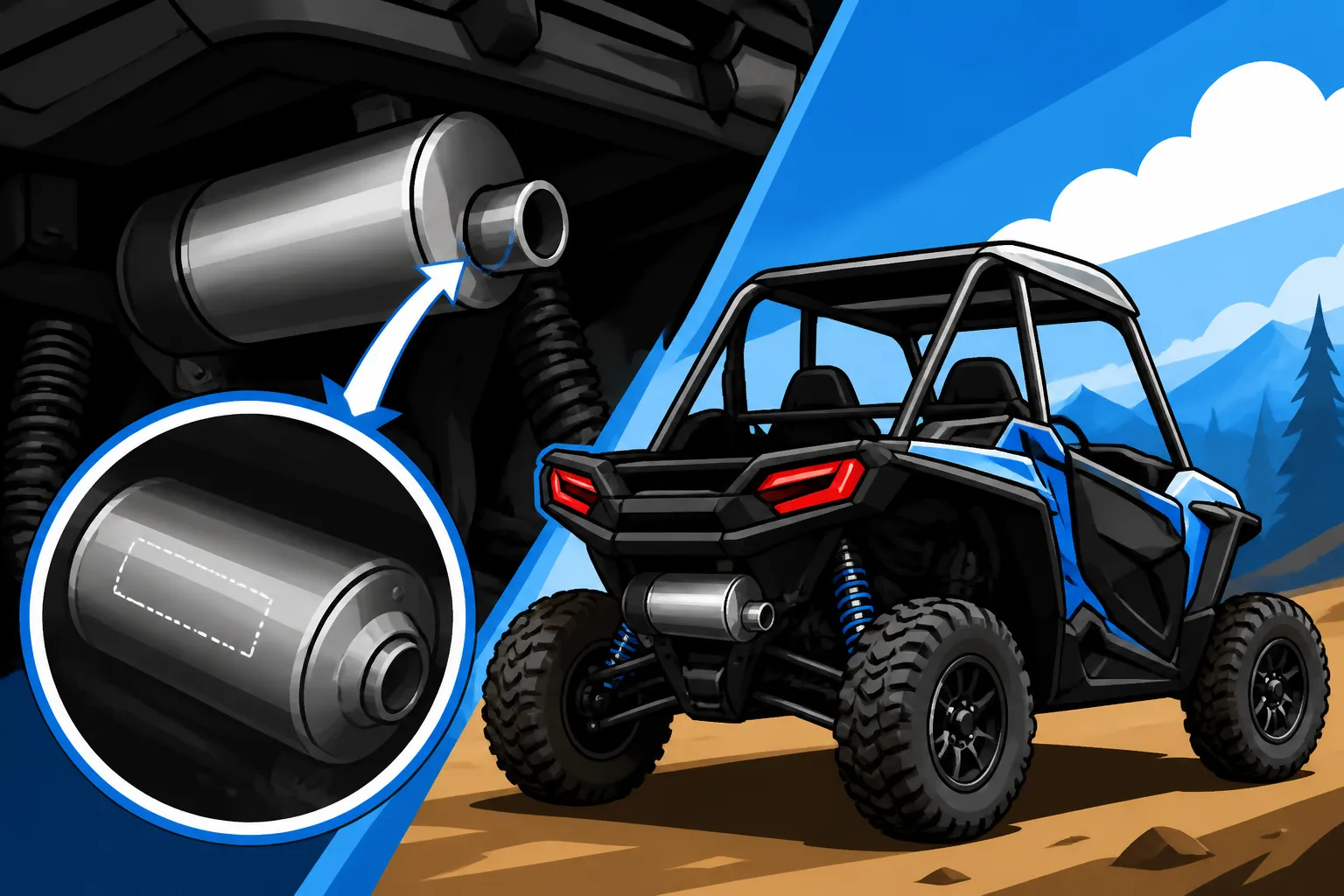
Start with a cool, parked machine. Exhaust parts can stay hot long after the engine is shut off, so wait before touching or inspecting them. Use a flashlight and look around the muffler body, end cap, inlet area and any flat surfaces where a manufacturer could stamp or attach a label.
On some ATVs and UTVs, the mark is visible from the side. On others, it may face inward toward the frame or be partly hidden by a heat shield, cargo rack or body panel. Do not remove a shield or disassemble the exhaust just to find a mark unless the owner’s manual or a qualified mechanic says it is safe to do so.
Look for lettering, numbers or symbols that can help identify the component. A useful record usually includes the exhaust maker, part or model number, and any standard or specification printed nearby. Photograph the entire muffler first, then take close-up images of each marking. A photo can preserve faint lettering and make it easier to compare the mark with the owner’s manual or parts information.
| What you find | What it may help establish | What it does not prove on its own |
|---|---|---|
| Manufacturer name or logo | Who made the exhaust | That it contains a spark arrestor |
| Part or model number | Which exhaust component is installed | That it is the correct part for your machine |
| Noise or emissions label | A stated noise or emissions reference | Spark-arrestor compliance |
| Spark-arrestor reference | A potentially relevant specification or approval | That the arrestor is present, intact and unmodified |
| No visible marking | That identification may require another method | That the exhaust necessarily lacks an arrestor |
Do not use a wire brush, grinder, harsh cleaner or abrasive pad to uncover a faint stamp. These can damage a label or remove the very information you are trying to read. A soft cloth and a gentle cleaner suitable for the surface are safer for ordinary dirt. If mud or corrosion still obscures the mark, photograph the area and ask a dealer or mechanic to help identify the exhaust rather than scraping aggressively.
If the stamp is on a removable heat shield, do not assume the shield itself identifies the muffler beneath it. Check whether the marking is on the exhaust body or on a separate cover. The component may have been replaced while the original shield remained in place.
For an ATV, the exhaust may be relatively exposed, but a UTV’s bodywork, cargo bed or frame can make access less obvious. Use the owner’s manual to locate the exhaust and identify panels that can be removed safely. Avoid reaching near hot components, and do not run the engine with panels removed just to make the marking easier to inspect.
Confirming what the marking means
Once you have a clear photo and any numbers, check the owner’s manual and the parts information for your exact machine. Match the year and model carefully: similar-looking machines can use different exhaust systems, and a previous owner may have installed an aftermarket muffler.
If the part number does not appear in the machine’s standard parts information, it may belong to an aftermarket system. Search the exhaust maker’s documentation or contact the company with the number and photos. Ask a specific question: does this part number include a spark arrestor, and how can you confirm that the device is present and serviceable? A general response that the muffler is “approved,” “quiet,” or “for off-road use” may not answer that question.
A dealer or qualified exhaust mechanic can also help identify an original or replacement component. Bring the machine’s make, model and year, along with photos of the stamp and the whole exhaust. If the muffler has been modified, mention that. An internal screen can be missing, damaged, or altered even when the outside marking remains.
If you are shopping for a replacement, use the exact part number and confirm fitment and arrestor details with the seller or manufacturer before ordering. A marketplace such as Amazon may list exhaust components, but a product title or compatibility list is not a substitute for checking that the particular part has the required arrestor. Save the manufacturer’s documentation and any purchase information with your machine records.
A stamp may be difficult to interpret because it uses abbreviations or a code that is not explained on the muffler. In that case, do not guess based on a similar-looking mark found online. Different manufacturers can use similar abbreviations for different purposes. Send the maker a sharp close-up and ask what the full code denotes.
Even when documentation confirms that an exhaust model includes an arrestor, inspect the actual machine. Look for signs of damage, loose hardware, missing end caps or evidence of modification. If the exhaust is serviceable only by removing a component, follow the manufacturer’s maintenance instructions. For a practical pre-ride inspection, see Checking an Arrestor Before a Ride.
If there is no clear stamp
An absent or unreadable mark does not automatically tell you whether the machine has a spark arrestor. It does mean you should avoid treating appearance alone as confirmation. Some systems may have identifying labels elsewhere, or the component may be identifiable through a part number, receipt, manual or manufacturer’s records.
Use this sequence to work through the uncertainty:
- Record the machine details. Note the make, model and year, and check whether the exhaust appears original.
- Inspect the exhaust when it is cool. Photograph the entire system and any marks you can find without scraping or taking it apart.
- Look up the part number. Check the owner’s manual, parts catalogue, service information or paperwork from a previous replacement.
- Ask the manufacturer or a qualified dealer. Provide clear photos and request confirmation about the exact component and its arrestor.
- Have an uncertain or modified system inspected. A mechanic can help identify missing, damaged or altered parts.
- Check the ride location’s current requirements. Conditions can differ by area and change with wildfire restrictions, so verify before setting out.
If you cannot confirm that the installed system has a working arrestor, the cautious choice is to resolve that before riding somewhere that requires one. Do not assume that an original-looking muffler is still complete, or that an aftermarket system is acceptable because it is quiet. A spark arrestor is about containing hot particles, while sound control is a separate issue.
BC conditions can also involve temporary restrictions. A machine that is equipped appropriately may still be subject to a closure or prohibition in a particular area. Check relevant notices before travelling, especially during wildfire season; BC Fire Centre Riding Bans covers why restrictions can affect access. For enforcement and possible consequences, review BC Spark Arrestor Rules and Fines rather than relying on a general trail discussion.
It helps to keep a small record with the machine: photos of the marking, the exhaust part number, relevant manufacturer information, and notes about any inspection or replacement. Keep the records accessible on your phone or in your vehicle, but do not treat paperwork as a substitute for a properly maintained exhaust. When you inspect the machine again, compare it with the photos so you can spot a replacement or change.
The key is to identify the actual exhaust, interpret its mark through reliable documentation, and confirm that the arrestor is still present and functional. If the stamp is missing or unclear, a manufacturer or qualified mechanic can often help establish what is fitted. When that cannot be confirmed, do not assume the system meets the requirement for your intended ride.
Disclaimer
This article is for general informational purposes only and does not constitute professional advice. Laws, prices and regulations vary by location and change over time. Consult a qualified professional for guidance on your specific situation.