BC Crown Land Access Rules
Crown land can look like open riding country, but public land does not mean every road, trail or hillside is open to ATVs and UTVs. Before you unload, you need to know whether the route is restricted, what registration and insurance apply, and whether a site pass or separate permission is needed. These checks help you avoid a closed area, a ticket or a ride that damages sensitive land.
What Crown land access means for ATV and UTV riders
Crown land is land owned by the provincial or federal Crown, rather than privately owned land. In British Columbia, it includes a wide range of places: remote backcountry, areas with resource roads, and land used for forestry, range, recreation or other purposes. Some Crown land is also leased or subject to other rights and uses.
Public access is not a blanket permission to ride anywhere. A route may be closed to motor vehicles, access may be limited by a sign or order, or a recreation site may have its own rules. Some land may be accessible on foot but not open to motorized use. A road that appears on a map is not automatically an ATV route, either.
For riders, the key question is not just “Is this Crown land?” It is “Is this machine allowed here, on this route, under the conditions in force today?” The details can change by location and season.
BC Crown Land Riding Explained provides a useful overview of the riding context. For the practical access question, check BC Rules for Riding Crown Land alongside maps, signs and local restrictions before setting out.
Crown land and resource roads are not the same thing
A Forest Service road or another resource road may cross Crown land, but riding on that road can involve additional requirements. Roads may be used by logging trucks, industrial traffic or other authorized users. They can also be closed or restricted, even when the surrounding land is accessible.
Treat road access and off-road access as separate questions. Confirm that motorized travel is allowed on the road itself, and do not assume that permission to use a road also permits riding onto nearby trails, cutblocks or leased land. BC Resource Roads Count as Crown Land explains why the land status matters; BC Forest Service Road Requirements covers the additional road-related rules.
| Where you want to ride | What to check before going | Common point of confusion |
|---|---|---|
| Crown land trail or backcountry route | Whether motorized use is permitted and whether a closure applies | Crown land is not automatically open to every vehicle |
| Forest Service or other resource road | Road restrictions, active industrial use, insurance and safe operating practices | A road can be closed or hazardous even if it is on Crown land |
| Managed recreation site or trail system | Local rules, pass requirements, sound limits and staging arrangements | There is no single pass that covers every BC riding area |
| Leased or privately controlled land | Whether the lease, landholder or operator allows access | Crown ownership does not necessarily mean unrestricted access |
| Park or protected area | The specific park rules and vehicle restrictions | A nearby Crown land route may have different rules |
Registration, plates and insurance
BC’s off-road vehicle rules apply to machines used on Crown land, subject to the applicable definitions and exemptions. If your ATV or UTV is required to be registered, make sure its registration is in order before you ride. A valid plate is not permission to use a closed route, but registration is an important part of lawful operation.
The general requirement covers work and recreational riding alike. Using a quad for farm or forestry work does not by itself make it exempt. Some equipment classes are treated differently, so identify what your machine is and check the rules that apply to it. BC Registration Covers Work and Recreation and BC Farm Quads Are Not Exempt explain two common sources of confusion.
Plate and paperwork
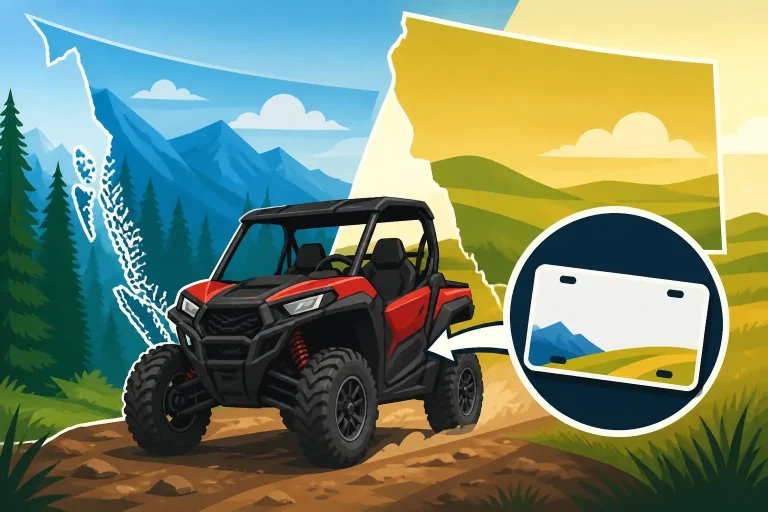
Check that the registration plate is attached in an approved, visible position and can be read. Keep the certificate of registration and photo ID with you while riding where the rules require them. A phone photo can be a useful backup, but do not rely on it instead of the documents you are required to carry.
A registration plate also does not prove that you may ride across every parcel of land. It identifies a registered machine; it does not replace a land-use permit, a site pass, permission from a landholder or compliance with a closure. For details on the documents to carry, see BC Riders Must Carry the Certificate and BC Riders Must Carry Photo ID.
If you are visiting from another province or country, check how BC treats your machine’s home registration and what proof you should carry. Do not assume that a visiting rider follows exactly the same process as a BC resident. BC Non-Resident Riding Rules and BC’s Rule Keys on Whether Home Has a Registry are useful starting points for that question.
Insurance depends on where you ride
Insurance requirements differ by location and type of route. Riding on a Forest Service road has a specific liability insurance requirement; other Crown land riding does not automatically carry the same mandatory coverage requirement. That does not mean riding uninsured is a good risk. A collision can injure someone or damage property, and your own policy may have exclusions for off-road use or particular locations.
Confirm both the legal requirement and what your policy actually covers. Ask specifically about resource roads, Crown land, passengers, and damage to someone else’s property. BC Forest Service Road Insurance explains the road requirement, while What Liability Coverage Pays for on a Resource Road can help you understand the purpose of liability coverage.
Closures, leases, sites and passes
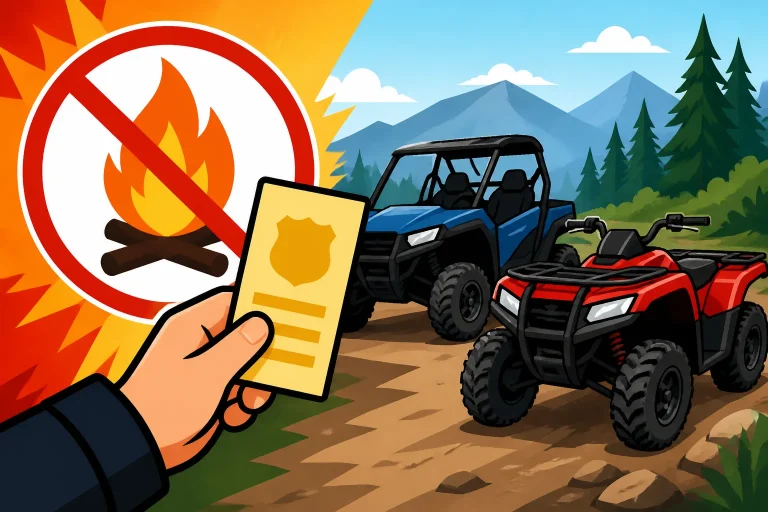
Crown land use is shaped by more than the ownership label. Before riding, check whether the area has a motor-vehicle closure, a seasonal restriction, a fire-related prohibition or another posted limit. Closures can apply to a specific road, trail, watershed or larger area, and they may change as conditions change.
A gate or sign deserves attention even if it looks temporary. It may indicate active logging, a land-use restriction, a local access rule or a closure issued for safety or environmental reasons. Do not go around a barrier to see whether the route is passable. Check the current information for the area and choose a legal alternative if access is restricted. For more detail, see BC Motor Vehicle Closures and How to Find Them and Signs That Restrict ORV Use in BC.
Fire conditions are another reason to check shortly before departure. Restrictions can affect motorized recreation and may be introduced, adjusted or lifted as conditions change. Do not assume that a route open last weekend is still open today. Checking a Fire Ban Before You Ride in BC explains what to verify.
Leases and other users
Some Crown land is leased or used under authorization for purposes such as ranching or other resource activities. That can affect where and how a rider may travel. Do not cross a gate or enter an area used by a landholder or operator unless access is clearly allowed. When the access status is uncertain, ask the person or organization responsible for the land rather than treating Crown ownership as consent.
Even where riding is allowed, stay on established routes and avoid damaging vegetation, wetlands, stream banks and other sensitive ground. A machine can leave lasting ruts, especially on wet or soft terrain. Keep clear of livestock and wildlife, and respect signs related to active work or environmental protection.
Managed sites and trail passes
Some recreation sites and trails are managed by local organizations or clubs. They may require a day pass or other site-specific authorization, and may set conditions such as sound limits, designated staging areas or rules for particular trails. A pass for one managed area does not give you access to every Crown land trail in the province.
BC does not have one province-wide trail pass that grants access everywhere. Check the rules for the specific site and carry proof of any pass you purchase. If you are comparing site access with general land access, BC Passes Exist Only at Managed Sites and Why Club Membership Is Not the Same as a Pass help distinguish the two.
A practical pre-ride access check
Use this checklist before loading your machine. It is especially useful when you are visiting an unfamiliar area, riding during fire season or planning to use a resource road.
- Pin down the route. Identify the trailhead, road and riding area on a current map. Do not rely on a route name or an old trip report alone.
- Check whether motorized use is allowed. Look for closures, signs, gates and restrictions that apply to the route or area. Confirm that a road shown on a map is open to your type of machine.
- Check local land uses. Watch for leased land, active industrial work, ranching activity and other users. Get permission where access is not clearly authorized.
- Confirm site-specific rules. If you are using a managed recreation site or trail, check whether it requires a pass and whether it has additional operating conditions.
- Check registration and documents. Make sure the machine’s registration and plate are valid where required, and carry the documents and identification you need. Visiting riders should confirm what home-jurisdiction proof is accepted.
- Confirm insurance for the route. Pay particular attention if the ride includes a Forest Service road. Check your policy’s off-road and liability coverage rather than assuming your regular vehicle policy applies.
- Review current fire and weather conditions. Restrictions, closures and ground conditions can change. A route that is legal may still be unsafe or unsuitable after heavy rain, snowmelt or a fire-related order.
- Plan for other users. Resource roads can carry industrial traffic. Give large vehicles room, follow posted directions and avoid blocking gates or work areas.
- Stay on the permitted route. Do not use registration or a trail pass as a reason to cross into a closed or unauthorized area. Turn around if signs or conditions show that access has changed.
If you cannot confirm that a route is open, do not treat the uncertainty as permission. Ask the responsible local office, site operator or landholder, or choose a route with clear access information. Keeping a map and a second option is also sensible when cell service is limited.
The useful distinction is simple: registration authorizes the machine’s status, while land access rules determine where you may ride. Insurance, passes and local restrictions add separate conditions. Check each one for the specific route, and remember that Crown land access can change with closures, land uses and site rules.
Disclaimer
This article is for general informational purposes only and does not constitute professional advice. Laws, prices and regulations vary by location and change over time. Consult a qualified professional for guidance on your specific situation.