Who Is Fined When a Child Rides Unsupervised
A child riding an ATV or UTV without the required supervision can put both the young rider and the adults around them under scrutiny. In British Columbia, age, written permission and qualifying training can affect what is allowed. The key point: a parent is not automatically fined just because their child is riding, but an adult may face separate consequences if they breach a legal duty.
Who may be fined when a child rides unsupervised
There is no automatic rule that the parent or vehicle owner gets a ticket whenever a child is found riding alone. An officer will look at who was operating the machine, the rider’s age and whether the applicable supervision or exception requirements were met.
The child is the person operating the ATV or UTV. If that operation breaches the rules for their age, the young rider may be subject to enforcement. An adult may also face consequences if the facts show that they separately broke a rule—for example, by allowing conduct that is prohibited or by failing to meet a duty that applies to them. That is not the same as saying every parent or supervising adult is automatically fined.
| Situation | What may matter for enforcement |
|---|---|
| A child under 14 rides without the required supervision | Whether a person aged 19 or older was actually supervising |
| A 14- or 15-year-old rides alone | Whether the young rider meets the requirements for the unsupervised exception |
| An adult is nearby but cannot see or direct the child | Whether the adult’s presence amounts to effective supervision |
| A parent owns the machine but is not present | Ownership alone does not establish what happened or who breached a rule |
| A child carries a passenger | Separate age-related passenger restrictions may apply |
An adult’s role matters, but it is not a shortcut to deciding who is liable. A parent who gave permission may not be in the same position as an adult who was supposed to supervise and could not keep the child in view. The details of the incident, the child’s age and the rule involved all matter.
A ticket or other enforcement action can have consequences beyond its immediate cost. It may require a response by a parent or guardian, and the right next step depends on the notice and the circumstances. Check the instructions on any ticket, and get legal advice if you are unsure how to respond.
The age rules and the unsupervised exception
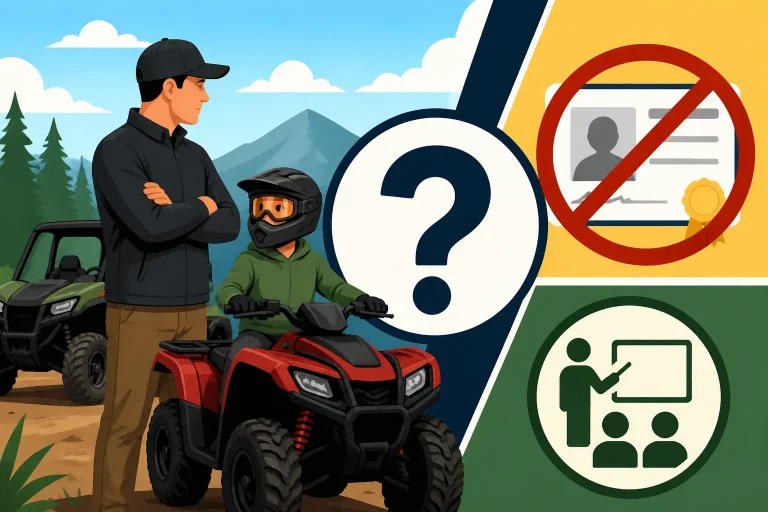
British Columbia’s youth riding rules generally require a child under 16 to operate an off-road vehicle under the supervision of someone aged 19 or older. Supervision needs to be practical: an adult who is out of sight, too far away to intervene or unable to direct the rider immediately may not satisfy the requirement. Simply being somewhere on the same property is not necessarily enough.
There is an exception for some riders aged 14 or 15 to operate without direct supervision. It is not safe to assume that a verbal “yes” from a parent is all that is needed. The exception involves written parental or guardian permission and qualifying training for the relevant class of machine. Confirm the course requirements and what proof the rider should carry before relying on this option. The broader rules are covered in BC Youth Riding Rules Explained and BC Rules for a Child Under 16.
Age is only one part of the decision. Before a young person rides, check:
- The rider’s exact age. The options differ for riders under 14 and those who are 14 or 15. See BC Rules for a 14-Year-Old Rider and BC Rules for a 15-Year-Old Rider.
- Whether supervision is required. If it is, the supervisor must be at least 19 and able to keep the rider within sight and provide immediate direction. BC Rules for a Supervising Adult explains what that role involves.
- Whether the unsupervised exception applies. For a 14- or 15-year-old, check that the written permission and qualifying training requirements are met; do not rely on a general permission note without confirming it is sufficient. See BC Written Permission Letters.
- Whether the machine is appropriate for the rider. Follow the manufacturer’s age, height, weight and passenger guidance. A youth’s legal eligibility does not mean every machine is suitable.
- Whether the child is carrying someone. Separate restrictions apply to young operators carrying passengers. A child’s permission to ride does not automatically allow them to carry another person.
If a young rider does not qualify to ride alone, a parent’s consent does not replace the required supervision. Likewise, an adult’s presence does not make an otherwise unsuitable machine safe for a child. Legal compliance and safe machine selection are related, but they are not the same test.
What counts as supervision, and what evidence helps
Supervision needs to be real, not nominal. An adult who is inside a cabin, riding far ahead or distracted may be unable to see what the child is doing or give immediate direction. The adult should be positioned to monitor the young rider and respond promptly if the child approaches a hazard or rides beyond the agreed area. More detail is available in BC Supervision on Crown Land.
The adult should also know the child’s route, limits and machine. Agree on where the child may ride, how fast, what to do at crossings and when to stop. On a trail or resource road, the adult needs to account for other users, changing conditions and industrial traffic. A supervision plan that works in a quiet yard may not be adequate on a busy backcountry route.
For a 14- or 15-year-old relying on the unsupervised exception, keep the required written permission and proof of qualifying training accessible. Make sure the documents apply to the rider and machine class, and confirm whether originals or copies are accepted. A parent’s verbal confirmation at the trailhead may not establish that the legal requirements have been met.
It can help to keep these items together before a ride:
- Written permission from the parent or guardian, if the rider is using the applicable exception.
- Proof of the required training for the machine class, if the exception depends on it.
- The machine’s registration documents where registration is required.
- The adult supervisor’s contact details and a clear riding plan, when supervision is required.
These documents do not guarantee that no ticket will be issued. They make it easier to show what permission, training or supervision was in place. Also check the rules for the location. Crown land, private land and resource roads can raise different access and operating issues; parental permission does not grant access to land where riding is not allowed.
How to reduce the chance of a ticket or a preventable incident
The most reliable approach is to decide whether the child can ride alone before unloading the machine. Do not make the decision based only on confidence, past experience or the fact that other children are riding nearby. Check age, supervision, training, written permission and the machine’s suitability as separate requirements.
Use this practical sequence:
- Confirm the child’s age and riding category. Work out whether the child needs direct supervision or could qualify for the 14- or 15-year-old exception.
- Check the requirements for that category. If the rider plans to go without a supervisor, confirm both the written permission and qualifying training details with an authoritative source before the ride.
- Choose an appropriate machine. Follow the manufacturer’s age and size guidance, and do not assume that a machine is suitable just because the child can reach the controls.
- Set clear boundaries. Explain where the child may ride, who they may ride with and what conditions mean they must stop.
- Put the supervisor in a position to supervise. Stay close enough to see the young rider and provide immediate direction. A remote check-in by phone is not a substitute for required direct supervision.
- Review passenger restrictions. Do not let a child carry a passenger unless the rules and the machine’s specifications permit it. See BC Rules for Passengers on a Quad.
- Check location and access rules. Permission from a parent or landowner does not override restrictions that apply to a trail, road or riding area.
If an officer questions the arrangement, stay calm and explain who was riding, who was supervising and what permission or training applied. Do not assume that a child’s age, a parent’s ownership of the machine or a note in a pocket settles the matter on its own. If a ticket is issued, read it carefully and follow the response instructions rather than ignoring it or guessing which person must deal with it.
The practical answer is that the child may face enforcement for operating contrary to the youth rules, while an adult may face separate consequences if their own conduct or legal responsibility is at issue. A parent is not automatically fined merely because their child rides unsupervised. The safest way to avoid uncertainty is to meet the supervision rule or confirm that the young rider satisfies every condition for riding without direct supervision.
Disclaimer
This article is for general informational purposes only and does not constitute professional advice. Laws, prices and regulations vary by location and change over time. Consult a qualified professional for guidance on your specific situation.