Riparian Areas and Damage
A shallow creek crossing can look harmless from an ATV, but soft banks, wet soil, and hidden vegetation can make one pass leave damage long after the tracks disappear. In British Columbia, riders need to think beyond whether a route is physically passable: this guide explains what riparian areas are, how to avoid damaging them, and what to do when a trail or crossing is unclear.
What riparian areas are and why they matter
The land beside water is part of the habitat
A riparian area is the strip of land beside a waterway, wetland, or lake. It can include more than the obvious shoreline. Depending on the terrain, water levels, soil, and vegetation, the area may extend from the water’s edge into surrounding ground where plants and wildlife depend on the connection to water.
Along a creek, that strip might be a narrow band of shrubs and trees. Around a wetland, it may be a broad patch of sedges, grasses, and soft ground. A stream that looks small in late summer can also rise, spread, or shift during wetter conditions. That makes judging the full sensitive area from the trail especially difficult.
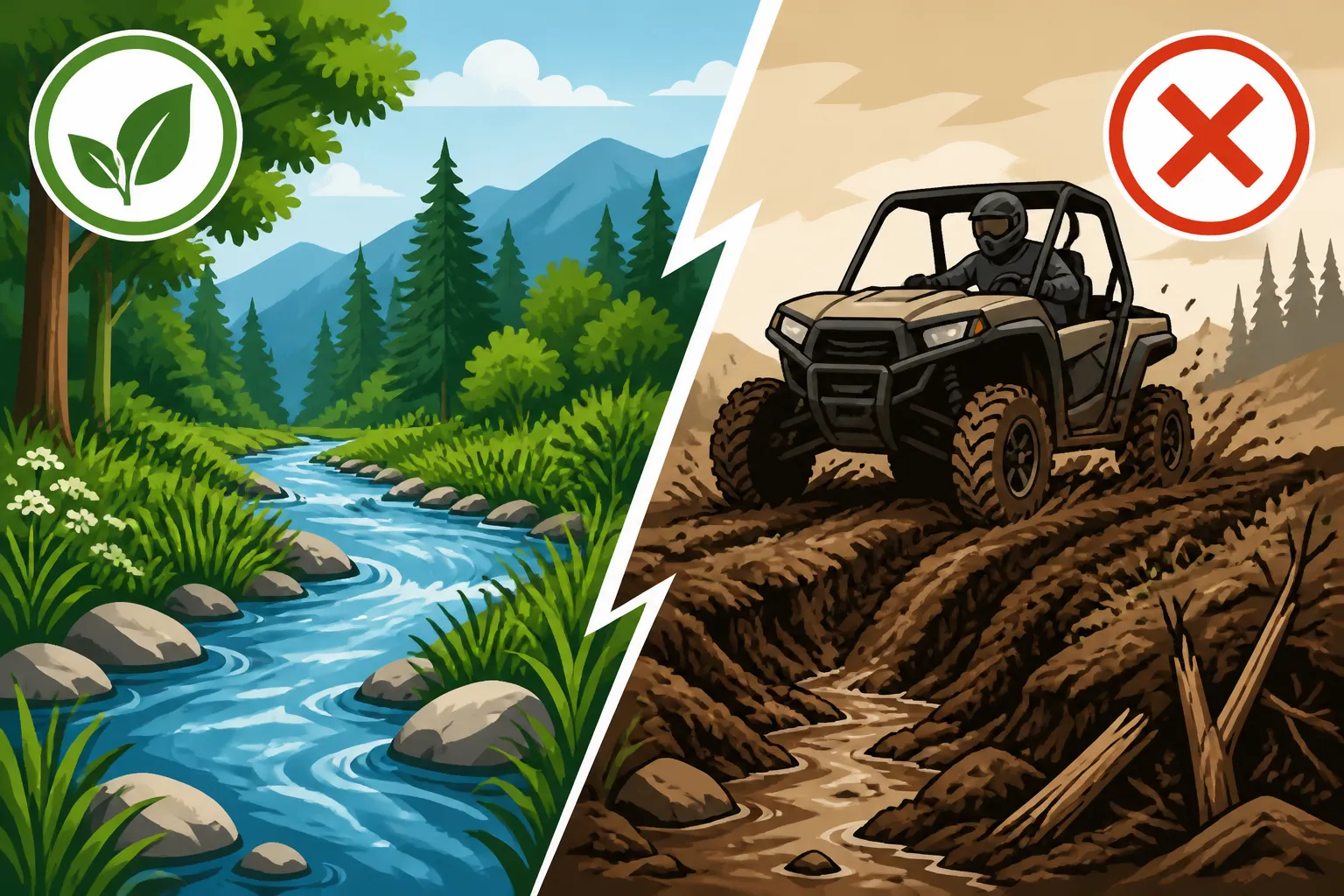
Riparian vegetation does important work. Roots help hold soil in place, plants slow runoff, and shaded banks can help keep water cooler. The area may also provide cover, food, and travel routes for wildlife. When a vehicle breaks through the vegetation or cuts into a bank, the result can be erosion, sediment in the water, and a wider, muddier route as other riders follow the same line.
Why ATV and UTV traffic can cause lasting damage
An ATV or side-by-side concentrates weight on a relatively small contact area. On dry, firm ground, a tire track may be minor. On saturated soil or a steep bank, the same machine can press into the ground, shear vegetation, and loosen soil. Spinning the tires to climb out can make the damage worse by digging ruts that channel future runoff.
Damage is not always dramatic. A single crossing may leave little more than a flattened patch of plants. Repeated use, however, can widen that patch into an informal trail, especially when riders detour around mud or a difficult obstacle. Those parallel tracks can spread disturbance across the bank and make the original route harder to recognize.
This is why “I only crossed once” does not always settle the question. A careful crossing on an established, permitted route is different from creating a new route through a wet area. If you cannot tell whether a line is an authorized crossing or simply a set of old tire marks, avoid assuming that visible tracks mean permission.
How to avoid harming a creek, wetland, or shoreline
Stay on the established route and obey closures
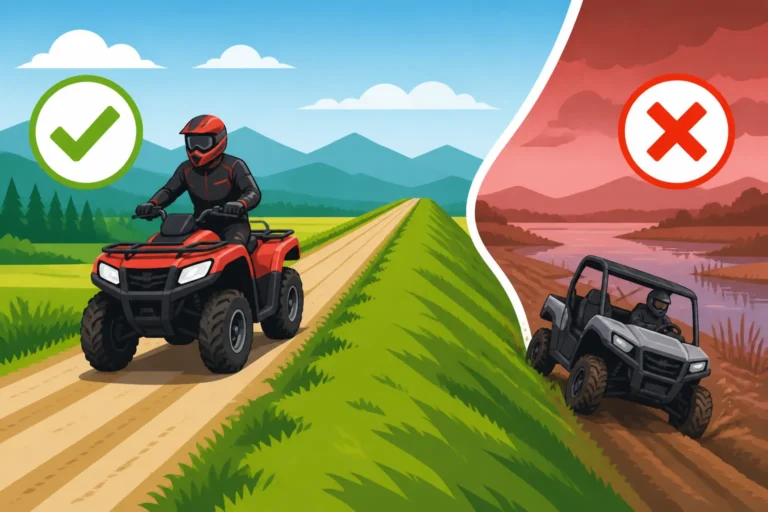
The simplest way to reduce impact is to stay on a designated or clearly authorized route and use an established crossing where one exists. Avoid making a new line to bypass a puddle, fallen tree, steep bank, or damaged bridge. A detour through vegetation can turn one obstacle into a much larger area of disturbance.
Check for signs, gates, and posted restrictions before you ride. Conditions can change after heavy rain, a storm, active road work, or a seasonal closure. A route that was open on your last visit may no longer be suitable or available. [BC Motor Vehicle Closures and How to Find Them] and [Signs That Restrict ORV Use in BC] are useful starting points when you are planning a route or encounter a restriction on the ground.
Local context matters. A trail in the Chilliwack Valley, a forest road near Campbell River, and a route in the Okanagan can have very different soils, drainage, and management rules. Do not assume that a route is open just because it is popular, appears on an old map, or has tire tracks. [BC Crown Land Riding Explained] provides useful context, but Crown land access does not automatically mean every route or sensitive area is open to motorized use.
Make a crossing only where it is allowed and suitable
If an established crossing is open and the ground is firm enough, approach it slowly and steadily. Follow the marked line rather than widening it to find a smoother path. Avoid sharp turns, aggressive acceleration, and repeated wheelspin, which can tear up soil and vegetation. If a crossing looks deep, fast, undercut, flooded, or unstable, do not try to force your way through.
For UTV drivers, remember that a wider machine may not fit safely within a narrow established route. A side-by-side’s width can make it tempting to swing around a bank or vegetation, but that can enlarge the disturbed area. If the authorized line is too narrow or unsuitable for your machine, turn around rather than making a new route.
Do not ride through a wet meadow or along a shoreline simply because the ground appears flat. Waterlogged soil can compress easily, and plant cover can hide soft spots. If you are uncertain whether a route crosses a sensitive area, stop before entering it, look for posted information, and seek guidance from the relevant land manager or local recreation organization.
Use equipment to reduce risk, not to justify a risky route
Good equipment can help you avoid getting stuck, but it cannot make an unauthorized or environmentally sensitive crossing appropriate. A winch, suitable tires, and recovery gear may help you turn around safely rather than spinning the tires in a creek bank. SuperATV sells off-road accessories such as winches and protective equipment; if you are comparing gear, check that it suits your machine and use case. A product’s presence does not establish that a route is permitted.
SuperATV snorkel kits or other water-oriented accessories should not be treated as permission to ride through streams or wetlands. A machine that can tolerate water mechanically can still damage the habitat, and water depth or current can create serious safety risks. Plan around crossings instead of treating extra equipment as a reason to attempt more of them.
| Situation | Lower-impact choice | Avoid |
|---|---|---|
| A marked crossing is open and firm | Follow the established line at a controlled pace | Widening the crossing to find a smoother path |
| A creek is high or the bank is unstable | Turn around and find a confirmed alternative route | Testing the depth by driving into the water |
| A wet patch blocks the trail | Wait, turn back, or use an authorized detour | Cutting through nearby vegetation |
| You are stuck near a waterway | Use suitable recovery gear carefully or seek help | Spinning tires or winching from living riparian trees |
| The route or restriction is unclear | Stop and check with the land manager | Treating old tracks as proof of access |
What to do when a trail is wet, damaged, or unclear
Decide when turning around is the right call
Riders often feel pressure to keep moving when they have already driven a long distance to a trailhead. That is understandable, particularly when a group is waiting or a planned loop depends on one crossing. But if water is running across the trail, the bank is crumbling, or the tires are sinking into saturated soil, pressing on may create damage and put the machine or riders at risk.
Pause somewhere stable, away from the water’s edge, and assess the route. Look for a signed crossing, visible road surface, or clear evidence that the trail is intended to pass there. Do not use a fresh-looking rut, a gap in shrubs, or another rider’s tracks as your only evidence. If the crossing is questionable, retrace your route or choose another route that you have confirmed is open.
A group should agree on this before setting off. One rider may be comfortable attempting a crossing while another sees the same conditions as unsafe. A simple plan helps: identify a point where the group will turn around if the route is flooded, blocked, or visibly eroding. [BC Trail Etiquette Locals Expect] covers the kind of shared awareness that makes group riding safer and less disruptive.
Recover a stuck machine without worsening the damage
If a machine becomes stuck, stop before the tires dig deeper. Repeated throttle inputs can turn a small rut into a trench, especially on soft ground. Ask the group to assess whether the machine can be backed out along the existing track without tearing up the bank. Keep people clear of recovery lines, and use appropriate recovery practices for the machine and equipment.
Choose a stable recovery point and avoid attaching a winch line to a living tree beside the water. If a tree must be used as an anchor in an appropriate location, protect its bark with a suitable tree-saver strap and follow the equipment manufacturer’s instructions. Do not drag a cable or strap across shrubs or vegetation that is holding a bank together. SuperATV recovery products can be one option to consider when assembling gear, but equipment selection should be based on the machine, rated capacity, and safe-use instructions—not on a promise that every situation can be recovered without impact.
Once the machine is free, do not keep trying the same crossing if the ground is deteriorating. Move to firm ground by the existing route if possible, then turn back or wait for conditions to improve. If a trail is already badly rutted, avoid making it worse and report the problem through the appropriate land manager or trail organization.
Report damage and follow the right authority
If you find a newly damaged bank, an unsafe crossing, a washout, or a route that appears to have been cut through a wet area, record the location and describe what you observed. A photograph taken from stable ground can help identify the issue without requiring you to approach the water or enter the damaged area. Do not post an exact location publicly if doing so could encourage more traffic through a sensitive spot.
The right contact depends on who manages the land or route. A recreation site or trail may have a listed managing organization, while a resource road or public land area may involve a different authority. Trail clubs can sometimes point riders toward the appropriate contact, but they do not necessarily control every road or parcel. [Recreation Sites and Trails and What They Manage] can help explain that distinction.
If you encounter a closure sign, gate, or instruction to keep out, follow it even if other riders are passing through. [BC Trespass Rules for Riders] offers related context about access and permission. When in doubt, stop, take the machine back to a known route, and confirm the status before returning.
Planning a lower-impact ride in British Columbia
Check conditions before you leave
A route that is manageable in dry weather may become a poor choice after sustained rain or snowmelt. Before loading up, check for current closures, road notices, trail updates, and local conditions. Look for information from the land manager or a local club that knows the area rather than relying only on an old map or a social-media post.
Plan fuel, turnaround points, and alternate routes so that one blocked crossing does not force a last-minute detour through sensitive ground. This is especially helpful on long rides around remote areas, where cell coverage may be limited and a group may be tempted to push onward rather than retrace its route. [BC ATV Trail Map Downloads] can help with route planning, but maps should be checked against current signs and restrictions on the ground.
If you are heading out with a mixed group of ATVs and UTVs, choose routes that fit the widest machine. A narrow trail may be suitable for a quad but not a side-by-side. Confirming that ahead of time reduces pressure to widen the trail or improvise a crossing once everyone is already there.
Keep water, wildlife, and other trail users in mind
Riparian areas are often shared spaces. Other riders, hikers, anglers, landowners, and wildlife may be nearby, even when the trail looks empty. Slow down around water, keep noise and disturbance to a minimum, and do not approach animals or drive through vegetation to get a closer look.
A responsible route choice can also protect your own ride. Deep mud and unstable banks can damage a machine, create recovery problems, and leave a group stranded. Riding within the limits of the route is not just an environmental precaution; it is a practical way to avoid turning a planned outing into a difficult recovery.
Remember that accessories do not replace judgment. SuperATV products may help riders prepare for recovery or protect machine components, but the best way to prevent riparian damage is often to avoid entering the sensitive area in the first place. Confirm permission, use designated routes, and turn around when conditions make a crossing unsafe or unclear.
A practical pre-ride check
Before heading out, use this quick sequence:
- Confirm that the trail or road is open to your type of machine.
- Check for posted restrictions, seasonal closures, and recent condition updates.
- Identify creeks, wetlands, and other likely sensitive areas on the route.
- Choose a route that fits every machine in the group.
- Carry recovery gear and know how to use it safely.
- Agree that the group will turn around rather than create a new route.
- Follow signs and established crossings when you arrive.
These steps cannot remove every uncertainty from a backcountry ride, but they make it less likely that a tempting detour will become a damaged bank or an unsafe recovery. When the line ahead is wet, eroding, or ambiguous, the careful choice is usually the one that leaves the ground—and your group—in better shape.
Disclaimer
This article is for general informational purposes only and does not constitute professional advice. Laws, prices and regulations vary by location and change over time. Consult a qualified professional for guidance on your specific situation.