BC Parks That Ban Motorized Recreation
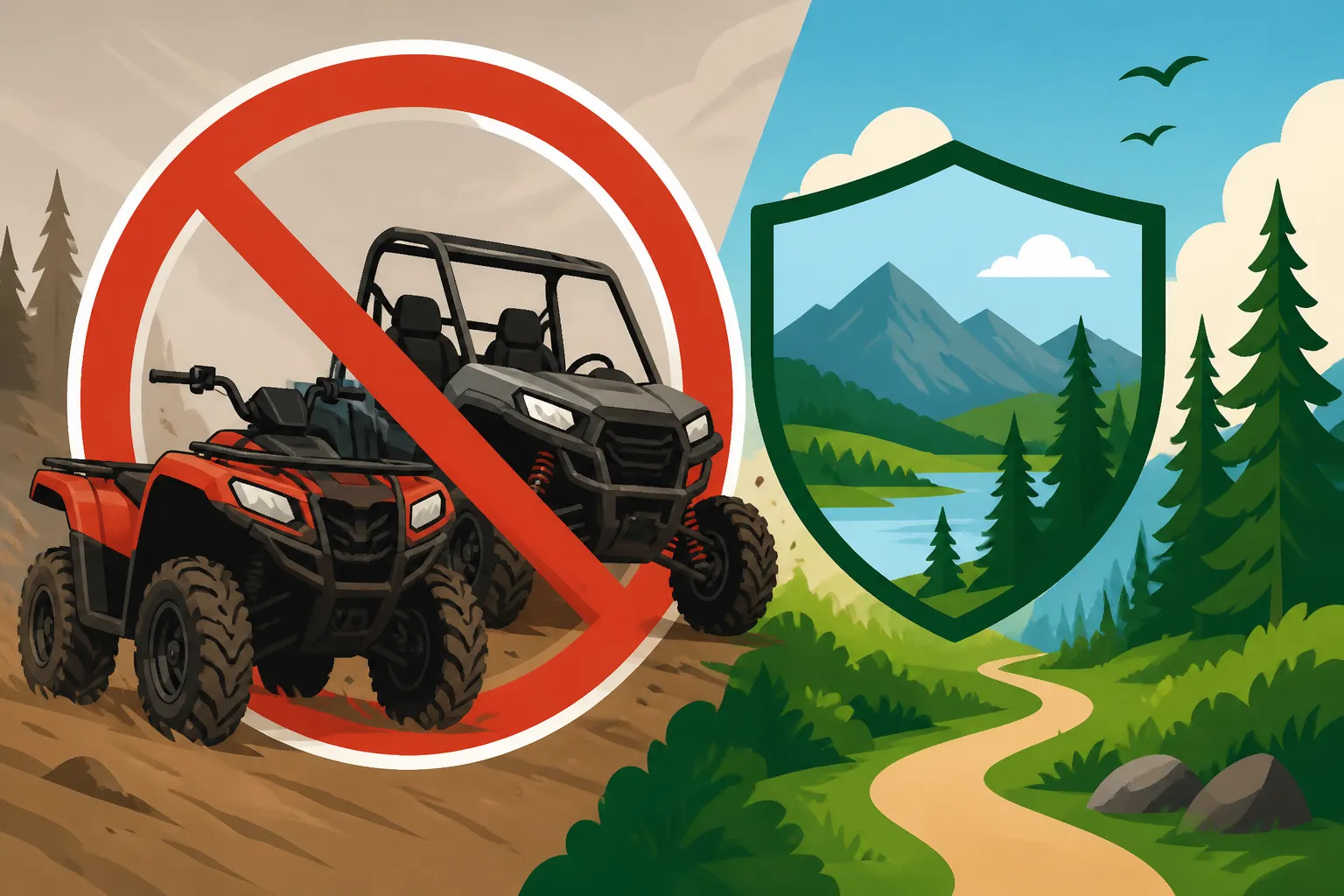
It’s a truly disheartening experience when you meticulously plan an epic ATV or UTV adventure, envisioning stunning BC landscapes, only to discover that your chosen destination – a beautiful provincial park – strictly bans motorized recreation. This guide is here to shed light on which types of BC Parks and protected areas typically prohibit the use of off-road vehicles (ORVs), explaining the reasons behind these rules, and most importantly, how you can research your route effectively to avoid disappointment and ensure your ride is both thrilling and legal.
Why Motorized Recreation Is Restricted in Some BC Parks
The vast and diverse landscape of British Columbia is home to an incredible network of parks and protected areas, each managed with specific conservation and recreation goals in mind. While some areas, like extensive networks of [BC Forest Service Roads Worth Riding] and designated OHV areas on [BC Crown Land Riding Explained], welcome ORVs, many provincial parks and ecological reserves have a different mandate. The primary reasons for restricting motorized recreation often boil down to preserving ecological integrity, promoting quiet enjoyment, and preventing user conflicts.
Protecting Sensitive Ecosystems and Wildlife
One of the most fundamental roles of provincial parks and ecological reserves is to protect and conserve natural ecosystems, biodiversity, and sensitive wildlife habitats. ATVs and UTVs, while offering fantastic access to remote areas, can have significant impacts if not managed carefully. The noise, exhaust emissions, and physical disturbance from tires can disrupt wildlife, leading to stress, displacement, and changes in feeding or breeding patterns. Imagine a serene nesting ground for migratory birds suddenly exposed to the roar of an engine – it’s simply not compatible with their survival.
Beyond direct disturbance, ORVs can contribute to soil erosion, especially on fragile terrain, steep slopes, or near water bodies, altering drainage patterns and impacting water quality. The spread of invasive species is another major concern; seeds or plant fragments can easily be transported on tires and undercarriages from one area to another, outcompeting native flora and fundamentally changing an ecosystem. These areas are designated for preservation first and foremost, and unfortunately, motorized vehicles often conflict with those goals.
Ensuring Quiet Enjoyment for Non-Motorized Users
Many visitors flock to BC Parks seeking solitude, tranquility, and an immersive nature experience. Hikers, birdwatchers, wilderness campers, and equestrians often cherish the peace and quiet that these natural spaces offer. The presence of motorized vehicles, with their inherent noise and speed, can significantly detract from this "quiet enjoyment" experience. The frustration of encountering an ORV while on a peaceful hike or paddle is a common complaint, and park managers strive to create designated zones where different types of recreation can coexist without conflict.
Park planners try to balance various recreational needs, but in areas designated for passive, non-motorized use, ORVs simply don't fit the vision. This isn't about one activity being "better" than another, but rather about ensuring that there are dedicated spaces for every kind of outdoor enthusiast, including those who prefer their adventures powered by their own two feet or a paddle. This separation helps prevent negative interactions and preserves the desired atmosphere for all visitors.
Preventing Damage and Maintaining Infrastructure
While less about conservation and more about practical management, motorized vehicles can also pose challenges to park infrastructure and trail systems designed for lighter use. Trails built for hiking or mountain biking may not be robust enough to withstand the weight and wear of ATVs or UTVs, leading to rapid deterioration, increased maintenance costs, and safety hazards for all users. Maintaining these trails in a state suitable for their intended purpose is a huge undertaking, and introducing heavy, powerful machines complicates that considerably.
Furthermore, managing potential safety risks becomes a factor. In multi-use areas where hikers and motorized vehicles might share trails, there’s an increased risk of accidents. Park authorities consider the design and capacity of their trail networks, and if they weren't built with motorized traffic in mind, the decision to prohibit ORVs is often a pragmatic one to protect both the environment and public safety.
Understanding BC Parks and Protected Areas Designations
British Columbia has a comprehensive system of protected areas, each with its own classification and set of rules governing activities, including motorized recreation. Navigating these categories is key to understanding where you can and cannot take your ATV or UTV. It's not a one-size-fits-all situation; a "park" can mean many things in BC.
Provincial Parks: The Most Common Category
When most people think of "BC Parks," they're generally referring to Provincial Parks. These are established under the Park Act and are managed by BC Parks, an agency of the provincial government. Their primary purpose is to preserve natural environments, provide outdoor recreation opportunities, and protect cultural heritage. While some larger parks might have specific access roads or even designated areas for certain types of vehicles, the general rule of thumb for most provincial parks is that motorized recreation off of designated park roads is prohibited.
This means you typically can’t take your ATV or UTV onto hiking trails, into backcountry areas, or off-road within the park boundaries. If there’s a paved or gravel road leading to a campground or viewpoint within a provincial park, you might be able to drive your machine on that road if it's legally registered for road use or as part of transporting it to a staging area outside the park. However, using it for recreational riding within the park is generally a no-go. For specifics, always check the individual park's web page on the BC Parks site.
Ecological Reserves, Conservancies, and Protected Areas
Beyond general Provincial Parks, BC has several other classifications of protected lands, each with even stricter limitations on human activity, especially motorized use. These include:
- Ecological Reserves: These areas are established to preserve representative examples of natural ecosystems, rare or endangered native plants and animals, or unique geological features. They are managed primarily for scientific research and educational purposes. Public access is often restricted, and motorized recreation is almost universally prohibited to prevent any disturbance to their fragile ecosystems. Think of them as living laboratories, not playgrounds.
- Conservancies: A unique BC designation, conservancies are established to protect areas that are significant for their cultural, environmental, and recreational values, often with a strong emphasis on Indigenous traditional uses. While they may allow a broader range of activities than ecological reserves, motorized recreation is still heavily restricted and usually only permitted on specific, pre-existing access routes, if at all.
- Protected Areas: These are often established under the Protected Areas of British Columbia Act and share many characteristics with provincial parks, but may have slightly different management objectives or co-management agreements with Indigenous communities. Again, the general principle is conservation, and off-road motorized use is typically restricted or banned.
Here’s a quick overview of how these areas generally treat motorized recreation:
| Protected Area Type | Primary Focus | General ORV Access (Off-Road) |
|---|---|---|
| Provincial Parks | Conservation, general recreation, cultural heritage | Generally Prohibited |
| Ecological Reserves | Scientific research, ecosystem preservation | Strictly Prohibited |
| Conservancies | Cultural, environmental, recreational values | Heavily Restricted / Prohibited |
| Protected Areas | Conservation, varied recreation | Generally Prohibited |
| Recreation Sites & Trails | User-managed recreation, forest access | Often Permitted / Designated |
This table highlights that while "protected" sounds similar across the board, the nuances matter. For example, [BC Recreation Sites and Trails and What They Manage] are explicitly designed to support various forms of outdoor recreation, including ORV use in many locations, contrasting sharply with the preservation-focused mandates of provincial parks.
How to Verify Park Regulations Before You Go
So, you've got your machine ready, maybe outfitted with some robust SuperATV accessories, and you’re itching to hit the trails. But before you load up and head out, it's absolutely crucial to verify the specific regulations for your chosen destination. Don't rely on old maps, hearsay, or the assumption that "if it's out in the wilderness, it must be okay." That’s a quick route to a violation ticket or worse, harming a sensitive area.
The Official BC Parks Website is Your Best Friend
The single most reliable source for information on BC Parks and protected areas is the official BC Parks website. Every park, reserve, and conservancy has its own dedicated page. On these pages, you will find:
- Activities Permitted/Prohibited: This section explicitly lists what you can and cannot do within the park boundaries. Look for mentions of "motorized vehicles," "ATVs," "ORVs," or "off-road use." If it's not listed as permitted, assume it's prohibited.
- Park Management Plans: Larger parks often have detailed management plans available for download. These documents outline the specific zoning within the park, environmental sensitivities, and detailed policies regarding recreational use, including motorized access. While dense, they offer the most comprehensive overview.
- Maps: Detailed maps sometimes indicate designated access routes or areas where certain activities are allowed or restricted. Pay close attention to any symbols or legends related to vehicle use.
- Alerts and Advisories: Always check for current advisories. These can include [BC Fire Centre Closures for ORVs], seasonal restrictions, temporary closures due to wildlife activity, or trail maintenance.
It’s a good habit to check the website right before your trip, as conditions and regulations can change. It's truly a frustration when you get there only to find a gate or a sign that wasn't there last month, so a quick check saves a lot of wasted time and fuel.
Look for On-Site Signage
While pre-trip research is paramount, always pay attention to signs posted at park entrances, staging areas, and along trails. These signs are the official, on-the-ground communication of park rules and can sometimes reflect very localized or temporary restrictions.
Common signs you might see include:
- "No Motorized Vehicles Beyond This Point"
- "Foot Traffic Only"
- "Area Closed to Motorized Recreation"
- "Sensitive Habitat – No Off-Road Vehicles"
These signs are legally binding, and ignoring them can lead to serious consequences, including significant [BC Fines for Careless Operation] or even [BC Seizure Powers Under the ORV Act]. Remember, park rangers and conservation officers regularly patrol these areas, and they are authorized to enforce the rules strictly.
When in Doubt, Contact the Park Directly
If, after thoroughly checking the website and looking at maps, you are still unsure about the rules regarding ORV use in a specific BC Park or protected area, your best bet is to contact BC Parks directly. Their regional offices or specific park contacts can provide clarity. It's always better to ask than to unknowingly violate a rule and face the repercussions. This also applies if you're exploring areas that might be adjacent to a park, like [BC Crown Land Triggers the Registration Rule] or [BC Resource Roads Count as Crown Land], where the rules can change literally at a boundary line.
What to Do If Your Dream Spot Is Off-Limits
Discovering that your planned ride in a pristine BC Park is a non-starter can definitely feel like a letdown. However, BC is vast, and there are countless other incredible places where you can legally and responsibly enjoy your ATV or UTV. The key is to shift your focus from frustration to exploration and find an alternative that suits your adventurous spirit.
Seek Out Dedicated OHV Trails and Recreation Sites
British Columbia has many areas specifically designated for motorized recreation. These places are designed with ORV use in mind, often featuring extensive trail networks, staging areas, and amenities. Some popular examples, without getting into specific, current details, include managed recreation sites in regions like the Okanagan, Kootenays, and Fraser Valley, which often provide excellent riding experiences. Many of these are managed by BC Recreation Sites and Trails or local ATV clubs.
These designated areas are built to handle the impact of ORVs and often have maps, signage, and sometimes even volunteer patrols to ensure safety and responsible use. They are your best bet for a worry-free ride. You can often find trail passes for these managed sites, and some even have wash stations to help you keep your machine clean and prevent the spread of invasive species, ensuring your SuperATV gear stays in top shape.
Explore Forest Service Roads and Crown Land
Outside of provincial parks, vast expanses of Crown land and the extensive network of [BC Forest Service Road Rules for ORVs] offer incredible opportunities for ORV exploration. [BC Crown Land Riding Explained] offers a huge canvas for riders, but it comes with its own set of responsibilities.
On Crown land and FSRs, you generally have legal access for your ORV, provided you are registered, insured, and adhere to the [What the Off-Road Vehicle Act Covers in BC] and any other regulations. Always be aware of active logging operations on resource roads; industrial traffic always has the right of way. Remember that even on Crown land, there can be specific [BC Motor Vehicle Closed Areas] or seasonal restrictions, especially in sensitive ecological zones, hunting management units during certain times, or areas affected by wildfire bans. Always double-check current conditions and maps for any local prohibitions.
Consider Private Land with Permission
If you know someone with private land, riding there with explicit permission is another option. This removes many of the public land regulations, though you still need to ensure your machine is safely operated and you have appropriate insurance. Remember, even on [BC Private Land and the Registration Question], common sense and courtesy go a long way. Obtaining written permission is always a smart move to avoid any misunderstandings.
Respect Closures to Preserve Future Access
It might be disappointing to be turned away from a beautiful park, but respecting closures is paramount. Ignoring regulations not only puts you at risk of fines and penalties, but it also harms the reputation of the entire ORV community. When riders disregard rules, it fuels arguments against motorized access and can lead to further restrictions on areas that are currently open.
By researching beforehand, sticking to designated trails, and always being aware of your surroundings and any posted signs, you contribute to a positive image for ORV enthusiasts. This kind of responsible riding helps ensure that future generations will continue to have access to the incredible riding opportunities BC has to offer, perhaps even in areas enhanced by accessories from brands like SuperATV that make exploration safer and more enjoyable. The goal is to be part of the solution, not the problem, preserving the beauty of BC for everyone.
Disclaimer
This article is for general informational purposes only and does not constitute professional advice. Laws, prices and regulations vary by location and change over time. Consult a qualified professional for guidance on your specific situation.