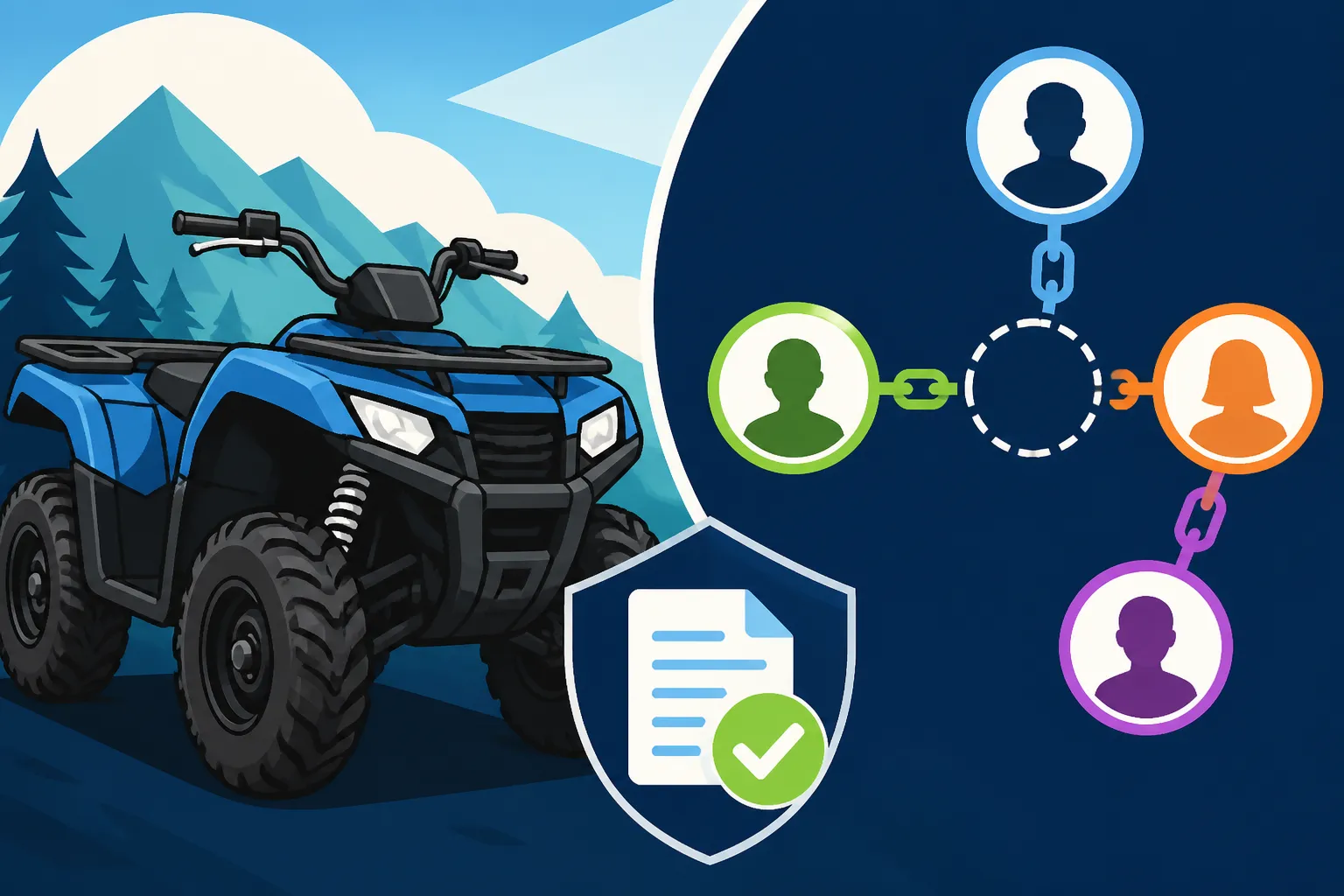
Registering a Quad With a Gap in Its Ownership Chain
You've just bought a used quad, maybe a vintage beauty that's been passed through a few hands over the years, only to hit a wall when you try to register it. Suddenly, you realize there's a missing link in its history—a bill of sale from a previous owner that simply doesn't exist anymore. It’s a frustrating predicament many BC riders face, but don't despair! This guide will walk you through the essential steps to overcome a gap in your quad's ownership chain and get your machine properly registered in beautiful British Columbia.
Understanding the "Ownership Chain" Problem in BC
Let's face it, buying a used off-road vehicle (ORV) can be an exciting journey. You find the perfect machine, negotiate a fair price, and imagine all the adventures you'll have on BC's incredible trails. But then you hear those dreaded words from an Autoplan broker: "We need the bill of sale from every previous owner." This isn't just a quirky rule; it's a fundamental part of how BC's ORV registration system works, and a missing piece in that chain can bring your registration plans to a grinding halt.
Why a Missing Link Stops Registration
The core reason an incomplete ownership chain is a problem stems from the province's need to verify legitimate ownership. Unlike highway vehicles, ORVs in BC don't have titles in the same way. Instead, a [BC's Certificate of Registration Explained] serves as your proof of registration. To issue this certificate, the system needs to trace the machine's ownership back to its original sale from a dealer, or at least through a continuous line of private sales. Each bill of sale, or proof of transfer, acts like a link in a chain. If a link is missing, it creates a break, and the province can't confidently say that the person trying to register it is the rightful owner. It's a safeguard against stolen vehicles and ensures that the correct Provincial Sales Tax (PST) is collected at each transfer. Without this unbroken chain, a broker simply cannot complete the registration process for you.
Imagine you bought a quad from someone who bought it from their uncle, who bought it from a friend. You have a bill of sale from the person you bought it from, but they never got one from their uncle, and the uncle never got one from his friend. That's two missing links right there, and suddenly, you're stuck. The broker needs to see that progression of ownership, ensuring that each transfer was legitimate and accounted for. This is why [Why Every Past Sale Has to Be Documented] is such a critical concept in BC's ORV registration system.
Common Scenarios for Gaps
Gaps in the ownership chain are far more common than you might think, especially with older machines. One of the most frequent scenarios involves quads that were purchased long before [BC Registration Became Mandatory in 2015]. Back then, there was no provincial registry, so many private sales occurred with nothing more than a handshake or a simple, informal receipt that has since been lost. People simply didn't keep meticulous records for a machine they used primarily on their own property or a remote logging road.
Another common situation arises when a machine has been passed down through a family or between friends without any formal documentation. Perhaps a parent gifted a youth quad to their child, who later sold it to a friend. No money exchanged hands, or if it did, no formal bill of sale was ever created. Then, that friend sells it to you, and you suddenly realize the paperwork trail ends abruptly a few owners back. Sometimes, an owner simply moves away, changes phone numbers, or even passes away, making it impossible to track down the necessary previous bills of sale. These informal transfers, while perfectly innocent, create significant hurdles when you try to register your ORV today.
The Frustration of Unregistered Machines
There's a genuine sting when you realize your new-to-you quad can't be registered easily. You've got this awesome machine, ready for adventure, but the bureaucracy is holding you back. Maybe you've got friends planning a trip to the [Chilliwack Area Riding in BC], or you're hoping to explore some new [BC Crown Land Riding Explained], only to remember that you can't legally operate your ORV on most Crown land or Forest Service Roads without that all-important registration and display of your [BC ORV Number Plates and Decals]. It's a major bummer.
Beyond the missed riding opportunities, there's the underlying worry. You've invested your hard-earned money, and without proper registration, your ownership isn't fully solidified in the eyes of the province. What if the machine is ever stolen? What if you're pulled over by a Conservation Officer and can't produce the required documents? [BC Tickets for an Unregistered Machine] can be costly, and the hassle is just not worth it. The goal is to get your machine legal, and that means tackling the ownership chain head-on. This is precisely why understanding the options for [BC Registration Without a Bill of Sale] is so crucial for many riders.
The BC Statutory Declaration as Your Solution
When faced with a missing link in your quad's ownership chain, the province of British Columbia offers a formal pathway to affirm your ownership: the Statutory Declaration. This legal document is a powerful tool designed to bridge those frustrating gaps in paperwork and allow you to proceed with registering your ORV. It essentially allows you to declare, under oath, the circumstances of your ownership when traditional documentation isn't available.
What a Statutory Declaration Is
At its heart, a Statutory Declaration is a sworn statement of facts. In the context of ORV registration, it's a formal declaration by you, the current owner, detailing how you came into possession of the machine, what efforts you made to obtain missing paperwork, and why those documents are unavailable. You are essentially providing a narrative of ownership, backed by the weight of an oath or affirmation. This isn't just signing a piece of paper; it's a solemn promise that the information you're providing is true to the best of your knowledge and belief. Making a false declaration can have serious legal consequences, so it's not something to be taken lightly.
The Statutory Declaration is a specific type of legal document governed by provincial law. It needs to be precise, accurate, and signed in front of an authorized official, such as a Commissioner for Oaths or a Notary Public. It's the province's way of saying, "Okay, we understand the paperwork is missing, so tell us your story formally." This process offers a viable path for [Declaring Ownership Under Oath] when the usual paper trail has gone cold.
How It Replaces Missing Paperwork
Think of the Statutory Declaration as a substitute for a missing bill of sale. When you present this document to an Autoplan broker, it fills in that critical missing link in the ownership chain. Instead of a bill of sale from 'Owner X' to 'Owner Y,' the Statutory Declaration explains why that bill of sale doesn't exist and affirms your belief that 'Owner Y' legitimately acquired the machine and subsequently sold it to you (or your predecessor). The declaration needs to cover the entire missing period, detailing the transfer of ownership that is otherwise undocumented.
For example, if the person you bought the quad from acquired it without a formal bill of sale, your Statutory Declaration would need to explain that situation. It would describe your purchase from them, and then, to the best of your knowledge, how they acquired it. If you have any supporting details—like names, approximate dates, or even just a description of the transaction—those should be included. The goal is to provide enough credible information for the registrar to be satisfied with the legitimacy of the ownership transfer, even without the original paper trail. This is a common solution for [BC Registration When the Seller Has No Papers] and offers a route to getting your machine registered.
The Role of an Autoplan Broker
Your local Autoplan broker is your key ally in navigating this process. While the Statutory Declaration itself is a sworn statement you create, the broker is the one who will review all your documentation, including the declaration, and submit it to ICBC for registration. They are the experts in [BC Autoplan Brokers Handle ORV Registration] and understand the specific requirements for various scenarios, including gaps in the ownership chain.
When you bring your Statutory Declaration and any other supporting documents to your broker, they will meticulously go through everything to ensure it meets the province's criteria. They will advise you if your declaration is missing any crucial details or if further information is required. It's often helpful to discuss your specific situation with your broker before you finalize your declaration, as their experience can guide you on what information is most important to include. They act as the gatekeepers, ensuring that everything is in order before submitting your [BC Registration Paperwork Checklist] to the provincial system. Don't underestimate their knowledge; they deal with these kinds of situations frequently.
Step-by-Step: Preparing Your Statutory Declaration
So, you've accepted that a Statutory Declaration is your path forward. Now comes the practical part: preparing this critical document. It might seem daunting, but by breaking it down, you'll find it's a manageable process. The key is thoroughness, honesty, and presenting a clear, coherent narrative of your quad's journey into your hands.
Gathering Supporting Evidence
Even if you're missing a key bill of sale, you likely have other pieces of information that can support your declaration. Start by gathering everything you do have. This might include:
- Your own bill of sale: The one you received from the person who sold you the quad. Even if it's handwritten, it's a starting point.
- Previous informal receipts: Any scraps of paper, text messages, or emails that show communication about the sale or transfer of the machine, even if they're not formal bills of sale.
- Photos of the quad: Especially if they include serial numbers or unique identifiers.
- Vehicle Identification Number (VIN) or serial number: Crucial for identifying the machine. Make sure you have the exact [Serial Numbers and Where They Hide] and consider [Photographing a VIN for the Broker].
- Witness statements: If anyone else was present during your purchase or a previous, undocumented transfer, their willingness to provide a written statement can be incredibly valuable.
- Correspondence: Any emails, letters, or social media messages related to the quad's history.
- Proof of payment: Bank statements or e-transfer records showing you paid for the machine.
Even if these pieces seem small, they collectively build a picture that supports your claim of ownership. The more evidence you can provide, the stronger your declaration will be. The goal is to make your story as credible and verifiable as possible for the Autoplan broker and the provincial registrar.
Drafting Your Declaration
Now it's time to put your story into a formal document. A Statutory Declaration needs to follow a specific format and contain certain information. While you can certainly draft it yourself, many people find it helpful to use templates. Online legal document services like LawDepot can be a useful resource for understanding the typical structure and phrasing of a statutory declaration, although you'll need to adapt it specifically for an ORV ownership situation in BC. They often provide frameworks for legal documents that can guide your writing, ensuring you don't miss any essential components.
Your declaration should clearly state:
- Your full legal name and address.
- A clear description of the ORV: Make, model, year, and especially the VIN/serial number.
- The circumstances of your acquisition: When, where, and from whom you purchased the machine, including their name and contact information if available.
- The reason for the missing paperwork: Explain honestly why you cannot produce a complete chain of bills of sale. Was it an informal sale years ago? Did the previous owner move or pass away?
- Efforts made to obtain missing paperwork: Detail any attempts you made to contact previous owners or track down documents. For instance, "I attempted to contact [Previous Owner's Name] via phone/email on [date(s)], but received no response/the number was disconnected."
- A statement affirming you are the rightful owner: Declare that to the best of your knowledge and belief, you are the legal owner, and the machine is not stolen or encumbered.
- The full history of ownership as you understand it: Even if some links are missing paperwork, state what you know about the machine's history. For example, "I believe the machine was originally sold new to [original owner's name/dealer] and subsequently transferred through [number] owners before I acquired it."
Remember, truthfulness is paramount. Do not invent information or exaggerate claims. The declaration must be based on your genuine knowledge and belief. You can find general templates for a [BC Statutory Declaration for an ORV] through various legal resources, but make sure to customize it completely to your unique situation.
Swearing an Oath at Service BC
Once your Statutory Declaration is drafted, the next crucial step is to have it formally declared. This means signing it in front of an authorized official who can administer an oath or affirmation. In British Columbia, this is typically a Commissioner for Oaths or a Notary Public. Often, you can find these services at your local Service BC Centre. [Service BC and the Declaration] are closely linked for this very reason.
When you go to Service BC, bring your drafted declaration and a valid piece of photo identification. The Commissioner for Oaths will review the document with you, confirm your identity, and then ask you to swear or affirm that the contents of the declaration are true. You will then sign the document in their presence, and they will sign and stamp it, officially making it a sworn statement. There is usually a small fee for this service, but it's a necessary step to legitimize your declaration. This formal act transforms your written statement into a legally recognized document, which can then be presented to your Autoplan broker.
What to Expect After Submitting Your Declaration
You've done the hard work: gathered your evidence, drafted your declaration, and had it officially sworn. Now, with your Statutory Declaration in hand, you're ready to take it to your Autoplan broker to initiate the registration process. This final stage involves the broker reviewing everything and submitting it to ICBC, followed by a period of waiting for approval.
Processing Times and Potential Challenges
Once your Autoplan broker submits your registration application, including your Statutory Declaration, it will be reviewed by ICBC. While many standard ORV registrations can be processed quickly, those involving a Statutory Declaration often take a bit longer. This is because the declaration requires a more thorough review by ICBC staff to ensure all requirements have been met and the ownership claim is deemed credible. There isn't a guaranteed fixed processing time; it can vary depending on the complexity of your declaration, the volume of applications, and the specific details of your case. Your broker might be able to give you a rough estimate, but be prepared for it to take anywhere from a few days to a few weeks.
Potential challenges can arise if the declaration is incomplete, lacks sufficient detail, or if ICBC requests further clarification. This is why being as thorough and honest as possible in your initial declaration is so important. If ICBC has questions, your broker will contact you, and you may need to provide additional information or even amend your declaration. While this can be frustrating, remember it's part of the due diligence process to ensure legitimate ownership. Knowing [BC Registration Processing Time] can help manage your expectations.
Maintaining Your Records
Even after your ORV is successfully registered with the help of your Statutory Declaration, it's absolutely vital to keep a meticulous record of everything. This includes your copy of the sworn Statutory Declaration, all supporting evidence you gathered, and of course, the [What the Broker Hands You After You Register]—your Certificate of Registration and your new ORV plate and decal.
Store these documents in a safe, accessible place, preferably a fireproof safe or a secure digital backup. You should always carry a copy of your [BC Riders Must Carry the Certificate] whenever you're operating your ORV on Crown land or Forest Service Roads. While the Statutory Declaration itself isn't something you carry on the trail, having it easily accessible means you can quickly reference or produce it if any questions arise in the future, particularly if you decide to sell the machine. This diligence protects you and helps any future owner verify the machine's history.
The Benefits of a Registered Machine
Finally, with your ORV successfully registered, you can breathe a huge sigh of relief and enjoy all the benefits that come with legal operation in British Columbia. No more worrying about that missing link! You'll have your [BC ORV Number Plates and Decals] proudly displayed, and you'll be able to confidently explore the vast network of [BC ATV Trails: Where to Ride] and [BC Forest Service Road Rules for ORVs].
Proper registration isn't just about avoiding [BC Penalties for Riding Unregistered]. It's about legitimate ownership, peace of mind, and the freedom to ride where you're allowed. It ensures that your investment is recognized by the province and makes it easier to sell your machine down the road, as you'll have all the necessary paperwork. Now, go forth and explore BC's incredible backcountry, knowing your quad is fully legitimate and ready for adventure!
| Document Type | Purpose | When it's Used |
|---|---|---|
| Bill of Sale (You to Seller) | Proof of your purchase from the immediate prior owner. | Always required by the broker. |
| Previous Bills of Sale | To show continuous ownership from prior owners. | Essential for a complete chain; often missing. |
| Statutory Declaration | Legal sworn statement to explain missing bills of sale and affirm ownership. | When there's a gap in the ownership chain. |
| Supporting Evidence | Any documents, photos, or witness statements bolstering your claim. | Submitted with the Statutory Declaration. |
| Certificate of Registration | Official proof your ORV is registered in BC. | Issued by ICBC after successful registration. |
| Photo Identification | To verify your identity. | Required by broker and Commissioner for Oaths. |
Disclaimer
This article is for general informational purposes only and does not constitute professional advice. Laws, prices and regulations vary by location and change over time. Consult a qualified professional for guidance on your specific situation.