BC ORV Crossing Rules at Stops and Lights
It’s a scenario every off-road vehicle (ORV) enthusiast in British Columbia has faced: you’re out enjoying a fantastic day on the trails, the dust is flying, the engine is humming, and suddenly, you see it – a paved road cutting right through your path. Maybe it’s a quiet two-lane highway, maybe it’s a bustling intersection, but either way, it’s a stark reminder that your ORV wasn't built for asphalt. This guide is here to walk you through the often-confusing and sometimes frustrating rules for legally and safely crossing these paved sections, ensuring your adventures stay on track and out of trouble.
Understanding the Core Challenge: ORVs and Paved Roads in BC
The open wilderness of British Columbia offers unparalleled freedom for ORV riders, but that freedom often bumps up against the structured world of public highways. It’s a classic juxtaposition: raw power and rugged terrain meeting smooth asphalt and traffic laws. Navigating this divide is crucial for every rider.
The Fundamental Disconnect: ORVs Are Not Highway Vehicles
Let's be frank: your quad, side-by-side, dirt bike, or snowmobile is a magnificent machine designed for ripping through mud, climbing rocky trails, and conquering snowdrifts. It thrives where paved roads end. The knobby tires, the suspension travel, the seating position – everything about an ORV is optimized for off-highway conditions. This fundamental design difference is why the province has drawn a clear line in the sand (or, more accurately, in the asphalt) when it comes to ORV use on paved roads. Riders often feel a pang of frustration when a perfectly good trail ends abruptly at a highway, forcing a detour or a trailer trip when a simple, short connection would seem so logical. This feeling is totally valid; you just want to get from Point A to Point B to keep your adventure going. However, the law sees it differently, prioritizing safety and the distinct operational characteristics of different vehicle types.
When the Trail Meets the Tarmac: The Inevitable Crossing
Despite the legal distinctions, it’s simply a fact of life in BC that trails and resource roads often intersect or are separated by public highways. Whether you’re trying to link up two parts of a sprawling trail system, access a small community for fuel or food, or return to your staging area after a long day, a highway crossing can become unavoidable. The temptation to just "nip across" or "ride the shoulder for a minute" can be strong, especially if the alternative means a long, inconvenient detour or loading your machine onto a trailer. This is precisely where understanding and adhering to the specific crossing rules becomes not just about avoiding a ticket, but about ensuring your safety and the safety of everyone else on the road. It’s about being a responsible rider, even when the rules feel like a bit of a bureaucratic hurdle.
The Letter of the Law: What the ORV Act Says About Pavement
British Columbia’s Off-Road Vehicle Act is the primary legislation governing where and how you can operate your machine. When it comes to paved roads, its stance is clear, with very specific, limited exceptions. Understanding these legal boundaries is your first line of defense against fines and potential accidents.
BC's Blanket Prohibition on Highway Use
The Off-Road Vehicle Act, which came into effect in 2015, fundamentally states that ORVs are not permitted to operate on a "highway." In BC, the term "highway" is broad, encompassing not just multi-lane freeways but virtually any road maintained for public vehicular traffic, including provincial highways, municipal roads, and even some public thoroughfares that might look like quiet country lanes. This means, as a general rule, your quad or side-by-side cannot be driven on pavement in BC. The intention behind this blanket prohibition is simple: to keep machines designed for rough terrain and specific off-road performance separate from the higher speeds and different dynamics of highway traffic. It’s a clear demarcation designed to protect both ORV riders and the drivers of conventional vehicles. If you've ever wondered [What the Off-Road Vehicle Act Covers in BC], this absolute exclusion of highways is one of its cornerstones. This often catches new riders off guard, as they might assume a short jaunt down a quiet road to connect trails is harmless. However, the law makes no distinction based on distance or traffic volume; if it's a highway, your ORV is generally excluded. This is why [BC Has No Street-Legal Path for an ATV] in the typical sense.
The Limited Concessions: Permitted Highway Crossings
While the general rule is strict, the ORV Act does acknowledge the practical need for riders to traverse highways to access different riding areas. Crucially, a "crossing" is distinct from "operating on" a highway. The Act carves out very specific, narrow exceptions that permit an ORV to cross a highway, provided certain conditions are met. These conditions are not suggestions; they are legal requirements. Essentially, you are allowed to move your ORV directly from one side of a highway to the other. You cannot travel along the highway, even for a short distance on the shoulder, nor can you make a turn and proceed down the highway. The intent is solely to bridge the gap between two legal off-road sections. These specific rules, outlined in detail in the ORV Regulation, are what allow riders to responsibly connect trails and [BC ORV Crossing Rules at Stops and Lights] are designed to facilitate this while maintaining the highest level of safety. It's a precise permission, not a broad allowance, and understanding this distinction is paramount.
Navigating Intersections: Crossing a Highway at a Stop Sign
Many resource roads and trails emerge onto a public highway at a stop-controlled intersection. This is one of the most common scenarios for an ORV highway crossing, and it demands the same vigilance and adherence to road rules as any other vehicle.
The "Straight Across" Rule: Minimal Exposure
When you approach a stop sign at a highway, emerging from a trail or a gravel road, the fundamental rule for your ORV is to cross the highway as directly and efficiently as possible. This means a straight line from where you stop to the opposite side of the highway, minimizing the time your machine spends on the paved surface. Imagine a string pulled taut across the intersection; that's your designated path. There is no allowance for turning onto the highway and then immediately turning off, nor can you travel any distance along the shoulder to make a wider, perhaps easier, turn. The goal is to reduce your exposure to highway traffic as much as possible. This rule exists precisely because ORVs are not designed for highway speeds or handling. Even a short stretch on the shoulder can be incredibly dangerous due to speed differentials and the potential for larger vehicles to not anticipate an ORV moving alongside them. Keep it simple, keep it straight.
Yielding and Safety Protocols at Stop-Controlled Intersections
Just like any other vehicle, when you come to a stop sign, your primary responsibility is to stop completely and yield to all traffic on the intersecting highway. This means waiting until the way is absolutely clear, not just for a moment, but with ample time to safely complete your crossing. It’s not a game of chicken, nor is it about rushing.
Here’s a checklist for a safe crossing at a stop sign:
| Action | Why It's Important |
|---|---|
| Come to a complete stop | Essential for observing traffic fully. Even a rolling stop can lead to misjudging speed or distance of oncoming vehicles. |
| Scan left, right, then left again | Crucial for checking traffic in all directions. Vehicles can approach quickly from either side, and the final look to the left ensures you're aware of the most immediate threat. |
| Make eye contact with drivers (if possible) | Helps confirm that other drivers have seen you and understand your intention to cross. However, do not assume they see you; always yield. |
| Wait for a safe, wide gap | Do not guess or rush. ORVs accelerate differently than cars and are less visible. Ensure you have more than enough time to cross completely before any oncoming vehicle reaches your path. |
| Proceed directly across | Follow the "straight across" rule. Minimize your time on the paved surface. Any deviation can be seen as operating on the highway, which is illegal. |
| Maintain steady, predictable speed | Once you commit to crossing, do so decisively but without excessive speed that could cause loss of control. Erratic movements are dangerous. |
| Be aware of turns | Watch for vehicles on the highway that might be turning into the road you're coming from or going towards, especially if they are signalling. |
Remember, your ORV is likely less visible than a car or truck, and other drivers might not be expecting you. Use your judgment, err on the side of caution, and never assume you have the right of way. This vigilance is particularly important when you're crossing a major highway, where traffic speeds are higher. For more specific guidance, always consult the official [BC Crossings at a Stop Sign] rules.
Dealing with Traffic Lights: Crossing a Highway at a Traffic Light
While less common than stop-controlled intersections for connecting trails, you might occasionally encounter a highway crossing governed by a traffic light. These present their own unique challenges for ORV riders.
Waiting for the Green: ORVs and Lighted Intersections
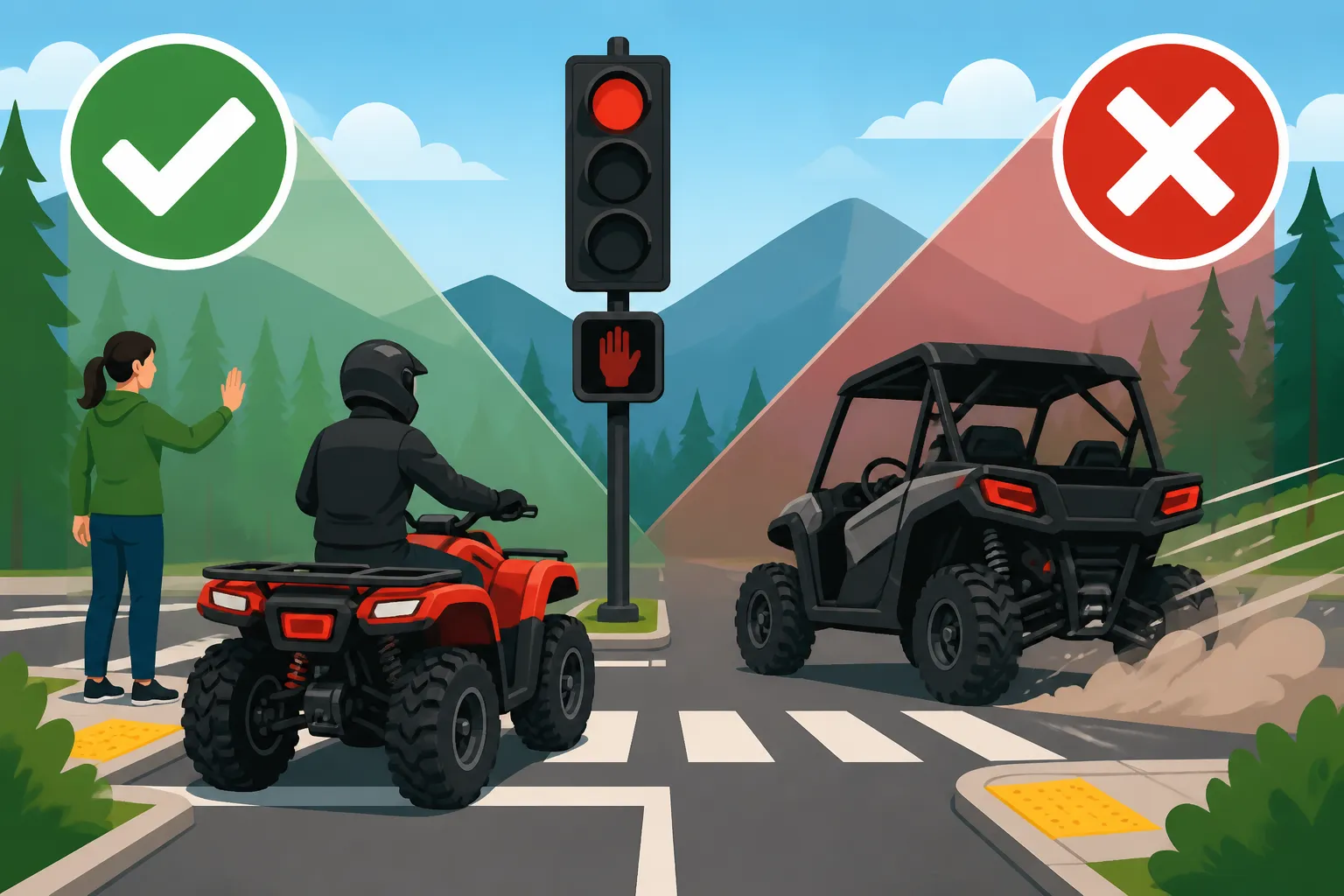
The rule here is unambiguous: you must obey the traffic signal. If the light is red, you stop. If it's green, and it's safe to do so, you cross. However, there's a practical hurdle many ORV riders face: the sensors that trigger traffic lights are often designed to detect larger, heavier vehicles like cars and trucks. Your lighter, smaller ORV might not trip the sensor, leaving you sitting at a red light that never changes. This can be incredibly frustrating, especially if there's no cross-traffic to trigger the light manually. In such a scenario, you're faced with a tough decision: wait indefinitely (which isn't practical), or make a judgment call. Legally, you are required to obey the light. If you find yourself in this situation and the light simply will not change, it's generally recommended to wait for another vehicle to pull up behind you and trigger the sensor, or, if absolutely necessary and safe, carefully pull off the highway, re-evaluate, and find an alternative crossing point. Never run a red light just because you think you weren't detected. Safety first.
Completing the Crossing Safely and Efficiently
Once the light turns green and you've confirmed it's safe to proceed – checking for turning vehicles, pedestrians, and cyclists – you should complete your crossing directly and without hesitation, following the same "straight across" principle as at a stop sign.
Here’s what to keep in mind:
- Be Decisive: When the light changes and the path is clear, move. Don't dither, but don't blast across recklessly either. A predictable, steady pace is best.
- Watch for Turners: Traffic coming from the opposite direction might have a green light to turn left across your path, or vehicles from your left or right might be turning into the road you're coming from or going towards. Always anticipate these movements.
- Stay in Your Lane: If the crossing is wide and has multiple lanes, pick a path and stick to it. Don't weave between lanes.
- Minimize Time: Just like at a stop sign, the goal is to spend the absolute minimum amount of time on the paved highway surface. Your ORV is most vulnerable here.
For detailed specifics on intersections with signals, refer to [BC Crossings at a Traffic Light]. These rules are designed to integrate ORV crossings into the existing traffic flow as smoothly and safely as possible, acknowledging their limitations on pavement.
Why These Rules Exist: Safety and Separation on BC Roads
The stringent rules surrounding ORV use and highway crossings aren't arbitrary; they are deeply rooted in safety considerations for all road users. Understanding the "why" behind the rules can help riders appreciate their importance, even when they seem inconvenient.
The Safety Imperative: Protecting Riders and Road Users
At the heart of BC’s ORV crossing rules is a clear safety imperative. Off-road vehicles, by their very design, are ill-suited for paved highway environments.
- Tires and Handling: The knobby, low-pressure tires optimized for grip on loose terrain have very different traction characteristics on hard pavement. They can feel squirmy, offer less braking power, and affect steering response, especially at higher speeds or during emergency maneuvers. A sudden swerve or hard brake that a car could handle might put an ORV rider in a dangerous skid or rollover situation.
- Speed Differentials: Highways are designed for vehicles moving at much higher speeds. An ORV crossing a highway, even quickly, creates a significant speed differential with oncoming or passing traffic. This reduces the reaction time for other drivers and increases the severity of any potential collision.
- Visibility: ORVs are often smaller and lower profile than typical highway vehicles, making them less visible to drivers, especially in adverse weather, low light, or if obscured by larger vehicles. Drivers of cars and trucks might not anticipate seeing an ORV in the middle of a highway, increasing the risk of an oversight.
- Suspension and Stability: The suspension on an ORV is built for absorbing bumps and impacts off-road, not for smooth, high-speed cornering or sudden directional changes on pavement. This can lead to instability and reduced control in a highway context.
These factors combine to create a much higher risk environment for an ORV on a highway than on a trail. The rules are there to mitigate these risks, protecting not only the ORV rider but also the occupants of other vehicles.
Maintaining Order and Preventing Misuse
Beyond immediate safety, the rules also serve to maintain order on BC’s roads and prevent the misuse of ORVs. If ORVs were freely permitted on highways, even for short stretches, it would blur the lines between vehicle classes and create enforcement nightmares.
- Preventing De Facto Highway Use: Without strict crossing rules, the temptation for riders to extend their highway travel beyond a mere crossing would be immense. A "short hop" could become a regular commute, defeating the purpose of regulating ORVs as off-road machines.
- Legal Frameworks: The entire legal framework for vehicles in BC is built upon distinct classes – highway vehicles (regulated by the Motor Vehicle Act) and off-road vehicles (regulated by the Off-Road Vehicle Act). Allowing ORVs to operate extensively on highways would necessitate a complete overhaul of licensing, insurance, safety standards, and enforcement, for which ORVs are simply not designed.
- Public Expectation: The general public expects certain types of vehicles on highways and not others. Introducing ORVs into that mix without strict controls could lead to confusion, frustration, and increased hazard for everyone.
These rules, therefore, are not just about safety in a narrow sense, but about preserving the integrity of BC’s transportation network and ensuring that each type of vehicle operates in its intended environment. While it might seem like a minor infraction to ride your machine down the road for a moment, the cumulative effect of many such actions could lead to a breakdown of safety and order. Remember, fines for improper operation, even if not directly tied to registration like [BC Penalties for Riding Unregistered], can be substantial and affect your ability to ride in the future.
Beyond the Crossing: Limited Highway Access and Alternatives
While direct highway operation is largely prohibited, there are very specific, narrow circumstances where ORVs might be on pavement, and, more commonly, practical alternatives for connecting riding areas.
Police-Issued Operation Permits for Specific Highway Use
In very limited scenarios, an ORV might be permitted to travel a short distance on a highway under the authority of a police-issued operation permit. These permits are not for recreational trail connections. They are typically reserved for specific work-related tasks, agricultural purposes, emergency services, or special events where there is no practical alternative, and the travel is minimal and highly controlled. For example, a farmer might get a permit to move their farm quad a short distance down a rural road to access another field, or a utility worker might use a side-by-side to inspect power lines along a road allowance.
These permits are:
- Highly Conditional: They come with strict conditions regarding time of day, route, safety equipment, and duration.
- Limited in Scope: They are not a pathway to making your ORV "street legal" for general use. They address very specific operational necessities.
- Issued by Police: You apply directly to your local police detachment (RCMP or municipal police) for these permits. It’s not something an ICBC broker handles.
- Temporary: Permits are typically valid for a limited period, often up to two years, and for a specific machine and purpose.
Obtaining one of these permits is a formal process, and riders should not assume they will be granted. It requires a clear justification demonstrating that highway travel is absolutely necessary and that all safety measures will be taken. If you believe your situation warrants such a permit, research [BC Operation Permit Application Steps] for your local detachment.
Transporting Your ORV: The Safest and Most Common Practice
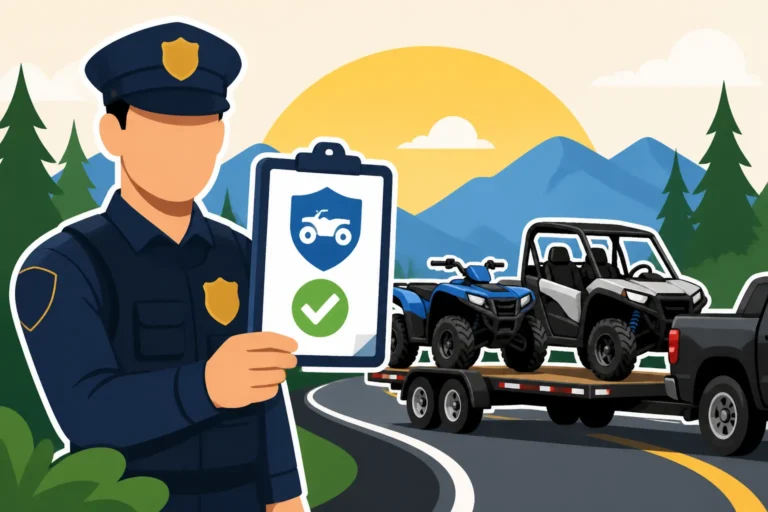
For the vast majority of recreational ORV riders, the safest, most legal, and most practical way to bridge distances between riding areas or get to and from trails that involve highway travel is by transporting your machine. This means loading it onto a truck bed, a utility trailer, or specialized ORV trailer.
This method completely bypasses the complexities and dangers of highway crossings and limited operation permits. It allows you to:
- Connect Disparate Trails: Drive your machine to a staging area, ride, then load up and drive to another, completely different trail system without risking fines or accidents on pavement.
- Maintain Safety: Your ORV is safe and secure on a trailer, away from the hazards of high-speed highway traffic.
- Avoid Legal Troubles: There are no questions about whether you're legally "crossing" or "operating" if your machine is hitched to a legal highway vehicle.
- Explore More: By being able to easily move your ORV, you gain access to a wider range of riding opportunities across the province.
Many riders invest in robust trailers or truck accessories specifically for this purpose. If you're frequently loading heavy side-by-sides or quads, equipment like a powerful winch can be a game-changer. Imagine a situation where you're struggling to load a mud-caked, heavy machine onto your trailer after a long day. Having a reliable winch, perhaps from a brand like SuperATV, can make the difference between a frustrating wrestling match and a smooth, effortless loading experience. This investment in transport gear is an investment in your safety, legality, and overall enjoyment of the sport. It's truly the default and recommended method for connecting your off-road adventures.
Common Misconceptions and Costly Mistakes
Despite the clear rules, riders often fall victim to common misconceptions or make costly mistakes when it comes to ORVs and highway crossings. These errors, even if made with good intentions, can lead to serious consequences.
The "Just Around the Corner" Fallacy
One of the most prevalent and dangerous misconceptions is the idea that "it's just a short distance," so the rules don't really apply. Riders might think:
- "The next trail entrance is just 200 meters down this road."
- "I'll just ride on the gravel shoulder for a minute to get to the store."
- "There's no traffic here, so it's fine for a quick ride."
This "just around the corner" fallacy is incredibly risky. The BC Off-Road Vehicle Act makes no distinction based on distance. Operating your ORV on a highway for even a few meters, beyond a legal direct crossing, is considered illegal.
- It's still operating on a highway: The law doesn't have a "grace distance." If you're on the pavement or the paved shoulder, you're on the highway.
- It's still dangerous: Even short distances expose you to the same risks: speed differentials, lack of visibility, and unexpected maneuvers from other drivers. A collision can happen in a split second, regardless of how short your intended journey.
- It's still a ticketable offense: Enforcement officers don't measure the distance you traveled. If they observe you operating illegally, you can receive a violation ticket, which can carry significant fines. Don't gamble with your safety or your wallet based on the length of the illegal stretch.
Ignoring Signage and Traffic Control Devices
Another common mistake is to assume that because you're on an ORV, standard road signage and traffic control devices don't fully apply during a crossing. This couldn't be further from the truth. When you are making a legal highway crossing, your ORV is temporarily interacting with highway traffic, and therefore, you are bound by all relevant traffic laws applicable to that intersection.
- Stop Signs and Red Lights: As discussed, running a stop sign or a red light, even while on an ORV, is illegal and dangerous. The penalties for these infractions are severe, just as they would be for a car driver.
- Yield Signs: If you encounter a yield sign during a crossing, you must yield to all traffic as required.
- One-Way Streets: Be aware of the direction of traffic if crossing a one-way street, and ensure you cross perpendicular to the flow.
- Accident Liability: If you are involved in a collision while making an illegal maneuver (like running a red light or riding on the shoulder), your liability could be significantly increased. Your ORV insurance might not cover damages if you were operating illegally on a highway, potentially leaving you financially devastated.
Essentially, when you are on that strip of pavement, even for a moment, you are expected to operate with the same caution and adherence to rules as any highway driver. Failure to do so isn't just a minor oversight; it's a serious breach of safety and legal responsibility that can have profound and lasting consequences.
Preparing for Your Ride: Equipment and Awareness
Ensuring a safe and legal ORV experience in BC involves more than just knowing the rules; it also requires preparing your machine and yourself. This means having the right equipment and maintaining a high level of awareness, particularly when approaching any highway interface.
Ensuring Your Machine is Visible and Legal for Crossings
Before you even head out to the trails, a quick check of your ORV can prevent issues later, especially concerning highway crossings.
- Lights: Ensure all your lights are in working order: headlights, tail lights, and brake lights. While not strictly "street legal" equipment, functional lighting significantly improves your visibility to other drivers, particularly during dusk, dawn, or overcast conditions. If your machine doesn't have lights, consider adding some reliable aftermarket options. Good visibility is crucial for making your presence known, especially to fast-moving highway traffic.
- Horn: If your ORV is equipped with a horn, ensure it works. A horn can be a critical safety device for alerting inattentive drivers or pedestrians to your presence.
- License Plate: Your BC ORV number plate must be clearly visible and securely mounted. [BC ORV Number Plates and Decals] specifies that the plate must be mounted horizontally, at the front, back, or left side of the machine, and kept clean enough to be legible at all times. This is non-negotiable. An obscured or missing plate can lead to fines and immediate attention from enforcement officers. For instance, if you've got a large storage box or a cooler strapped to your rack, make sure it doesn't block your plate. It's a small detail that often gets overlooked but is very important for legality during any interaction with public roads.
- Spark Arrestor: While not directly related to highway crossings, ensuring your spark arrestor is in good working order is a general requirement for riding in BC’s wildland areas and can prevent fines and fire hazards. Many managed sites require them, so it's a good habit to check.
Taking a few moments for these checks before you leave ensures that your machine meets the basic legal and safety requirements for all aspects of your ride, including those brief but critical highway crossings.
Rider Readiness and Carrying Essential Documents
Beyond your machine, your personal preparedness is just as vital. This includes wearing the right gear and always having your required documents on hand.
- Safety Gear: Always wear appropriate safety gear, especially a helmet. While BC has specific helmet laws, even for a brief highway crossing, a properly fitted helmet is non-negotiable. [BC ATV Helmet Law Explained] details these requirements, which cover every rider on a ride-astride ORV, regardless of age or experience. For side-by-sides, if the vehicle has seat belts and an enclosed cab, a helmet might not be required, but it's still a wise choice for protection. Gloves, eye protection (goggles), and sturdy footwear are also highly recommended for any ride.
- Carrying Your Certificate of Registration: You are legally required to carry your [BC Riders Must Carry the Certificate] of registration with you whenever you operate your ORV. This certificate is your proof that the machine is registered under the Off-Road Vehicle Act. It's not like a car's registration where it sits in the glovebox; on an ORV, it needs to be with the operator. A waterproof pouch is an excellent way to keep this document safe and dry.
- Carrying Photo ID: Alongside your Certificate of Registration, you must also carry valid [BC Riders Must Carry Photo ID] that can confirm your identity. This could be your driver's license (even if you're not riding on a highway, it's still good ID), a BC Services Card, or another government-issued photo identification. Should you be stopped by an enforcement officer, having these documents readily available will make the interaction much smoother.
Being prepared—both with your machine and your person—demonstrates responsibility and ensures that when you encounter those inevitable paved sections, you can navigate them legally, safely, and with confidence, keeping your focus on the enjoyment of your incredible BC adventures.
Disclaimer
This article is for general informational purposes only and does not constitute professional advice. Laws, prices and regulations vary by location and change over time. Consult a qualified professional for guidance on your specific situation.