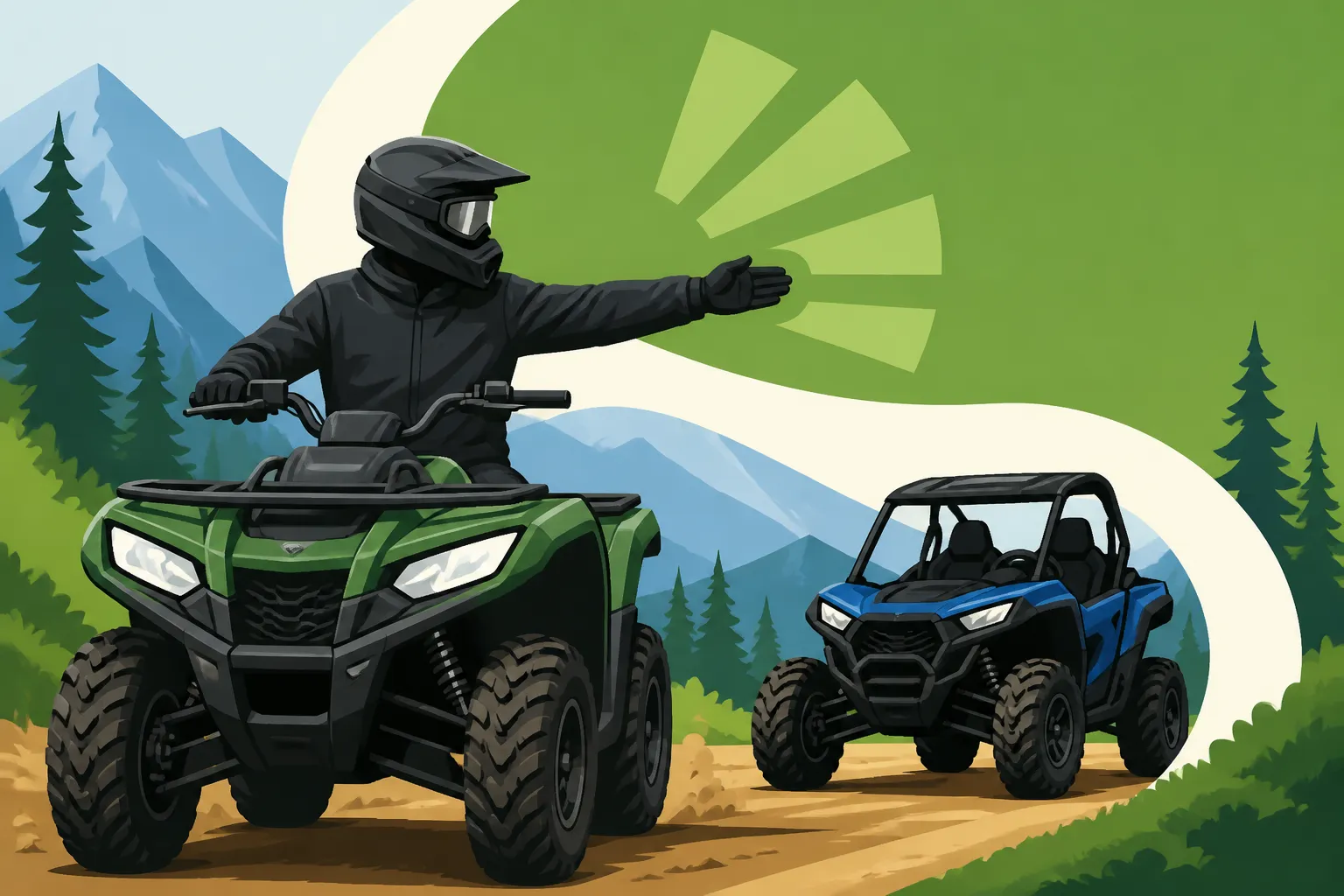
BC’s Visible and Immediate Direction Test
A young rider may be technically within sight of an adult and still be too far away for that adult to supervise effectively. In BC, the visible-and-immediate-direction test is about more than being on the same trail: the adult must be able to see the rider and give direction promptly. Here’s how to apply that standard when planning an ATV or UTV ride.
What “Visible and Able to Give Immediate Direction” Means
The test has two connected parts. The supervising adult must be able to see the young operator, and must be able to give direction immediately. Meeting one part does not make up for failing the other.
“Visible” means the adult can keep the rider in view in the actual riding conditions. Being nearby, following the same route, or knowing where the child is does not necessarily mean the child is visible. A bend, rise, stand of trees, dust cloud or other obstruction can break the view.
“Immediate direction” means the adult can communicate guidance without a delay that makes the supervision ineffective. The adult needs to be positioned and attentive enough to respond to what the rider is doing. A phone call, radio check-in or promise to catch up later is not a substitute for being able to direct the rider promptly if the adult cannot see what is happening.
The rule is best understood as a real-time safety standard, not a fixed distance. There is no single number of metres that works for every trail, machine and situation. On an open, flat section, an adult may be able to see and direct a rider at a greater distance than on a narrow, winding trail with trees and steep changes in elevation. Dust, weather, traffic and the speed of the machines also affect how much separation is reasonable.
| Riding situation | What can make supervision effective | What may make it ineffective |
|---|---|---|
| Open, level trail | The adult can see the rider clearly and communicate promptly | The adult falls far behind or becomes distracted |
| Winding forest trail | The adult stays close enough to maintain sight around bends and obstacles | The trail repeatedly hides the rider from view |
| Dusty group ride | The adult reduces speed or separation so the rider remains visible | Dust blocks the view while the group continues at normal pace |
| Different machines in a group | The supervisor rides in a position that allows direct observation and guidance | The supervisor rides elsewhere in the group and cannot see the young operator |
| Radio-equipped ride | A radio can support communication when the rider remains visible | Radio contact is treated as a replacement for the required visual supervision |
The practical question is not simply, “Is the adult somewhere nearby?” It is, “Can this adult see this young rider now, understand what the rider is doing, and give useful direction in time?” If the answer changes as the trail changes, the supervision arrangement has to change too.
For a fuller overview of the age requirement, see BC Supervision Required Under 16. The visible-and-immediate-direction test is one part of that broader responsibility.
Who Can Supervise and When the Rule Matters
BC’s youth riding requirements apply according to the operator’s age and the circumstances of the ride. A supervising adult must meet the applicable age requirement; an older sibling or other capable teenager does not qualify just because they are experienced. The relevant minimum age for the supervising adult is 19. See BC Supervisors Must Be 19 or Older for that part of the rule.
The standard is about the adult’s ability to supervise, not simply their relationship to the young rider. A parent, guardian, relative or family friend may be in a position to supervise, but the title of “parent” or “instructor” does not solve the visibility and response questions. The person still has to be able to observe and direct the operator as required.
The adult’s own licence or training status is a separate question from whether they can provide the required supervision. Do not assume that a licence, riding experience or a safety course automatically makes a particular setup compliant. For that distinction, see Does the Supervising Adult Need a Licence or Training?.
The location matters as well. A rider may be on a Crown land trail, a resource road, private property or another managed area, and each place can bring its own access, permission and operating requirements. Supervision does not grant permission to ride somewhere that is closed or where the rider has no right of access. It also does not replace registration, insurance, equipment or other rules that apply to the machine and location. For the broader setting, see BC Supervision on Crown Land and BC Riding on Family Property.
A separate age-related permission rule may also be relevant to riders aged 14 or 15. Do not treat a parent’s written permission as proof that every other requirement has been met, or assume it changes the visible-and-immediate-direction test in every situation. The rule can depend on the rider’s age, machine and riding circumstances. Check the requirements that apply to the specific young operator before planning a ride. Related information is available in BC Written Permission Letters, BC Rules for a 14-Year-Old Rider and BC Rules for a 15-Year-Old Rider.
The age threshold itself matters. A rider who has reached 16 may be treated differently under the youth supervision rules than a younger operator, but that does not remove other restrictions or make every machine and route suitable. See [BC Rules for a 16-Year-Old Rider] for the age-specific context.
A useful way to avoid mixing up separate rules is to check each question independently:
- Who is operating? Confirm the operator’s age and whether the youth rules apply.
- Who is supervising? Confirm that the adult meets the applicable age standard.
- Can the adult see and direct the rider? Assess the actual position, terrain, visibility and communication.
- Is the rider allowed to operate this machine? Check any applicable age, size, manufacturer and permission requirements.
- Is the route open and lawful to use? Check access, closures and local restrictions.
- Are the machine and riders otherwise compliant? Consider registration, protective equipment and other rules that may apply.
Passing one check does not automatically pass the others. For example, a young operator may have the right adult nearby but still be riding on a closed route. Or the route may be open, but the adult may lose sight of the rider around a bend.
How to Apply the Test on a Real Ride
The most reliable approach is to decide how supervision will work before the machines start moving. Do not rely on an informal arrangement that becomes unclear once the group spreads out.
- Choose the supervising adult. Identify who is responsible for the young rider, rather than assuming that any adult in the group will take over. Make sure that person understands the task and will not be occupied with navigation, towing, mechanical work or supervising several unrelated riders at once.
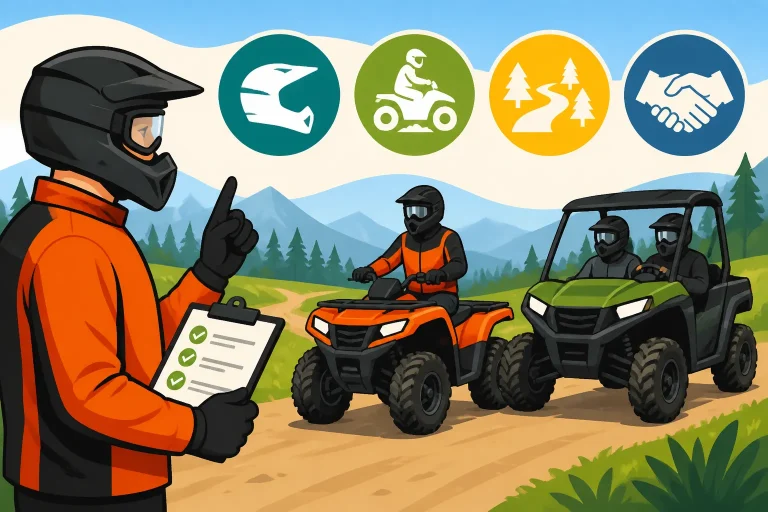
- Agree on a position. Decide whether the adult will ride ahead, behind or alongside the young operator. The right choice depends on the trail and the rider. The position must allow the adult to keep the young operator in view and give direction promptly.
- Set a pace that preserves supervision. The group should travel at a speed and spacing that allow the adult to observe the child’s riding. If the adult has to race to catch up, supervision is already being compromised.
- Identify places where sight may be lost. Before a blind corner, steep rise, narrow section or dusty stretch, slow down and regroup as needed. Do not assume that the rider will remain visible just because the previous part of the route was open.
- Agree on stopping and regrouping signals. Establish simple instructions before departure, such as where riders should stop if separated. These help manage the ride, but they do not replace the adult’s ability to see and direct the operator while riding.
- Reassess when conditions change. A route can become harder to supervise after traffic builds, dust rises, weather changes or the trail becomes more technical. Change the spacing, speed or route rather than continuing with a plan that no longer works.
There is no magic riding position that guarantees compliance. An adult riding behind a young operator may be able to see the child on a straight trail, but may lose sight at every bend. An adult riding ahead may be visible to the child while being unable to observe what the child is doing behind them. Riding alongside may work on a sufficiently wide, open route, but not where the trail is narrow or the machines cannot safely travel next to one another.
The adult should choose a position based on the actual view, not on what feels convenient. If the adult cannot see the rider’s actions, the adult may not be able to identify a developing problem or give useful direction in time. If a rider disappears around a corner, the adult should not continue onward on the assumption that the child will follow safely. Stop, re-establish contact and bring the group back into a workable arrangement.
Communication tools can help, but they are supporting tools. A radio can make it easier to tell a rider to stop or wait, particularly in a group. It does not let the adult see whether the rider is approaching a hazard, struggling with control or taking a different route. The same is true of a phone. Being reachable is not the same as being able to supervise in real time.
The adult also needs to be attentive. A person who is technically within sight but focused on another task may not be able to give meaningful direction. For example, if the adult is checking a map while the young operator moves ahead, the distance may be short but the supervision may still be poor. The point is not to demand constant verbal instructions; it is to ensure the adult can notice when direction is needed and provide it promptly.
A young rider’s ability should shape the plan. A child who is new to the machine, unfamiliar with the trail or struggling with a section may need closer observation and more frequent stops than a confident rider on an easy route. However, greater confidence does not erase an applicable legal requirement. The adult must still meet the relevant supervision standard.
For practical advice on maintaining sight of a young operator, see Keeping a Child in Clear View. The companion explanation of the second part of the test is What Giving Immediate Direction Means in BC.
Common Setups That Can Fail the Test
Many supervision problems come from treating proximity as a substitute for observation. The adult may be on the same road, in the same group or only a short distance away, yet still be unable to see the young operator or intervene effectively.
The adult rides well ahead
If the supervising adult rides ahead and the child is out of view, the adult cannot monitor the child’s actions. The young operator might be visible from time to time at a straight section, but that does not necessarily make supervision effective across the entire route. A safer plan is to keep the child in view, stop at agreed points, and avoid advancing through sections where the adult cannot see what is happening behind.
The adult trails far behind
Following at a distance can also create a problem. The adult may not be able to give timely direction if the young operator reaches a hazard before the adult does. A long gap may become even less workable when the trail is steep, winding or dusty. Reduce the spacing or use a route that allows continuous observation.
The group spreads out
On a group ride, it is easy to assume that another adult is watching the child. That assumption can fail if the other adult does not know they have responsibility, or if they are riding ahead and cannot see the young operator. Name the supervising adult and make the arrangement clear to the whole group. If the supervising adult changes, confirm that the new person understands and can meet the test.
The adult relies on a radio
A radio may be useful, but it does not solve the visibility requirement by itself. A child can respond to a radio instruction and still be outside the adult’s view. Radio messages may also be delayed, unclear or missed in noise. Use communication equipment as an added safeguard, not as a reason to allow the rider to go out of sight.
Dust or terrain blocks the view
An open trail can become difficult to supervise when machines raise dust. A rider can vanish into the dust even when the distance between machines has not changed. Slow down, leave more time for dust to settle or stop until everyone can see clearly. Similarly, a ridge, tight corner or dense vegetation can break sight unexpectedly. Plan for those features rather than assuming that the adult will be able to see through them.
The adult is present but distracted
A supervising adult who is loading equipment, talking with other riders, navigating or dealing with a mechanical issue may not be paying attention to the young operator. If the adult cannot watch and respond, pause the young rider’s operation or arrange for another qualified adult to take over. Being physically present is not enough if the adult cannot provide active direction.
The machine makes the arrangement unsafe
The type and size of machine affect the practical setup. A side-by-side, for example, may have a different seating arrangement from a quad, while trail width and passenger configuration can affect how the adult and young operator travel together. Follow the machine’s operating limits and any age or passenger requirements that apply. A young operator’s presence in a group does not make an unsuitable vehicle or passenger arrangement acceptable. See [BC Children Cannot Carry Passengers] for the separate passenger issue.
The central lesson is that compliance depends on what is happening during the ride, not just on the plan made at the trailhead. A setup that works on one section may stop working at the next. The adult should be ready to slow down, stop, reposition or end the ride if they cannot maintain the required sight and direction.
A Practical Pre-Ride Check for Families and Groups
A short conversation before departure can prevent confusion later. It should cover both the legal requirement and the practical realities of the day.
Start by naming the adult who will supervise. Confirm the adult’s age and make sure they understand that responsibility does not pass automatically to whoever happens to be nearest. If more than one young rider is present, decide whether one adult can reasonably keep each operator in view and direct them promptly. If not, add another qualified adult, split the group or choose a more manageable route.
Next, discuss the machine and the rider. Check that the operator’s age, ability and size are appropriate for the particular machine, and review manufacturer guidance. A rule that allows a young person to operate does not mean every machine is a safe fit. The adult should also consider whether the rider has enough experience for the terrain, expected traffic and likely conditions.
Then review the route. Look for narrow sections, blind corners, steep grades, water crossings, active industrial traffic and places where the group may separate. Confirm that the trail or road is open to the machine and that access is permitted. An adult’s supervision does not override a closure, a landowner’s restriction or a posted limit.
Agree on a response if the rider is no longer visible. The group should know where to stop and how to regroup without continuing in different directions. The supervising adult should not expect a young operator to make complex navigation decisions alone when the adult has lost sight of them.
A simple pre-ride checklist can help:
- The supervising adult is identified and meets the applicable age requirement.
- The young operator understands who is supervising them.
- The adult has a position that allows a clear view of the young rider.
- The planned pace and spacing allow prompt direction.
- The group knows what to do at blind corners and other visibility breaks.
- The route is open and suitable for the machine and rider.
- Separate age, permission, passenger, registration and equipment requirements have been checked.
- The plan includes a way to stop and regroup if visibility or communication is lost.
If the plan depends on perfect conditions, it is not a robust plan. Dust, unexpected traffic, fatigue or a difficult section can change the situation quickly. A good supervisor adjusts rather than pushing on simply because the group has already started.
It is also reasonable to choose a shorter or easier route. A young rider may enjoy the outing more, and the adult may supervise more effectively, when the machines stay together and the ride has planned stops. The purpose of the test is not to make family riding impossible. It is to make sure the young operator has an adult who can actually observe and guide them.
Frequently Asked Questions
Does the supervising adult have to ride directly beside the child?
Not necessarily. The adult’s position must allow them to see the young operator and give direction promptly. That may be alongside, ahead or behind in a particular setting, but a position that repeatedly puts the rider out of view may not meet the test.
Is a radio enough if the adult cannot see the young rider?
A radio can support communication, but it does not replace the visual part of the test. If the adult cannot see the young operator, radio contact alone may not provide effective supervision.
Is there a set maximum distance between the adult and rider?
There is no single distance that fits every trail and situation. Terrain, visibility, dust, speed and the rider’s ability all matter. The adult needs to stay close enough to maintain the required view and provide timely direction.
Can another adult in the group supervise if the original adult falls behind?
Only if that adult meets the applicable requirements and can actually see and direct the young rider. Make the change clear rather than assuming that someone else has taken responsibility.
Does supervision make a closed trail or restricted road legal to ride?
No. Supervision is only one part of lawful operation. Riders must also follow applicable access rules, closures, machine requirements and other restrictions.
Disclaimer
This article is for general informational purposes only and does not constitute professional advice. Laws, prices and regulations vary by location and change over time. Consult a qualified professional for guidance on your specific situation.